◄ Carnets Geol. 26 (18) ►
Outline
[1. Introduction]
[2. Historical context]
[3. Collection of Eurypterus podolicus]
[4. Discussion]
[5.Conclusion] and ... [Bibliographic references]
Institute of Geological Sciences of the NAS of Ukraine,
Department of Palaeontology and Stratigraphy of Palaeozoic Sediments, Oles
Honchar Str., 55b, Kyiv (Ukraine);
National Museum of Natural History of the
NAS of Ukraine, Department of Geology, Bohdan Khmelnytskyi Street, 15, Kyiv
(Ukraine)
Published online in final form (pdf) on October 10, 2026
DOI 10.2110/carnets.2026.2618

[Editor: Bruno R.C. Granier;
language editor: Robert W. Scott]

This article presents the results of an investigation into the complex history of the eurypterid species "Eurypterus podolicus Chernyshev, 1947", for which neither an original description nor a type series is known. The study confirms that this species is a nomen nudum, as it was never formally described. Moreover, the specimens of "Eurypterus podolicus" from the Borys Chernyshev's collection lack distinct morphological features that would justify recognizing it as a separate species.
• taxonomy;
• original description;
• type series;
• holotype;
• Ludlow (Epoch)
Dernov V. (2026).- The taxonomic status of Eurypterus podolicus Chernyshev, 1947 (Arthropoda: Eurypterida), from the Silurian of Podillia, Ukraine.- Carnets Geol., Madrid, vol. 26, no. 18, p. 409-416. DOI: 10.2110/carnets.2026.2618
Statut taxonomique de Eurypterus podolicus Chernyshev, 1947 (Arthropoda : Eurypterida), du Silurien de Podolie, Ukraine.- Cet article présente les résultats d'une étude consacrée à l'histoire taxinomique complexe de l'espèce d'euryptéridé "Eurypterus podolicus Chernyshev, 1947", pour laquelle aucune description originale ni série-type n’est connue. L'étude confirme que cette espèce constitue un nomen nudum, dans la mesure où elle n'a jamais fait l'objet d'une description formelle. En outre, les spécimens désignés sous le nom d'Eurypterus podolicus, provenant de la collection de Borys Chernyshev, ne présentent pas de caractères morphologiques distinctifs permettant de justifier sa reconnaissance en tant qu'espèce à part entière.
• taxinomie ;
• protologue ;
• série-type ;
• holotype ;
• Ludlowien
Eurypterida Burmeister, 1843, is an order of Palaeozoic aquatic predatory chelicerates with an almost global distribution (Poschmann, 2006; Dunlop et al., 2023; Lamsdell, 2025). To date, approximately 250 species across 21 families have been identified, ranging in age from the Early Ordovician to the Late Permian (Tetlie, 2007; Bicknell et al., 2020; Braddy, 2022; Van Roy et al., 2025). These arthropods inhabited marine to freshwater (continental) environments (Bicknell et al., 2020). In Ukraine, eurypterid remains have been found in Silurian and Devonian deposits of the Volyn-Podillia Monocline (Fischer de Waldheim, 1839; Veniukov, 1899; Kasianyk & Matuz, 2017; Naugolnykh & Shpinev, 2018; Dernov, 2026) as well as in Carboniferous strata of the Donets Basin (Chernyshev, 1933; Shpinev, 2014).
Silurian eurypterids from Ukraine were first described by Fischer de Waldheim in 1839. Later, Veniukov (1899) referred to Eurypterus tetragonophthalmus Fischer de Waldheim, 1839, under the name Eurypterus fischeri Eichwald, 1854. Subsequently, additional specimens were illustrated by various researchers, including Văscăuţanu (1932), Nikiforova (1954), and Selden and Drygant (1987), among others. More recently, Naugolnykh and Shpinev (2018) described Pterygotus sp. from Silurian strata of Podillia (Podolia in Russian-language literature) in western Ukraine. However, despite nearly two centuries of study, most Silurian eurypterids from this region have not been revised.
This article focuses on clarifying the taxonomic status of Eurypterus podolicus Chernyshev, 1947, a species occasionally cited in the literature (e.g., Nikiforova, 1954; Pirozhnikov, 1957, 1965; Drygant, 1968; Uziuk et al., 2007; Hotsaniuk & Ivanina, 2017; Dunlop et al., 2023). The validity of this species remains uncertain due to the lack of a verifiable original description and the absence of known type material. Lamsdell (2025) suggested that Eurypterus podolicus is a nomen nudum; however, he did not provide convincing arguments, likely due to the limited accessibility of Soviet palaeontological literature in the West, which is necessary for the successful completion of such a complex taxonomic investigation as the one presented in this paper.
Nikiforova (1954: footnote on p. 21) reported that the name Eurypterus podolicus was first used by Dr Borys I. Chernyshev in 1947 but did not specify in which work. The same information was confirmed by Pirozhnikov (1957, 1965), but he also did not refer to a specific work by Chernyshev (probably repeating Nikiforova's report without proper data verification). Nikiforova (1954) did not designate either a holotype or provide a species diagnosis, both of which are key requirements for the availability of a published name (International Code of Zoological Nomenclature, 1999, articles 11 and 13).
In the official bibliography of the academician Borys I. Chernyshev (anonymous, 1950, and in the list compiled by the author of this paper), no work was published in 1947 that could describe this species (there are only one article on Carboniferous bivalves and four chapters on arthropods for a reference book on the guiding species of the Triassic and Jurassic systems of the former USSR). A check of bibliographical lists in reference books (e.g., Novozhilov, 1962; Bzhelenko et al., 1971) did not yield any new information.
Nikiforova (1954: footnote on p. 21) noted that in the opinion of Borys I. Chernyshev, Podillian eurypterids, including the specimens figured by Veniukov (1899: Pl. 9, fig. 9), are morphologically significantly different from Eurypterus fischeri (junior synonym of Eurypterus tetragonophthalmus according to Selden, 1981), so they were named by him Eurypterus podolicus sp. nov. Nikiforova (1954: Pl. 6) figured two specimens of Eurypterus podolicus, probably originating from the Ustia Horizon (the Ustia Member of the Bagovytsya Formation, Yaruga Group, Gorstian in the modern lithostratigraphic scheme).
Chernyshev (1949) did not formally report Eurypterus podolicus from the Silurian of Podillia, although, according to Nikiforova (1954) and Pirozhnikov (1957, 1965), he first used this name as early as 1947. However, the planned publication of a series of reference volumes, including a chapter on Silurian eurypterids of the former USSR authored by Chernyshev, was delayed by the outbreak of the Second World War. As a result, the relevant section was likely written well before 1947, probably in the pre-war years. Supporting this, the bibliography of Chernyshev (anonymous, 1950) indicated that the manuscript on Silurian eurypterids of the USSR was submitted to the publisher in 1939. In the 1949 work (Pl. 63, fig. 7), Chernyshev illustrated Eurypterus fischeri Eichwald, 1857, based on a specimen from Veniukov's collection, now housed in the National Museum of Natural History, National Academy of Sciences of Ukraine (NMNHU), Kyiv.
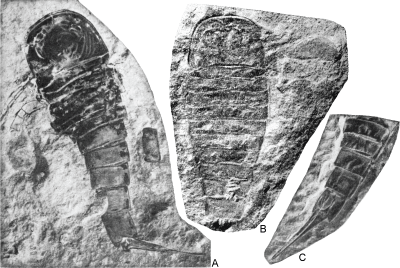
Until recently, the only sources providing insight into the morphology of Eurypterus
podolicus were the images of two specimens published by Nikiforova
(1954: Pl. 6; see also Fig. 1A, C  in this paper), as well as specimens from Veniukov's collection (Veniukov,
1899: Pl. 9, fig. 9; Chernyshev,
1949: Pl.
63, fig. 7;
Fig. 1B in this paper), which Chernyshev (as cited in Nikiforova,
1954) referred to Eurypterus podolicus. The
author's search for eurypterid specimens in the Veniukov's
collection NMNHU-G
367
in June 2025 was unsuccessful, suggesting that the material has likely been
lost.
in this paper), as well as specimens from Veniukov's collection (Veniukov,
1899: Pl. 9, fig. 9; Chernyshev,
1949: Pl.
63, fig. 7;
Fig. 1B in this paper), which Chernyshev (as cited in Nikiforova,
1954) referred to Eurypterus podolicus. The
author's search for eurypterid specimens in the Veniukov's
collection NMNHU-G
367
in June 2025 was unsuccessful, suggesting that the material has likely been
lost.
|
|
Figure 1:
Specimens attributed to Eurypterus podolicus
Chernyshev, 1947. A, C - "Eurypterus podolicus Chern."
figured by Nikiforova (1954: Pl. 6). B - "Eurypterus fischeri Eichwald,
1854" from the collection of Veniukov, figured by Chernyshev
(1949: Pl. 63, fig. 7). Not to scale. |
During the period after the Second World War, Borys I. Chernyshev worked in Kyiv, holding positions at Kyiv University and the Institute of Geological Sciences, Academy of Sciences of the Ukrainian SSR (Novik, 1950; Makarenko, 1998). However, an examination of Chernyshev's personal archive at the Institute of Archival Studies of the Vernadsky National Library of Ukraine (Kyiv) and his technical reports at the State Geological Information Fund of Ukraine (Kyiv) did not yield any information regarding the bibliographic details of the original description of Eurypterus podolicus.
In
the Department of Geology of the NMNHU, the author discovered a small collection
of Silurian eurypterids from Podillia (NMNHU-G 1335), collected by Borys I. Chernyshev.
The museum digital catalogue lists this collection as "Impressions of Eurypterus
podolicus sp. n. from Silurian deposits of the Dniester River area." The
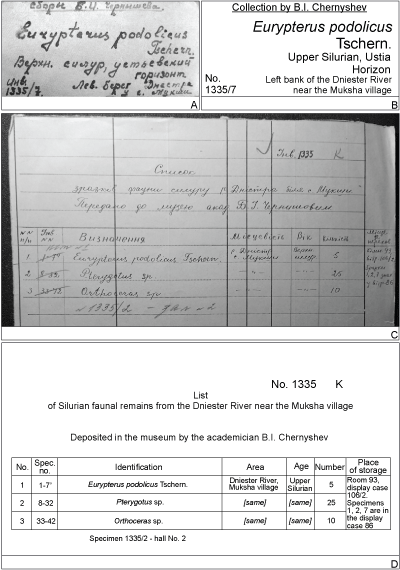
original label was preserved for only one specimen (NMNHU-G 1335/07) (Fig.
2A-B ), but it and the inventory of the collection NMNHU-G 1335 compiled by Borys I. Chernyshev
(Fig. 2C-D ) (archive of the Department of Geology, NMNHU) confirm that this is
the material that Chernyshev attributed to Eurypterus podolicus.
Novik (1950) reported that two months before his death (i.e., approximately in June 1950), Borys I. Chernyshev visited Podillia, from where he brought back a collection of eurypterids that he intended to study in the future. This collection is most likely the one currently housed in the NMNHU under catalogue number 1335.
|
|
Figure 2: Documents
accompanying collection NMNHU-G 1335. A - Original label of specimen NMNHU-G 1335/07;
B - Translation of the label of specimen NMNHU-G 1335/07 from Russian; C -
Inventory of the collection NMNHU-G
1335 compiled by Borys I. Chernyshev; D - Translation of the inventory
from Ukrainian. |
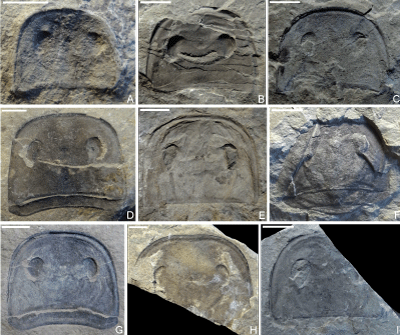
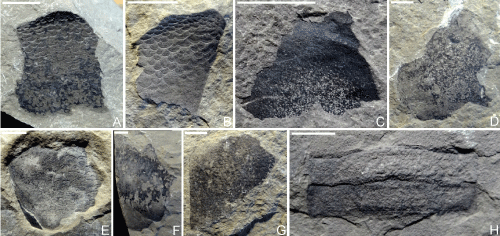
The
collection comprises relatively poorly preserved fragments of eurypterid
exoskeletons, which can be identified as Eurypterus
tetragonophthalmus Fischer de Waldheim,
1839 (Fig.
3 ),
Pterygotidae indet. (Fig. 4.A-B, E ), and Eurypterida indet.
(Fig. 4.C-D, F-H ).
Specimens identified here as Pterygotidae indet. were assigned by Chernyshev
to Pterygotus sp. (Fig. 2C-D ). Together with the eurypterid specimens,
slabs containing orthocerid moulds are also present. The
specimens assigned by Chernyshev to Eurypterus podolicus (Fig.
1 )
show no morphological differences from Eurypterus tetragonophthalmus that
would justify the separation of the putative species. Therefore, based on this
material, there are
insufficient morphological grounds to support the distinction of the species Eurypterus
podolicus.
|
|
Figure 3:
Some
specimens identified by Dr Borys
I. Chernyshev as Eurypterus podolicus sp.
nov. (Ustia Member, Bagovytsya Formation, Gorstian, Late Silurian; Podillia, western Ukraine). A-I - Eurypterus tetragonophthalmus Fischer
de Waldheim, 1839 (A - prosoma NMNHU-G 1335/09, B - prosoma NMNHU-G
1335/07a, C - prosoma NMNHU-G 1335/?, D - prosoma NMNHU-G 1335/04, E - prosoma
NMNHU-G 1335/03, F - prosoma NMNHU-G 1335/18, G - prosoma NMNHU-G 1335/07, H -
prosoma NMNHU-G 1335/06, I - prosoma NMNHU-G 1335/11). Scale bars equal 5 mm. |
|
|
Figure 4:
Some specimens identified
by Dr Borys
I. Chernyshev as Pterygotus sp. and Eurypterus podolicus sp.
nov. (Ustia Member, Bagovytsya Formation, Gorstian, Late Silurian; Podillia, western Ukraine). A, B, E - Pterigotidae
indet. (A - exoskeleton
fragment NMNHU-G 1335/28, B - exoskeleton fragment NMNHU-G 1335/27, E -
exoskeleton fragment NMNHU-G 1335/22b); C, D, F-H - Eurypterida indet. (C -
exoskeleton fragment NMNHU-G 1335/14, D - exoskeleton fragment NMNHU-G 1335/21,
F - exoskeleton fragment NMNHU-G 1335/26, G - exoskeleton fragment NMNHU-G
1335/25, H - segments of opisthosoma NMNHU-G 1335/22). Scale bars equal 5 mm. |
Based on the inscriptions on the slabs bearing the eurypterids, this material originates from the Ustia, Muksha, and Dumaniv localities (Khmel'nytskyi Oblast, Ukraine). These localities are situated near the village of Ustia, at the mouth of the Smotrych River (outcrop No. 13 in Tsegelnyuk et al., 1983); at the mouth of the Muksha River, near the village of Velyka Slobidka (outcrop No. 20 in Nikiforova & Predtechenckiy, 1968; Nikiforova et al., 1972, or Nos. 33 and 34 in Tsegelnyuk, 1974); and near the village of Dumaniv (outcrop No. 98 in Nikiforova et al., 1972), respectively. Specimens of Eurypterus fischeri from Dumaniv were described by Veniukov (1899). Detailed information on these localities can be found in Nikiforova and Predtechenckiy (1968), Nikiforova et al. (1972), Tsegelnyuk (1974, 1980), Tsegelnyuk et al. (1983), Selden and Drygant (1987), and Jarochowska et al. (2016).
The eurypterid-bearing strata are currently designated as the Ustia Member of the Bagovytsya Formation (Yaruga Group, Gorstian) (Tsegelnyuk et al., 1983; Selden & Drygant, 1987; Konstantynenko & Tsegelnyuk, 2013).
Borys I. Chernyshev passed away in 1950 (Novik, 1950; Makarenko, 1998). According to the bibliography section "Works submitted for publication" (anonymous, 1950), he had planned to publish 15 papers in 1950 and later, including an article on new Palaeozoic arthropod taxa from the former USSR. Although this article was reportedly submitted for publication in the Materials of the Tsentral'nyy Nauchno-Issledovatel'skiy Geologorazvedochnyy Institut (Central Research Geological Exploration Institute, Leningrad) (anonymous, 1950), in 1953 Chernyshev's work on Palaeozoic arthropods from the Angara River in Siberia was published in the Yearbook of the All-Union Palaeontological Society (Chernyshev, 1953). If this is indeed the article referenced as "submitted for publication" in Chernyshev's bibliography, then no publication remains in which Eurypterus podolicus could have been formally described. Furthermore, the Department of Geology of the NMNHU does not hold any publication containing a description of the Eurypterus podolicus specimens.
It should also be noted that Nikiforova, in her later works (e.g., Nikiforova & Predtechenckiy, 1968), when describing the Ustia "Horizon", did not mention Eurypterus podolicus but assigned the eurypterids from this unit to Eurypterus tetragonophthalmus. This fact also likely indicates that the formal publication of Eurypterus podolicus never took place. Nikiforova et al. (1972, p. 53) further stated that N.S. Krylov collected a new collection of Silurian eurypterids from Podillia and concluded that Eurypterus podolicus sp. nov., "provisionally identified by B.I. Chernyshev in 1949 [this is probably an error; 1947 is meant - VD]" is morphologically identical to Eurypterus tetragonophthalmus. However, Krylov's research results were never published. Moreover, it is not entirely clear who N.S. Krylov was, since the only Soviet palaeontologist with the surname Krylov (Igor Nikolaevich) specialized in the study of stromatolites (Zanina, 1968; Sergeev & Sumina, 2015) and never worked as field researcher in Podillia (Sergeev & Sumina, 2015). The researcher Krylov, who worked on eurypterids, is not mentioned in the lists of Soviet palaeontologists (Zanina, 1968; Donakova et al., 1984; Mironova, 1990).
Eurypterus podolicus is here considered a nomen nudum. Although Chernyshev likely used this name for Silurian eurypterids from Podillia as early as 1947, the species was never formally described. Thus, the formal requirements for publishing a new species, as defined by Articles 8, 11, and 13 of the International Code of Zoological Nomenclature (1999), have not been fulfilled.
The material attributed to Eurypterus podolicus by Chernyshev (collection NMNHU-G 1335) does not exhibit sufficient morphological features to support designation as a new species and can only be defined as Eurypterus tetragonophthalmus, Pterygotidae indet., and Eurypterida indet.
Thus, the Silurian eurypterids of Podillia are currently represented by only two species-level taxa, Eurypterus tetragonophthalmus and Pterygotus sp., both confined to a narrow stratigraphic interval (Ustia Member). Overall, in addition to these taxa, the Silurian chelicerate assemblage of Podillia also includes Pasternakevia podolica Selden & Drygant, 1987, and Smotrychaspis kurtopleurae Smith & Selden, 2025, both of which likewise originate from the Ustia Member (Selden & Drygant, 1987; Krzemiński et al., 2010; Smith & Selden, 2025).
The author expresses gratitude to Dr Jason A. Dunlop (Berlin) for his numerous consultations and Drs Volodymyr P. Grytsenko (Kyiv) and Halyna V. Anfimova (Kyiv) for their valuable advice and assistance with collections stored in the NMNHU. The author is sincerely grateful to Dr Russel Bicknell (Adelaide), Dr Jason A. Dunlop (Berlin), and one anonymous reviewer whose comments and suggestions improved the quality of the final version of the manuscript. This study was funded by the Institute of Geological Sciences of the NAS of Ukraine (research project "Fauna and flora of the Ediacaran and Palaeozoic of Ukraine: Taxonomy, biostratigraphy, and biogeography").
anonymous (1950).- Scientific activity of B.I. Chernyshev, a member of the Academy of Sciences of the Ukrainian SSR.- Geologičnij žurnal [Geological Journal (Ukraine)], Kyiv, vol. 10, no. 1, p. 7-14 [in Ukrainian].
Bicknell R.D.C., Smith P.M. & Poschmann M. (2020).- Re-evaluating evidence of Australian eurypterids.- Gondwana Research, vol. 86, p. 164-181.
Braddy S.J. (2022).- Ontogeny and orientation: implications for sea scorpion (Eurypterida: Chelicerata) diversity.- Neues Jahrbuch für Geologie und Paläontologie, Stuttgart, vol. 304, no. 2, p. 221-226.
Burmeister H. (1843).- Die Organisation der Trilobiten, aus ihren lebenden Verwandten entwickelt; nebst einer systematischen Uebersicht aller zeither beschriebenen Arten.- Reimer, Berlin, xii + 147 p.
Bzhelenko L.K., Mitroshina L.N. & Shevyrev A.A. (1971).- Palaeozoology of the USSR. Bibliography of domestic literature for 1917-1967. General part. Invertebrates.- Nauka, Moscow, 459 p. [in Russian].
Chernyshev B.I. (1933).- Arthropods from the Urals and other regions of the USSR.- Materials of the Central Research Institute of Geological Prospecting: Palaeontology and stratigraphy, Leningrad, vol. 1, p. 15-24 [in Russian].
Chernyshev B.I. (1949).- Class Merostomata. Order Gigantostraса. In: Yanishesvkiy M.E. (ed.), Atlas of guiding forms of fossil faunas of the USSR. Vol. 2. Silurian.- Gosgeolizdat, Moscow, p. 315-316 [in Russian].
Chernyshev B.I. (1953).- New arthropods from the Angara River area.- Yearbook of the All-Union Palaeontological Society, Leningrad, vol. 14, p. 106-125 [in Russian].
Dernov V. (2026).- New records of Silurian and Devonian arthropods in western Ukraine.- Geological and Mineralogical Bulletin of Kryvyi Rih National University, vol. 28, no. 1, p. 12-18.
Donakova L.M., Gromova N.S., Kruchinina N.V., Kulikov M.V., Mironova L.V., Modzalevskaya E.A., Titova E.I. & Oleinikov A.N. (1984).- All-Union Palaeontological Society. Reference book.- Nauka, Leningrad, 240 p. [in Russian].
Drygant D. (1968).- New palaentological evidence of Ludlow age for the Ustia and Malynivtsi horizons (Silurian of Podillia).- Paleontological Review, vol. 5, no. 2, p. 54-57 [in Ukrainian].
Dunlop J.A., Penney D. & Jekel D. (2023).- A summary list of fossil spiders and their relatives. In: World spider catalog.- Natural History Museum, Bern. URL: http://wsc.nmbe.ch, version 23.5 (accessed on May 29, 2025).
Eichwald E. (1854).- Die Grauwackenschichten von Live- und Esthland.- Bulletin de la Société Impériale des Naturalistes de Moscou, vol. 27, p. 1-211.
Fischer de Waldheim G. (1839).- Notes sur un crustacé fossile du genre Eurypterus de Podolie.- Bulletin de la Société Impériale des Naturalistes de Moscou, vol. 11, p. 125-128.
Hotsaniuk H.I. & Ivanina A.V. (2017).- Historical geology with the basics of palaeontology. Part 1. Palaeontology.- Lviv University Press, Lviv, 310 p. [in Ukrainian].
Jarochowska E., Munnecke A., Frisch K., Ray D.C. & Castagner A. (2016).- Faunal and facies changes through the mid Homerian (late Wenlock, Silurian) positive carbon isotope excursion in Podolia, western Ukraine.- Lethaia, vol. 49, p. 170-198.
Kasianyk I.P. & Matuz O.V. (2017).- Thanatocenoses of eurypterids in the Ustia Member of Silurian strata of Podillia. In: Dukh O.I. & Tsysyura N.I. (eds.), Podilian Readings. Proceedings of the All-Ukrainian scientific conference dedicated to the 90th anniversary of the birth of the renowned botanist, systematist, and florist Borys Volodymyrovych Zaverukha (October 12-13, 2017; Kremenets).- Taras Shevchenko Kremenets Regional Humanitarian and Pedagogical Academy, Kremenets, p. 86-88 [in Ukrainian].
Konstantynenko L.I. & Tsegelnyuk P.D. (2013).- Silurian System. In: Gozhyk P.F. (ed.), Stratigraphy of the Upper Proterozoic and Phanerozoic of Ukraine. Vol. 1. Stratigraphy of the Upper Proterozoic, Palaeozoic, and Mesozoic.- LAT&K, Kyiv, p. 176-195 [in Ukrainian].
Krzeminski W., Krzeminska E. & Wojciechowski D. (2010).- Silurian synziphosurine horseshoe crab Pasternakevia revisited.- Acta Palaeontologia Polonica, Warszawa, vol. 55, p. 133-139.
Lamsdell J.C. (2025).- Codex Eurypterida: A revised taxonomy based on concordant parsimony and Bayesian phylogenetic analyses.- Bulletin of the American Museum of Natural History, no. 473, p. 1-196.
Makarenko D.Ye. (1998).- Chernyshev Borys Isydorovych (to the 110th anniversary of his birth).- Geologičnij žurnal [Geological Journal (Ukraine)], Kyiv, nos. 3-4, p. 147-149 [in Ukrainian].
Mironova L.V. (1990).- All-Union Palaeontological Society. Reference book (Supplement).- Leningrad, 143 p. [in Russian].
Naugolnykh S.V. & Shpinev E.S. (2018).- Pterygotid eurypterids from the Upper Silurian of Podolia (Ukraine).- Paleontological Journal, Moscow, vol. 52, no. 13, p. 1545-1552.
Nikifirova O.I. (1954).- Silurian stratigraphy and brachiopods of Podillia.- Gosgeoltekhizdat, Moscow, 176 p. [in Russian].
Nikiforova O.I. & Predtechenckiy N.N. (1968).- Guidebook for a geological field trip on the Silurian and Lower Devonian deposits of Podillia (middle course of the Dniester River).- All-Union Scientific Research Geological Institute, Leningrad, 61 p. [in Russian].
Nikiforova O.I., Predtechenckiy N.N., Abushik A.F., Ignatovich M.M., Modzalevskaya T.L., Berger A.Ya., Novoselova L.S. & Burkov Yu.K. (1972).- Reference section of the Silurian and Lower Devonian strata of Podillia.- Nauka, Leningrad, 262 p. [in Russian].
Novik K.O. (1950).- Borys Isydorovych Chernyshev (1888-1950).- Geologičnij žurnal [Geological Journal (Ukraine)], Kyiv, vol. 10, no. 4, p. 82-86 [in Ukrainian].
Novozhilov N. (1962).- Order Eurypterida. In: Rodendorf B.B. (ed.), Fundamentals of palaeontology. Arthropods: Tracheata and Chelicerata.- Publishing House of the Academy of Sciences of the USSR, Moscow, p. 404-424 [in Russian].
Pirozhnikov L.P. (1957).- Remains of sea scorpions from the Matarak Formation (Devonian of the Northern Minusinsk Depression).- Yearbook of the All-Union Palaeontological Society, Leningrad, vol. 16, p. 207-213 [in Russian].
Pirozhnikov L.P. (1965).- Eurypterids. In: Nikiforova O.I. & Obut A.M. (eds.), Stratigraphy of the USSR. Silurian System.- Nedra, Moscow, p. 449-450 [in Russian].
Poschmann M. (2006).- The eurypterid Adelophthalmus sievertsi (Chelicerata: Eurypterida) from the Lower Devonian (Emsian) Klerf Formation of Willwerath, Germany.- Palaeontology, vol. 49, no. 1, p. 67-82.
Ride W.D.L., Cogger H.G., Dupuis C., Kraus O., Minelli A., Thompson F.C. & Tubbs P.K. (eds., 1999).-International Code of Zoological Nomenclature. Fourth Edition.- The International Trust for Zoological Nomenclature, London, 124 p. URL: https://www.iczn.org/the-code/the-code-online/
Selden P.A. (1981).- Functional morphology of the prosoma of Baltoeurypterus tetragonophthalmus (Fischer) (Chelicerata: Eurypterida).- Transactions of the Royal Society of Edinburgh: Earth Sciences, vol. 72, p. 9-48.
Selden P. & Drygant D.M. (1987).- A new Silurian xiphosuran from Podolia, Ukraine, USSR.- Palaeontology, vol. 30, no. 3, p. 537-542.
Sergeev V.N. & Sumina E.L. (2015).- Igor Nikolaevich Krylov.- Lethaea rossica, Moscow, no. 11, p. 95-108 [in Russian].
Shpinev E.S. (2014).- New data on eurypterids (Eurypterida, Chelicerata) from the Upper Carboniferous deposits of the Donets Basin.- Paleontological Journal, Moscow, vol. 48, no. 3, p. 287-293.
Smith R.D.A. & Selden P.A. (2025).- A new Silurian synziphosurine arthropod from Ukraine.- Geological Magazine, vol. 162, article e47, p. 1-8.
Tetlie O.E. (2007).- Distribution and dispersal history of Eurypterida (Chelicerata).- Palæogeography, Palæoclimatology, Palæoecology, vol. 252, p. 557-574.
Tsegelnyuk P.D. (1974).- The Dniester River reference section of Silurian deposits. In: Aisenverg D.Ye. (ed.), Stratigraphy of the Ukrainian SSR. Vol. 4. Part 1. Silurian.- Naukova Dumka, Kyiv, p. 63-110 [in Russian].
Tsegelnyuk P.D. (1980).- The Yaruga and Malynivtsi groups (lower-upper Silurian) of the Podillia and Volyn.- Institute of Geological Sciences, Kyiv, 53 p. [in Russian].
Tsegelnyuk P.D., Grytsenko V.P., Konstantynenko L.I., Ischenko A.A., Abushik A.F., Bogoyavlenskaya O.V., Drygant D.M., Zaika-Novatsky V.S., Kadlets N.M., Kiselev G.N. & Sytova B.A. (1983).- The Silurian of Podillia. The guide of excursion.- Naukova Dumka, Kyiv, 222 p. [in Russian].
Uziuk V.I., Ivanina A.V., Hotsaniuk H.I., Shainoga I.V. & Tuzyak Ya.M. (2007).- Atlas of fossils.- Lviv University Press, Lviv, 120 p. [in Ukrainian].
Van Roy P., Richards J.C. & Ortega-Hernández J. (2025).- Early Ordovician sea scorpions from Morocco suggest Cambrian origins and main diversification of Eurypterida.- Proceedings of the Royal Society B, London, vol. 292, article 20252061, 12 p.
Văscăuţanu T. (1932).- Formatiunile Siluriene din Malul Romanesc al Nistrului (Contributiuni al Cunoasterea Paleozoicului din Basinul Moldo-Podolic).- Anuarul Institutului Geologic al României, Bucharest, vol. 15, p. 425-663 [in Romanian].
Veniukov P.N. (1899).- Fauna of Silurian deposits of Podillia Region.- Materials on the geology of Russia, St. Petersburg, vol. 19, p. 25-266 [in Russian].
Zanina I.E. (1968).- Palaeontologists of the USSR.- Nauka, Leningrad, 214 p. [in Russian].