◄ Carnets Geol. 26 (16) ►
Outline
[1. Introduction]
[2. Methods: Construction of CRET25DB]
[3. Late Jurassic-Early Cretaceous phytoplankton ecosystem evolution]
[4. Subdivision and correlation of the Valanginian carbon isotope excursion]
[5. Chronostratigraphy]
[6. Early Cretaceous atmospheric and oceanic climate and tectonism]
[7. Conclusions]
and ...[Bibliographic references]
Precision Stratigraphy Associates, 140 East 21st Street, Tulsa, Oklahoma 74114 (U.S.A.)
Published online in final form (pdf) on September 12, 2026
DOI 10.2110/carnets.2026.2616

[Editor: Bruno
R.C. Granier]

The Late Jurassic-Early Cretaceous Phytoplankton Ecosystem Evolution and its associated Calcification Event were major evolutionary innovations of calcareous marine pelagic micro-organisms. Beginning about 160 Ma in the Oxfordian Stage calcareous nannofossils and calcareous dinoflagellates began calcifying their tests that subsequently accumulated as calcareous ooze. By the Tithonian Stage and continuing into the early Valanginian, calpionellids added to the diversification and expansion of this new pelagic ecosystem. This gradual, progressive ecosystem change in the oceanic photic realm was associated with increased burial of light carbon isotope. This calcareous plankton ecosystem suffered a crisis about 135 Ma by the late Valanginian Carbon Isotope Excursion. This isotope excursion was temporally related to emplacement of the Paraná-Etendeka LIP in the Paraná Basin in South America.
The upper Valanginian Carbon Isotope Excursion (VCIE) is a positive δ13C peak 1.5‰ to 3.0‰. In a thick terrigenous section, Japan, this excursion has four subunits bracketed by three radioisotope ages on ash beds. The VCIE began at 135.56 Ma and ended at 132.50 Ma. Its mean duration was 2.47 Myr. The VCIE subunits are correlated globally. Among these sections the age of the VCIE spans from 135.79 Ma to 132.25 Ma.
The VCIE documents increased terrigenous sediment deposition and relative sea-level rise in the Gulf of Mexico, west-central Atlantic, France, Italy, and Oman. Globally, climate became more humid with lower atmospheric pCO2 as subaerial volcanics were emplaced and weathered. Coincident was the late Valanginian Nannofossil-Calpionellid-Calcareous-Dinoflagellate Crisis characterized by decreased abundance and diversity of these three groups. The biotic crisis is related to the VCIE and changing paleoenvironmental processes. This study illustrates ocean-climate processes that affected the latest Jurassic-earliest Cretaceous Earth system.
• phytoplankton evolution;
• Tithonian-Berriasian calcification event;
• Valanginian biotic crisis;
• Valanginian
Weissert Excursion;
• Valanginian excursion subunits;
• age of Valanginian
chemozone
Scott R.W. (2026).- Late Jurassic-Early Cretaceous phytoplankton ecosystem evolution interrupted by the late Valanginian Weissert carbon isotope event.- Carnets Geol., Madrid, vol. 26, no. 16, p. 355-375. DOI: 10.2110/carnets.2026.2616
Évolution de l'écosystčme phytoplanctonique du Jurassique supérieur au Crétacé inférieur, interrompue par l'événement isotopique (δ13C) Weissert au Valanginien supérieur.- L'évolution de l'écosystčme phytoplanctonique du Jurassique supérieur au Crétacé inférieur, ainsi que l'événement de calcification qui lui est associé, constituent des innovations évolutives majeures chez les microorganismes marins pélagiques calcaires. Ŕ partir d'environ 160 Ma, au cours de l'Oxfordien, les nannofossiles calcaires et les dinoflagellés calcaires ont commencé ŕ calcifier ; ces microstructures se sont ensuite accumulées sous forme de boues calcaires. En outre, ŕ partir du Tithonien et jusqu'au début du Valanginien, les calpionelles ont également contribué ŕ la diversification et ŕ l'expansion de ce nouvel écosystčme pélagique. Cette évolution progressive et graduelle de l'écosystčme dans la zone photique océanique s'est accompagnée d'un enfouissement accru de l'isotope léger du carbone. Cet écosystčme de plancton calcaire a subi une crise vers 135 Ma, lors de l'excursion isotopique (δ13C) du Valanginien supérieur. Cette excursion isotopique a été contemporaine de la mise en place de la grande province magmatique du Paraná-Etendeka dans le bassin du Paraná, en Amérique du Sud.
L'excursion isotopique (δ13C) du Valanginien supérieur (VCIE, Valanginian Carbon Isotope Excursion) correspond ŕ un pic positif de δąłC compris entre 1,5 ‰ et 3,0 ‰. Dans une épaisse série terrigčne du Japon, cette excursion comprend quatre sous-unités, encadrées par trois datations radio-isotopiques réalisées sur des niveaux de cendres volcaniques. La VCIE a débuté ŕ 135,56 Ma et s'est achevée ŕ 132,50 Ma pour une durée moyenne de 2,47 millions d'années. Les sous-unités de la VCIE sont corrélées ŕ l'échelle mondiale. Dans les différentes séries étudiées, l'âge de la VCIE s'étend de 135,79 Ma ŕ 132,25 Ma.
La VCIE témoigne d'une augmentation des dépôts de sédiments terrigčnes ainsi que d'une élévation relative du niveau marin dans le golfe du Mexique, l'Atlantique occidental et central, en France, en Italie et en Oman. Ŕ l'échelle mondiale, le climat est devenu plus humide, avec une diminution du pCO₂ atmosphérique, tandis que des roches volcaniques se mettaient en place en domaine émergé puis étaient soumises ŕ l'altération. Cette période coďncide avec la crise des nannofossiles calcaires, des calpionelles et des dinoflagellés calcaires du Valanginien supérieur, caractérisée par une diminution de l'abondance et de la diversité de ces trois groupes. Cette crise biologique est liée ŕ la VCIE et aux modifications des processus paléoenvironnementaux. Cette étude illustre les processus océaniques et climatiques qui ont affecté le systčme Terre dans l'intervalle Jurassique terminal - Crétacé basal.
• évolution du phytoplancton ;
• événement de calcification du Tithonien-Berriasien ;
• crise biotique du Valanginien ;
• excursion isotopique Weissert du Valanginien ;
• sous-unités de l'excursion du Valanginien ;
• âge de la chémozone du Valanginien
The Late Jurassic-Early Cretaceous oceans experienced the onset of calcification of major pelagic microbiota. This change drastically altered the marine planktonic paleocommunity and initiated deposition of marine calcareous ooze. Calcareous nannoplankton, calcareous dinoflagellates and calpionellid loricas became widespread and common organisms in the pelagic zone and were deposited as deep-sea ooze becoming limestone and marl. Consequently, these fossil groups are now important biostratigraphic markers of Tithonian, Berriasian and Valanginian stages. The acme of these groups, however, was stunted in late Valanginian by a significant increase in δ13C ‰ and changes in sea-surface temperature and partial CO2 pressure, and possibly increased trace element concentrations including phosphorus. This event has been identified as the Weissert Valanginian Carbon Isotope Excursion Excursion (VCIE) (Erba & Tremolada, 2004).
Chemozones, such as the Valanginian CIE, are integral to stratigraphic correlation and interpretation of paleoceanography and paleoclimates (Scott et al., 2023). The earliest Early Cretaceous positive carbon isotope excursion in bulk carbonate and organic matter was initially identified in marine facies in Italy and France (reviewed by Weissert et al., 2008). The upper Valanginian Carbon Isotope Excursion (VCIE) was documented in pelagic limestone of the Maiolica Formation deposited along the northern Tethys margin now in northern Italy (Weissert et al., 1985; Erba et al., 2015). Initially this δ13C excursion was viewed as a rather symmetrical positive peak from 1.5‰ to 3.0‰ spanning the upper Valanginian substage and locally extending into the lowermost Hauterivian Stage as defined by calcareous nannofossils (Lini et al., 2007; Weissert et al., 2008). Subsequent interpreters placed boundaries at different points on the curve, such as the inflection points where the isotope values increase or decrease or at the peaks. Boundaries were also placed at the peak where the isotope values begin to decrease or where they flatten out (Hennig Fischer, 2003) resulting in different correlation and timing results.
The Valanginian carbon isotope excursion is reported globally in the Tethys Realm as well as in the Boreal Arctic and Southern Antarctic regions (Gréselle et al., 2011; Möller et al., 2015; Alley et al., 2020; Charbonnier et al., 2020; Jelby et al., 2020; Cavalheiro et al., 2021). It is recorded in shallow-water carbonate facies, deep water facies, lacustrine facies (Tong et al., 2024), and in pedogenic terrestrial facies (Joeckel et al., 2023). Here, the denomination of this excursion is simplified to Valanginian Carbon Isotope Excursion (VCIE) so that its name is consistent with names of younger Cretaceous carbon isotope excursions.
This study correlates the VCIE based upon
lithostratigraphic, biostratigraphic and chemostratigraphic data from deep-sea
cores collected during the past fifty years. Consequently, data quality varies
because collection and processing standards have evolved. In most sections bulk
limestone samples were processed for δ13C and in a few sections
organic matter was processed, but no attempt was made to determine the sources
of the organic matter that produced the isotopes as is now required (Suan
et al., 2015; Bodin et al.,
2023). Also the fractionation
between organic matter and carbonate was not considered (Hayes et al.,
1999). Nevertheless, the four-fold pattern of the VCIE identified in the
Japanese Koyamada Formation (Tomaru et al., 2025) will
be tested to determine whether it represents a
global signal that can be identified in older carbon isotope curves. Recent
research is subdividing the carbon isotope curve at basal and upper peaks (Cavalheiro
et al., 2021).
Another issue is correlation of the VCIE with the Cretaceous time scale and the recently agreed upon Valanginian GSSP. In many sections the VCIE spans the upper Valanginian (Bottini et al., 2018; Cavalheiro et al., 2021), but in the Pont de Carajuan section the onset stage is reported in the lower Valanginian (Hennig et al., 1999; Martinez et al., 2015). In this section the onset began in the Busnardoites campylotoxus Subzone of the lower Valanginian Neocomites neocomiensiformis Zone and the highest peak was in the upper Valanginian Neocomites peregrinus Zone.
To address this issue, a biostratigraphic database
was constructed from 124 measured outcrops and cored sections, the Cretaceous25
Chronostratigraphic Database (CRET25DB). This database includes the Valanginian
GSSP Montbrun-les-Bains and the Hauterivian La Charce GSSP sections.
Check-lists of these localities document First-Occurrences and Last-Occurrences
(FO/LO) of events in given sections. These events were integrated into a global
chronostratigraphic database, CRET25DB, that integrates FOs/LOs as
First-Appearance Datums and Last-Appearance Datums (FAD/LAD) in multiple
sections. This database evolved from previous Cretaceous databases (Scott,
2019, 2022). It incorporates radioisotopic dates, sequence contacts and polarity
chrons where available. This Cretaceous database was used to correlate eight
marine stratigraphic sections with carbon isotope profiles in outcrops and cores
from the Western Atlantic, Vocontian Basin, Arabian shelf, Japan, and Weddell
Sea and in two terrestrial sections in North America and China (Fig.
1  ;
Table 1)
;
Table 1)
The primary goal of this study is to integrate global biotic events of Tithonian-Valanginian nannofossils, dinoflagellates and calpionellids with the Valanginian Carbon Isotope Excursion and to consider their effects upon the pelagic paleocommunities. To achieve this goal, evidence of the calcification process of three principal fossil groups is synthesized. Second, the numerical ages of boundaries of the Valanginian Carbon Excursion and its subunits are calibrated in the Koyamada Formation, Japan. The ages of subunits in the Koyamada Formation are projected from three radioisotope dates of volcanic material in the composited outcrop sections (Tomaru et al., 2025). A third goal is to define the boundaries of the VCIE precisely and consistently, in order to correlate the VCIE and its subunits in other sections. Precise definition of this chemozone enables accurate chemostratigraphic correlation of the excursion and reconstruction of paleo-oceanic and paleoclimatic conditions during this paleoenvironmental perturbation. The precise correlation of the VCIE demonstrates that this excursion is a global chemozone with multiple peaks and it has global paleoenvironmental implications affecting evolution of the global marine pelagic ecosystem.
The Cretaceous Chronostratigraphic Database (CRET25DB) is
composed of the first and last appearances of more than 2,800 stratigraphic
items: species, polarity chrons, dated bentonite and ash beds, and other types
of marker beds. The ranges of these events were integrated by graphic
correlation of check-lists and range charts in 124 measured outcrop sections and
cores in North, Central and South America, Europe, Africa, Asia, and Japan (Fig.
1 ). Also included are the accepted or proposed Cretaceous stage Global Boundary
Stratotype Sections and Points (GSSPs) and the species that define their
boundaries. The CRET25DB grew out of previous databases (Scott,
2019, 2022).
The method used to perform this stratigraphic experiment is Graphic Correlation, which is a transparent, reproducible, testable method that integrates biostratigraphic First/Last Occurrences (FOs/LOs) and other chronostratigraphic events in multiple measured sections (Carney & Pierce, 1995). Graphic correlation is a quantitative but non-statistical technique that enables stratigraphic correlation between two sections by comparing the ranges of event records in both sections. A graph of any pair of sections is an X/Y plot of the FOs/LOs of taxa and other types of stratigraphic datums found in both the section of interest (Y-axis) and the reference section (X-axis). To propose coeval relationships between sections, the interpreters place a correlation line of synchroneity (CLS) through the FOs/LOs that are at their maximum ranges in both sections. This CLS is the most constrained hypothesis of synchroneity between two sections and extends the ranges of the fewest bioevents onto the CLS. The CLS accounts for depositional rate changes, hiatuses, differential mechanical and chemical compaction, and tectonic processes. Hiatuses at stratal discontinuities or faults in the lithostratigraphic record divide the CLS into separate segments. The CLS is defined by the equation for a regression line (Carney & Pierce, 1995). The integrated ranges of the initial pair of sections form a reference section to which subsequent sections are plotted and the ranges in the new sections are then extended to comprise a composite set of ranges. Biostratigraphic ranges were integrated in multiple sections and extended FADs/LADs. Graphic correlation was used to integrate shallow-water carbonate platform fossils with deep marine assemblages spanning from Oxfordian to Hauterivian interval (Atasoy et al., 2022).
The CRET25DB biostratigraphic ranges are calibrated to the mega-annum time scale of Gale et al. (2020) by incorporating radioisotopic dates into the combined data set. Published radioisotope dates include the three dates from the Koyamada Formation. The accuracy of fossil-age ranges depends on the number of sections in which the events are recorded, fossil preservation, correct identification of the species, and recognition of reworking or down-section displacement of specimens. Event sequences and ages compiled by graphic correlation can be tested and fully evaluated because the sources of the data are available to all researchers. This experimental method complements and is tested by the prevalent practice of the corporate memory of events in many sections. In addition, the order of events in different basins and paleogeographic provinces can be compared.
Fourteen localities were selected in which biostratigraphic,
lithostratigraphic, magnetostratigraphic, and chemostratigraphic data of the
VCIE are well documented (Fig.
1 ). These sections span from northern to southern
latitudes and biogeographic provinces. They represent diverse marine and
terrestrial paleoenvironments. Biostratigraphic data include range charts of
multiple fossil groups in checklist form. The first and last occurrences (FO/LO)
of each species in each section were compiled into data files for each section.
Added to each section file were positions of unconformities, faults, polarity
chrons, and geochemical data. The range data of each section was plotted on the
Y-axis and compared to the numerically dated CRET25DB on the X-axis and the CLS
was interpreted.
|
|
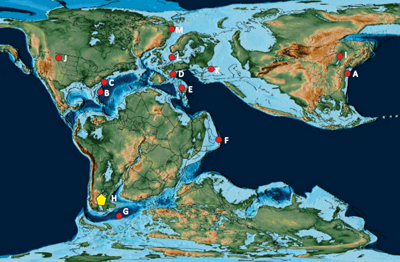
Figure 1:
Hauterivian
paleogeographic map (Scotese, 2013) showing sites of this study.
A.
Koyamada Formation, Japan (Tomaru et al., 2025);
B. DSDP 534A (Sheridan, 1983; Bergen,
1994); C. DSDP 603B (Covington & Wise,
1987; Habib & Drugg,
1987);
D. Vocontian Basin, France: La
Charce (Gréselle et al., 2011); Orpierre (Charbonnier et
al., 2013); Pont de Carajuan (Arnaud & Bulot,
1992);
E.
Capriolo, Italy (Hennig et al., 1999); F. Wadi Miadin, Oman (Celestino
et al., 2016); G. ODP 692B (Cavalheiro et al.,
2021);
H.
Paraná-Etendeka LIP (Tomaru et al., 2025); I. Luanping Basin,
China (Tong et al., 2024); J. Utahraptor Ridge, Montana (Joeckle
et al., 2023); K. Crimea (Gröcke et al.,
2005);
L. Lower
Saxony Basin (Thöle et al., 2020); M. Svalbard (Jelby et
al., 2020). |
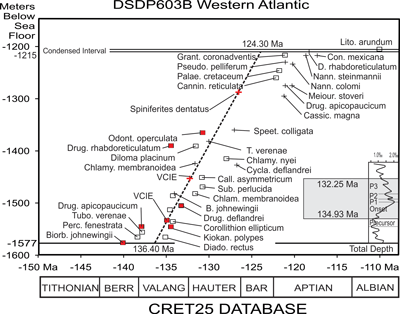
The plot of the west-central Atlantic DSDP 603B core with the CRET25DB
illustrates this technique (Fig. 2 ). Base of the plot is the base of the core
and the top is a condensed interval between -1215 and -1205.5 mbsf. The
interpreted CLS is controlled by the base of the Onset interval in VCIE, which
is close to the FO of Kiokansium polypes and the LO of Spiniferites
dentatus (Fig. 2 ). The CLS falls slightly left of the highest position of
VCIE and does not extend it.
|
|
Figure 2:
Correlation of lower
part of DSDP-603B core with the CRET25 Database. Base of the plot is core base
and plot top is a condensed interval, core subunit IVD; data from Covington
and Wise (1987) and Habib and Drugg
(1987). The CLS is
constrained by the FOs (rectangles) and LOs (crosses) of zone species (red). The
VCIE curve is projected into the CLS showing the positions of the base and top
of the chemozone. |
During
the twenty-five Myr interval from the Oxfordian Stage to early Valanginian, the
pelagic ecozone became progressively populated by diverse and abundant
calcareous coccolithophore and dinoflagellate phytoplankton (Price et
al., 2016), here called the Late Jurassic-Early Cretaceous Phytoplankton
Ecosystem Evolution. This was the beginning of the Mesozoic Marine Revolution
(MMR) (Vermeij, 1977; Hull,
2017), which gave rise to the Late
Cretaceous, Cenozoic and Holocene ocean ecosystems. The dinoflagellates first
began diversifying in Middle Jurassic (Wiggan et al.,
2018). The
Oxfordian-Valanginian phytoplankton radiation responded to increased nutrients,
which during the later part of the Cretaceous provided primary production that
prompted radiation in many other marine groups (Knoll & Follows,
2016). The Late Jurassic to Early Cretaceous ecosystem radiation phase also
affected crabs, echinoids and heteromorph ammonoids (Fraaije et al.,
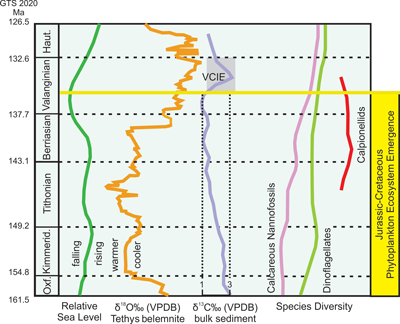
2018). During the Oxfordian-early Valanginian ocean parameters were relatively
stabile and changed unidirectionally. Sea level rose from Oxfordian to
Kimmeridgian, fell during the Tithonian, rose in the Berriasian, and fell in the
early part of the Valanginian and then rose during the VCIE (Fig.
3 ) (Ray
et al., 2019; Falkowski et al., 2004; Scotese et
al., 2024). The magnitude of short-term sea-level changes were low amplitude
in the Berriasian even as Gondwana began to disengage and increased up to three
times in the Valanginian (Fig. 3 ) (Ray et al.,
2019). Belemnite
oxygen isotopes show that global ocean temperature changes were moderate until
late Berriasian (Price et al., 2016). The secular trend towards
lower δ13C values was interrupted abruptly in the late
Valanginian at 135 Ma when burial of light carbon isotope increased that
resulted in the positive VCIE. During this period of open-ocean climate
stability, calcareous coccolith and dinoflagellate phytoplankton diversified and
contributed significant amount of CaCO3 to sea-floor sediment.
Calpionellid plankton formed calcite tests in the Tithonian Stage and were
abundant until their virtual extinction near the Valanginian-Hauterivian
boundary (Fig. 3 ). The increased diversification and abundance of these three
pelagic groups formed the Late Jurassic-Early Cretaceous Phytoplankton Ecosystem.
Calcareous planktonic foraminifera appeared in Early Jurassic but did not
diversify until the Aptian Stage (Hart et al., 2002; Gradstein et al.,
2017).
Because they are uncommon in open ocean Jurassic paleocommunities, they are not
considered here.
|
|
Figure 3:
Late Jurassic-Early Cretaceous Phytoplankton Diversification Evolution.
Relative sea-level and diversity curves of calcareous nannoplankton and
dinoflagellates from Falkowski et al. (2004); oxygen isotope and
carbon isotope curves from Price et al. (2016). |
Calcareous pelagic and benthic marine biota became the characteristic ecosystem members beginning in Tithonian to early Valanginian. The latest Jurassic-earliest Cretaceous Calcification Event (Cavalheiro et al., 2021) recognizes the increase of calcareous nannofossils, calpionellids, and calcareous and organic-walled dinoflagellate cysts. Planktonic microbiota precipitated calcareous tests around their protoplasm that was deposited as calcareous ooze.
The oldest known calcareous nannofossils are Late Triassic (Bown
et al., 1998). Throughout the Jurassic and Early Cretaceous nannofossils
diversified continuously with peaks around the Toarcian and Valanginian OAEs (Bown
et al., 2004: Fig. 2 ). Speciation and extinction rates were highest in
Early Jurassic up to the Toarcian Stage, when seawater temperature increased by
at least 10°C up to 25-30°C before cooling back to about 10°C (Korte et al.,
2015). Spanning the Tithonian and
Berriasian stages the nannofossil assemblages experienced significant turnover
with extinctions and originations of three important groups: nannoconids,
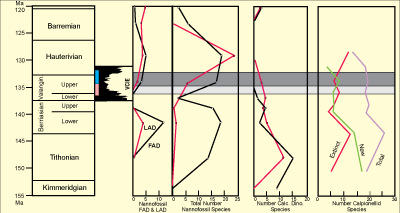
braarudosphaerids and microrhabdulids (Fig. 4 ) (Bown et al.,
2004). Nannoconids dominated Berriasian-Valanginian pelagic sediments replacing
radiolarians. Although, during the VCIE event, nannofossil diversity increased,
the calcite accumulation was low (Fig. 4 ).
|
|
Figure 4:
Number of nannofossil, dinoflagellate and
calpionellid species in the CRET25 Database. The range of the VCIE event is
represented by diversity data in the Polaveno core. Warm and cool intervals
marked by pink and blue bars. Number of species extinctions indicated by LAD
curve and number of new species by FAD. Total number of calpionellid species (blue),
number of new species (green) and number of extinct species (red) in ammonite
zones based on range data in CRET25 Database. |
Calcareous dinoflagellates, such as Colomiosphaera and Cadosina, diversified in early Tithonian in the southern oceans and became extinct by the end of the Berriasian (Ivanova & Kietzmann, 2017). In shallow-water shelves rudist bivalves first formed thick-walled aragonite shells in Oxfordian biostromes and diversified into the Tithonian (Steuber et al., 2016). Sea level rose across the globe (Cotillon, 1992; Haq, 2014) and deeper water shelf-to-basin habitats expanded. Earlier Jurassic carbonate habitats were drowned and fine-grained siliciclastic deposits expanded (Cotillon, 1992).
During this Calcification Event (Cavalheiro et al.,
2021)
Chitinodellids and their descendent Calpionellids evolved complex wall structure
in response to sea-water chemistry changes. Tithonian Chitinodellid
diversification preceded the Calpionellid appearance in latest Tithonian (Benzaggagh,
2021), which expanded in the Berriasian and early Valanginian, after which
calpionellids became nearly extinct (Fig. 5 ).
Calpionellidae is a diverse set of small, marine,
pelagic ciliate microorganisms with calcitic, cylindrical to globular tests or
loricas. Beginning in the Tithonian, calpionellids diversified rapidly and by
early Berriasian the major groups were present (Fig. 4 ). Many taxa are
characterized by distinctive collars around the lorica apertures (Reháková & Michalík,
1997). Complex
wall structure differentiated Calpionellids taxonomically. The ancestor
calpionellid group, the Tithonian Chitinodellids, secreted dark microgranular
calcite loricas (Reháková & Michalík,
1997).
The earliest Tithonian Chitinodellids precipitated densely-packed, nanometric microcrystalline calcite needles to form the lorica wall (Benzaggagh,
2021; Ölveczká et al.,
2024). Their descendants, the Semichitinoidella,
followed in late Tithonian and formed a two-layered wall, the inner layer of
which was microcrystalline calcite like that of Chitinodella. The outer
layer was composed of prismatic microcrystalline, hyaline
calcite crystals. The late Tithonian Praetintinnopsella formed a
different two-layer wall, an inner hyaline layer of densely-packed equant calcite microcrystals and an outer
dark organic non-calcitic layer. The earliest
calpionellids, Crassicolaria, Calpionella and Tintinnopsella,
formed hyaline tests (Ölveczká et al., 2024) (Fig. 5 ). The
different ways in which to precipitate calcite wall structures suggests that
significant changes occurred in mid-latitude ocean chemistry, possibly increased
concentrations of Ca2+ and CO2 as well as ocean warming.
|
|
Figure 5:
Tithonian-Valanginian
Calpionellid diversification and extinction Event. Red range bars identify named
zones. Note that short ranges of some species may be the result of their
presence in single localities in the database. The Tithonian/Berriasian boundary
is here arbitrarily placed at first appearance datum of Strambergella [Berriasiella]
jacobi, instead of the Praedalmasiceras progenitor Zone as in Szives
et al. (2024). |
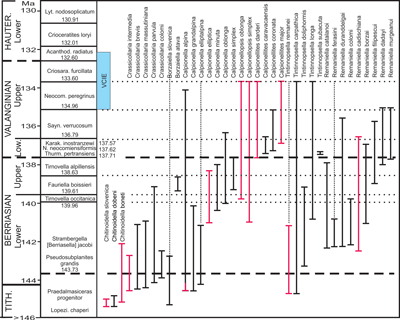
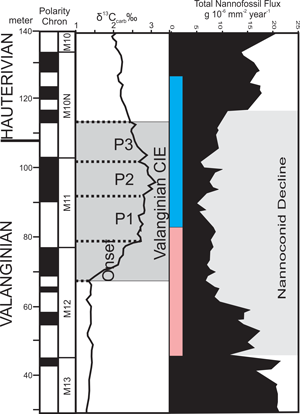
The Valanginian Biotic Crisis beginning about 136-135 Ma affected most
major marine pelagic groups (Figs. 4
- 5 ) (Erba & Tremolada,
2004). This crisis began about one million years before the VICE and continued
into it (Fig. 4 ). Calcareous nannofossils and nannoconids decreased in size,
diversity and abundance (Erba & Tremolada,
2004; Casellato
et al., 2008; Möller et al.,
2015, 2020; Bottini et
al., 2018; Casellato & Erba,
2021). This significant
reduction in nannofossil calcification was related to decreased pCO2
and increased fertility (Erba & Tremolada,
2004). The
calcification crisis began as sea-surface temperatures warmed (Fig. 6 ) (Cavalheiro
et al., 2021). The biotic change and positive carbon isotope shift are in
dominantly terrigenous-rich intervals indicating increased terrigenous
deposition in response to increased humidity and erosion (Bottini et
al., 2018).
|
|
Figure 6:
Poloveno outcrop
section, Italy, pelagic carbonate stratigraphy, polarity chrons, and carbon
isotope curve plotted with total nannofossil carbonate paleoflux demonstrating
nannoconid decline (Channel et al., 1995; Erba & Tremolada,
2004) correlated with warm-cool temperature changes (rose & blue bars) (Cavalheiro
et al., 2021). |
Pelagic Calpionellid diversity declined
significantly amplifying this crisis event (Figs. 4 ,
6 ). The organic-walled
dinoflagellates, however, appeared to be barely affected by the Valanginian
calpionellid-nannofossil crisis (MacRae et al., 1996; Riding
et al., 2023). The Kimmeridgian dinoflagellate diversity peak was
followed by a slight decline in the Berriasian (Fig. 4 ). However, a detailed
analysis of 136 dinoflagellate taxa in CRET25DB having FADs between 150 Ma and
110 Ma, revealed that species diversification decreased significantly. Between
150 Ma and 135 Ma, 27.2% of species were new, but during the VCIE between 135 Ma
and 131 Ma only 8.8% of species first appeared. Diversification resumed during
the next 10 Myr with 21.3% new species. Planktonic foraminifera were minor
members of the Late Jurassic-Early Cretaceous pelagic ecosystem, until the
Barremian when their abundance and diversity slowly increased (Aguado et
al., 2014).
By the late Valanginian in the Neocomites peregrinus Zone during
the beginning of the VCIE, many Calpionellid species became extinct (Fig. 6 ) (Reháková
& Michalı́k, 1997), and at the
Valanginian-Hauterivian transition they were virtually extinct (Remane,
1985; Andreini et al., 2007; Lipps et al.,
2013; Granier
et al., 2024). They diversified again in the late Aptian and early
Albian. By Barremian time the new Praecolomiellids appeared with microgranular
hyaline loricas. They were ancestors of the latest Aptian-early Albian
Colomiellids with hyaline tests. They went extinct at the end of the early
Albian after surviving the latest Aptian-early Albian OAE 1b chemozone.
Benthic ecosystems were also affected by the dramatic latest Jurassic-earliest Cretaceous Calcification Crisis and paleoclimate-paleoceanographic changes. The Oxfordian primitive rudist bivalves constructed low diversity biostromes on shallow-water shelves. They formed thick-walled aragonitic shells and diversified into the Kimmeridgian and Tithonian when some species secreted two-layered shells of both aragonite and calcite (Steuber et al., 2016: Fig. 7; 2023). Rudists experienced significant extinction at end of early Valanginian as the positive carbon excursion began. During the Hauterivian recovery, new species groups developed the ability to produce calcite-dominated shells. Rudists with aragonite-dominant shells diversified into the early Aptian when a second extinction occurred at the beginning of OAE 1a (Steuber et al., 2016: Fig. 6). These late Valanginian pelagic and benthic biota were associated with increased terrestrial erosion, clay influx, ocean fertilization and global cooling during the main parts of the VCIE (Bornemann & Mutterlose, 2008; Percival et al., 2023).
Berriasian-Hauterivian, deep-shelf brachiopod paleocommunities in central Tethys, now exposed in the Bakony Mountains, Hungary, experienced step-wise extinction (Vörös et al., 2020). During the transition from early to late Berriasian the first species replacement happened. The second step was at end of Berriasian into the Valanginian. Then, during the beginning of the Valanginian Carbon Isotope Excursion, eight species went extinct; of the two survivors, one was dwarfed. During latest Valanginian and into the Hauterivian, the recovery paleocommunity was populated by species apparently adapted to cooler waters. The recovery period was associated with rising sea level and increased weathering, which increased siliciclastic sediments (Vörös et al., 2020).
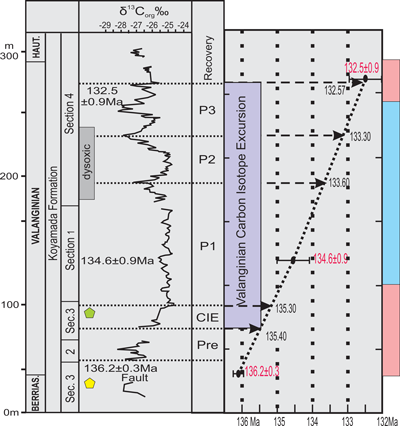
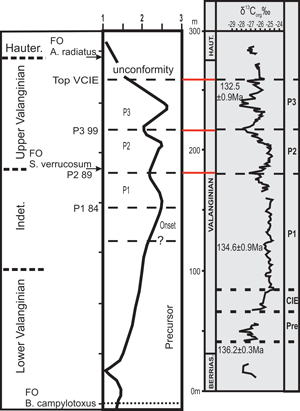
Numerical ages of
VCIE subunits. Tomaru et al. (2025) divided the Valanginian Carbon Isotope Excursion
(VCIE) into six elements in a 300 m-thick, organic-rich, siliciclastic interval
along the east coast of Japan (Fig. 7 ). A composite stratigraphic section of the
Koyamada Formation was composed of four measured, overlapping outcrops along a
fault zone. Sample spacing in the excursion interval was about 0.5 m. Details of
the δ13C curve measured on organic matter are clearly delineated
because the lithostratigraphic siliciclastic interval is much thicker than in
thinner basinal sections (Fig. 7 ). In addition, three volcanic tuff beds yielded
U-Pb zircon dates that bracket base to top of the excursion (Tomaru et
al., 2025: Fig. 8). The Koyamada Formation was sourced mainly by continental
sediments deposited in an oxygenated marine environment with occasional brief
dysoxic events based on analyses of total organic carbon (TOC), degree of
pyritization (DOP) and total sulfur (TS) (Tomaru et al.,
2025).
Yet to be determined are the admixture types of continental organic matter, as
for example, in OAE 1b (Suan et al., 2015; Bodin et al.,
2023).
In order to interpolate numerical ages of the four subdivisions of the
VCIE in the Koyamada Formation, Onset, P1, P2, and P3 subunits, the metric
positions of these subunits were plotted to mega-annums of the three radioisotope
dates measured in this outcrop (Fig. 7 ). This procedure created an approximate
time scale and duration of the subunits. Also, if in other sections the isotope
curve features vary, the placement of subunit boundaries may differ from those
in the Japanese composite section. These numerical ages are compared with ages
of ammonites, nannofossils, dinoflagellates, and polarity chrons in the global
CRET25DB. This experiment dates the VCIE in the Koyamada Formation from 135.40
to 132.57 Ma, which is older than
a start date of 134.56 ± 0.19 Ma calibrated by astrochonologic framework (Martinez
et al., 2023).
|
|
Figure 7:
Projection of three radioisotope dates of ash beds (red) in the
Koyamada Formation (Tomaru et al., 2024) and calibration of ages
of Valanginian CIE (gray bar) chemozone subunits.
Yellow symbol - four Berriasian ammonite genera; green symbol - four
Valanginian radiolarian taxa. Right-hand bar depicts warm (rose) and cool (blue)
climates. |
Characteristics of the VCIE.
The four subdivisions of the Valanginian carbon isotope curve can be defined
consistently at either strong positive or negative peaks (Tomaru et
al., 2025) (Fig. 7 ). The basal subunit of the VCIE, noted as "CIE" by
Tomaru and here called "Onset", is placed at the base of a narrow, distinct
positive peak of about 1‰ at 80 m in the Koyamada Formation, which is at the
base of the rise in isotope values to the first tall peak at 100 m, which is
about 1.5‰ above the background value (Fig. 7 ) called "P1" (Tomaru et
al., 2025). Below this Onset interval is a span between two shallow negative
peaks, which Tomaru et al. (2025) called the "Precursor". This preceding interval is highly variable and indistinct in other sections, so here the base
of the VCIE is placed at the base of the Onset interval.
The P1 interval is thick and bounded at top at 195 m by a sharp
negative shift about 1.0‰ or more (Fig. 7 ). The P2 interval is a narrow
positive peak bounded at 230 m by a distinct, sharp negative offset. The P3
interval is broad spanning two positive peaks and it is bounded by a distinct
negative shift at 275 m overlain by a long gentle slope to the background carbon
isotope levels (Fig. 7 ). This negative peak is taken as the top of the VCIE. The
"Recovery" part of the curve declines about 1‰ up to an unconformity.
Because its character is indistinct in other stratigraphic sections, it is not
included in the definition of VCIE. P3 is narrow in some sections.
The amplitudes of these shifts appear to be significantly above background of δ13C fractionation, which at 133 Ma carbonate fractionation was about 1.5‰ and for TOC it was about -27‰, both of which were less than the range of the VCIE. During the Cretaceous the carbon isotopic fractionation of carbonates varied from 1‰ to 3‰ and for TOC it varied from -29‰ to -25‰; and the carbon isotope fractionation between carbonate and TOC varied from -31 to -27 (Hayes et al., 1999: Fig. 3).
Prior to defining subunits of the VCIE in the thick Koyamada Formation, the excursion in the ODP692 section was divided into three subunits (Cavalheiro et al., 2021: Fig. 2). In the ODP692 core the VCIE is a 7-8 m-thick, marine shale compared to the much thicker terrigenous Japanese section, in which divisions of the carbon isotope curve are expanded. Interval A in ODP692 is similar to the Onset interval in Japan, unit B is equivalent to subunits P1 and P2, and Interval C approximates unit P3 in Japan. The positions of VCIE subunits of the eight stratigraphic sections in this study vary but their ages are similar (Table 1).
Similarly, the Cenomanian-Turonian carbon isotope curve, OAE 2, is subdivided into subunits (Lowrey et al., 2014; Beil et al., 2020), although the pattern differs from that of VCIE. The "ramp-up" interval is a gradual increase of about 1.5‰ of bulk carbonate isotope and 3-4‰ of organic carbon isotope. The first positive peak is the initial enrichment ("A"), followed by a negative shift ("B"), which is followed by a sustained plateau ("C") (Pratt & Threlkeld, 1984). The upper boundary is the beginning of the return to the initial value. This configuration is documented in the North American Western Interior, western Europe and elsewhere (Lowery et al., 2014).
The upper Pliensbachian carbon isotope excursion in eastern Oregon, western United States, is divided into four negative-positive segments about 1‰ in organic carbon (De Lena et al., 2019). The initial negative excursion began during a warm period, and the succeeding positive-negative peaks were during a cool period. Radioisotope dates show that this excursion preceded the Karoo-Ferrar LIP and was not driven by that volcanic event.
Table 1. Stratigraphic sections with data of Valanginian CIE and data of four subunits in each section.
| A. Data of Valanginian Carbon Isotope Excursion Chemozone | ||||||||
| Sections | δ13C Sample | Sample Spacing | Position Meters | Thickness | Ages Ma | |||
| meters | Base | Top | Base | Top | Duration | |||
| DSDP 534A, W. Atlantic | Carbonate | ~3 | -1220 | -1137 | 83 m | 135.04 | 132.55 | 2.49 Myr |
| La Charce, France | Carbonate | ~2 | 125 | 188 | 63 m | 134.77 | 132.61 | 2.16 Myr |
| Orpierre, France | Carbonate | ~1 | 97 | 232 | 135 m | 135.14 | 132.80 | 2.34 Myr |
| Capriolo, Italy | Carbonate | ~1.2 | -129 | -70 | 59 m | 134.55 | 132.51 | 2.04 Myr |
| Wadi Miadin, Oman | Carbonate | 0.3-1.0 | 55 | 73 | 18 m | 135.03 | 132.85 | 2.18 Myr |
| ODP 692B, Weddell Sea | Organics | 0.2 | -91.5 | -82 | 9.5 m | 135.56 | 132.56 | 3 Myr |
| DSDP 603B, W. Atlantic | Carbonate | 1.3 | -1533 | -1453 | 80 m | 135.50 | 132.86 | 2.64 Myr |
| Japan Outcrop | Organics | 0.5-2.0 | 80 | 270 | 190 m | ~135.40 | 132.50 | 2.9 Myr |
| Average | 0.4-1.5 | 79.69 m | 135.08 | 132.66 | 2.47 Myr | |||
| B. VCIE Subunit Data | |||||||
| Sections | Onset Thickness | P1 Thickness m-Ma | P2 Thickness m--Ma | P3 Thickness m-Ma | |||
| DSDP 534A, W. Atlantic | 0.84 m | -1192 | 134.20 | -1180 | 133.80 | -1153 | 133.03 |
| La Charce, France | 0.8 m | 150 | 133.91 | 170 | 133.22 | 179 | 132.90 |
| Orpierre, France | 0.3 m | 129 | 134.55 | 148 | 134.25 | 161 | 134.05 |
| Capriolo, Italy | 0.89 m | -100 | 134.46 | -90 | 133.84 | -86 | 133.58 |
| Wadi Miadin, Oman | 0.4 m | 59 | 134.60 | 65 | 134 | 67 | 133.70 |
| ODP 692B, Weddell Sea | 0.6 m | 89.6 | 134.92 | no data | 85.6 | 133.69 | |
| DSDP 603B, W. Atlantic | 0.93 m | -1505 | 134.55 | -1500 | 134.43 | -1495 | 134.08 |
| Japan Outcrop | 0.1 m | 100 | 135.30 | 195 | 133.6 | 230 | 133.30 |
| Average | 0.61 m | 134.56 | 133.87 | 133.54 | |||
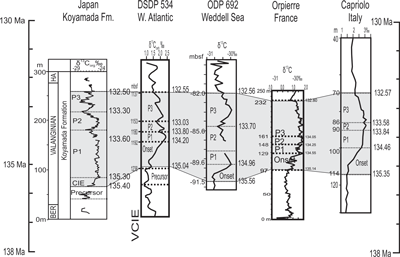
The
distinct pattern of the VCIE is documented in eight marine and non-marine
sections, four of which illustrate the variation of the isotope curve (Fig. 8 ).
The details of each curve are a function of sample spacing, which varied in each
section.
|
|
Figure 8:
Chemozone correlation of four VCIE subunits (gray zone) defined in Japan with
isotope curves in sections in north central Tethys, west central Atlantic and
offshore Antarctic showing variations of the curve and boundary positions.
Numerical ages of subunit boundaries were derived by plotting biostratigraphic
data of the four sections to the CRET25 database. |
The distinctive Valanginian δ13C
excursion and its four subunits defined in the Koyamada Formation, Japan, are
identified and correlated among four sections (Fig. 8 ). The δ13C
excursion increased abruptly and smoothly at most sites, remained a high plateau
with several perturbations for about 2.7 Myr, then decreased slowly. The
thicknesses and durations of the basal Onset interval vary greatly from section
to section (Table 1). Its age differs by 1 Myr where it is oldest in the Weddell
Sea DSDP 692 core and youngest in Capriolo, Italy. The Onset interval is
thickest on the western Atlantic slope off North America and thinnest in Japan
section. The diachroneity of the four subunits may in part be a function of
sample spacing, inconsistency in identifying unit boundaries and of imprecision
in interpolating numerical ages, and not necessarily a clue to the differential
oceanic and atmospheric distribution and migration of δ13C.
Beginning at the first high peak P1, the carbon isotope values remained steady
at about 3‰ above the preceding background level. Multiple negative shifts of
about 2‰ separate P1 through P3 subunits (Figs. 8
- 9 ). The interval between
the base of P1 to the end of P3 lasted on average 1.02 Myr. Following the end of
P3, the δ13C values decreased gradually to about 1‰ above the
prior background level.
A
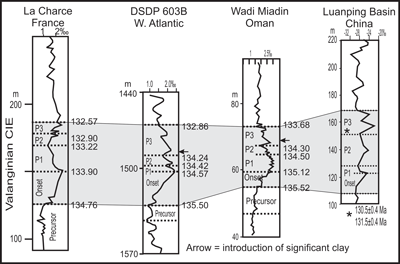
second cross section correlates an oceanic slope section in the western Atlantic
with a shallow epicontinental basin in France and a carbonate slope in Oman with
a lacustrine section in China (Fig. 9 ). The durations of the Onset and P1
intervals are variable, but subunits P2 and P3 are more consistent (Fig. 9 ;
Table 1).
In
the Luanping Basin, northeastern China, a positive ~3‰ δ13Corg
excursion is developed in the lacustrine facies (Tong et al.,
2024). The Dabeigou Formation is composed of non-marine fan-delta sandstone and
lacustrine mudstone and sandstone. Fresh black mudstone was sampled at intervals
of about 0.5 m spanning the carbon shift. The VCIE curve spans 70 m and consists
of three strong positive peaks, here identified as P1 at 124 m, P2 at 140 m and
P3 at 158 m directly overlying the youngest dated tuff bed (Fig. 9 ). The base of
the Onset interval is at a negative shift at 108 m. Its age is constrained by
four U-Pb zircon radioisotope ages in tuffs. Dates underlying the excursion in
the underlying Zhangjiakou Formation are 134.5±0.4 Ma and 134.1±1.0 Ma. A tuff
bed in the excursion in Member 3 lacustrine facies is dated at 131.5±0.4 Ma and
130.5±0.4 Ma. These radioisotope dates are about 1 Myr younger than ages of the
chemozone in the Japanese section; this difference needs further research. Three
TOC peaks of about 1% underlie and overlie the CIE. Within the CIE are minor TOC
increases of about 0.25-0.3%. The low TOC and organic geochemistry support the
conclusion that lake waters were mainly oxic to suboxic and related to declining
photosynthetic fractionation and reduced atmospheric pCO2 (Tong
et al., 2024).
|
|
Figure 9:
Correlation of the four VCIE subunits (gray zone) in France, western Atlantic,
Oman, and China showing variations of the curve and boundary positions.
Numerical ages were interpolated by projecting the subunit boundaries into the
CRET25DB. In the Luanping Basin section, the asterix indicates position of tuff
bed with two radioisotope dates (Tong et al., 2024). |
A well documented terrestrial example of the VCIE is in the Western Interior of North America at Utahraptor Ridge, Utah (Joeckle et al., 2023). The Yellow Cat Member of the Lower Cretaceous Cedar Mountain Formation is a classic dinosaur locality replete with interbedded pedogenic layers. A 10 m-thick interval in the Yellow Cat Member was sampled at 0.27 m intervals and yielded a detailed δ13Corg‰ curve with three prominent peaks and ending at a 1.7‰ positive limb suggestive of another peak; this limb is overlain by a covered interval (Joeckle et al., 2023: Fig. 5). The Yellow Cat Member is correlated with Berriasian to Hauterivian stages by palynologic, ostracod and charophyte data. The Early Cretaceous spore, Foraminisporis wonthaggiensis, was also reported in Spitsbergen (Jelby et al., 2020). Volcanogenic zircons from a paleosol in the middle of the carbon curve were dated at 135.1±0.3 Ma (Joeckle et al., 2023). This part of the Yellow Cat curve would correlate with subunit P2 in Japan, which is dated at 133.6 Ma.
In the Lower Saxony Basin, northern Germany, the Valanginian CIE is recorded in a Lower Cretaceous regressive-transgressive cored sequence (Thöle et al., 2020). Coincident with the beginning of the carbon isotope excursion sea-level regression is indicated by high Si/Al ratios and sandstone strata. Thus, the VCIE began during high terrigenous sediment supply in this basin and continued as terrigenous sediment supply declined. The positive δ13Corg excursion is correlated with the Valanginian by Boreal nannofossil zones and began in the transition from uppermost lower to upper Valanginian. The positive carbon excursion is about 3‰ and has multiple small shifts of about 1‰. Weight-percent organic matter ranges no more than 1% suggesting aerobic to dysaerobic conditions. The configuration of the curve defines five smaller offsets that compare well with the three major peaks in Japan.
In Spitsbergen the "Weissert Event" is identified in dark gray shale and siltstone of the Rurikfjellet Formation at a 3.5‰ positive shift in δ13Corg (Jelby et al., 2020). The excursion begins at a maximum flooding, condensed interval overlying the Volgian/Berriasian Agardhfjellet Formation, which is dated by Ryazanian ammonites. Lower Valanginian dinoflagellates date the lower 50 m of the excursion (Śliwińska et al., 2020), and its upper part is dated by the upper Valanginian-Hauterivian belemnite, Arctoteuthis bluethgeni Doyle (Alsen et al., 2020), which is overlain by Hauterivian dinoflagellates. The dinoflagellate assemblage is widespread in the Volga Basin and Western Europe and integrated with ammonites (Harding et al., 2011). The carbon isotope curve, however, differs from other VCIE curves in that above the 3‰ positive shift, the curve remains a plateau through the Hauterivian with few small broad wobbles less than 1‰ but no significant positive or negative peaks.
The La Charce outcrop, Vocontian Basin, France, integrates ammonites
with the VCIE (Fig. 9 ). The lower-upper Valanginian boundary in this
outcrop is
placed between the single occurrence of the lower Valanginian Neocomites
platycostatus Subzone at 1 m and the first occurrence of the upper
Valanginian Neocomites peregrinus Zone at 24 m, which is directly below
the base of the VCIE. In the CRET25DB the FAD of N. peregrinus is
projected at 134.96 Ma. Previously, the base of the carbon excursion was
correlated with the lower Valanginian Karakaschiceras inostranzewi Zone
to the Saynoceras verrucosum Zone (Hennig et al.,
1999: Martinez et al., 2023).
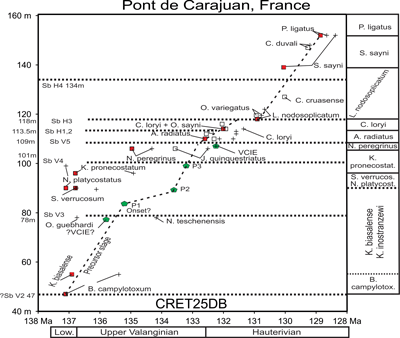
The VCIE was correlated with lower to upper
Valanginian in the Pont de Carajuan, France, section (Fig. 10 ) (Hennig et
al., 1999; Weissert et al.,
2008), although the
biostratigraphic data are inconclusive. This basin-margin section is divided
into seven Valanginian and five Hauterivian sequences. The upper stage boundary
is a significant disconformity that truncates uppermost Valanginian ammonite
zones and the upper part of the VCIE; and basal Hauterivian zones are condensed
(Arnaud & Bulot, 1992). The lower-upper Valanginian boundary
is indeterminate because ammonite samples are widely spaced and some species are
long ranging (Fig. 11 ). The lower Valanginian Busnardoites
campylotoxus
Zone is overlain by the upper Valanginian Saynoceras verrucosum Zone by a
35 m-thick interval (Arnaud & Bulot,
1992); intervening
samples yielded two long-ranging species, Olcostephanus guebhardi and Neocomites
teschenensis (Company & Tavera,
2015). Furthermore, the
lower forty meters of the carbon isotope curve in the Pont de Carajuan section
is a long rising line with no excursions except for a 0.3‰ negative blip in
the lowermost 3 m (Fig. 11 ). The first positive excursion of 1.5‰ at 40 m
equates with 84 m in the upper Valanginian part of the measured section and here
is identified as P1; the base of the Onset phase is indistinguishable. The
uppermost curve interval from 55 to 65 m at the unconformity is a single peak,
which may be the lower of two P3 peaks in the Japan section (Fig. 11 ). The upper
part of the carbon isotope curve apparently is cut out by the unconformity,
which is directly overlain by the lower Hauterivian Acanthodiscus radiatus
Zone. Thus, the carbon isotope curve in the Pont de Carajuan section correlates
with only part of the Koyamada curve and the positive excursions are above the
base of the Saynoceras sayni Zone marker in the lower Hauterivian.
|
|
Figure 10:
Graphic plot of the
Pont de Carajuan section to the CRET25DB. Sequence boundaries and fossil samples
are from Arnaud and Bulot (1992). Red rectangle makes position of
key Valanginian taxon; green symbols mark base and top of carbon isotope
excursion. |
|
|
Figure 11:
Correlation of the carbon curve at the Pont de Carajuan section (Hennig et
al., 1999) with the curve in the Koyamada Formation, Japan (gray zone) (Tomaru
et al., 2025). The measured lithologic section is 152 m thick (Arnaud
& Bulot, 1992) and the carbon curve is 74 m thick, in which 0 m
equals 47 m in the lithologic section. |
Eight of the 124 stratigraphic sections in the
CRET25DB are plotted to the CRET25DB in order to project the age of the
boundaries of the Valanginian carbon isotope excursion (Table
1). The projected
ages vary slightly because in several X/Y plots, more than one correlation line
of interpretation is possible as constrained by the FADs/LADs of ammonites,
calcareous nannofossils, calpionellids, and dinoflagellates. The age of VCIE
ranges from 135.79 Ma to 132.25 Ma averaging 2.47 Myr in duration and lasting up
to 2.90 Myr in Japan (Fig. 7 ;
Table 1). The average age of the base is 135.08 Ma
and the top is 132.66 Ma. The thicknesses of the excursion range from 190 m to
9.5 m and average 79.69 m. The average age of base P1 is 134.56 Ma, of P2 is
133.88 Ma and of P3 is 133.54 Ma. The lacustrine section in the Luanping Basin,
China, was not included in this list of sections, because the date of the
"P3" subunit is 2 to 3 Myr younger at 131.5±0.4 to 130.5±0.4 Ma, which
correlates it with the Hauterivian Stage.
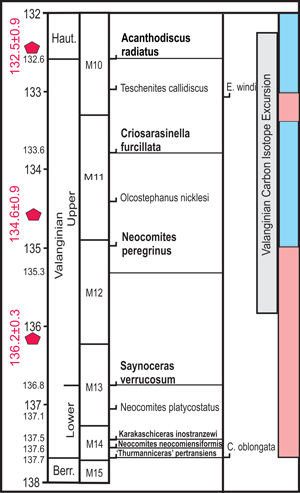
The
Valanginian Stage spans from the FO of Calpionellites darderi (FAD 137.71
Ma) to the base of Acanthodiscus radiatus (FAD 132.60 Ma) at base of the
Hauterivian Stage (Gale et al., 2020; Szives et al.,
2024) (Fig. 12 ). In the Tethys Realm the base of the Valanginian is also defined
by the "Thurmanniceras" pertransiens Zone, FAD 137.71 Ma, and the Neocomites
premolicus Subzone (Szives et al., 2024). The CRET25DB
projects the FADs of both species at 137.71 Ma. The duration of the Valanginian
as calculated by astrochronological methods ranges from 4.7 to 7.7 Myr (Charbonnier
et al., 2013; Martinez et al.,
2023). In the CRET25DB the
duration of the Valanginian Stage is 5.11 Myr from the FAD of C. darderi
at 137.71 Ma to the FAD of A. radiatus at 132.60 Ma.
The VCIE chemozone spans from the upper
Valanginian Saynoceras verrucosum Zone to the basal Hauterivian Acanthodiscus
radiatus Zone (Fig. 12 ). The VCIE spans the FADs of two nannofossil
bioevents, Calcicalathina oblongata at the base and Eiffellithus windi
near the top. It spans Polarity Chrons M12 to M10. In the Japanese section the
age of VCIE is dated from 135.40 Ma to 132.50 Ma, and thus, overlaps the
beginning of the Hauterivian Stage at 132.60 Ma. At the La Charce section the
base of the VCIE is in the lower part of the upper Valanginian in the Neocomites
peregrinus Zone and 1 m above the FO of the zone species. Two astrochronological studies dated the Valanginian CIE beginning at 135.22±1.0 Ma
with a duration of 5.85 Myr (Martinez et al., 2015); a later study
revised it to 134.56±0.19 Ma (Martinez et al., 2023). Tomaru
et al. (2025) dated the beginning between 136.2±0.3 and 134.6±0.9 Ma by
radioisotope dates in volcanic material.
|
|
Figure 12:
Correlation of Upper Valanginian Carbon Isotope Excursion with ammonite and
calcareous nannofossil FADs and polarity chrons in CRET25 Chronostratigraphic
Database. Bold names are standard ammonite zones (Szives et al.,
2024). Red symbols in left-hand column are dates from Japan; right-hand color
bar marks warm (rose) and cool (blue) climates. |
During
latest Jurassic into earliest Cretaceous, from the Oxfordian Age into the early
Valanginian, about twenty-five Myr, the δ13Ccarb of
bulk sediment became progressively lighter by about 2‰ (Fig. 10 ) (Price
et al., 2016). Among several processes, burial of more negative carbon
produced by photosynthesis in an oligotrophic, epipelagic/photic zone was likely
(Falkowski et al., 2004). During this same time interval, the 87Sr/86Sr
ratio increased uniformly from about 0.706900 to about 0.707500 (Price et
al., 2016), which suggests progressively increasing weathering. During Late
Jurassic and Early Cretaceous calcite precipitation was favored over aragonite
because the Mg/Ca ratio fell below 2 (Müller et al.,
2013). This
was during the beginning of continental separation and opening of the northern
Atlantic Ocean (Scotese et al., 2024).
Oceanic temperature histories during the Valanginian δ13C excursion have been carefully evaluated by multiple methods. Sea-surface temperatures (SST) were measured by foraminiferal successions, oxygen isotopes and Tex86 measurements on marine archaeal membrane lipids in organic matter (Gröcke et al., 2005; Möller et al., 2015, 2020; O'Brien et al., 2017; Cavalheiro et al., 2021; He et al., 2025).
Since Late Jurassic, global climate slowly warmed
into Early Cretaceous from slightly less than 20°C to slightly above 30°C (Goddéris
et al., 2020; Scott & Lindsey,
2025). Early Cretaceous
atmospheric temperatures fluctuated, decreasing slightly during early
Berriasian, then cooled dramatically in later Berriasian and into late
Valanginian and early Hauterivian (Fig. 3 ). Tethys belemnite data show a
stepwise temperature decrease throughout the Valanginian and into early
Hauterivian, which is followed by warming (Price et al.,
2016).
Integrated global paleotemperature data show that globally mean SST dropped 3.0±1.7°C
from late Valanginian into early Hauterivian (Cavalheiro et al.,
2021; He et al., 2025). Also, atmospheric pCO2
decreased during this time-period. At high latitudes (>±48° latitude)
Valanginian SST ranged from about 22°C to 23 °C at least 10°C cooler than at
low latitudes and possibly as great as 20°C (Gröcke et al.,
2005; Möller et al., 2015,
2020; O'Brien et al.,
2017; He et al., 2025). Low-latitude ocean temperature slightly
increased from less than 25°C to 30°C; then decreased into the Hauterivian
followed by a slight increase into early Aptian and then decreased again into
latest Aptian. However, in offshore Antarctica at paleolatitude ~54° S and at a
paleowater depth of ~500 meters, the temperature dropped 3-4°C during the late
Valanginian CIE (Cavalheiro et al., 2021). Multiple
Valanginian-early Hauterivian continental glaciation events are documented in
Australia while it was docked with Antarctica (Alley et al.,
2020).
The oceanic temperature off the coast of
Antarctica at a paleolatitude of 54° S cooled during the four Valanginian
carbon isotope subunits of the VCIE (Alley et al.,
2020; Cavalheiro
et al., 2021; He et al.,
2025). The carbon isotope curve in
the ODP 692B core, Weddell Sea, spans 14 m of thin-laminated black shale (Fig. 8 ) (Cavalheiro et al.,
2021). This pattern is documented across
all latitudes (Cavalheiro et al., 2021).
The TEX86 curve records the warmest interval at the beginning of VCIE from the Onset into the P1 interval (Cavalheiro et al., 2021). Then SST dropped nearly 5°C into the early part of P3 stage. By the end of the VCIE temperature warmed 3-4°C briefly. This warm-cool-warm-cool alternation is also documented in Madagascar by belemnites, oysters and bulk carbonate (He et al., 2025). Unlike younger Cretaceous carbon isotope excursions when ocean anoxia developed, oceanic conditions during the VCIE fluctuated between oxic and dysaerobic conditions (Percival et al., 2023; Tomaru et al., 2025).
During the earliest Valanginian and into the Valanginian-Hauterivian transition, climate was humid and marine productivity increased as documented by clay minerals, palynological and calcareous nannofossil assemblages (Duchamp-Alphonse et al., 2007; Kujau et al., 2012, 2013; Morales et al., 2013; Bodin et al., 2015; Price et al., 2016; Charbonnier et al., 2020; Percival et al., 2023).
Surface-water productivity as indicated by calcareous nannofossils and elevated Sr/Ca ratios in the west-central Atlantic recorded in DSDP 534A, was high during Berriasian-mid-Valanginian into the Onset phase about 135 Myr, then decreased into latest Valanginian (Casellato et al., 2008: Fig 2; Percival et al., 2023). In the southern ocean Weddell Sea, ODP 692B, ocean temperature was warmest prior to and during the Onset of VCIE and cooled beginning about P1 into the recovery phase after P3 to the end of the Valanginian (Cavalheiro et al., 2021). On the southeast margin of the Arabian platform prograding into the Rayda Basin, Jebal Akhdar, Oman (Dujoncquoy et al., 2018), terrigenous influx increased at about 134.00 Ma when deposition of the argillaceous Salil Formation began (Scott, 1990; Celestino et al., 2016). The δ18O also decreased from -3‰ to less than -4‰ suggesting a small temperature decrease, which was inferred by Dujoncquoy et al. (2018). About the same time on the western margin of the Central Atlantic, increased terrigenous influx during P3 subunit is also dated at 134.00 Ma (Figs. 8-9, arrows). This is consistent with a return to global humid climate as ocean temperatures cooled. Following the end of VCIE, as recorded in DSDP 534A, terrigenous influx increased suggesting sea-level changes (Cotillon, 1992) or more humid climate (Lini et al., 2007; Percival et al., 2023) or both. In East Texas the upper Valanginian-lower Hauterivian terrigenous Hosston Formation overlies the drowned lower Valanginian carbonate ramp, Knowles Limestone (Mann & Thomas, 1964; Mancini et al., 2012; Scott, 2019), which supports the regional extent of latest Valanginian increased terrigenous sedimentation and the rise of climate humidity. Late Valanginian Osmium isotope (187Os/188Os) preceding VCIE and into the Onset stage suggests that weathering of Paraná-Etendeka basalt increased influx of micronutrients, which fertilized the oceans (Percival et al., 2023). Manganese and iron are enriched in Valanginian carbonates in the Mediterranean and Atlantic suggesting elevated continental weathering and expansion of dysoxic water masses (Kuhn et al., 2005).
It appears that during the Tithonian Stage, calcite precipitation was favored because pCO2 was reduced and SST temperature warmed and photosynthesis was active (Dreybrodt et al., 1997). Aragonite tends to be precipitated faster than calcite at a given state (Mucci et al., 1989). These conditions changed during VICE resulting in dissolution of some pelagic organisms.
The Paraná-Etendeka LIP was apparently the main trigger of the Valanginian carbon isotope excursion (Martinez et al., 2015, 2023; Celestino et al., 2016; Gomes & Vasconcelos, 2021; Percival et al., 2023; Tomaru et al., 2025). Recent studies based on high-precision radioisotopes date the emplacement spanning from 135.0±0.6 to 133.2±0.3 Ma (Gomes & Vasconcelos, 2021). The timing coincidence of Paraná Continental Flood Basalt formation suggests that it impacted the Valanginian CIE (Jelby et al., 2020; Thöle et al., 2020; Joeckle et al., 2023; Tong et al., 2024). In the Japanese section the VCIE is bracketed by precise radioisotope dates on volcanic ash at 136.2±0.3 Ma and 132.5±0.9 Ma, which are consistent with new dates of these flood basalts.
The Late Jurassic-Early Cretaceous Phytoplankton Ecosystem Evolution and its associated Calcification Event were major evolutionary innovations that fundamentally altered the global oceanic marine pelagic zone. Pelagic micro-organisms, nannoflora, dinoflagellates and calpionellids, constructed tests out of calcium carbonate and diversified becoming abundant producers in the Late Jurassic-earliest Cretaceous seas. Phytoplankton diversification was detoured by the Valanginian CIE chemozone, when nannoconid diversity and abundance decreased along with dinoflagellates and calpionellids. Ocean chemistry and temperature fluctuated following volcanic eruptions of the Paraná-Etendeka LIP.
The VCIE is a global chronostratigraphic chemozone composed of four subunits that are documented in the Koyamada Formation, Japan, in the west Pacific Ocean. These four subunits of the VCIE are identified in eight globally widespread sections. The VCIE began during the late Valanginian Neocomites peregrinus Zone and ended in the Acanthodiscus radiatus Zone in the earliest Hauterivian; the recovery stage continued into the earliest part of the Hauterivian Stage. The VCIE chemozone spanned from M11r Polarity Chron into M10N Polarity Chron.
The Valanginian carbon isotope chemozone began with the Onset subunit at 135.79 Ma and ended at the end of subunit P3 at 132.25 Ma. This chemozone coincided with the emplacement of the Paraná-Etendeka LIP dated from 135.0±0.6 to 133.2±0.3 Ma. The duration of the Paraná-Etendeka LIP was a minimum of 1.8 Myr, and the average duration of the VCIE was 2.47 Myr. Erba and Tremolada (2004) estimated the duration of VCIE at about 2 Myr. This Valanginian carbon excursion is related to significant changes in the atmosphere and hydrosphere and to a major change in marine biota and ecosystems. The decrease of calcareous nannoconids and virtual extinction of calpionellids formed the first Cretaceous marine biotic crisis that influenced subsequent Cretaceous marine biota.
We acknowledge the fundamental stratigraphic research by many teams who acquired and interpreted the voluminous data. Understanding the biotic changes that preceded the Valanginian isotope excursion have matured since Helmut Weissert and colleagues discovered it in the 1980's. Apology to Dr. Weissert for editing the name of this carbon isotope event so its name is consistent with names of younger Cretaceous events. Erik Pollock, the University of Arkansas Stable Isotope Laboratory, helped in the processing and interpretation of the carbon isotope data. Colleagues Carl Brett, Rick Fluegeman, Ed Landing, and Brian Pratt helped to clarify and promote the concept of chemozone as an important stratigraphic unit. Anonymous reviewers recommended important changes and current research that upgraded the study of the Late Jurassic and Early Cretaceous biotic changes and of the Valanginian carbon isotope chemozone.
This research did not receive specific grants from funding agencies in the public, commercial, or not-for-profit sectors. AI tools were employed in searching the literature but not the gathering of data, nor in its manipulation or in preparing illustrations or writing. In research using Google Tools, Google AI summaries were examined before searching for resource publications.
Aguado R., Gea G.A. de & O'Dogherty L. (2014).- Integrated biostratigraphy (calcareous nannofossils, planktonic foraminifera, and radiolarians) of an uppermost Barremian-lower Aptian pelagic succession in the Subbetic Basin (southern Spain).- Cretaceous Research, vol. 51, p. 153-173.
Alley N.F., Hore S.B. & Frakes L.A. (2020).- Glaciations at high-latitude Southern Australia during the Early Cretaceous.- Australian Journal of Earth Sciences, vol. 67, no. 8, p. 1045-1095. DOI: 10.1080/08120099.2019.1590457
Alsen P., Jelby M.E., Śliwińska K.K. & Mutterlose J. (2020).- An Early Cretaceous stratigraphic marker fossil in the High Arctic: The belemnite Arctoteuthis bluethgeni.- Geological Magazine, vol. 157, Special Issue 10, p. 1715-1728
Andreini G., Caracuel J. & Parisi G. (2007).- Calpionellid biostratigraphy of the Upper Tithonian-Upper Valanginian interval in Western Sicily (Italy).- Swiss Journal of Geosciences, vol. 100, p. 179-198. DOI: 10.1007/s00015-007-1227-z
Arnaud H. & Bulot L.G. (1992).- Provence platform (Berriasian to Barremian) : Early Cretaceous backstepping, faunal renewals and séquence stratigraphy. In: Arnaud H. & Lemoine M. (eds.), Alpine Mesozoic basin in the South-East of France.- Field-Course of the American Association of Petroleum Geologists, Nice, vol. C5, p. 109-133.
Atasoy G., Altiner D. & Özkan-Altiner S. (2022).- Calibrating the Late Jurassic-Early Cretaceous shallow and deep marine bioevents by quantitative biostratigraphy: A synthesis from the Pontides Carbonate Platform (Turkey).- Earth-Science Reviews, vol. 231, article 104071, 41 p.
Beil U.S., Kuhnt W., Holbourn A., Scholz F., Oxmann J., Wallmann K., Lorenzen J., Aquit M. & Chellai E.H. (2020).- Cretaceous oceanic anoxic events prolonged by phosphorus cycle feedbacks.- Climate of the Past, vol. 16, no. 2, p. 757-782. DOI: 10.5194/cp-16-757-2020
Benzaggagh M. (2021).- Systematic revision and evolution of the Tithonian family Chitinoidellidae Trejo, 1975.- Carnets Geol., vol. 21, no. 2, p. 27-53. DOI: 10.2110/carnets.2021.2102
Bergen J.A. (1994).- Berriasian to Early Aptian calcareous nannofossils from the Vocontian Trough (SE France) and Deep Sea Drilling Site 534: New nannofossil taxa and a summary of low-latitude biostratigraphic events.- Journal of Nannoplankton Research, vol. 16, no. 2, p. 59-69.
Bodin S., Charpentier M., Ullmann C.V., Rudra A. & Sanei H. (2023).- Carbon cycle during the late Aptian-early Albian OAE 1b: A focus on the Kilian-Paquier levels intervals.- Global and Planetary Change, vol. 222, article 104074, 17 p. DOI: 10.1016/j.gloplacha.2023.104074
Bodin S., Meissner P., Janssen N.M.M., Steuber T. & Mutterlose J. (2015).- Large igneous provinces and organic carbon burial: Controls on global temperature and continental weathering during the Early Cretaceous.- Global and Planetary Change, vol. 133, p. 238-253
Bornemann A. & Mutterlose J. (2008).- Calcareous nannofossil and δ13C records from the Early Cretaceous of the western Atlantic Ocean: Evidence for enhanced fertilization across the Berriasian-Valanginian transition.- Palaios, vol. 23, no. 12, p. 821-832.
Bottini C., Dieni I., Erba E., Massari F. & Weissert H. (2018).- The Valanginian Weissert Oceanic Anoxic event recorded in Central-Eastern Sardinia (Italy).- Rivista Italiana di Paleontologia e Stratigrafia (Research in Paleontology and Stratigraphy), vol. 124, no. 3, p. 617-637. DOI: 10.13130/2039-4942/10740
Bown P.R., Lees J.A. & Young J.R. (2004).- Calcareous nannoplankton evolution and diversity through time. In: Thierstein H.R. & Young J.R. (eds.), Coccolithophores.- Springer, Berlin, Heidelberg, p. 481-508. DOI: 10.1007/978-3-662-06278-4_18
Bown P.R., Rutledge D.C., Crux L.A. & Gallagher L.T. (1998).- Lower Cretaceous. In: Bown P.R. (ed.), Calcareous nannofossil biostratigraphy.- Kluwer Academic Publishers, New York, p. 86-131.
Carney J.L. & Pierce R.W. (1995).- Graphic correlation and composite standard databases as tools for the exploration biostratigrapher. In: Mann K.O. & Lane H.R. (eds.), Graphic correlation.- SEPM Special Publication, vol. 53, p. 23-43.
Casellato C.E., Andreini G., Erba E. & Parisi G. (2008).- Calcareous Nannofossil and Calpionellid calcification events across the Tithonian-Berriasian time interval and low latitudes paleoceanographic implications. In: Lees J. (ed.), INA12, Lyon, France - Abstracts Volume.- Journal of Nannoplankton Research, Special Number, p. 33 (abstract). URL: https://ina.tmsoc.org/JNR/online/30/INA12%20ABSTRACTS%20JNR30S.pdf
Casellato C.E. & Erba E. (2021).- Reliability of calcareous nannofossil events in the Tithonian-early Berriasian time interval: Implications for a revised high resolution zonation.- Cretaceous Research, vol. 117, article 104611, 30 p.
Cavalheiro L., Wagner T., Steinig S., Bottini C., Dummann W., Esegbue O., Gambacorta G., Farnsworth A., Flögel S., Hofmann P., Lunt D.J., Rethemeyer J., Torricelli S. & Erba E. (2021).- Impact of global cooling on Early Cretaceous high pCO2 world during the Weissert Event.- Nature Communications, vol. 12, article 5411, 11 p. DOI: 10.1038/s41467-021-25706-0
Celestino R., Wohlwend S., Rehákova D. & Weisert H. (2016).- Biostratigraphy and sedimentology of the Upper Jurassic-Lower Cretaceous Rayda Formation, central Oman Mountains.- Newsletters on Stratigraphy, vol. 50, no. 1, p. 91-109.
Channel J.E.T., Cecca F. & Erba E. (1995).- Correlation of Hauterivian and Barremian (Early Cretaceous) stage boundaries to polarity chrons.- Earth and Planetary Science Letters, vol. 134, nos. 1-2, p. 125-140.
Charbonnier G., Boulila S., Gardin S., Duchamp-Alphonse S., Adatte T., Spangenberg J.E., Föllmi K., Colin C. & Galbrun B. (2013).- Astronomical calibration of the Valanginian "Weissert" episode: The Orpierre marl-limestone succession (Vocontian Basin, southeastern France).- Cretaceous Research, vol. 45, p. 25-42.
Charbonnier G., Duchamp-Alphonse S., Deconinck J.F., Adatte T., Spangenberg J.E., Colin C. & Föllmi K.B. (2020).- A global palaeoclimatic reconstruction for the Valanginian based on clay mineralogical and geochemical data.- Earth-Science Reviews, vol. 202, article 103092, 17 p.
Company M. & Tavera J.M. (2015).- Lower Valanginian ammonite biostratigraphy in the Subbetic Domain (Betic Cordillera, southeastern Spain).- Carnets Geol., Madrid, vol. 15, no. 8, p. 71-88. DOI: 10.4267/2042/56745
Cotillon P. (1992).- Search for eustacy record in deep Tethyan deposits through the study of sedimentary flux variations. Application to the Upper Tithonian-Lower Aptian series at DSDP Site 534 (central Atlantic).- Palæogeography, Palæoclimatology, Palæoecoloogy, vol. 91, nos. 3-4, p. 263-275.
Covington M. & Wise S.W. Jr (1987).- 16. Calcareous nannofossil biostratigraphy of a Lower Cretaceous deep-sea fan complex: Deep Sea Drilling Project Leg 93 Site 603, Lower Continental Rise off Cape Hatteras.- Initial Reports DSDP, vol. XCIII, p. 617-660. DOI: 10.2973/dsdp.proc.93.116.1987
De Lena L.F., Taylor D., Guex J., Bartolini A., Adatte T., Acken D. van, Spangenberg J.E., Samankassou E., Vennemann T. & Schaltegger U. (2019).- The driving mechanisms of the carbon cycle perturbations in the late Pliensbachian (Early Jurassic).- Scientific Reports, Nature Research, vol. 9, article 18430, 12 p. DOI: 10.1038/s41598-019-54593-1
Dreybrodt W., Eisenlohr L., Madry B. & Ringer S. (1997).- Precipitation kinetics of calcite in the system CaCO3 H2O C02: The conversion to CO2 by the slow process H+ + HCO3- → CO2 + H2O as a rate limiting step.- Geochimica et Cosmochimica Acta, vol. 61, no. 18, p. 3897-3904.
Duchamp-Alphonse S., Gardin S., Fiet N., Bartolini A., Blamart D. & Pagel M. (2007).- Fertilization of the northwestern Tethys (Vocontian basin, SE France) during the Valanginian carbon isotope perturbation: evidence from calcareous nannofossils and trace element data.- Palæogeography, Palæoclimatology, Palæoecology, vol. 243, nos. 1-2, p. 132-151. DOI: 10.1016/j.palaeo.2006.07.010
Dujoncquoy E., Grélaud C., Razin P., Imbert P., Buchem F. van, Dupont G. & Le Bec A. (2018).- Seismic stratigraphy of a Lower Cretaceous prograding carbonate platform (Oman) and implications for the eustatic sea-level curve.- AAPG Bulletin, vol. 102, no. 3, p. 509-543.
Erba E., Duncan R.A., Bottini C., Tiraboschi D., Weissert H., Jenkyns H.C. & Malinverno A. (2015).- Environmental consequences of Ontong Java Plateau and Kerguelen Plateau volcanism. In: Neal C.R., Sager W.W., Sano T. & Erba E. (eds.), The origin, evolution, and environmental impact of oceanic large igneous provinces.- GSA Special Paper, vol. 511, p. 271-303.
Erba E. & Tremolada F. (2004).- Nannofossil carbonate fluxes during the Early Cretaceous: Phytoplankton response to nutrification episodes, atmospheric CO2, and anoxia.- Paleoceanography, vol. 19, no. 1, article PA1008, 18 p. DOI: 10.1029/2003PA000884
Falkowski P.G., Katz M.E., Knoll A.H., Quigg A., Raven J.A., Schofield O. & Taylor F.J.R. (2004).- The evolution of modern eukaryotic phytoplankton.- Science, vol. 305, no. 5682, p. 354-360.
Fraaije R.H.B., Van Bakel B.W.M. & Jagt J.W.M. (2018).- The rise of a novel, plankton-based marine ecosystem during the Mesozoic: A bottom-up model to explain new higher-tier invertebrate morphotypes.- Boletín de la Sociedad Geológica Mexicana, vol. 70, no. 1, p. 187-200. DOI: 10.18268/bsgm2018v70n1a11
Gale A.S., Mutterlose J. & Batenburg S. (2020).- Ch. 27. The Cretaceous Period. In: Gradstein F.M., Ogg J.G., Schmitz M.D. & Ogg G.M. (eds.), The Geologic Time Scale 2020, 2.- Elsevier, Amsterdam, p. 1023-1086.
Goddéris Y., Donnadieu Y. & Pohl A. (2020).- The Phanerozoic climate. In: Ramstein G., Landais A., Bouttes N., Sepulchre P. & Govin G. (eds.), Paleoclimatology.- Springer, Stuttgart, p. 359-383.
Gomes A.S. & Vasconcelos P.M. (2021).- Geochronology of the Paraná-Etendeka large igneous province.- Earth-Science Reviews, vol. 220, article 103716, 34 p.
Gradstein F., Gale A., Kopaevich L., Waskowska A., Grigelis A., Glinskikh L. & Görög Á. (2017).- The planktonic foraminifera of the Jurassic. Part II: Stratigraphy, palaeoecology and palaeobiogeography.- Swiss Journal of Palaeontology, vol. 136, no. 2, p. 259-271. DOI: 10.1007/s13358-017-0132-y
Granier B.R.C. (coordinator), Andreu Rodes J.M., Benzaggagh M., Blau J., Böker É., Estévez Rubio A., Ferré B., Lambert B.C., Marini A., Monteil E., Reboulet S. & Virgone A. (2024).- Rectifying a substantial biostratigraphic error: There are no Hauterivian calpionellids in Busot (Alicante, Spain).- Carnets Geol., Madrid, vol. 25, no. 2, p. 29-72. DOI: 10.2110/carnets.2025.2502
Gréselle B., Pittet B., Mattioli E., Joachimski M., Barbarin N., Riquier L., Reboulet S. & Pucéat E. (2011).- The Valanginian isotope event: A complex suite of palaeoenvironmental perturbations.- Palæogeograpy, Palæoclimatology, Palæoecology, vol. 306, nos. 1-2, p. 41-57.
Gröcke R., Price G.D., Robinson S.A., Baraboshkin E.Y., Mutterlose J. & Ruffell A.H. (2005).- Upper Valanginian (Early Cretaceous) positive carbon-isotope event recorded in terrestrial plants.- Earth and Planetary Science Letters, vol. 240, no. 2, p. 495-509.
Habib D. & Drugg W.S. (1987).- 27. Dinoflagellate are of Middle Jurassic-Early Cretaceous sediments in the Blake-Bahama Basin.- Initial Reports DSDP, vol. LXXVI, p. 623-638. DOI: 10.2973/dsdp.proc.76.126.1983
Haq B.U. (2014).- Cretaceous eustasy revisited.- Global and Planetary Change, vol. 113, p. 44-58.
Harding I.C., Smith G.A., Riding J.B. & Wimbledon W.A.P. (2011).- Inter-regional correlation of Jurassic/Cretaceous boundary strata based on the Tithonian-Valanginian dinoflagellate cyst biostratigraphy of the Volga Basin, western Russia.- Review of Palaeobotany and Palynology, vol. 167, nos. 1-2, p. 82-116.
Hart M.B., Oxford M.J. & Hudson W. (2002).- The early evolution and palaeobiogeography of Mesozoic planktonic foraminifera. In: Crame J.A. & Owen A.W. (eds.), Palaeobiogeography and biodiversity change: The Ordovician and Mesozoic-Cenozoic radiations.- GSL Special Publication, vol. 194, p. 11-125.
Hayes J.M., Strauss H. & Kaufman A.J. (1999).- The abundance of 13C in marine organic matter and isotopic fractionation in the global biogeochemical cycle of carbon during the past 800 Ma.- Chemical Geology, vol. 161, nos. 1-3, p. 103-125.
He S., Wang T., Spicer R.A., Farnsworth A., Mulch A., Widdowson M., Zhang Q., Cai F., Valdes P.J., Wang C., Randrianaly H.N., Xie J. & Ding L. (2025).- Back to an ice-free future: Early Cretaceous seasonal cycles of sea surface temperature and glacier ice.- Science Advances, vol. 11, article eadr9417, 13 p. DOI: 10.1126/sciadv.adr9417
Hennig S., Weissert H. & Bulot L. (1999).- The Valanginian C-isotope excursion: Calibration with ammonite stratigraphy.- Geologica Carpathica, vol. 50, no. 1, p. 91-96. URL: https://geologicacarpathica.com/browse/archive/?journal_article_no=2516
Hennig Fischer S. (2003).- Geochemical and sedimentological evidence for environmental changes in the Valanginian (Early Cretaceous) of the Tethys region.- Dissertation Nr. 15106, ETH Zurich, 185 p. DOI: 10.3929/ethz-a-004572748
Hull P.M. (2017).- Emergence of modern marine ecosystems.- Current Biology, vol. 27, no. 11, p. R466-R469. DOI: 10.1016/j.cub.2017.04.041
Ivanova D.K. & Kietzmann D.A. (2017).- Calcareous dinoflagellate cysts from the Tithonian - Valanginian Vaca Muerta Formation in the southern Mendoza area of the Neuquén Basin, Argentina.- Journal of South American Earth Sciences, vol. 77, p. 150-169.
Jelby M.E., Śliwińska K.K., Koevoet M.J., Alsen P., Vickers M.L., Olaussen S. & Stemmerik L. (2020).- Arctic reappraisal of global carbon-cycle dynamics across the Jurassic-Cretaceous boundary and Valanginian Weissert Event.- Palæogeography, Palæoclimatology, Palæoecology, vol. 555, article 109847, 18 p.
Joeckel R.M., Suarez C.A., McLean N.M., Möller A., Ludvigson G.A., Suarez M.B., Kirkland J.I., Andrew J., Kiessling S. & Hatzell G.A. (2023).- Berriasian-Valanginian Geochronology and Carbon-Isotope Stratigraphy of the Yellow Cat Member, Cedar Mountain Formation, Eastern Utah, USA.- Geosciences, vol. 13, no. 2, 18 p. DOI: 10.3390/geosciences13020032
Knoll A.H. & Follows M.J. (2016).- A bottom-up perspective on ecosystem change in Mesozoic oceans.- Proceedings of the Royal Society B, vol. 283, no. 1841, article 20161755, 10 p. DOI: 10.1098/rspb.2016.1755
Korte C., Hesselbo S.P., Ullmann C.V., Dietl G., Ruhl M., Schweigert G. & Thibault N. (2015).- Jurassic climate mode governed by ocean gateway.- Nature Communications, vol. 6, no. 10015, 7 p. DOI: 10.1038/ncomms10015
Kuhn O., Weissert H., Föllmi K. & Hennig S. (2005).- Altered carbon cycling and trace-metal enrichment during the late Valanginian and early Hauterivian.- Eclogae geologicae Helvetiae, vol. 98, no. 3, p. 333-344. DOI: 10.1007/s00015-005-1172-7
Kujau A., Heimhofer U., Hochuli P.A., Pauly S. & Mutterlose J. (2013).- Reconstructing Valanginian (Early Cretaceous) mid-latitude vegetation and climate dynamics based on spore-pollen assemblages.- Review of Palaeobotany and Palynology, vol. 197, p. 50-69.
Kujau A., Heimhofer U., Ostertag-Henning C., Gréselle B. & Mutterlose J. (2012).- No evidence for anoxia during the Valanginian carbon isotope event - An organic geochemical study from the Vocontian Basin, SE France.- Global and Planetary Change, vols. 92-93, p. 92-104.
Lini A., Weissert H. & Erba E. (2007).- The Valanginian carbon isotope event - a 1st episode of greenhouse climate conditions during the Cretaceous.- Terra Nova, vol. 4, no. 3, p. 374-384.
Lipps J.H., Stoedk T. & Dunthorn M. (2013).- Chapter 8. Fossil Tintinnids. In: Dolan J.R., Montagnes D.J.S., Agatha S., Coats D.W. & Stoecker D.K. (eds.), The biology and ecology of Tintinnid Ciliates: Models for marine plankton, first edition.- John Wiley & Sons Ltd., New York, p. 186-193.
Lowery C.M., Corbett M.J., Leckie R.M., Watkins D., Romero A.M. & Pramudito A. (2014).- Foraminiferal and nannofossil paleoecology and paleoceanography of the Cenomanian-Turonian Eagle Ford Shale of southern Texas.- Palæogeography, Palæoclimatology, Palæoecology, vol. 413, p. 49-65.
MacRae R.A., Fensome R.A. & Williams G.L. (1996).- Fossil dinoflagellate diversity, originations, and extinctions and their significance.- Canadian Journal of Botany, vol. 74, no. 11, p. 1687-1694.
Mancini E.A., Aharon P., Goddard D.A., Horn M. & Barnaby R. (2012).- Basin analysis and petroleum system characterization and modeling, interior salt basins, central and eastern Gulf of Mexico - Part 3: Tectonic/depositional history, resource assessment.- AAPG Search and Discovery, Article 10395, 111 p. URL: http://www.searchanddiscovery.com/documents/2012/10396mancini/mancini-part3.pdf
Mann J. & Thomas W.A. (1964).- Cotton Valley Group (Jurassic) nomenclature, Louisiana and Arkansas.- Gulf Coast Association of Geological Societies Transactions, vol. 14, p. 143-152.
Martinez M., Aguirre-Urreta B., Dera G., Lescano M., Omarini J., Tunik M., O'Dogherty L., Aguado R., Company M. & Bodin S. (2023).- Synchrony of carbon cycle fluctuations, volcanism and orbital forcing during the Early Cretaceous.- Earth-Science Reviews, vol. 239, article 104356, 41 p.
Martinez M., Deconinck J.-F., Pellenard P., Riquier L., Company M., Reboulet S. & Moiroud M. (2015).- Astrochronology of the Valanginian-Hauterivian stages (Early Cretaceous): Chronological relationships between the Paraná-Etendeka large igneous province and the Weissert and the Faraoni events.- Global and Planetary Change, vol. 131, p. 158-173.
Möller C., Bornemann A. & Mutterlose J. (2020).- Climate and paleoceanography controlled size variations of calcareous nannofossils during the Valanginian Weissert Event (Early Cretaceous).- Marine Micropaleontology, vol. 157, article 101875, 13 p.
Möller C., Mutterlose J. & Alsen P. (2015).- Integrated stratigraphy of Lower Cretaceous sediments (Ryazanian-Hauterivian) from North-East Greenland.- Palæogeography, Palæoclimatology, Palæoecology, vol. 437, p. 85-97.
Morales C., Gardin S., Schhnyder J., Spangenberg J., Arnaud Vanneau A., Arnaud H., Adatte T. & Föllmi K.B.F. (2013).- Berriasian and early Valanginian environmental change along a transect from the Jura Platform to the vocontian Basin.- Sedimentology, vol. 60, no. 1, p. 36-63.
Mucci A., Canuel R. & Zhong S. (1989).- The solubility of calcite and aragonite in sulfate-free seawater and the seeded growth kinetics and composition of the precipitates at 25°C.- Chemical Geology, vol. 74, nos. 3-4, p. 309-320.
Müller R.D., Dutkiewica A., Seton M. & Gaina C. (2013).- Seawater chemistry driven by supercontinent assembly, breakup, and dispersal.- Geology, vol. 41, no. 8, p. 907-910.
O'Brien C.L., Robinson S.A., Pancost R.D., Sinningh Damsté J.S., Schouten S., Lunt D.J., Alsenz H., Bornemann A., Bottini C., Brassell S.C., Farnsworth A., Forster A., Huber B.T., Inglis G.N., Linnert C., Littler K., Markwick P., McAnena A., Mutterlose J., Naafs B.D.A., Püttmann W., Sluijse A., Helmond N.A.G.M. van, Vellekoop J., Wagner T., Neil E. & Wrobel N.E. (2017).- Cretaceous sea-surface temperature evolution: Constraints from TEX86 and planktonic foraminiferal oxygen isotopes.- Earth-Science Reviews, vol. 172, p. 224-247. DOI: 10.1016/j.earscirev.2017.07.012
Ölveczká D., Tomašových A., Reháková D., Schlögl J. & Michalík J. (2024).- Assessing temporal transition between microgranular and hyaline tests of calcareous microplankton during the Late Jurassic.- Marine Micropaleontology, vol. 190, article 102379, 15 p.
Percival L.M.E., Ownsworth E., Robinson S.A., Selby D., Goderis S. & Claeys P. (2023).- Valanginian climate cooling and environmental change driven by Paraná-Etendeka basalt erosion.- Geology, vol. 51, no. 8, p. 753-757. DOI: 10.1130/G51202.1
Pratt L.M. & Threlkeld C.N. (1984).- Stratigraphic significance of 13C/12C ratios in mid-Cretaceous rocks of the Western Interior, U.S.A. In: Stott D.F. & Glass D.J. (eds.), The Mesozoic of Middle North America.- Canadian Society of Petroleum Geologists Memoir, vol. 9, p. 305-312.
Price G.D., Főzy I. & Pálfy J. (2016).- Carbon cycle history through the Jurassic - Cretaceous boundary: A new global δ13C stack.- Palæogeography, Palæoclimatology, Palæoecology, vol. 451, p. 46-61.
Ray D.C., Buchem F.S.P. van, Baines G., Davies A., Gréselle B., Simmons M.D. & Robson C. (2019).- The magnitude and cause of short-term eustatic Cretaceous sea-level change: A synthesis.- Earth-Science Reviews, vol. 197, article 102901, 20 p.
Reháková D. & Michalík J. (1997).- Evolution and distribution of calpionellids - the most characteristic constituents of Lower Cretaceous Tethyan microplankton.- Cretaceous Research, vol. 18, no. 3, p. 493-504.
Remane J. (1985).- Calpionellids. In: Bolli H.M., Saunders J.B. & Perch Nielsen K. (eds.), Plankton stratigraphy.- Cambridge University Press, p. 555-572.
Riding J.B., Fensome R.A., Soyer-Gobillard M.-O. & Medlin L.K. (2023).- A review of the Dinoflagellates and their evolution from fossils to modern.- Journal of Marine Science and Engineering, vol. 11, no. 1, 34 p. DOI: 10.3390/jmse11010001
Scotese C.R. (2013).- Map Folio 29, Early Cretaceous (Hauterivian, 132.0 Ma).- DOI: 10.13140/2.1.1284.1768
Scotese C.R., Vérard C., Burgener L., Elling R.P. & Kocsis A.T. (2024).- The Cretaceous world: Plate tectonics, palaeogeography and palaeoclimate.- GSL Special Publications, vol. 544, p. 31-202.
Scott M. & Lindsey R. (2025).- What's the hottest Earth's ever been?- NOAA. URL: https://www.climate.gov/news-features/climate-qa/whats-hottest-earths-ever-been
Scott R.W. (1990).- Chronostratigraphy of the Cretaceous carbonate shelf, southeastern Arabia.- GSL Special Publications, vol. 49, p. 89-108.
Scott R.W. (2019).- Valanginian Knowles Limestone, East Texas: Biostratigraphy and potential hydrocarbon reservoir.- Gulf Coast Association of Geological Societies Journal, vol. 8, p. 79-88. URL: https://www.gcags.org/Journal/2019.GCAGS.Journal/2019.GCAGS.Journal.v8.06.p79-88.Scott.pdf
Scott R.W. (2022).- Tithonian-Hauterivian chronostratigraphy (latest Jurassic-Early Cretaceous), Mediterranean-Caucasian Subrealm and southern Andes: A stratigraphic experiment and Time Scale.- Carnets Geol., Madrid, vol. 22, no. 13, p. 619-660. DOI: 10.2110/carnets.2022.2213
Scott R.W., Brett C.E., Fluegeman R.H., Pratt B.R. & Landing E. (2023).- North American Commission on Stratigraphic Nomenclature, Report 15 - Revised articles 2, 61 and 62 of the North American Stratigraphic Code to formalize chemostratigraphic units.- Stratigraphy, vol. 20, no. 3, p. 233-236.
Sheridan R.E. (1983).- 4. Site 534: Blake-Bahama Basin.- Initial Reports DSDP, vol. LXXVI, p. 141-340. DOI:10.2973/dsdp.proc.76.1983
Śliwińska K.K., Jelby M.E., Grundvag S.-A., Nohr-Hansen H., Alsen P. & Olaussen S. (2020).- Dinocyst stratigraphy of the Valanginian-Aptian Rurikfjellet and Helvetiafjellet formations on Spitsbergen, Arctic Norway.- Geological Magazine, vol. 157, Special Issue 10, p. 1693-1714.
Steuber T., Löser H., Mutterlose J. & Parente M. (2023).- Biogeodynamics of Cretaceous marine carbonate production.- Earth-Science Reviews, vol. 238, article 104341, 23 p. DOI: 10.1016/j.earscirev.2023.104341
Steuber T., Scott R.W., Mitchell S.F. & Skelton P.W. (2016).- Part N, Revised, Volume 1, Chapter 26C: Stratigraphy and diversity dynamics of Jurassic-Cretaceous Hippuritida (Rudist Bivalves).- Treatise Online, no. 81, 17 p. DOI: 10.17161/to.v0i0.6474
Suan G., Schootbrugge B. van de, Adatte T., Fiebig J. & Oschmann W. (2015).- Calibrating the magnitude to the Toarcian carbon cycle perturbation.- Paleoceanography, vol. 30, no. 5, article PA002758, p. 495-509. DOI: 10.1002/2014PA002758
Szives O., Moreno-Bedmar J.A., Aguirre-Urreta B., Company M., Frau C., López-Horgue M., Pictet A., Ploch I., Salazar C., Barragán R., Latil J.-L., Lehmann J., Robert E. & Reboulet S. (2024).- Report on the 7th International Meeting of the IUGS Lower Cretaceous Ammonite Working Group, the Kilian Group (Warsaw, Poland, 21st August 2022): State of the art on the current Standard Ammonite Zonation of the Western Tethyan Mediterranean Province.- Cretaceous Research, vol. 153, article 105716, 14 p. DOI: 10.1016/j.cretres.2023.105716
Thöle H., Bornemann A., Heimhofer U., Luppold F.W., Blumenberg M., Dohrmann R. & Erbacher J. (2020).- Using high-resolution XRF analyses as a sequence stratigraphic tool in a mudstone-dominated succession (Early Cretaceous, Lower Saxony Basin, Northern Germany).- Depositional Record, vol. 6, no. 1, p. 236-258. DOI: 10.1002/dep2.83
Tomaru T., Takashima R., Orihashi Y., Yamanaka T., Ando H., Asahara Y., Nishi H., Kuroyanagi A. & Otsubo T. (2025).- First evidence of the Lower Cretaceous Weissert Event in the northwestern Panthalassa: Carbon isotope stratigraphy and U-Pb radiometric ages of the Somanakamura Group in northeastern Japan.- Newsletters on Stratigraphy, vol. 58, no. 2, p. 219-238. DOI: 10.1127/nos/2025/0868
Tong X., Hu J., Pan Y., Qin Z., Xi D., Peng P. & Aledo T. (2024).- Terrestrial response to the Early Cretaceous Weissert Event: Insights from carbon isotope records of organic matter and leaf wax n-alkanes in an inland East Asian lake.- Palæogeography, Palæoclimatology, Palæoecology, vol. 656, article 112570, 9 p.
Vermeij G.J. (1977).- The Mesozoic marine revolution: Evidence from snails, predators and grazers.- Paleobiology, vol. 3, no. 3, p. 245-258.
Vörös A., Főzy I., Dulai A. & Szives O. (2020).- Late Valanginian extinction and turnover of Tethyan brachiopods: A signal of the Weissert Event (Bakony Mountains, Hungary).- Palæogeography, Palæoclimatology, Palæoecology, vol. 555, article 109856, 15 p. DOI: 10.1016/j.palaeo.2020.109856
Weissert H., McKenzie J.A. & Channell J.E.T. (1985).- Natural variations in the carbon cycle during the Early Cretaceous. In: The carbon cycle and atmospheric CO2: Natural variations Archean to the present.- Geophysical Monograph, vol. 32, p. 531-545.
Weissert H., Joachimski M. & Sarnathein M. (2008).- Chemostratigraphy.- Newsletters on Stratigraphy, vol. 42, no. 3, p. 145-179.
Wiggan N.J., Riding J.B, Fensome R.A. & Mattioli E. (2018).- The Bajocian (Middle Jurassic): A key interval in the early Mesozoic phytoplankton radiation.- Earth-Science Reviews, vol. 180, p. 126-146. DOI: 10.1016/j.earscirev.2018.03.009