◄ Carnets Geol. 26 (15) ►
Outline
[1. Introduction]
[2. Geological and palaeontological framework]
[3. Repository of the material studied]
[4. Systematic palaeontology]
[5.General discussion] and ... [Bibliographic references]
Dipartimento di Scienze della Terra, Università di Pisa, via Santa
Maria 53, 56126 Pisa (Italy);
Corso di Dottorato in Geoscienze e Ambiente, Università di Pisa, via
Santa Maria 53, 56126 Pisa (Italy)
Gruppo Avis Mineralogia e Paleontologia Scandicci, Piazza Vittorio
Veneto 1, Badia a Settimo, 50018 Scandicci (FI) (Italy);
Istituto di Fisica Applicata "Nello Carrara", CNR-IFAC, Via
Madonna del Piano 10, 50019 Sesto Fiorentino (FI) (Italy)
Dipartimento di Scienze Veterinarie, Università di Pisa, viale delle
Piagge 2, 56124 Pisa (Italy)
Dipartimento di Scienze della Terra, Università di Pisa, via Santa
Maria 53, 56126 Pisa (Italy)
Gruppo Avis Mineralogia e Paleontologia Scandicci, Piazza Vittorio
Veneto 1, Badia a Settimo, 50018 Scandicci (FI) (Italy);
Studio Tecnico Geologia e Paleontologia,
Via Pietro Annigoni 16A, 55025 Montespertoli (FI) (Italy)
Dipartimento di Scienze della Terra, Università di Pisa, via Santa
Maria 53, 56126 Pisa (Italy);
Museo di Storia Naturale, Università di Pisa, via Roma 79, 56011 Calci
(PI) (Italy)
Dipartimento di Scienze della Terra, Università di Pisa, via Santa
Maria 53, 56126 Pisa (Italy);
Museo di Storia Naturale, Università di Pisa, via Roma 79, 56011 Calci
(PI) (Italy)
Published online in final form (pdf) on September 12, 2026
DOI 10.2110/carnets.2026.2615

[Editor: Bruno
R.C. Granier; language editor: Robert W. Scott]

We report on new finds of pufferfish (Tetraodontiformes: Tetraodontidae) beak-like jaws from well-constrained stratal packages at seven Pliocene localities in Tuscany (central Italy). Although these specimens cannot be identified confidently below the family level, their broad distribution and abundance suggest that pufferfishes were established components of the Mediterranean ecosystems under the warm-water conditions that characterised most of the Pliocene Epoch. As some Pliocene intervals are regarded as robust analogues for near-future climate scenarios, our Tuscan fossils provide a deep-time perspective supporting the idea that continued warming may once again promote the invasion and expansion of tetraodontids and other thermophilic vertebrates in the region - a process already underway as the ongoing 'tropicalization' and 'Lessepsian invasion' drive a dramatic surge in Mediterranean pufferfish diversity and abundance.
• Piacenzian;
• Zanclean;
• Tetraodontidae;
• Lessepsian invasion;
• climate change;
• conservation palaeobiology;
• Tuscany
Mulè F., Casati S., Pieri A., Merella M., Di Cencio A., Bianucci G. & Collareta A. (2026).- A sea of pufferfishes: New tetraodontid fossils from the Italian Pliocene shed light on an ongoing Mediterranean bioinvasion.- Carnets Geol., Madrid, vol. 26, no. 15, p. 343-354. DOI: 10.2110/carnets.2026.2615
Une mer de poissons-globes : De nouveaux fossiles de tétraodontidés du Pliocène italien éclairent une bio-invasion méditerranéenne en cours.- Nous présentons ici de nouvelles découvertes de becs de poissons-globes (Tétraodontiformes : Tetraodontidae), mis au jour dans des niveaux stratigraphiques précisément datés de sept sites pliocènes de Toscane (Italie centrale). Bien que ces spécimens ne puissent être identifiés avec certitude au-delà du rang familial, leur large distribution géographique et leur abondance indiquent que les tétraodontidés constituaient l'une des composantes bien établies des écosystèmes méditerranéens durant les phases de réchauffement et les épisodes caractérisés par des eaux relativement chaudes qui ont marqué une grande partie du Pliocène. Certains intervalles du Pliocène étant considérés comme des analogues pertinents des scénarios climatiques susceptibles de prévaloir dans un avenir proche, les fossiles toscans apportent une perspective de temps profond permettant d'étayer l'hypothèse selon laquelle un réchauffement durable pourrait favoriser de nouveau l'expansion des tétraodontidés et d'autres vertébrés thermophiles en Méditerranée. Un tel processus est déjà observable aujourd'hui dans le contexte de la "tropicalisation" de la Méditerranée et de l' "invasion lessepsienne", qui favorisent notamment l'augmentation spectaculaire de l'abondance et de la diversité des poissons-globes.
• Plaisancien ;
• Zancléen ;
• Tetraodontidae ;
• invasion lessepsienne ;
• changement climatique ;
• paléobiologie de
la conservation ;
• Toscane
The teleostean family Tetraodontidae comprises some 206 extant species in 28 genera (Froese & Pauly, 2026). Known by the vernacular name of 'pufferfishes', the tetraodontids are characterised by their inflatable bodies (Wainwright & Turingan, 1997) and high contents of the alkaloid poison tetrodotoxin (e.g., Kodama et al., 1985). These iconic bony fishes are broadly distributed in tropical to warm-temperate coastal settings worldwide (e.g., Tyler, 1980; Alfaro et al., 2007; Santini et al., 2013; Stump et al., 2018).
The fossil record of Tetraodontidae mostly consists of their characteristic quadripartite 'beaks', which originate from the contralateral premaxillae and dentaries. Each beak quarter is shaped as a crushing plate made of stacked piles of rod-like, enameloid dental units embedded within an osteodentine matrix. New dental units are generated continuously at the base of the tooth plates and subsequently migrate apically, replacing older and increasingly worn units (e.g., Tyler, 1980; Andreucci et al., 1982; Britski et al., 1985; Nelson et al., 2016; Thiery et al., 2017).
The fossil history of Tetraodontidae dates back to the Eocene, with some of the earliest members of the family being known from the Bolca Konservat-Lagerstätte of northeastern Italy (e.g., Zigno, 1887; Carnevale & Santini, 2006; Carnevale & Tyler, 2010, 2015; Tyler & Bannikov, 2012; Ridolfi et al., 2025; Carnevale et al., 2026). Their Italian record continues into the Neogene, with some Pliocene occurrences being known from Tuscany (e.g., at Orciano and Volterra, two historic fossil localities of the Pisa Province) and Emilia-Romagna, yet most of these occurrences are documented in works that are more than a century old (e.g., Capellini, 1876; Lawley, 1876; Carraroli, 1897; Stefano, 1910), which means that their palaeoecological and palaeoenvironmental significance remains to be assessed within a modern interpretive framework.
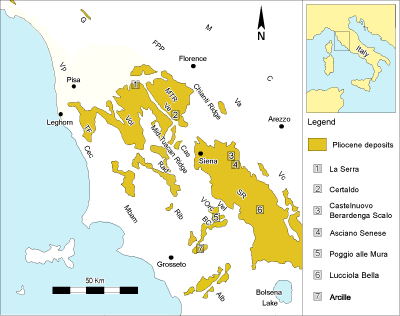
Our recent reappraisal of the palaeontological collections of the 'Gruppo AVIS Mineralogia e Paleontologia Scandicci' (= GAMPS; Scandicci, Florence Province, Italy), which are mostly comprised of marine vertebrate remains collected in the Tuscan countryside over the last few decades, has revealed the occurrence of several tetraodontid jaws from as many as seven Pliocene localities near Siena (Asciano Senese, Castelnuovo Berardenga Scalo, Lucciola Bella and Poggio alle Mura), Grosseto (Arcille), Pisa (La Serra) and Florence (Certaldo). These new specimens were collected from well-documented sites, thus differing from most of the historical finds from the 19th century, which typically lack precise geographic and stratigraphic whereabouts (e.g., Landini, 1977). These additions to the Italian Pliocene record of Tetraodontidae allow for a comprehensive understanding of the palaeoenvironmental significance of this record. Interpreting these finds from a conservation palaeobiology perspective (e.g., Dillon et al., 2022) further enables a new perspective on the 'Lessepsian invasion', that is, the ongoing dispersal of thermophilic marine-life forms entering the Mediterranean Basin from the Red Sea through the Suez Canal (e.g., Bernardi & Tiralongo , 2025; Weterings et al., 2026).
The fossil specimens described herein were discovered at seven localities
of the Siena-Radicofani, Val d'Orcia, Baccinello-Cinigiano and Valdelsa basins of Tuscany (Fig.
1  ). These basins are located in the hinterland of
the Northern Apennine orogen and are home to marine and terrestrial successions
of Miocene to Pleistocene age (e.g., Martini
& Sagri, 1993). The Pliocene portions of these successions mostly
consist of marine and paralic deposits that accumulated in semi-protected
embayments at the foot of the nearby mountain chain.
). These basins are located in the hinterland of
the Northern Apennine orogen and are home to marine and terrestrial successions
of Miocene to Pleistocene age (e.g., Martini
& Sagri, 1993). The Pliocene portions of these successions mostly
consist of marine and paralic deposits that accumulated in semi-protected
embayments at the foot of the nearby mountain chain.
The Lucciola Bella, Castelnuovo Berardenga Scalo and Asciano Senese localities of the Siena Province are placed within the Siena-Radicofani Basin (Benvenuti et al., 2014; Martini & Aldinucci, 2017). The Lucciola Bella area is characterised by badland-like exposures of Zanclean offshore mudstones punctuated by coarser-grained turbidites (Pascucci et al., 2006; Bianucci et al., 2009). Fossil vertebrate finds from this site include an incomplete skeleton of the extinct delphinid species Etruridelphis giulii (Lawley, 1876) (Bianucci et al., 2009), a dentary beak of an ocean sunfish (Collareta et al., 2025a) and abundant elasmobranch remains (Collareta et al., 2017b), among which are some teeth with trace fossils produced by the 'zombie worm', Osedax Rouse et al., 2004 (Collareta et al., 2025b). At Castelnuovo Berardenga Scalo, pufferfish remains were collected from upper Piacenzian mudstones exposed at the 'I Sodi' quarry (Martini et al., 2016). These mudstones were deposited in an outer shelf or upper slope setting and are home to a remarkable deep-water elasmobranch fossil assemblage, including an impressive abundance of teeth of the extinct frilled shark, Chlamydoselachus lawleyi Davis, 1887 (e.g., Cigala-Fulgosi et al., 2009; Collareta et al., 2018). Some 13 km SE of Castelnuovo Berardenga Scalo, in the vicinity of Asciano Senese, dermal denticles of the extinct bramble shark, Echinorhinus richiardii Lawley, 1876, have been collected from lithologically similar, roughly coeval deposits (Collareta et al., 2023a).
In the Val d'Orcia basin, near Montalcino (Siena Province), the Poggio alle Mura locality exposes Zanclean clayey-sandy deposits that have yielded a balaenopterid whale skeleton, as well as shark teeth and bony fish otoliths (Bisconti et al., 2023; Marini et al., 2023).
Lower Pliocene siliciclastic deposits occur at Arcille (Grosseto Province), close to the southwestern margin of the Baccinello-Cinigiano Basin (Sorbi et al., 2012). The local succession consists of yellowish sandstones with subordinate conglomerate layers overlain by greyish mudstones (Sorbi et al., 2012; Bianucci et al., 2019; Dominici & Forli, 2021). Vertebrate fossils from this site include the holotype and only referred specimen of the monodontid delphinoid Casatia thermophila Bianucci et al., 2019, the holotype and two referred specimens of the rajiform skate Nebriimimus wardi Collareta et al., 2021b, and several well-preserved specimens of sirenians, sharks and rays (Sorbi et al., 2012; Merella et al., 2022, 2023; Collareta et al., 2023b). Like so many other vertebrate fossils, the tetraodontid specimens discussed herein have been recovered from a fossil-rich interval of yellowish sandstones reflecting a shallow-marine setting influenced by fluvial inputs.
In the Valdelsa Basin, pufferfish fossils have been collected at Certaldo (Florence Province) and La Serra (Pisa Province). Strata belonging to the mid-Pliocene S3 synthem of Dominici et al. (2018) crop out along an artificial cliff near Certaldo, mostly consisting of sands and clayey sands. These strata have been home to finds of dental and dermal denticles of bony and cartilaginous fishes, including one of the few Mediterranean Pliocene records of Aetobatus cf. cappettai Antunes & Balbino, 2006 (Collareta et al., 2021a). At La Serra, a ca. 25-m-thick succession of late Piacenzian age (Dominici et al., 2018) crops out in an active quarry. This succession includes a paralic, mostly sandy lower division and a shallow-marine, mostly silty upper division (Garassino et al., 2012). Besides some remarkable finds of terrestrial and freshwater vertebrates originating from the base of the quarry (including tortoises, terrapins, cervids, suids and proboscideans; Collareta et al., 2020a; Merella et al., 2023; Mulè et al., 2025a, 2025b, 2026), this locality has yielded a small cartilaginous- and bony fish-assemblages from the upper quarry beds (Collareta et al., 2020b; Di Cencio et al., 2021; Merella et al., 2023).
|
|
Figure 1:
Simplified geological map of Tuscany. Numbers within
squares indicate the geographic position of the Tuscan localities where the new
pufferfish fossils described herein were collected. Abbreviations: Alb, Albegna Basin; BC, Baccinello-Cinigiano Basin; C, Casentino Basin;
Cec,
Cecina Basin; FPP, Firenze-Prato-Pistoia Basin; G, Garfagnana Basin; M, Mugello
Basin; Mbam, Montebamboli Basin; MTR, Montespertoli-Tavernelle Ridge; Rad,
Radicondoli Basin; Rib, Ribolla Basin; SR, Siena-Radicofani Basin; TF, Tora-Fine
Basin; Va, Upper Valdarno Basin; Vc, Valdichiana Basin; Ve, Valdelsa-Lower
Valdarno Basin; Vel, Velona Basin; Vol, Volterra Basin; VOrc, Val d'Orcia Basin.
Redrawn
from Benvenuti et al. (2014). |
The fossil specimens dealt with herein are currently housed at Badia a Settimo, Scandicci (Florence Province, Italy), in the GAMPS permanent exhibition. They consist of 18 beak-like jaws, including essentially complete as well as heavily worn fragments.
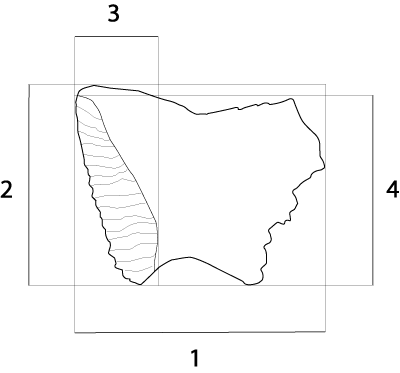
Whenever possible, the total anteroposterior length, total
dorsoventral height, anteroposterior length of symphysis and dorsoventral height
of symphysis were
measured with a manual caliper as shown in Figure 2 .
Photographs were taken using a Nikon D850 camera equipped with a Nikon Micro Nikkor AF-S 60 mm f/2.8 G ED macro-lens.
The studied specimens were attributed to either the upper or lower jaws based on comparisons with the descriptions and illustrations of extant tetraodontid beaks provided by Tyler (1980) and McEwan et al. (2024). Specifically, the upper-jaw parts (premaxillae) are characterised by a thick and robust posteromedial process, extensive interdigitating contacts with the corresponding maxilla, and a relatively elongate internal pulp cavity. Lower jaw parts (dentaries), in turn, are characterised by a deeply concave posterior articulation for the articular. The identification of some largely incomplete specimens as either premaxillae or dentaries remained tentative.
|
|
Figure 2:
Scheme
of the measurements referred to in the text. (1) Total anteroposterior length. (2) Total
dorsoventral height. (3) Anteroposterior length of symphysis. (4) Dorsoventral
height of symphysis. |
TETRAODONTIFORMES Regan, 1929
TETRAODONTIDAE Bonaparte, 1832
Tetraodontidae gen. et sp. indet.
Referred material and occurrence. Eighteen pufferfish jaws from the Tuscan Pliocene: GAMPS-1969a-c (three specimens) from Lucciola Bella; GAMPS-301a, GAMPS-301b and GAMPS-1966a-d (four specimens) from Castelnuovo Berardenga Scalo; GAMPS-1963 from Asciano Senese; GAMPS-1970a-d (four specimens) from Poggio alle Mura; GAMPS-1968 from Arcille; GAMPS-1965 from Certaldo; GAMPS-1964a and GAMPS-1964b from La Serra.
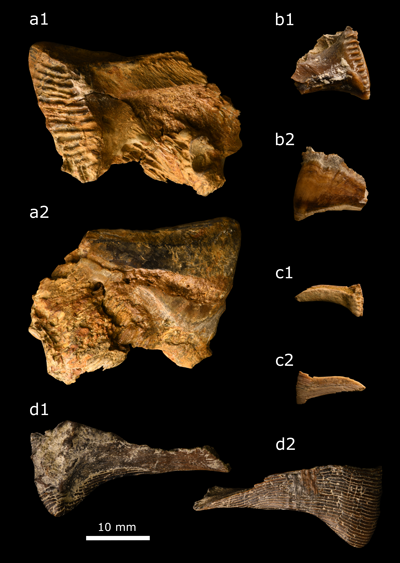
Description. The
most complete specimen in the GAMPS palaeontological collection is, arguably,
GAMPS-1964a (Fig. 3a1, a2 ), a right dentary from La
Serra. Its total
anteroposterior length and dorsoventral height are about 15 mm and 19 mm,
respectively. The symphysis is 4 mm long and 13 mm high and features 17
emarginations.
The rod-like dental units are partially exposed on the labial jaw surface, close
to the anterodorsal angle thereof. The well-preserved posterior margin is
somewhat jagged. GAMPS-1964b (Fig. 3b1, b2 ), from the same site as GAMPS-1964a,
is
also best interpreted as a right dentary. It measures 14 mm in length
and 10 mm in height. The symphysis is 3 mm long and 10 mm high and
comprises at least 13 emarginations.
As observed in GAMPS-1964a,
the dental units are partially exposed on the labial jaw surface, close to the
anterodorsal angle thereof. Other fairly well-preserved right dentaries include
GAMPS-1966a (Fig. 3c1, c2 ) and GAMPS-301b (Fig. 4a1, a2 ) from
Castelnuovo Berardenga Scalo. They are similar to each other in size and larger
than both GAMPS-1964a and GAMPS-1964b, exhibiting a symphysis that is 7 mm long
and 20 mm high and including as many as 15 emarginations. GAMPS-1970a from
Poggio alle Mura (Fig. 3d1, d2 ) is best interpreted as a left
dentary.
Its symphysis is 3 mm long and 14 mm high and comprises 16 emarginations.
Labially, the dental units are exposed close to the anterodorsal angle as well
as along the symphysis. The posterior articular margin is only partially
preserved. GAMPS-301a from Castelnuovo Berardenga Scalo (Fig.
4b1, b2 ) is
best interpreted as a left premaxilla. The symphysis is 2 mm long and 11 mm high
and features 11 well-preserved emarginations. Some dental units are exposed
along the whole of the biting edge.
Other specimens are more fragmentary as well as heavily worn. Among these
are GAMPS-1968
from Arcille
(Fig. 4c1, c2 ) and GAMPS-1966c (Fig.
4d1, d2 ) from Poggio alle
Mura, each consisting of a small jaw fragment preserving most of the biting edge.
Dental units of different lengths are broadly exposed on the labial jaw surface
of both these specimens.
Most of the above specimens exhibit a plate-like structure that projects
sub-horizontally along the lingual surface of the jaw. This morphology results
from the development of aligned trituration teeth posterior to the symphysis (Tyler,
1980) as seen e.g. in the highly
abraded specimen GAMPS-1966c (Fig. 4d1 ).
Remarks. The fossil specimens described herein closely match the distinctive oral apparatus of the family Tetraodontidae (Tyler, 1980). They cannot be identified confidently at the genus level because pufferfish beaks generally lack diagnostic features that would allow for such resolution (e.g., Tyler & Santini, 2002; Marsili, 2007).
In living tetraodontids, only a few dental units are typically left
uncovered on each jaw due to feeding-related wear (Tyler,
1980). That
said, some of the specimens described herein exhibit an unusually extensive
exposure of the dental units - a condition that typically correlates with
reduced completeness (e.g., Fig. 4c1, c2, d1, d2 ). This observation suggests that biostratinomic processes -
first and foremost, mechanical transport and abrasion - may have contributed to
the pronounced denudation of dental units observed in most fossils.
|
|
Figure 3:
New
pufferfish jaw fossils from the Tuscan Pliocene. (a1, a2) GAMPS-1964a from La
Serra. 2) GAMPS-1964b
from La Serra. (c1, c2) GAMPS-1966a from Castelnuovo Berardenga Scalo. (d1, d2) GAMPS-1970a from Poggio alle Mura.
Specimens are shown in (a1, b1, c1, d1) lingual and (a2, b2, c2, d2) labial
views. |
|
|
Figure 4:
New
pufferfish jaw fossils from the Tuscan Pliocene. (a1,
a2) GAMPS-301b from Castelnuovo Berardenga Scalo. (b1, b2) GAMPS-301a from
Castelnuovo Berardenga Scalo. (c1, c2) GAMPS-1968 from Arcille. (d1, d2)
GAMPS-1966c from Castelnuovo Berardenga Scalo. Specimens are shown in (a1, b1, c1, d1) lingual and
(a2, b2, c2, d1) labial views. |
Albeit fragmentary, the new tetraodontid fossils described herein expand the fossil record of these bony fishes in Italy as well as in the whole of the Mediterranean region. Their occurrence in multiple Pliocene embayments of Tuscany further supports earlier hypotheses, grounded on a more limited number of specimens, that pufferfishes were widespread along the Italian coasts during that time (Marsili, 2007). Moreover, the mere abundance of these finds suggests that tetraodontids were rather common off Tuscany in Pliocene times.
Until the late 19th century, only a single pufferfish species - namely, Lagocephalus lagocephalus Linnaeus, 1758 - was reliably known from the Mediterranean Sea, and even then, it was reported only rarely, first and foremost from Sicilian waters (Doderlein, 1878-1879; Bini, 1968; Tortonese, 1970; Relini & Orsi Relini, 1995; Zava et al., 2005). Over the past ~150 years, however, the diversity, geographic range and abundance of pufferfishes have increased dramatically in the Mediterranean Sea. Indeed, tetraodontids are just some of the many species that have entered the basin via the Strait of Gibraltar and, especially, the Suez Canal, progressively expanding northwards and becoming increasingly common along the Italian coastline and elsewhere in the region (e.g., Lipej et al., 2013). Thus, whereas pufferfish sightings were once rare and sporadic off Tuscany, they have become markedly more frequent in recent decades (e.g., Deidun et al., 2024). At present (2026), as many as nine different pufferfish species are known from the Mediterranean Sea, the majority of which represent recent 'Lessepsian' bioinvaders originating from the Red Sea (e.g., Por, 1971; Bilecenoglu et al., 2006; Bianchini & Ragonese, 2007; Orsi Relini, 2009; Farrag et al., 2016; Carbonara et al., 2017; Kovačić et al., 2021; Deidun et al., 2024). Impacting most components of the marine fauna (e.g., Orsi Relini, 2009; Zenetos, 2019), the Lessepsian invasion of the Mediterranean Basin reflects the latter's ongoing 'tropicalization'. Indeed, rising sea surface temperatures and shifting environmental conditions increasingly favour the establishment and spread of thermophilic species originating from warmer marine areas (Galil & Zenetos, 2002; Bernardi et al., 2010). The native Mediterranean ichthyofauna may, thus, be substantially reshaped through competition, predation or hybridization (Carey & Wahl, 2010; Christidis et al., 2024), which in turn would have major repercussions on fisheries and public health, not least because of the abundance of tetrodotoxin in several pufferfish species (Bentur et al., 2008; Guardone et al., 2018; Ulman et al., 2024).
Now, however, we may turn to the fossil record through the lens of conservation palaeobiology to envision how the Mediterranean fauna will respond to future warming. In recent years, some Pliocene intervals have come to be widely regarded as a meaningful analogue for near-future Mediterranean conditions, with sea-surface temperatures 2-3 °C above pre-industrial values, comparable atmospheric CO2 concentrations and significantly higher sea stands (e.g., Combourieu-Nebout et al., 2015; Prista et al., 2015; Guiot & Cramer, 2016; Vega et al., 2020). In marine settings, a warmer climate supported a markedly thermophilic fauna including, for instance, the knifetooth sawfish, Anoxypristis White & Moy-Thomas, 1941, and the pelagic eagle ray, Aetobatus Blainville, 1816, both of which are known from a few Mediterranean Pliocene sites, including outcrops in Tuscany (Collareta et al., 2017a, 2021a). Within this framework, our results indicate that pufferfishes were established components of the Mediterranean ecosystems at a time when warmer-than-today conditions proved welcoming to these and other thermophilic taxa. In this perspective, the fossil record highlights a scenario in which the modern Mediterranean could increasingly come to resemble its Pliocene counterpart, with pufferfishes and other warm-water fishes (e.g., the porcupinefishes of the tetraodontiform family Diodontidae; Zava et al., 2024) becoming ever more prominent components of its ichthyofauna.
Our gratitude goes to the anonymous journal reviewers for their constructive comments, which helped improve the quality and clarity of this manuscript.
Alfaro M.E., Santini F. & Brock C.D. (2007).- Do reefs drive diversification in marine teleosts? Evidence from the pufferfish and their allies (Order Tetraodontiformes).- Evolution, vol. 61, no. 9, p. 2104-2126.
Andreucci R.D., Britski H.A. & Carneiro J. (1982).- Structure and evolution of tetraodontoid teeth: An autoradiographic study (pisces, Tetraodontiformes).- Journal of Morphology, vol. 171, no. 3, p. 283-292.
Antunes M.T. & Balbino A.C. (2006).- Latest Miocene myliobatids (Batoidei, Selachii) from the Alvalade Basin, Portugal.- Cainozoic Research, Leiden, vol. 4, p. 41-49. URL: https://natuurtijdschriften.nl/pub/541715
Bentur Y., Ashkar J., Lurie Y., Levy Y., Azzam Z.S., Litmanovich M., Golik M., Gurevych B., Golani D. & Eisenman A. (2008).- Lessepsian migration and tetrodotoxin poisoning due to Lagocephalus sceleratus in the eastern Mediterranean.- Toxicon, vol. 52, no. 8, p. 964-968.
Benvenuti M., Del Conte S., Scarselli N. & Dominici S. (2014).- Hinterland basin development and infilling through tectonic and eustatic processes: Latest Messinian-Gelasian Valdelsa Basin, Northern Apennines, Italy.- Basin Research, vol. 26, no. 3, p. 387-402.
Bernardi G., Golani D. & Azzurro E. (2010).- Chapter 4. The genetics of Lessepsian bioinvasions. In: Golani D. & Appelbaum-Golani B. (eds.), Fish invasions of the Mediterranean Sea: Change and renewal.- Pensoft Publishers, Sofia, p. 71-84.
Bernardi J. & Tiralongo F. (2025).- Northernmost Mediterranean record of Lagocephalus cf. spadiceus (Actinopterygii: Tetraodontidae) from the Venice lagoon (Adriatic Sea).- Thalassas, Vigo, vol. 41, article 237, 5 p.
Bianchini M.L. & Ragonese S. (2007).- Presenze di specie ittiche esotiche come possibili indicatori di cambiamenti climatici: Il caso dello Stretto di Sicilia. In: Carli B., Cavarretta G., Colacino M. & Fuzzi S. (eds.), Clima e cambiamenti climatici: Le attività di ricerca del CNR.- CNR, Rome, p. 513-516.
Bianucci G., Pesci F., Collareta A. & Tinelli C. (2019).- A new Monodontidae (Cetacea, Delphinoidea) from the lower Pliocene of Italy supports a warm-water origin for narwhals and white whales.- Journal of Vertebrate Paleontology, vol. 39, no. 3, article e1645148, 10 p.
Bianucci G., Vaiani S.C. & Casati S. (2009).- A new delphinid record (Odontoceti, Cetacea) from the Early Pliocene of Tuscany (Central Italy): Systematics and biostratigraphic considerations.- Neues Jahrbuch fur Geologie und Palaontologie - Abhandlungen, Band 254, Heft 3, p. 275-292.
Bilecenoglu M., Kaya M. & Akalin S. (2006).- 14. Range expansion of silverstripe blaasop, Lagocephalus sceleratus (Gmelin, 1789), to the northern Aegean Sea.- Aquatic Invasions, vol. 1, no. 4, p. 289-291. DOI: 10.3391/ai.2006.1.4.14
Bini G. (1968).- Atlante dei pesci delle coste italiane, vol. VIII.- Mondo Sommerso Ed., Rome, 164 p.
Bisconti M., Scotton R., Santagati P., Foresi L. M., Ragaini L., Tartarelli G., Carnevale G., Buckeridge J., Koening E., Tabolli J., Nannini P. & Tarantini M. (2023).- A whale in a vineyard: Palaeontological preparation and education during the 'Brunella' Project, a large-scale conservation effort focused on a Pliocene whale in southern Tuscany, Italy.- Geoheritage, vol. 15, article 1, 19 p.
Blainville H.M. de (1816).- Prodrome d'une nouvelle distribution systématique du règne animal.- Bulletin des Sciences par la Société Philomathique de Paris, Paris, vol. 8, p. 121-124.
Bonaparte C.L. (1832).- Saggio d'una distribuzione metodica degli animali vertebrati a sangue freddo.- Presso Antonio Boulzaler, Rome, 86 p. URL: http://resolver.sub.uni-goettingen.de/purl?PPN641587295
Britski H.A., Andreucci R.D., Menezes N.A. & Carneiro J. (1985).- Coalescence of teeth in fishes.- Revista Brasileira de Zoologia, São Paulo, vol. 2, no. 8, p. 459-484. DOI: 10.1590/S0101-81751984000400001
Capellini G. (1876).- L'uomo pliocenico in Toscana.- Accademia Nazionale dei Lincei, Tipi del Salviucci, Rome, p. 1-7. URL: https://bibliotecadigitale.regione.liguria.it/id/MAZZM08110801
Carbonara P., Kolitari J., Đurović M., Gaudio P., Ikica Z., Kroqi G., Milone N. & Spedicato M.T. (2017).- The presence of Tetraodontidae species in the Central Mediterranean: An update from the southern Adriatic Sea.- Acta Adriatica, Split, vol. 58, no. 2, p. 325-338. DOI: 10.32582/aa.58.2.11
Carey M.P. & Wahl D.H. (2010).- Native fish diversity alters the effects of an invasive species on food webs.- Ecology, vol. 91, no. 10, p. 2965-2974.
Carnevale G., Giusberti L., Dominici S., Papazzoni C. A., Roghi G., Marramà G., Calzoni P., Serafini G. & Zorzin R. (2026).- The Bolca Lagerstätten: a one-day palaeontological field trip into the Eocene tropical marine life of the western Tethys.- Geological Field Trips and Maps, Rome, vol. 18, p. 1-81.
Carnevale G. & Santini F. (2006).- †Archaeotetraodon cerrinaferoni, sp. nov. (Teleostei: Tetraodontidae), from the Miocene (Messinian) of Chelif Basin, Algeria.- Journal of Vertebrate Paleontology, vol. 26, no. 4, p. 815-821.
Carnevale G. & Tyler J.C. (2010).- Review of the fossil pufferfish genus Archaeotetraodon (Teleostei, Tetraodontidae), with description of three new taxa from the Miocene of Italy.- Geobios, Villeurbanne, vol. 43, no. 3, p. 283-304.
Carnevale G. & Tyler J.C. (2015).- A new pufferfish (Teleostei, Tetraodontidae) from the Middle Miocene of St. Margarethen, Austria.- Paläontologische Zeitschrift, vol. 89, p. 435-447.
Carraroli A. (1897).- Avanzi di pesci fossili pliocenici del Parmense e del Piacentino.- Rivista Italiana di Paleontologia e Stratigrafia, Milano, Anno III, fasc. III-IV, p. 23-28. URL: http://www.biodiversitylibrary.org/page/14484962
Christidis, G., Batziakas S., Peristeraki P., Tzanatos E., Somarakis S. & Tserpes G. (2024).- Another one bites the net: Assessing the economic impacts of Lagocephalus sceleratus on small-scale fisheries in Greece.- Fishes, Basel, vol. 9, no. 3, article 104, 19 p. DOI: 10.3390/fishes9030104
Cigala Fulgosi F., Casati S., Orlandini A. & Persico D. (2009).- A small fossil fish fauna, rich in Chlamydoselachus teeth, from the Late Pliocene of Tuscany (Siena, central Italy).- Cainozoic Research, Leiden, vol. 6, no. 1, p. 3-23. URL: https://natuurtijdschriften.nl/pub/541734
Collareta A., Casati S. & Di Cencio A. (2018).- The porbeagle shark, Lamna nasus (Elasmobranchii: Lamniformes), from the late Pliocene of the central Mediterranean Basin.- Neues Jahrbuch für Geologie und Paläontologie - Abhandlungen, Band 287, Heft 3, p. 307-316.
Collareta A., Casati S., Catanzariti R. & Di Cencio A. (2017a).- First record of the knifetooth sawfish Anoxypristis (Elasmobranchii: Rhinopristiformes) from the Pliocene of Tuscany (central Italy).- Neues Jahrbuch für Geologie und Paläontologie - Abhandlungen, Band 284, Heft 3, p. 289-297.
Collareta A., Casati S. & Di Cencio A. (2017b).- A pristid sawfish from the lower Pliocene of Lucciolabella (Radicofani basin, Tuscany, central Italy).- Atti della Società Toscana di Scienze Naturali, Memorie (Serie A), Pisa, vol. CXXIV, p. 49-55. DOI: 10.2424/ASTSN.M.2017.18
Collareta A., Casati S., Mulè F., Farina S. & Di Cencio A. (2023a).- Re-discovery of bramble shark dermal denticles in the marine Pliocene of Italy.- Neues Jahrbuch für Geologie und Paläontologie - Abhandlungen, Band 310, Heft 1,, p. 25-32.
Collareta A., Casati S., Mulè F., Pieri A., Di Cencio A. & Bianucci G. (2025a).- A fossil mola from the Mediterranean Pliocene.- Neues Jahrbuch für Geologie und Paläontologie - Abhandlungen, Band 313, Heft 3, p. 341-351.
Collareta A., Casati S., Zuffi M.A.L. & Di Cencio A. (2020a).- First authentic record of the freshwater turtle Mauremys from the Upper Pliocene of Italy, with a new occurrence of the rarely reported ichnotaxon Thatchtelithichnus holmani.- Carnets Geol., Madrid, vol. 20, no. 16, p. 301-313. DOI: 10.2110/carnets.2020.2016
Collareta A., Merella M., Casati S., Coletti G. & Di Cencio A. (2021b).- Another thermophilic "Miocene survivor" from the Italian Pliocene: A geologically young occurrence of the pelagic eagle ray Aetobatus in the Euro-Mediterranean region.- Carnets Geol., Madrid, vol. 21, no. 10, p. 203-214. DOI: 10.2110/carnets.2021.2110
Collareta A., Merella M., Casati S. & Di Cencio A. (2020b).- Did titanic stingrays wander the Pliocene Mediterranean Sea? Some notes on a giant-sized myliobatoid stinger from the Piacenzian of Italy.- Neues Jahrbuch für Geologie und Paläontologie - Abhandlungen, Band 298, Heft 2, p. 155-164.
Collareta A., Merella M., Casati S., Di Cencio A., Tinelli C. & Bianucci G. (2023b).- Polyplacophoran feeding traces on Mediterranean Pliocene sirenian bones: Insights on the role of grazing bioeroders in shallow-marine vertebrate falls.- Life, Basel, vol. 13, no. 2, article 327, 15 p. DOI: 10.3390/life13020327
Collareta A., Mezzasalma O., Agresti J., Barucci A., Bosio G., Mulè F., Casati S., Di Cencio A., Bianucci G., Pieri A. & Nobile F. (2025b).- Trace fossil evidence for Osedax Rouse et al., 2004 exploiting shark tooth dentine on a Pliocene seafloor: Broadening our understanding of a major taphonomic agent.- Fossil Record, vol. 28, no. 2, p. 359-375.
Collareta A., Mollen F.H., Merella M., Casati S. & Di Cencio A. (2021a).- Remarkable multicuspid teeth in a new elusive skate (Chondrichthyes, Rajiformes) from the Mediterranean Pliocene.- PalZ - Paläontologische Zeitschrift, vol. 95, p. 117-128. DOI: 10.1007/s12542-020-00542-7
Combourieu-Nebout N., Bertini A., Russo-Ermolli E., Peyron O., Klotz S., Montade V., Fauquette S., Allen J., Fusco F., Goring S., Huntlay B., Joannin S., Lebreton V., Magri D., Martinetto E., Orain R. & Sadori L. (2015).- Climate changes in the central Mediterranean and Italian vegetation dynamics since the Pliocene.- Review of Palaeobotany and Palynology, vol. 218, p. 127-147.
Davis J.W. (1887).- Note on a fossil species of Chlamydoselachus.- Proceedings of the Scientific Meetings of the Zoological Society of London, p. 542-544.
Deidun A., Corsini-Foka M., Marrone A., Galdies J., Zava B., Crobe V. & Tinti F. (2024).- Yet another non-indigenous fish from Maltese waters, central Mediterranean: A first record of Lagocephalus guentheri Miranda Ribeiro, 1915 (Tetraodontiformes, Tetraodontidae).- BioInvasions Records, Helsinki, vol. 13, no. 3, p. 777-786.
Di Cencio A., Dulai A., Catanzariti R., Casati S. & Collareta A. (2021).- First record of the brachiopod Lingula? From the Pliocene of Tuscany (Italy): The youngest occurrence of lingulides in the Mediterranean Basin.- Neues Jahrbuch für Geologie und Paläontologie - Abhandlungen, Stuttgart, Band 299 Heft 3, p. 237-249.
Dillon E.M., Pier J.Q., Smith J.A., Raja N.B., Dimitrijević D., Austin E.L., Cybulski J.D., Entrambasaguas J. de, Durham S.R. & Grether C. (2022).- What is conservation paleobiology? Tracking 20 years of research and development.- Frontiers in Ecology and Evolution, Lausanne, vol. 10, article 1031483, 24 p. DOI: 10.3389/fevo.2022.1031483
Döderlein P. (1878-1879).- Prospetto metodico delle varie specie di pesci riscontrate sin'ora nelle acque marine e fluviali della Sicilia.- Palermo, Tipografia del Giornale di Sicilia.- Atti della Accademia di Scienze, Lettere e Arti di Palermo (n.s.), vol. VI, p. 25-63. URL: http://www.biodiversitylibrary.org/page/33013921
Dominici S., Danise S. & Benvenuti M. (2018).- Pliocene stratigraphic paleobiology in Tuscany and the fossil record of marine megafauna.- Earth-Science Reviews, vol. 176, p. 277-310.
Dominici S. & Forli M. (2021).- Lower Pliocene molluscs from southern Tuscany (Italy).- Bollettino della Società Paleontologica Italiana, Modena, vol. 60, no. 1, p. 69-98.
Farrag M., El-Haweet A., Akel E.-S. & Moustafa M. (2016).- Occurrence of puffer fishes (Tetraodontidae) in the Eastern Mediterranean, Egyptian coast - Filling in the gap.- BioInvasions Records, Helsinki, vol. 5, no. 1, p. 47-54.
Froese R. & Pauly D. (2026).- FishBase (version 06/2026).- URL: https://www.fishbase.org
Galil B.S. & Zenetos A. (2002).- A sea change - Exotics in the Eastern Mediterranean Sea. In: Leppäkoski E., Gollasch S. & Olenin S. (eds.), Invasive aquatic species of Europe. Distribution, impacts and management.- Springer Dordrecht, p. 325-336.
Garassino A., Pasini G., De Angeli A., Charbonnier S., Famiani F., Baldanza A. & Bizzarri R. (2012).- The decapod community from the Early Pliocene (Zanclean) of "La Serra" quarry (San Miniato, Pisa, Toscana, central Italy): Sedimentology, systematics, and palaeoenvironmental implications.- Annales de Paléontologie, Paris, vol. 98, no. 1, p. 1-61.
Guardone L., Gasperetti L., Maneschi A., Ricci E., Susini F., Guidi A. & Armani A. (2018).- Toxic invasive pufferfish (Tetraodontidae family) along Italian coasts: Assessment of an emerging public health risk.- Food Control, vol. 91, p. 330-338.
Guiot J. & Cramer W. (2016).- Climate change: The 2015 Paris Agreement thresholds and Mediterranean basin ecosystems.- Science, vol. 354, no. 6311, p. 465-468.
Kodama M., Sato S., Ogata T., Suzuki Y., Kaneko T. & Aida K. (1985).- Tetrodotoxin secreting glands in the skin of puffer fishes.- Toxicon, vol. 24, no. 8, p. 819-829.
Kovačić M., Lipej L., Dulčić J., Iglesias S.P. & Goren M. (2021).- Evidence-based checklist of the Mediterranean Sea fishes.- Zootaxa, Auckland, vol. 4998, no. 1, p. 1-115.
Landini W. (1977).- Revisione degli "Ittiodontoliti pliocenici" della collezione Lawley.-Palaeontographia Italica, Pisa, vol. 70, p. 92-134.
Lawley R. (1876).- Nuovi studi sopra ai pesci ed altri vertebrati fossili delle Colline Toscane.- Tipografia dell'Arte della Stampa, Firenze, 122 p. (55 Pls.). URL: http://resolver.sub.uni-goettingen.de/purl?PPN623750546
Linnaeus C. von (1758).- Systema Naturae sive Regna Tria Naturae, secundum Classes, Ordines, Genera, Species, cum characteribus, differentiis, synonymis, locis, Tomus I. Editio decima, reformata.- Stockholm, 824 p.
Lipej L., Mavric B. & Paliska D. (2013).- New northernmost record of the blunthead pufferfish, Sphoeroides pachygaster (Osteichthyes: Tetraodontidae) in the Mediterranean Sea.- Annales - Series Historia Naturalis, Ljubljana, letnik 23, številka 2, p. 103-114. URL: https://www.dlib.si/details/URN:NBN:SI:DOC-RMDLCD84
Marini M., Foresi L.M., Barbagallo V., Bisconti M., Di Stefano A., Muttoni G. & Martini I. (2023).- Age and depositional environment of whale-bearing sedimentary succession from the Lower Pliocene of Tuscany (Italy): Insights from palaeomagnetism, calcareous microfossils and facies analyses.- Journal of Marine Science and Engineering, Basel, vol. 11, no. 2, article 455, 23 p. DOI: 10.3390/jmse11020455
Marsili S. (2007).- Analisi sistematica, paleoecologica e paleobiogeografica della selaciofauna plio-pleistocenica del Mediterraneo.- Ph.D. Dissertation (2006), Università di Pisa, 246 p. (16 Pls.).
Martini I. & Aldinucci M. (2017).- Sedimentation and basin-fill history of the Pliocene succession exposed in the northern Siena-Radicofani Basin (Tuscany, Italy): A sequence-stratigraphic approach.- Rivista Italiana di Paleontologia e Stratigrafia, Milano, vol. 123, no. 3, p. 407-432. URL: https://riviste.unimi.it/index.php/RIPS/article/view/9017
Martini I., Foresi L.M., Bambini A.M., Riforgiato F., Ambrosetti E. & Sandrelli F. (2016).- Calcareous plankton bio-chronostratigraphy and sedimentology of the "I Sodi" section (Siena Basin, Italy): A key section for the uppermost Neogene marine deposition in the inner northern Apennines.- Italian Journal of Geosciences, Rome, vol. 135, no. 3, p. 540-547.
Martini I.P. & Sagri M. (1993).- Tectono-sedimentary characteristics of Late Miocene-Quaternary extensional basins of the Northern Apennines, Italy.- Earth-Science Reviews, vol. 34, no. 3, p. 197-233.
McEwan B., Emery K.F., Quitmyer I. R., Wing E.S., Scudder S., Born Drake D. & Odorizzi T. (2024).- Pictorial skeletal atlas of fishes.- Florida Museum of Natural History, Gainesville - FL. URL: https://www.floridamuseum.ufl.edu/fishatlas/default.html
Merella M., Collareta A., Casati S., Di Cencio A. & Bianucci G. (2023).- Pliocene geotourism: Innovative projects for valorizing the paleontological heritage of three different-staged quarries of Tuscany (Central Italy).- Geoheritage, Heidelberg, vol. 15, article 82, 17 p. DOI: 10.1007/s12371-023-00838-5
Merella M., Collareta A., Granata V., Casati S. & Bianucci G. (2022).- New remains of Casatia thermophila (Cetacea, Monodontidae) from the lower Pliocene marine vertebrate-bearing locality of Arcille (Tuscany, Italy).- Rivista Italiana di Paleontologia e Stratigrafia, Milano, vol. 128, no. 1, p. 229-240. URL: https://riviste.unimi.it/index.php/RIPS/article/view/15459
Mulè F., Casati S., Bonfigli L., Di Cencio A. & Collareta A. (2025a).- Terrapin aches and pains: parasite borings and other bone modifications in an Italian Pliocene population of Mauremys (Testudines, Geoemydidae).- Carnets Geol., Madrid, vol. 25, no. 13, p. 265-281. DOI: 10.2110/carnets.2025.2513
Mulè F., Casati S., Bonfigli L., Di Cencio A. & Collareta A. (2025b).- First unambiguous record of the tortoise genus Testudo from the Italian Pliocene.- Neues Jahrbuch für Geologie und Paläontologie - Abhandlungen, Band 316, Heft 1, p. 87-101.
Mulè F., Godfrey S.J.S., Pandolfi L., Bianucci G., Bosio G., Bonfigli L., Casati S., Di Cencio A. & Collareta A. (2026).- Episkeletozoan shadowing: A largely uninvestigated taphonomic effect of barnacle encrustation of vertebrate bones.- PalZ - Paläontologische Zeitschrift, vol. 100, article 815, 15 p.
Nelson J.S., Grande T.C. & Wilson M.V. (2016).- Fishes of the World.- John Wiley and Sons Inc., Hoboken - NJ, 707 p.
Orsi Relini L. (2009).- Non native marine fish in Italian waters. In: Golani D. & Appelbaum-Golani B. (eds.), Fish invasions of the Mediterranean Sea: Change and renewal.- Pensoft Publishers, Sofia, p. 267-292.
Pascucci V., Costantini A., Martini I.P. & Dringoli R. (2006).- Tectono-sedimentary analysis of a complex, extensional, Neogene basin formed on thrust-faulted, Northern Apennines hinterland: Radicofani Basin, Italy.- Sedimentary Geology, vol. 183, nos. 1-2, p. 71-97.
Por F.D. (1971).- One hundred years of Suez Canal - a century of Lessepsian migration: Retrospect and viewpoints.- Systematic Zoology, Oxford, vol. 20, no. 2, p. 138-159.
Prista G., Agostinho R.J. & Cachão M.A. (2015).- Observing the past to better understand the future: A synthesis of the Neogene climate in Europe and its perspectives on present climate change.- Open Geosciences, vol. 7, no. 1, p. 65-83. DOI 10.1515/geo-2015-0007
Regan C.T. (1929).- Fishes.- Encyclopedia Britannica (14th ed.), Heterosomata, vol. IX, p. 305-329.
Relini M. & Orsi Relini O. (1995).- Pesci palla in Mediterraneo, presenze antiche e recenti.- Biologia Marina Mediterranea, Genoa, vol. 2, no. 2, p. 509-511.
Ridolfi L., Marramà G., Tyler J.C. & Carnevale G. (2025).- A new fossil clarifies the anatomy and phylogenetic relationships of the Eocene gymnodont fish †Zignoichthys oblongus (Zigno, 1874).- Rivista Italiana di Paleontologia e Stratigrafia, Milano, vol. 131, p. 117-138. DOI: 10.54103/2039-4942/23409
Rouse G.W., Goffredi S.K. & Vrijenhoek R.C. (2004).- Osedax: Bone-eating marine worms with dwarf males.- Science, Washington, vol. 305, p. 668-671.
Santini F., Nguyen M.T., Sorenson L., Waltzek T.B., Lynch Alfaro J.W., Eastman J.M. & Alfaro M.E. (2013).- Do habitat shifts drive diversification in teleost fishes? An example from the pufferfishes (Tetraodontidae).- Journal of Evolutionary Biology, vol. 26, p. 1003-1018. DOI: 10.1111/jeb.12112
Sorbi S., Domning D.P., Vaiani S.C. & Bianucci G. (2012).- Metaxytherium subapenninum (Bruno, 1839) (Mammalia, Dugongidae), the latest sirenian of the Mediterranean Basin.- Journal of Vertebrate Paleontology, vol. 32, no. 3, p. 686-707.
Stefano G. de (1910).- Osservazioni sulla ittiofauna pliocenica di Orciano e San Quirico in Toscana.- Bollettino della Società Geologica Italiana, Rome, vol. 28, p. 539-648.
Stump E., Ralph G.M., Comeros-Raynal M.T., Matsuura K. & Carpenter K.E. (2018).- Global conservation status of marine pufferfishes (Tetraodontiformes: Tetraodontidae).- Global Ecology and Conservation, vol. 14, article e00388, 12 p.
Thiery A.P., Shono T., Kurokawa D., Britz R., Johanson Z. & Fraser G.J. (2017).- Spatially restricted dental regeneration drives pufferfish beak development.- Proceedings of the National Academy of Sciences, vol. 114, no. 22, p. E4425-E4434. DOI: 10.1073/pnas.1702909114
Tortonese E. (1970).- Fauna d'Italia. Osteichthyes (Pesci Ossei). Parte Prima.- Ed. Calderini, Bologna, 565 p.
Tyler J.C. (1980).- Osteology, phylogeny, and higher classification of the fishes of the order Plectognathi (Tetraodontiformes).- NOAA Technical Report NMFS Circular, vol. 434, 422 p. URL: http://www.biodiversitylibrary.org/page/41180086
Tyler J.C. & Bannikov A.F. (2012).- A new species of puffer fish, Eotetraodon tavernei, from the Eocene of Monte Bolca, Italy (Tetraodontidae, Tetraodontiformes).- Studi e Ricerche sui Giacimenti Terziari di Bolca, Verona, vol. XIV, p. 51-58. URL: https://museodistorianaturale.comune.verona.it/media/_Musei/_StoriaNaturale/_Allegati/Eotetraodon-5.pdf
Tyler J.C. & Santini F. (2002).- Review and reconstruction of the tetraodontiform fishes from the Eocene of Monte Bolca, Italy, with comment on related Tertiary taxa.- Studi e Ricerche sui Giacimenti Terziari di Bolca, Verona, vol. IX, p. 47-119.
Ulman A., Abd Rabou A.F.N., Al Mabruk S., Bariche M., Bilecenoğlu M., Demirel N., Galil B.S., Hüseyinoğlu M.F., Jimenez C., Hadjioannou L., Kosker A.R., Peristeraki P., Saad A., Samaha Z., Stoumboudi M.Th., Temraz T.A. & Karachle P.K. (2024).- Assessment of human health impacts from invasive pufferfish (attacks, poisonings and fatalities) across the Eastern Mediterranean.- Biology, Basel, vol. 13, no. 4, article 208, 19 p. DOI: 10.3390/biology13040208
Vega E. de la, Chalk T.B., Wilson P.A., Bysani R.P. & Foster G.L. (2020).- Atmospheric CO2 during the Mid-Piacenzian Warm Period and the M2 glaciation.- Scientific Reports, London, vol. 10, article 11002, 8 p. DOI: 10.1038/s41598-020-67154-8
Wainwright P.C. & Turingan R.G. (1997).- Evolution of pufferfish inflation behavior.- Evolution, Oxford, vol. 51, no. 2, p. 506-518.
Weterings R., Roodenburg A., Vries R.E. de, Sneekes T. & Cornwell T.O. (2026).- Climate-driven range expansion of the invasive silver-cheeked toadfish (Lagocephalus sceleratus Gmelin, 1789) in the Mediterranean: Modelling habitat suitability.- Mediterranean Marine Science, Athens, vol. 27, no. 1, p. 83-94. DOI: 10.12681/mms.42200
White E.I. & Moy-Thomas J.A. (1941).- XXV. Notes on the nomenclature of fossil fishes. Part III. Homonyms M-Z.- Annals and Magazine of Natural History (Series 11), London, vol. 7, no. 40, p. 395-400.
Zava B., Corsini-Foka M., Scannella D., Insacco G., Deidun A., Crobe V. & Tinti F. (2024).- Chilomycterus reticulatus (Actinopterygii: Tetraodontiformes: Diodontidae) in the southern Sicilian waters, central Mediterranean Sea.- Acta Ichthyologica et Piscatoria, Sofia, vol. 54, p. 157-163.
Zava B., D'Anna G., Giordano D., Giusto G.B., Monteverde G., Pipitone C. & Fiorentino F. (2005).- Note biologiche su Lagocephalus lagocephalus (L., 1758) (Osteichthyes-Tetraodontidae) delle acque siciliane.- Biologia Marina Mediterranea, Genoa, vol. 12, p. 614-617.
Zenetos A. (2019).- Mediterranean Sea: 30 years of biological invasions (1988-2017). In: Langar H. & Ouerghi A. (eds.), Proceedings of the 1st Mediterranean Symposium on the Non-Indigenous Species (Antalya, Turkey, 17-18 January 2019).- Centre d'Activités Régionales pour les Aires Spécialement Protégées, Tunis, p. 13-19.
Zigno A. de (1887).- Nuove Aggiunte alla Ittiofauna dell'Epoca Eocena del Veneto.- Memorie dell'Istituto Veneto di Scienze, Lettere ed Arti, Venice, vol. 23, p. 1-24.