◄ Carnets Geol. 26 (13) ►
Outline:
[1. Introduction]
[2. Geological setting]
[3. Material and methods]
[4. Systematic paleontology]
[5. Conclusions] and ...
[Bibliographic references]
Natural History Department, Brukenthal National Museum,
Natural History Museum, Sibiu (Romania);
Research Center for Integrated Geological Studies, Babes-Bolyai University,
Cluj-Napoca (Romania)
Published online in final form (pdf) on August 8, 2026
DOI 10.2110/carnets.2026.2613

[Editor:
Alberto Collareta; language editor: Brian Pratt; technical editor: Bruno
R.C. Granier]

This study provides the first record of the genus Anoxypristis in Romania and in the whole of southeastern Europe based on two isolated rostral spines discovered in Priabonian deposits of the Transylvanian Basin. Assessment of the validity of previously described Paleogene species of Pristidae emphasizes the need for more rigorous taxonomic criteria based on more than isolated rostral spines. The paleoecological implications of the Romanian Anoxypristis specimens, considering the habitat preferences of the extant species and the depositional environments represented by the fossiliferous strata, point to a coastal or estuarine setting.
• Pristidae;
• sawfish;
• Priabonian;
• Eocene;
• Transylvanian Basin
Trif N. (2026).- On the first occurrence of Anoxypristis (Pristidae, Elasmobranchii) in the Paleogene of Romania and southeastern Europe.- Carnets Geol., Madrid, vol. 26, no. 13, p. 317-326. DOI: 10.2110/carnets.2026.2613
Sur la première occurrence d'Anoxypristis (Pristidae, Elasmobranchii) dans le Paléogène de Roumanie et d'Europe du Sud-Est.- Cette étude, fondée sur la découverte de deux épines rostrales isolées dans des dépôts priaboniens du bassin de Transylvanie, constitue le premier signalement du genre Anoxypristis en Roumanie et en Europe du Sud-Est. L'évaluation de la validité des espèces de Pristidae du Paléogène décrites antérieurement met en évidence la nécessité de critères taxonomiques plus rigoureux, reposant sur davantage que de simples épines rostrales isolées. Les implications paléoécologiques des spécimens roumains d'Anoxypristis, en tenant compte des préférences d'habitat des espèces actuelles et des environnements de dépôt représentés dans les couches fossilifères, suggèrent un milieu côtier ou estuarien.
• Pristidae ;
• poissons-scies ;
• Priabonien ;
• Éocène ;
• bassin de Transylvanie
The paleoichthyological record has been historically underrepresented in Romania, with isolated teeth being often reduced to rare mentions in faunal lists or simply categorized as 'fish teeth.' Even in the extensively studied northwestern region of the Transylvanian Basin (see Trif & Codrea, 2018, for a comprehensive review of prior research), ichthyolith occurrences have been rarely documented. This study provides the first record of Anoxypristis, a cartilaginous fish genus previously unknown from Romania, based on two isolated rostral spines. A very fragmentary fossil record of Elasmobranchii exists across a broad geographic area, stretching from Croatia to Greece and from Turkey to Bulgaria. The understanding of the Eocene elasmobranch assemblages has recently improved based on work conducted in Hungary and Ukraine (see Kovalchuk et al., 2023; Szabó, 2024), but Anoxypristis was until now unknown from this entire region.
The fossils discussed herein were collected from the northwestern part
of the Transylvanian Basin. The Transylvanian Basin represents an Upper
Cretaceous to Neogene sedimentary basin developed on top of a sequence of
Paleozoic crystalline schist, ophiolites, volcanic deposits and sedimentary
rocks spanning the Triassic to the mid-Cretaceous (Ciupagea et
al., 1970; Săndulescu & Visarion,
1978; Paraschiv, 1979; Krezsek & Bally,
2006). The stratigraphic architecture
of the basin comprises four distinct tectonic and stratigraphic megasequences
that date to the Late Cretaceous, Paleogene, Early Miocene, and Middle to Late
Miocene, respectively (Krezsek & Bally,
2006). The specimens
investigated were recovered from deposits belonging to the Paleogene
megasequence. These deposits, located in northwestern Transylvania, display
remarkable lateral facies variations, hence the delimitation of three
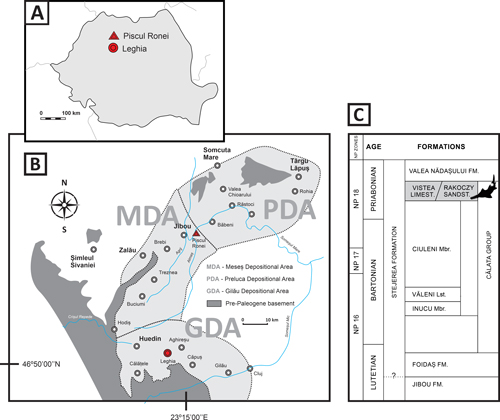
depositional areas, namely, Gilău, Preluca and Meseș (Fig.
1.A-B  ). The Anoxypristis
spines were derived from two localities in the Gilau and Meseș depositional
areas.
). The Anoxypristis
spines were derived from two localities in the Gilau and Meseș depositional
areas.
|
Figure 1:
A-B) Location of the study sites in Romania (A) and in the depositional areas
of the northwestern Transylvanian Basin (B). C) Simplified lithostratigraphic
log of the Eocene deposits of the northwestern Transylvanian Basin [abbreviations:
FM.=Formation, Mbr.=Member, Lst.=limestone; panel 1B after Popescu
(1984), simplified]. |
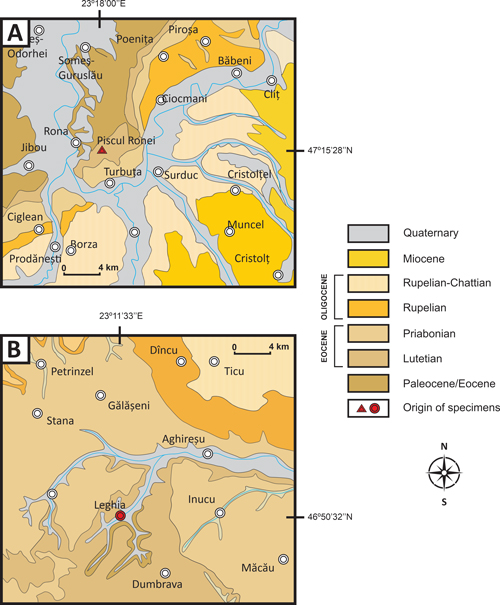
Piscul Ronei (Turbuța): The Turbuța
locality (Fig. 2.A ) occurs within the Meseș depositional area. A prominent
topographic feature, the Piscul Ronei is a 919-m-high peak sculpted by the
erosion of a Paleogene monoclinal structure that dominates the landscape of the
Turbuța-Jibou region. Here, the stratigraphic succession encompasses
Paleocene to Eocene units, with minor occurrences of Pleistocene deposits. The
following units are present at Piscul Ronei, in ascending stratigraphic order:
the Jibou Formation (including the Rona Member of Thanetian-?Sparnacian age and
the "upper red member" of Paleocene-Lutetian age), the Foidaș
Formation (Lutetian), the Călata Group (including the lower
Lutetian-Bartonian Căpuș Formation and the lower Priabonian
Racoți Sandstone) and the Turbuța Formation (middle Priabonian) (Petrescu
et al., 1975; Mészáros,
2000;
Codrea & Săsăran,
2002). The Turea Group,
represented by the Cluj Limestone (upper Priabonian), only crops out in the
southern sector of Piscul Ronei.
A single Anoxypristis sp. rostral spine (BBUPSM 24018) was recovered from the Racoți Sandstone, alongside unidentified chelonian remains. The Racoți Sandstone (appearing in some publications under the alternative name of Rakoczy Sandstone) is a calcareous sandstone exhibiting a gradual increase in quartz content from south (Treznea region) to north (Turbuța), ultimately transitioning into a quartz sandstone (Popescu, 1984).
Leghia: The Leghia locality (Fig. 2.B )
is found approximately 45 kilometers northwest of Cluj-Napoca, in the Gilău
depositional area (Popescu, 1984). A specimen of Anoxypristis sp.
(BBUPSM 24019) was recovered from the Valea Fânului quarry, south of the Leghia
village. The Leghia area encompasses deposits belonging to the Călata
Group, including the Căpuș Formation, the Inucu Formation, the Văleni
Limestone and the Ciuleni Formation, all of which are overlain by Viștea Limestone (Rusu,
1995).
The Leghia specimen was collected from the Viștea Limestone, which
in older geological literature was referred to as the “Lower Coarse Limestone”
(see Rusu, 1987, 1995, for a comprehensive synonymy of this stratal
package). This lithostratigraphic unit is assigned to the Lower Priabonian. The
Viștea Limestone represents deposition within an inner shelf environment
characterized by warm water and a sandy substrate (Rusu,
1995;
Trif et
al., 2024). The Leghia Limestone and the Racoți Sandstone are
time-equivalent (Fig. 2.C ).
|
Figure 2:
Geological maps of the (A) Piscul Ronei (Turbuța) and (B) Leghia localities,
showing the find localities of the two pristid specimens dealt with herein [after
the Geological Map of Romania, folio Cluj-Napoca, 1:200.000, Saulea
et al. (1967), modified and simplified]. |
The two rostral spines described in the present paper are housed in the Paleontology and Stratigraphy Museum of Babeș-Bolyai University, Cluj-Napoca (BBUPSM). These specimens were photographed using a Nikon d5300 camera equipped with a Sigma 105 mm lens. The images were edited using GIMP, version 3.0.
Subclass Elasmobranchii Bonaparte, 1838
Order Rhinopristiformes Naylor et al., 2012
Family Pristidae Bonaparte, 1838
Genus Anoxypristis White & Moy-Thomas, 1941
Anoxypristis sp.
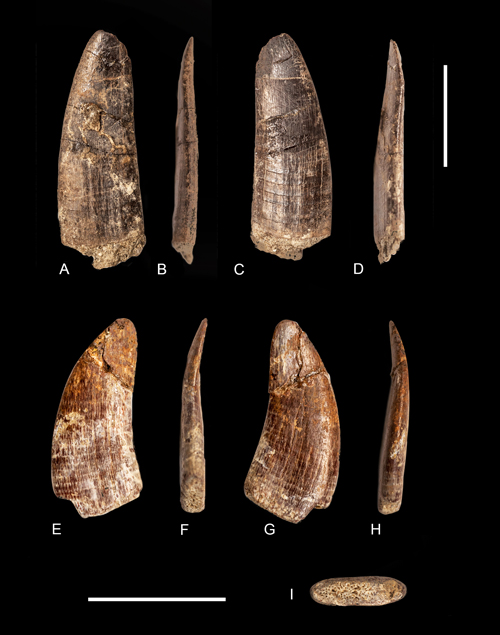
Material: BBUPSM 24018
and BBUPSM 24019, two rostral
spines in the BBUPSM collection (Fig. 3.a-h ).
Occurence: Piscul Ronei, Turbuța locality, Racoți Sandstone (BBUPSM 24018); and Valea Fânului quarry, Leghia locality, Viștea Limestone (BBUPSM 24019)
Age: Priabonian
Description: The two rostral spines
display a similar morphology. They are strongly dorsoventrally compressed and
feature convex anterior and posterior edges. They are slightly curved
posteriorly as well as ventrally. The posterior curvature is more pronounced on
the Leghia specimen (BBUPSM 24019) compared to the one from Turbuța (BBUPSM
24018). The transverse section of the spines has a very thin, oval outline (Fig.
3.i ). Both specimens exhibit faint longitudinal striations, but BBUPSM 24018 also
displays raised transverse striations on its basal part (Fig.
3.e, g ). The same
specimen bears numerous striations on its the apical part, which are related to
functional wear.
Discussion: The family Pristidae encompasses two extinct genera (Peyeria Weiler, 1935, and Propristis Dames, 1883) and two extant genera (Anoxypristis White & Moy-Thomas, 1941, and Pristis Linck, 1790). These taxa exhibit considerable morphological similarities with respect to the rostrum and associated rostral spines (Cappetta, 1987; Wueringer et al., 2009). The oral dentition of the family remains poorly documented in the fossil record, although a further genus of Pristidae, Glaucopristis, was recently erected based on teeth previously assigned to Rhinobatos bruxelliensis (Reinecke et al., 2024). Given that extinct pristid genera have previously been established based solely on rostral spines, and considering the possibility that loose oral teeth may belong to any of the aforementioned genera, a conservative approach in proposing new genera of Pristidae based on oral teeth is advisable in order to avoid the growth of a parallel taxonomy.
The oldest genus within the Pristidae family is Peyeria, represented solely by P. lybica Weiler, 1935, from the Cenomanian of Libya. Cappetta (1987) questioned the validity of this genus due to the existence a significant stratigraphic gap between Peyeria and the remaining genera, which only appeared in the Paleocene (Cicimurri, 2007) or Eocene (Case, 1994; Cappetta, 2012). In contrast, Wueringer et al. (2009) regarded Peyeria as a potential ancestral lineage for the family Pristidae, suggesting a radiation event following the Cretaceous/Paleogene boundary. Notably, Cappetta (2012), in his comprehensive review of Pristidae, completely disregarded this genus without any acknowledgment of its prior assignment to the pristids.
The second extinct genus, Propristis, made its appearance in the Eocene and is represented by a single valid species, P. schweinfurthi Dames, 1883. This genus is morphologically distinct from Pristis and Anoxypristis by featuring short rostral spines that are notably wide anteroposteriorly and have predominantly sharp carinae. Also, the length of the part inserted into the rostrum (i.e., the 'root') is much shorter in Propristis than in Anoxypristis or Pristis.
More recently, the taxon Mesopristis osonensis Farres, 2003, was erected based on a single rostrum that purportedly represents an intermediate morphology between Pristis and Anoxypristis. However, Cappetta (2012) synonymized Mesopristis with Anoxypristis without providing any supporting justification. A highly apomorphic character of Mesopristis is the way in which the rostral spines attach to the rostrum, with the hollowed spine base articulating on a tongue-like projection of the rostrum, forming an interlocking mechanism of mortise-and-tenon type. This morphological character is not present in the spines from Romania, nor in any other spines known in the literature.
|
Figure 3:
Rostral spines of Anoxypristys sp. from (A-D) Leghia [specimen BBUPSM
24019] and (E-I) Piscul Ronei (Turbuța) [specimen BBUPSM
24018]. A, E - dorsal views; B, F - posterior views; C, G - ventral views; D, H
- anterior views; I - basal view. Based on their
dorsoventral curvature, both spines likely come from the right side of the
rostrum. Scale bars = 10 mm. |
The two extant genera, Pristis and Anoxypristis, are typically readily distinguishable through the morphology of their rostral spines. Pristis is characterized by elongated, pointed spines exhibiting a ventral curvature. In dorsal view, these spines are either straight or display a slight posterior curvature, with the anterior margin generally sharp and the posterior margin concave (Cappetta, 2012, p. 394), though the latter can occasionally be straight or roughly “D-shaped” in cross section. The sharpness is usually restricted to the distal end of the spine. Conversely, Anoxypristis is distinguished by strongly dorsoventrally compressed spines possessing either sharp or rounded anterior and posterior cutting edges (Cappetta, 2012, p. 393). It is crucial to acknowledge that heavily worn rostral spines of Pristis may be superficially similar to those of Anoxypristis. Consequently, making taxonomic assignments beyond the family level (Pristidae indet.) in case of worn or juvenile rostral spines is to be avoided.
In contrast to the relatively straightforward determination of the pristid genera, species-level identifications are challenging based on rostral spine morphology alone. Even with respect to the extant taxa, an accurate species assignment requires a comprehensive approach that integrates morphological observations with statistical morphometric analyses of both the spines and rostrum (see the extensive discussions in Seitz & Hoover, 2017, and Trif & Vonica, 2018). Unfortunately, this multifaceted approach is largely inapplicable to fossil materials.
Within the fossil record, rostral spines are the most commonly reported pristid remains, while rostra are exceedingly rare. While oral teeth are likely more represented than hitherto reported in the fossil record, their morphology remains poorly understood, hindering their reliable identification as belonging to pristids (Cappetta, 1987, 2012; Dica, 2006), though this is beginning to change (Reinecke et al., 2023). Beyond considerations of size, establishing a connection between oral teeth and rostral spines necessitates a comprehensive examination of these structures in extant species before morphological traits can be reliably applied to fossil specimens.
Systematic examination of all the published records of Pristidae reveals that no less than 42 nominal fossil species have been described and included in the family, 27 of which are Eocene, or presumed to be Eocene in age. Most of them are assigned to the genus Pristis, including P. lathami Galeotti, 1837, P. hastingsiae Agassiz, 1841, P. bisulcatus Agassiz, 1843, P. acutidens Agassiz, 1843, P agassizi Gibbes, 1847, P. contortus Dixon, 1850, P. parisiensis Gervais, 1852, P. curvidens Leidy, 1855, P. amblodon Cope, 1869, P. brachyodon Cope, 1869, P. bassanii Zigno, 1882, P. ingens Stromer, 1905, P. fajumensis Stromer, 1905, Eopristis reinachi Stromer, 1905, Oxypristis ferinus Böhm, 1926, P. mucrodens White, 1926, P. hamatus White, 1926, P. priemi Leriche, 1933, P. wateleti Leriche, 1933, P. imhoffi Leriche, 1933, P. propinquidens Casier, 1949, P. praecursor Casier, 1949, P. brevis Casier, 1949, P. brayi Casier, 1949, P. olbrechtsi Dartevelle & Casier, 1959, P. pickeringi Case, 1981. Potentially included in Pristis is also M. osonensis Farres, 2003.
Based on original species descriptions, a significant proportion of characters purportedly distinguishing these taxa from one another are in fact plesiomorphic within the family Pristidae. Conversely, truly autapomorphic characters diagnostic of Anoxypristis are relatively few. Furthermore, many among the aforementioned species lack detailed descriptions or remain entirely undescribed. Several taxa are known only from fragmentary remains such as isolated rostral fragments (e.g., P. propinquidens, P. bisulcatus) or rostral spines only (e.g., P. imhoffi). The widely recognized species P. lathami, which is frequently cited for Eocene rostral spines, also exemplifies another problematic, or at least tenuous, taxonomic assignment, as it was originally described for a fragmentary rostrum devoid of articulated rostral spines. Spines were subsequently recovered from calcareous sands proximal to the limestone matrix containing the rostrum, raising concerns regarding their definitive association: "... à côté de ce bloc gisaient, dans le sable calcarifère, deux pointes osseuses sourcent sans doute de ce museau ..." […aside of this block, lying in the calcareous sand, were two bony spikes that undoubtedly originated from this snout…] (Galeotti, 1837, p. 46).
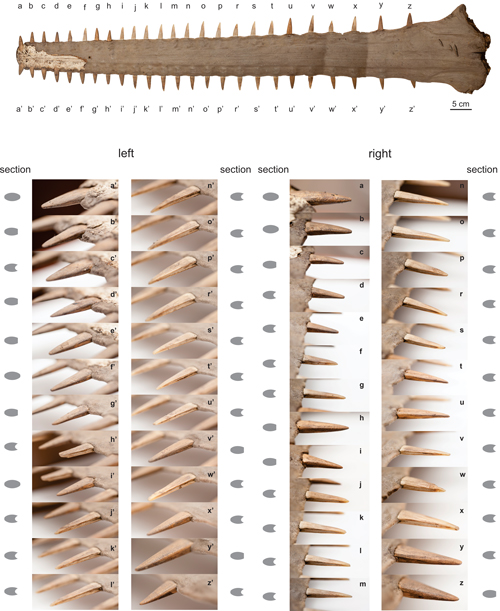
Observations on an extant rostrum of Pristis sp. housed in the
Zoological Museum of Babeș-Bolyai University, Cluj-Napoca have revealed a
significant extent of morphological variability among the rostral spines. While
proximal spines (i.e., those closer to the rostrum apex) often lack the
characteristic posterior concavity observed in this genus, the remaining spines
exhibit considerable variations without discernible patterns or morphological
trends. At seemingly random intervals, rostral spines deviate from the typical
morphology, losing the posterior concavity and displaying a reduced dorsoventral
compression as well as a straight posterior margin, or even a convex edge like
that characterizing the anterior face (Fig. 4 ).
|
Figure
4:
Variability of cross-section profiles in the rostral spines of Pristis
sp. (specimen from the Zoological Museum of Babeș Bolyai University,
Cluj-Napoca - no inventory number). The label only indicates that the specimen
originated in the Mediterranean Sea (note that Pristis
is no longer part of the Mediterranean fauna). |
Although the ambiguities in the definition of some of the fossil species of Pristidae were sometimes pointed out as early as in the 19th and early 20th centuries (Dames, 1883, p. 138; Woodward, 1889, p. 73; Stromer, 1905, p. 46), taxonomical identification of pristid fossils to the genus level have only become more widespread recently, especially in the case of finds consisting of isolated rostral spines (Cappeta, 2012; Carrillo-Briceño et al., 2015). In light of these considerations, the morphology of the Romanian spines dealt with herein, in the context of the variability of extant pristid spines, are best assigned to the Anoxypristis. These fossils represent the first record of this taxon from Romania as well as from the whole of southeastern Europe. Fossil Anoxypristis spines have previously been reported from the Eocene of Morocco (Cappetta, 2012), Belgium (Casier, 1949), Uzbekistan (Case et al., 1996), Mexico (González-Barba, 2003), Egypt (Zalmout et al., 2012), USA (Ebersole et al., 2019, 2025) and Austria (Adnet et al., 2021). Included in this list are only those instances where the morphology of the transversal section of the rostral spine could be verified from published photographs or from comprehensive descriptions.
The inferred habitat preferences of the fossil Anoxypristis is based on that of the only extant species in the genus, namely, A. cuspidata (Latham, 1794). Anoxypristis cuspidata is a benthopelagic amphidromous fish found in tropical and sub-tropical, coastal-marine and estuarine waters, with a depth range of 0-40 m. It mainly occurs in inshore coastal waters, estuarine environments and river deltas (Peverell, 2005; Radkhah & Eagderi, 2019). These observations are consistent with the depositional environment inferred for the Viștea Limestone and the Racoți Sandstone, the two stratigraphic units from which the specimens in question were recovered.
This study contributes to the understanding of the paleobiodiversity of the southeastern European region by documenting the first occurrence of Anoxypristis in Romania. The discovery of Anoxypristis in the Transylvanian Basin provides valuable insight into the paleoecology of the area, confirming the local occurrence of coastal-marine or estuarine environments during the Priabonian. In addition, the considerable morphological variability of the rostral spines, coupled with the fragmentary and isolated nature of most pristid fossils, present significant challenges in accurately identifying the fossil members of Pristidae at the species-level.
I am grateful to the reviewers, David J. Cicimurri and June Ebersole, for their insightful and valuable corrections. My thanks also extend to Editor Alberto Collareta for his work in handling this research. I also extend my gratitude to Cristian Sitar (Zoological Museum, Babeș-Bolyai University, Cluj-Napoca) and Liana Săsăran (Paleontology and Stratigraphy Museum, Babeș-Bolyai University, Cluj-Napoca) for their assistance in examining the collections under their care. Furthermore, I am deeply indebted to Cristina and Volker Thummel (Germany) for their generous support in providing access to a scarce publication pertaining to a pristid species. Finally, I acknowledge Jürgen Pollerspöck (Germany) for his invaluable assistance in locating crucial and otherwise inaccessible historical references.
Agassiz L. (1833-1844).- Recherches sur les Poissons fossiles.- vols. 1-5. Imprimerie de Petit-Pierre, Neuchâtel, 1420 p.
Adnet S., Feichtinger I., Harzhauser M. & Pollerspöck J. (2021).- A mesopelagic selachian fauna from the middle Eocene of St. Pankraz (Austria) reveals homogeneity in deep-marine environments during the warm period in Europe.- Neues Jahrbuch für Geologie und Paläontologie, Abhandlungen, Stuttgart, vol. 301, no. 1, p. 25-63.
Bonaparte C.L. (1838).- Selachorum tabula analytica.- Nuovi Annali delle Scienze Naturali, Bologna, vol. 1, p. 195-214 [in Latin].
Böhm J. (1926).- Über tertiäre Versteinerungen von den Bogenfelser Diamantfeldern.- Die Diamantenwüste Südwestafrikas, Berlin, vol. 2, p. 55-87 [in German].
Cappetta H. (1987).- Chondrichthyes II. Mesozoic and Cenozoic Elasmobranchii. In: Schultze H.P. (ed.), Handbook of paleoichthology, Vol. 3B.- Gustav Fischer Verlag, Stuttgart, 193 p.
Cappetta H. (2012).- Chondrichthyes. Mesozoic and Cenozoic Elasmobranchii: Teeth. In: Schultze H.P. (ed.), Handbook of Paleoichthology, Vol. 3E.- Verlag Dr. Friedrich Pfeil, München, 512 p.
Case G.R. (1981).- Late Eocene selachians from South-central Georgia.- Palaeontographica, Abteilung A, Stuttgart, vol. 176, nos. 1-3, p. 52-79.
Case G.R. (1994).- Fossil fish remains from the Late Paleocene Tuscahoma and Early Eocene Bashi Formations of Meridian, Lauderdale County, Mississippi. Part I. Selachians.- Palaeontographica, Abteilung A, Stuttgart, vol. 230, nos. 4-6, p. 97-138.
Case G.R., Udovichenko N.I., Nessov L.A., Averianov A.O. & Borodin P.D. (1996).- A Middle Eocene selachian fauna from the White Mountain Formation of the Kizylkum Desert, Uzbekistan, C.I.S.- Palaeontographica, Abteilung A, Stuttgart, vol. 242, nos. 4-6, p. 99-126.
Carrillo-Briceno J.D., De Gracia C., Pimiento C., Aguilera O.A., Kindlimann R., Santamarina P. & Jaramillo C. (2015).- A new Late Miocene Chondrichthyan assemblage from the Chagres Formation, Panama.- Journal of South American Earth Sciences, vol. 60, p. 56-70.
Casier E. (1949).- Contributions à l'étude des poissons fossiles de la Belgique. VIII; Les Pristidés éocènes.- Bulletin de l'Institut royal des Sciences naturelles de Belgique, Bruxelles, vol. 25, no. 10, p. 1-52.
Cicimurri D.J. (2007).- A partial rostrum of the sawfish Pristis lathami Galeotti, 1837, from the Eocene of South Carolina.- Journal of Paleontology, Lawrence - KS, vol. 81, no. 3, p. 597-601.
Ciupagea D., Păucă M. & Ichim T. (1970).- Geology of the Transylvanian Depression.- Editura Academiei, Bucharest, 256 p.
Codrea V.A. & Săsăran E. (2002).- A revision of the Rona Member.- Studia Universitatis Babeş-Bolyai, Geologia, Cluj-Napoca, vol. 2, p. 27-36.
Cope E.D. (1869).- Descriptions of some extinct fishes previously unknown.- Proceedings of the Boston Society of Natural History, Boston - MA, vol. 12, p. 310-317.
Dames W. (1883).- Über eine tertiäre Wirbelthierfauna von der westlichen Insel der Birket-EI-Qrûn im Fajum (Aegypten).- Sitzungsberichte der Königlich Preussischen Akademie der Wissenschaften zu Berlin, vol. 6, p. 129-153 [in German].
Dartevelle E. & Casier E. (1959).- Les poissons fossiles du Bas-Congo et des régions voisines.- Annales du Musée du Congo Belge (Série A : Minéralogie, Géologie, Paléontologie), Bruxelles, vol. 3, p. 257-568.
Dica P. (2006).- Studii paleoambientale în formaţiunile paleogene din NV-ul Depresiunii Transilvaniei pe baza asociaţiilor ichtiologice.- PhD Thesis, Universitatea Babeș-Bolyai, Cluj-Napoca, 212 p. [in Romanian].
Dixon F. (1850).- The geology and fossils of the Tertiary and Cretaceous formations of Sussex.- Longman, Brown, Green, and Longmans, London, 469 p.
Ebersole J.A., Cicimurri D.J. & Stringer G.L. (2019).- Taxonomy and biostratigraphy of the elasmobranchs and bony fishes (Chondrichthyes and Osteichthyes) of the lower-to-middle Eocene (Ypresian to Bartonian) Claiborne Group in Alabama, USA, including an analysis of otoliths.- European Journal of Taxonomy, Paris, vol. 585, p. 1-274. DOI: 10.5852/ejt.2019.585
Ebersole J.A., Cicimurri D.J., Stringer G.L., Jacquemin S.J. & Ciampaglio C.N. (2025).- Paleogene fishes of Alabama: Anoxypristis version 2. In: Ebersole J.A. (ed.), Fossil fishes of Alabama.- McWane Science Center, Birmingham - AL, p. 1-5. DOI: 10.69737/VESC7991
Farres F. (2003).- Mesopristis nov. gen. osonensis nov. sp., nuevo genero y especie de pez-sierra del Eoceno de Vic (Catalunya, N.E. de España).- Batalleria, Barcelona, vol. 11, p. 93-113.
Galeotti H. (1837).- Mémoire sur la constitution géognostique de la province de Brabant.- Mémoire de l' Académie Royale de Belgique, Bruxelles, vol. 12, no. 3, p. 1-193.
Gervais P. (1852).- Zoologie et paléontologie françaises.- Arthus Bertrand, Paris, 271 p.
Gibbes R.W. (1847).- On the fossil genus Basilosaurus, Harlan, (Zeuglodon, Owen,) with a notice of specimens from the Eocene Green Sand of South Carolina.- Journal of the Academy of Natural Sciences of Philadelphia, Philadelphia - PA, vol. 1 no. 2, p. 5-15. DOI: 10.5962/bhl.title.16324
González-Barba G. (2003).- Descripción de asociaciones faunísticas de elasmobranquios fósiles del eoceno superior (Priaboniano) de las formaciones Tepetate y Bateque de Baja California Sur, México.- PhD Thesis, Centro Interdisciplinario de Ciencias, La Paz, Mexico, Marinas, 226 p.
Kovalchuk O., Kriwet J., Shimada K., Ryabokon T., Barkaszi Z., Dubikovska A., Anfimova G. & Davydenko S. (2023).- Middle Eocene cartilaginous fishes (Vertebrata: Chondrichthyes) of the Dnieper-Donets Basin, northern Ukraine.- Palaeontologia Electronica, Los Angeles - CA, vol. 26, no. 2, Article a32. DOI: 10.26879/1283
Krézsek C. & Bally A.W. (2006).- The Transylvanian Basin (Romania) and its relation to the Carpathian fold and thrust belt: insights in gravitational salt tectonics.- Marine and Petroleum Geology, vol. 23, p. 405-442.
Latham J. (1794).- An essay on the various species of Sawfish.- Transactions of the Linnean Society of London, London, vol. 2, p. 273-282
Leidy J. (1855).- Indications of five species, with two new genera, of extinct fishes.- Proceedings of the Academy of Natural Sciences of Philadelphia, Philadelphia - PA, vol. 7, 531 p.
Leriche M. (1933).- Les poissons éocènes du bassin de Paris (Deuxième note additionnelle).- Bulletin de la Société Géologique de France (5e série), Paris, t. II, p. 357-374 (Pl. XXIII). URL: https://patrimoine.sorbonne-universite.fr/idurl/1/2654
Linck H.F. (1790).- Versuch einer Eintheilung der Fische nach den Zähnen.- Magazin für das Neueste aus der Physik und Naturgeschichte, Bielefeld, vol 6, no. 3, p. 28-38 [in German].
Mészáros N. (2000).- Correlation of the Paleogene and Neogene deposits from northern Transylvania.- Studia Universitatis Babes-Bolyai (Geologia), Cluj-Napoca, vol. 45, no. 2, p. 9-12. URL: https://digitalcommons.usf.edu/geologia/vol45/iss2/art1
Naylor G.J.P., Caira J.N., Jensen K., Rosana K.A., Straube N. & Lakner C. (2012).- Elasmobranch phylogeny: A mitochondrial estimate based on 595 species. In: Carrier J.C., Musick J.A. & Heithaus M.R. (eds.), Biology of sharks and their relatives.- CRC Press, Boca Raton - FL, p. 31-56.
Paraschiv D. (1979).- Romanian oil and gas fields.- Institutul de Geologie şi Geofizică Studii Tehnice şi Economice Seria A, Bucharest, vol. 13, 382 p.
Petrescu I., Enea G. & Vlad V. (1975).- Harta geologică a României, scara 1:50.000, foaia 29b-Jibou.- Institutul Geologic al României, București, p. 1.
Peverell C.S. (2005).- Distribution of sawfishes (Pristidae) in the Queensland Gulf of Carpentaria, Australia, with notes on sawfish ecology.- Environmental Biology of Fishes, vol. 73, p. 391-402.
Popescu B.M. (1984).- Lithostratigraphy of cyclic continental to marine Eocene deposits in NW Transylvania, Romania.- Archives des Sciences et Compte Rendu des Séances de la Société de Physique et d'Histoire Naturelle de Genève, vol. 37, no. 1, p. 37-73.
Radkhah A.R. & Eagderi S. (2019).- Threatened fishes of the world: Anoxypristis cuspidata (Latham, 1794) (Pristidae).- Journal of Fisheries, Rajshahi, vol. 7, no. 1, p. 681-684. DOI: 10.17017/j.fish.9
Reinecke T., Mollen F.H., Gijsen B., D'Haeze B. & Hoedemakers K. (2024).- Batomorphs (Elasmobranchii: Rhinopristiformes, Rajiformes, Torpediniformes, Myliobatiformes) of the middle to late Ypresian, early Eocene, in the Anglo-Belgian Basin (south-western North Sea Basin) - A review and description of new taxa.- Palaeontos, Bruxelles, vol. 35, p. 1-172.
Reinecke T., Mollen F.H., Seitz J.C., Motomura H., Hovestadt D.C. & Hoedemakers K. (2023).- Iconography of jaws and representative teeth of extant rhinopristiform and dasyatoid batoids (Chondrichthyes, Elasmobranchii) for comparison with fossil batoid material.- Palaeontos, Bruxelles, vol. 34, p. 3-158.
Rusu A. (1987).- Ostreina Biohorizons in the Eocene of the North-West Transylvania (Romania). In: Petrescu I. & Ghergari L. (eds.), The Eocene from the Transylvanian Basin, Romania.- University of Cluj-Napoca, p. 175-182.
Rusu A. (1995).- Eocene formation in the Călata region (NW Transylvania): A critical review.- Romanian Journal of Tectonic & Regional Geology, Bucharest, vol. 76, p. 59-72.
Saulea E., Dumitrescu I., Bombiţă G., Marinescu F., Borcoş M. & Stancu I. (1967).- Harta Geologică a României, 1: 200.000, folio Cluj, Bucureşti, Institutul Geologic.
Săndulescu M. & Visarion M. (1978).- Considérations sur la structure tectonique du soubassement de la Dépression de Transylvanie.- Dări de Seamă Institutul de Geologie şi Geofizică, Bucharest, vol. 64, p. 153-173.
Seitz C. J. & Hoover J.J. (2017).- Taxonomic resolution of sawfish rostra from two private collections.- Endangered Species Research, Oldendorf (Luhe), vol. 32, p. 525-532. DOI: 10.3354/esr00833
Stromer E. (1905).- Die Fischreste des Mittleren und Oberen Eocäns von Ägypten. I. Teil: Die Selachier, Myliobatiden und Pristiden.- Beiträge zur Paläontologie und Geologie Österreich-Ungarns, Wien, vol. 18, p. 163-185 [in German].
Szabó M. (2024).- A Kárpát-Pannon-térség fosszilis porcoshalai.- Hungarian Natural History Museum, Dabasi Nyomda Zrt., Budapest, 255 p. [in Hungarian].
Trif N. & Codrea V. (2018).- Critical overview on the odontological researches of the Mesozoic and Cenozoic fish from Romania.- Brukenthal Acta Musei, Sibiu, vol. 13, no. 3, p. 467-487.
Trif N. & Vonica G. (2018).- Reassessment of the sawfish rostra taxonomy from the Natural history Museum Sibiu.- Brukenthal Acta Musei, Sibiu, vol. 13, no. 3, p. 517-530.
Trif N., Codrea V.A., Pleş G. & Bordeianu M. (2024).- The Priabonian fish from Leghia (Transylvanian Basin, Romania).- Historical Biology, vol. 36, no. 11, p. 2295-2308.
Weiler W. (1935).- Ergebnisse der Forschungsreisen Prof. E. Stromers in den Wüsten Ägyptens. II. Wirbeltierreste der Baharije-Stufe (unterstes Cenoman). 16. Neue Untersuchungen an den Fischresten.- Abhandlungen der Bayerischen Akademie der Wissenschaften, Mathematisch-Naturwissenschaftliche Abteilung (Neue Folge), München, vol. 32, no. 16, p. 1-57 [in German].
White E.I. (1926).- Eocene fishes from Nigeria.- Bulletin of the Geological Survey of Nigeria, Lagos, vol. 10, p. 1-82.
White E.I. & Moy-Thomas J.A. (1941).- Notes on the nomenclature of fossil fishes. Part III: Homonyms M-Z.- Annals and Magazine of Natural History (Series II), London, vol. 7, p. 395-400.
Woodward A.S. (1889).- Catalogue of the fossil fishes in the British Museum (Natural History). Volume. 1.- British Museum (Natural History), London, 474 p.
Wueringer B.E., Squire L. & Collin S.P. (2009).- The biology of extinct and extant sawfish (Batoidea: Sclerorhynchidae and Pristidae).- Reviews in Fish Biology and Fisheries, London, vol. 19, p. 445-464.
Zalmout I.S., Antar S.M., Shafy E.A., Metwally M.H., Hatab E.-B.E. & Gingerich P.D. (2012).- Priabonian sharks and rays (late Eocene: Neoselachii) from Minqar Tabaghbagh in the Western Qattara Depression, Egypt.- Contributions from the Museum of Paleontology, University of Michigan, Ann Arbor - MI, vol. 3, no. 6, p. 71-90.
Zigno A. (1882).- Nuove aggiunte alla fauna Eocena del Veneto.- Memoire del Reale Instituto Veneto di Scienze Lettere e Arti, Venezia, vol. 21, p. 775-790.