◄ Carnets Geol. 26 (12) ►
Outline:
[1. Introduction]
[2. Geological setting]
[3. Materials and methods]
[4. Results]
[5. Micropalaeontology]
[6. Systematic palaeontology]
[7. Discussion]
[8. Summary and conclusions] [Bibliographic references]
and ...
[Appendix]
Departament de Dinàmica de la Terra i l'Oceà, Facultat de Ciències de la
Terra, Universitat de Barcelona, Martí i Franquès s/n, 08028 Barcelona (Spain)
Department of Geology, University of Vienna, Josef-Holaubek-Platz 2, 1090 Vienna
(Austria)
Departament de Mineralogia, Petrologia i Geologia Aplicada, Facultat de Ciències de la
Terra, Universitat de Barcelona, Martí i Franquès s/n, 08028 Barcelona (Spain)
Published online in final form (pdf) on August 8, 2026
DOI
10.2110/carnets.2026.2612

[Editor: George Pleş; language editor: Robert W. Scott;
technical editor: Bruno Granier]

The study of upper Eocene-Oligocene larger foraminiferal assemblages in two sections of the Prebetic Range in south-eastern Iberia (Ibi and La Font Roja sections) revealed a rich diversity, including species previously known only from the Central Tethys, such as the Eocene Neorhipidionina cf. spiralis, and the Oligocene Pfendericonus globulus, Austrotrillina howchini, Idalina pignattii, and Archaias sp., as well as endemic forms such as Peneroplis peramplus, Spirolinella emmae, and Borelis sp. 1. The continuous record of Austrotrillina (Rupelian-Chattian) and Risananeiza (upper Chattian) showed evolutionary trends and allowed for a systematic revision. Austrotrillina asmariensis, A. striata, and A. brunni are considered morphotypes of a single species, A. striata, evolving anagenetically from the lower Rupelian A. paucialveolata, which originated from the Eocene A. eocaenica. The two known species of Risananeiza, R. crassaparies and R. pustulosa, were identified for the first time within the same stratigraphic section. They represent successive stages of an anagenetic species throughout the upper Chattian. The biostratigraphic results provide an improved characterization of Shallow Benthic zones SB 21 to 23 in the westernmost Tethys and allow the subdivision of SB 23 (upper Chattian) into two sub-biozones, 23A and 23B, based on the stratigraphic ranges of miogypsinids (Miogypsinella spp., Postmiogypsinella intermedia) and Risananeiza. The Priabonian-Chattian Neorotalia burdigalensis also exhibits evolutionary trends with potential biostratigraphic relevance. Overall, the biostratigraphic data obtained indicate diachronous, parallel evolution and extinction in several genera, improving our understanding of diversity patterns and migration pathways in Oligocene larger Foraminifera.
• Rupelian;
• Chattian;
• Priabonian;
• shallow benthic zones;
• Borelis;
• Neorotalia;
• Pfendericonus
Ferràndez-Cañadell C., Granero P. & Bover-Arnal T. (2026).- Upper Eocene-Oligocene larger Foraminifera from the westernmost Tethys (Prebetic Range, SE Iberia). Revision of Austrotrillina and Risananeiza.- Carnets Geol., Madrid, vol. 26, no. 12, p. 239-315. DOI: 10.2110/carnets.2026.2612
Grands foraminifères de l'Éocène supérieur-Oligocène de la Téthys occidentale (Prébétique, sud-est de la péninsule ibérique). Révision des genres Austrotrillina et Risananeiza.- L'étude des assemblages de grands foraminifères de l'Éocène supérieur-Oligocène dans deux coupes de la chaîne prébétique du sud-est de la péninsule Ibérique (coupes d'Ibi et de La Font Roja) a révélé une riche diversité, incluant des espèces auparavant connues uniquement de la Téthys centrale, telles que Neorhipidionina cf. spiralis de l'Éocène, et Pfendericonus globulus, Austrotrillina howchini, Idalina pignattii et Archaias sp. de l'Oligocène, ainsi que des formes endémiques comme Peneroplis peramplus, Spirolinella emmae et Borelis sp. 1. La présence continue d'Austrotrillina (Rupélien-Chattien) et de Risananeiza (Chattien supérieur) a mis en évidence des tendances évolutives et a permis une révision systématique. Austrotrillina asmariensis, A. striata et A. brunni sont considérées comme des morphotypes d'une seule espèce, A. striata, ayant évolué de manière anagénétique à partir d'A. paucialveolata (Rupélien inférieur), elle-même issue d'A. eocaenica (Éocène). Les deux espèces connues de Risananeiza, R. crassaparies et R. pustulosa, ont été identifiées pour la première fois dans la même coupe stratigraphique. Elles représentent des stades successifs d'une espèce anagénétique tout au long du Chattien supérieur. Les résultats biostratigraphiques permettent une meilleure caractérisation des zones benthiques de faible profondeur SB 21 à 23 dans la Téthys occidentale et la subdivision de SB 23 (Chattien supérieur) en deux sous-biozones, 23A et 23B, en fonction de la répartition stratigraphique des miogypsinidés (Miogypsinella spp., Postmiogypsinella intermedia) et de Risananeiza. La Neorotalia burdigalensis (Priabonien-Chattien) présente également des tendances évolutives potentiellement pertinentes sur le plan biostratigraphique. Globalement, les données biostratigraphiques obtenues indiquent une évolution diachronique et parallèle, ainsi que des extinctions chez plusieurs genres, ce qui contribue à une meilleure compréhension des schémas de diversité et des voies de migration chez les grands foraminifères de l'Oligocène.
• Rupélien ;
• Chattien ;
• Priabonien ;
• zones benthiques de faible profondeur ;
• Borelis ;
• Neorotalia ;
• Pfendericonus
The late Eocene-Oligocene was characterised by major climatic and palaeoceanographic changes, marking the end of the Eocene's warm conditions and the onset of the cooler and more seasonal climate of the Oligocene (e.g., Berggren & Prothero, 1992; Zachos et al., 2001; Pälike et al., 2006; Liu et al., 2009; Jovane et al., 2009). These environmental changes led to a progressive decline in larger foraminiferal diversity, most evident in the Mediterranean region, and the extinction of major groups that had flourished during the early and middle Eocene, including Alveolina, orthophragmines (Discocyclinidae and Orbitoclypeidae), and most lineages of Nummulites.
In the Western Tethys, the reduced diversity of larger Foraminifera during the late Eocene-early Oligocene is further compounded by a scarce and discontinuous geological record. For example, the Pyrenean foreland basin (Ebro Basin), which was very rich in larger Foraminifera during the early and middle Eocene, lost its connection with the Atlantic Ocean in the middle Priabonian and became endorheic (Riba et al., 1983; Garcés et al., 2020). Consequently, the late Priabonian and Oligocene were characterized by endorheic deposition, dominated by alluvial, lacustrine, and palustrine successions, including evaporites, carbonates, and siliciclastics. In the Helvetic Alps, the Priabonian record of larger Foraminifera is mainly represented by limestones with hyaline species from relatively deep facies (heterosteginids and orthophragmines), overlain by the deeper-water Globigerina marls (e.g., Ferràndez-Cañadell et al., 2023b). A large part of the marine Oligocene deposits from the Western Tethys were either eroded or deformed by tectonic processes, during or after deposition, as noted by Hottinger (1963) for the Betics. A classical Oligocene section in northern Spain, San Vicente de la Barquera (Heck & Drooger, 1984), consists of turbiditic deposits where lepidocyclinids and nummulitids occur together with reworked Eocene nummulitids and orthophragminids, as well as a few Lower Cretaceous orbitolinids (Ferràndez-Cañadell et al., 1999).
Oligocene larger Foraminifera have been extensively studied in the Central Tethys (Iran, Iraq, Oman, Yemen, eastern Turkey; e.g., Henson, 1936, 1937, 1950; Smout & Eames, 1958; Adams, 1968; Sirel, 2003; Gedik, 2008, 2014, 2015; Özcan & Less, 2009; Özcan et al., 2009a, 2010a, 2010b; Işik, 2010; Işik & Hakyemez, 2011; Sirel et al., 2013, 2020a, 2020b; Serra-Kiel et al., 2016). In contrast, studies from the Western Tethys (Mediterranean region-western and central Turkey) are fewer and more limited, particularly regarding shallow-water facies with porcellaneous larger Foraminifera. These facies have only been reported from Malta (Felix, 1973; Brandano et al., 2009), Italy (Pignatti, 1995; Bassi et al., 2007), Mallorca (Colom, 1929, 1935), and SE Spain (Didon et al., 1961; Hottinger, 1963), or are restricted to the nearly monospecific 'Archiacina beds' in the Paris Basin (Alimen & Lucas, 1945), Aquitaine (Sztrákos & Steurbaut, 2017), Transylvania (Bombita, 1980), and Mallorca (Colom, 1957). Hottinger (1963), Sirel (1997), and Bassi et al. (2007) emphasised the scarcity of shallow-water carbonate facies in the Western Tethys ("virtually absent", Sirel, 1997, p. 167).
The global reduction in larger Foraminifera diversity, together with the poor geological record of shallow-platform facies in the Western Tethys, makes Priabonian-Oligocene biozonation particularly challenging. Biostratigraphic correlation is further complicated by multiple migration episodes involving several groups (e.g., Robinson, 1996; Renema, 2002, 2007; Harzhauser & Piller, 2007; Boudagher-Fadel & Price, 2013; Hottinger, 2014; Benedetti et al., 2018; Sarfi & Yazdi-Moghadam, 2024; and references therein). These limitations in the geological and fossil record have led to the assumption that diversity in the Western Tethys during the Priabonian and Oligocene was lower compared to the Central Tethys (e.g., Bassi et al., 2007; Dimou et al., 2024). Bassi et al. (2007) further suggesting a gradual reduction in porcellaneous species diversity in the Central-Western Tethys from south-east to north-west.
In this study, we report a rather complete
succession of Eocene-Oligocene age (Priabonian-upper Chattian) from the Prebetic Range
(Figs. 1  - 2 ), representing shallow-water
platform carbonates developed along the south-eastern coast of the Iberian
Peninsula. These deposits contain rich assemblages of both hyaline and
porcellaneous larger Foraminifera, unique in the Western Tethys, offering new
insights into the diversity and palaeobiogeography of these organisms during the
Oligocene. Furthermore, the continuous record throughout the Oligocene enables a
detailed analysis of morphological variation and evolutionary trends in several
genera, particularly Austrotrillina,
Risananeiza, and Neorotalia.
These findings provide valuable contributions to biozonation and
biostratigraphic correlation, as well as to the interpretation of
palaeobiogeographic diversity and migration patterns.
- 2 ), representing shallow-water
platform carbonates developed along the south-eastern coast of the Iberian
Peninsula. These deposits contain rich assemblages of both hyaline and
porcellaneous larger Foraminifera, unique in the Western Tethys, offering new
insights into the diversity and palaeobiogeography of these organisms during the
Oligocene. Furthermore, the continuous record throughout the Oligocene enables a
detailed analysis of morphological variation and evolutionary trends in several
genera, particularly Austrotrillina,
Risananeiza, and Neorotalia.
These findings provide valuable contributions to biozonation and
biostratigraphic correlation, as well as to the interpretation of
palaeobiogeographic diversity and migration patterns.
The Betic Cordillera in southeastern Spain
forms part of the Western Mediterranean Alpine belt. It is subdivided into an
External Zone and an Internal Zone, corresponding respectively to the former
passive southern margin of Iberia and a stack of allochthonous nappe complexes (García-Hernández
et al., 1980; Geel & Roep,
1999; Vera, 2000). The External Prebetic Domain occupies the northern
part of the Prebetic Zone, in a proximal position relative to the southeastern
Iberian margin, and consists mainly of platform carbonates, which were
periodically interrupted by detrital inputs. On the other hand, the Internal
Prebetic is characterised by hemipelagic deposits including turbidites (Martín-Chivelet
& Chacón, 2007; Höntzsch et al.,
2013). The studied
sections record a ~500 m-thick succession of shallow-platform
limestones belonging to the External Prebetic, located near the town of Ibi (Fig. 1 ).
|
|
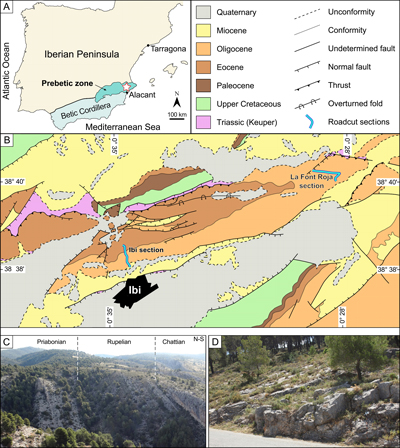
Figure 1:
Geographical
and geological setting of the study area. A)
Location of the study area (star) in the eastern part of the Prebetic domain
within the Betic Cordillera of the Iberian Peninsula. B) Geological map of the study area showing the location of the two
sections studied along roadcuts: Ibi and La Font Roja. This map is an adapted
version derived from the geological maps by Almela et al.
(1973), Martínez del Olmo & Benzaquen
(1973), Martínez et al.
(1977), and Colodrón et al. (1980), updated from data from Geel
(1995) and this study. C) Panoramic
view of the lower and middle parts of the Ibi section, showing the boundaries
between the Priabonian, Rupelian, and Chattian stages based on the
biostratigraphic analysis conducted in the present study. D) Outcrop view of the upper Chattian succession at La Font Roja
section. |
Deposition of upper Eocene-Oligocene deposits in the Prebetic Domain was influenced by the Alpine tectonic activity. Initially, the southern Iberian margin acted as a passive margin, later undergoing an extensional phase before evolving into a thrust-and-fold belt during the Betic orogeny and the opening of the Gulf of València in the late Oligocene-Miocene (Azéma, 1977; Roca & Desegaulx, 1992; Vegas, 1992; Geel, 1995). Consequently, Paleogene palaeogeography and sedimentation in this region were complex and variable (Martín-Martín et al., 2021).
There is no consensus among authors regarding the age of the post-Eocene deposits. In particular, the younger shallow-water limestone beds in the Ibi and surrounding areas were initially interpreted as Aquitanian-Burdigalian (Almela et al., 1973; Martínez del Olmo & Benzaquen, 1973; Martínez et al., 1977; Colodrón et al., 1980), and later reassigned to the Burdigalian (Geel, 1995) or even to the middle Oligocene (Geel, 2000). It should be noted, however, that the chronostratigraphic meaning of these stratigraphic units has varied over time.
The Oligocene larger Foraminifera from the Prebetic of Alacant have been previously studied by Hottinger (1963), Azéma et al. (1969), Geel (1995, 2000), Höntzsch et al. (2013), Bover-Arnal et al. (2017), Ferràndez-Cañadell and Bover-Arnal (2017), Falces-Delgado and Giannetti (2023), and Ferràndez-Cañadell (2024). The pioneering work by Hottinger (1963) revealed an association of porcellaneous forms ("Calcaires à Pénéroplidés de Moratalla"), which he compared to those from the Middle East reported by Henson (1950) and interpreted as late Oligocene in age, based on previous data on molluscs in Durand Delga and Magné (1958). Later studies by Azéma et al. (1969), Geel (1995, 2000), and Höntzsch et al. (2013) identified larger Foraminifera only at the group or generic level, providing a basic biostratigraphy (supplemented by planktic foraminiferal data in Geel, 1995) and focusing on major stratigraphic sequences and their relation with tectonic evolution and climatic changes. Ferràndez-Cañadell and Bover-Arnal (2017) studied larger Foraminifera from the easternmost Prebetic (Benitatxell Range) and identified a characteristic upper Chattian (SB 23) assemblage containing both porcellaneous and hyaline species. The study by Falces-Delgado and Giannetti (2023), which focused on the palaeoecology of Kuphus, reported an upper Rupelian (SB 22A) association of larger Foraminifera from Serra de l'Arguenya, located on the southern flank of the Diapiric Anticline of the Saix-Castalla-Ibi subunit (Martínez et al., 1977), approximately 20 km ESE of Ibi.
The Ibi section (Els Molins ravine, north of
Ibi town; Fig. 1 ) preserves a long record of Palaeogene deposits, ranging from
the middle Cuisian, Shallow Benthic zone (SB) 11 (Martín-Martín et
al., 2025; Miclăuş et
al., 2025), to the late Chattian (SB 23). The Oligocene record of the
Ibi section was previously studied by Geel (1995,
2000), who interpreted
the facies as back-reef deposits and recognised four Oligocene sedimentary
cycles, O1 to O4. Based on the larger Foraminifera assemblages (identified at
the group or genus level), together with regional correlations and planktic
foraminiferal data, Geel (1995) assigned the ages of these cycles as
lower Rupelian (P18-19-20, cycles O1 and O2), upper Rupelian to lower Chattian
(P21, cycle O3), and upper Chattian (P22, Cycle O4). In a later paper, Geel
(2000) revised this interpretation and considered all these cycles to represent
the lower and middle Oligocene. Similarly, Höntzsch et al.
(2013) used foraminiferal assemblages, recognised at the
level of group or genus, to develop a depositional model for the Prebetic
Paleogene platform, highlighting the influence of climate changes and tectonics.
These earlier studies focused primarily on the sedimentary evolution of the area
and did not address the systematics of the Foraminifera at the species level.
Consequently, they do not provide information on species diversity. Their
biostratigraphic frameworks are based on the first occurrences and
co-occurrences of genera. In this regard, Geel (2000) used the first
occurrences of Nephrolepidina, Eulepidina,
and Miogypsinoides to define an 'upper
lower Oligocene', a 'middle Oligocene', and an 'upper Oligocene', respectively.
Preliminary results of the present study were given in two congress abstracts (Granero et al., 2020, 2022), and in Ferràndez-Cañadell (2024), a paper focused on two early Rupelian new species perhaps endemic to the Prebetic domain.
The studied specimens were documented from over
6,000 microphotographs taken from 385 thin sections of 212 limestone samples,
collected along nearly 500 m of stratigraphic section (Fig. 2 ). Most of the
Foraminifera were, therefore, studied in unoriented and non-centred sections.
Consequently, the measurements reported in tables and plots are approximate and
may be slightly smaller than the real dimensions. Thin sections of the samples
were produced in the Laboratories of Palaeontology and Petrology of the Faculty
of Earth Sciences of the University of Barcelona. Several microscopes and
cameras were used; with the majority of photographs taken using a Zeiss AxioCam
MRc 5 digital camera mounted on a Zeiss Axioplan-2 petrographic microscope. The
thin sections are deposited at the Faculty of Earth Sciences of the University
of Barcelona, except for those containing type material of Peneroplis
peramplus and Spirolinella emmae (Ferràndez-Cañadell,
2024), which are housed at the Museum of Natural Sciences of Barcelona (Museu de
Ciències Naturals de Barcelona) in seven thin sections under catalog numbers
MGB 94151 (sample MN-6), MGB
94152 (sample MN-18), MGB 94153 (sample Ibi-120), and MGB 94154 (sample
Ibi-126). According to Martinsson (1979) and Emiliani
(1991), we use the terms "planktic" and "benthic" rather
than "planktonic" and "benthonic", which are incorrect
derivations from the Greek terms. Original toponymic names in the Catalan
language are used instead of the Castilianised forms imposed during the Franco
dictatorship found in the literature (e.g.,
Alacant instead of 'Alicante', Saix instead of 'Sax', Serra de l'Arguenya
instead of 'Sierra de la Argueña', and Barranc dels Molins instead of 'Barranco
de los Molinos'). To simplify the text and improve readability, full species
names are listed in Appendix.
List of abbreviations: FR: La Font Roja, SB: Shallow Benthic (biozone), FO: first occurrence, EI: elongation index (= test length/width), P: internal equatorial diameter of the megalospheric proloculus (excluding chamber wall thickness).
|
|
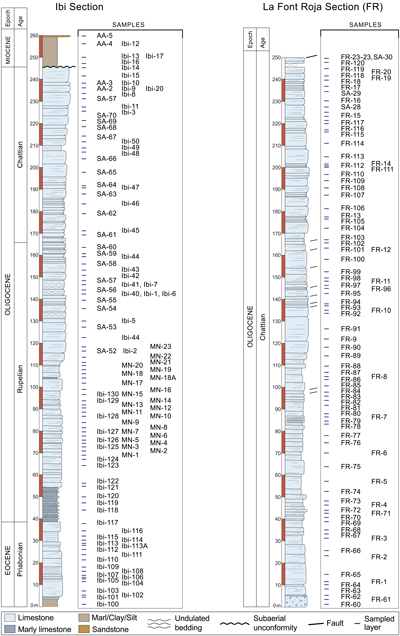
Figure 2:
Stratigraphic
logs of the studied sections and stratigraphic positions of the samples
collected. See Fig. 1 |
|
|
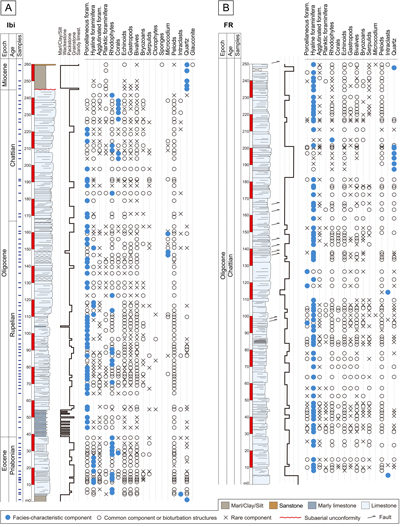
Figure 3:
Stratigraphic
logs studied, A) Ibi section and B)
La Font Roja section, showing textures and qualitative abundances of skeletal
and non-skeletal components. See Fig. 1 |
Two sections were studied in the south-eastern
Iberian Peninsula: Ibi and La Font Roja (Figs. 1
- 2
- 3
- 4 ). Both belong to the External
Prebetic Domain, which comprises a mixed carbonate-siliciclastic succession of
Triassic to Miocene age, deposited along the South Iberian passive continental
margin of the Tethys (García-Hernández et
al., 1980; Vera, 2000; Höntzsch et al.,
2013). No formal
lithostratigraphic units have yet been defined for the succession analysed.
The Ibi section was logged along the Molins
ravine (Barranc dels Molins), north of Ibi town in Alacant province (Fig. 1 ).
The section, corresponding to the 'Ibi west' section of Geel
(1995, 2000), includes a continuous record of platform limestones from the middle
Eocene to the late Chattian, which is cut by an erosional surface unconformably
overlain by middle Miocene marls and sandstones containing planktic
Foraminifera. The part of the Ibi section studied here (base: 38°38'13"N,
0°34'43"W) shows a continuous series of
shallow-water limestones ranging from the uppermost Eocene (Priabonian) to the
upper Chattian (Figs. 1
- 2
- 3
- 4
- 5 ). The La
Font Roja section (FR),
located 9 km to the east-north-east, lies within the Carrascar de la Font Roja
Natural Park (Figs. 1
- 2
- 3
- 4
- 5 ) and roughly corresponds to the 'Ibi-east'
section of Geel (1995).
|
|
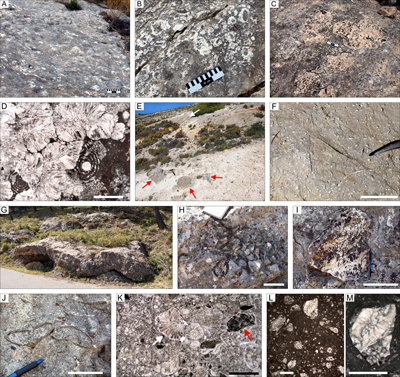
Figure 4:
Sedimentary
and fossil features from the Ibi and La Font Roja sections. A-B) Outcrop view (A) and detail (B) of an upper
Chattian rhodolith bed, upper part of the Ibi section. Note the nodular
appearance of the surface, reflecting the accumulation of rhodoliths; ruler = 15
cm. C) Outcrop view of an upper
Chattian coral biostrome, upper part of the Ibi section. Coral colonies can be
distinguished by their lighter beige coloration; ruler = 15 cm. D)
Microphotograph showing Microcodium invading Borelis tests,
late Rupelian, sample SA-57, Ibi section metre 148, scale bar = 1 mm. E)
Irregular erosional surface capping the upper Chattian platform carbonate
succession at the top of the Ibi section (white arrow). This unconformity is
overlain by marls containing scleractinian coral colonies in growth position
(red arrows). Hammer = 32 cm. F)
Detail of the rockground at the top of the Ibi section (white arrow in e) with bioerosional features associated with the
unconformity.
Scale bar = 5 cm. G-H) Outcrop view
(G) and detail (H) of an undulated breccia bed conforming to an underlying
irregular palaeotopography in the lowermost part of the FR section; scale bar =
15 cm. I) Coral colony in growth
position from La Font Roja section, at 145 m (Figs. 2 |
Ibi succession
The sedimentary succession logged at Ibi is 260 m
thick (Figs. 2 ,
3A ) and is mainly composed of well-bedded limestone beds ranging
from centimetre- to metre-scale thickness. Locally, the limestones display
nodular bedding and are interbedded with marl layers of comparable thickness.
The limestones predominantly exhibit packstone to grainstone textures, although
wackestone textures are also locally present. Porcellaneous Foraminifera
constitute the main skeletal component of these platform carbonates. However,
beds dominated by hyaline Foraminifera, corals, rhodophytes, or Microcodium
also occur. Beds dominated by hyaline Foraminifera are mainly found in the lower
part of the section, between metres 11 and 26, and metres 111 and 120 (Fig.
3A ).
Like hyaline Foraminifera, rhodophytes are also common throughout the succession
but become locally dominant between metres 3 and 39, 113 and 122, and 209 and
241. The Rhodophyta observed include geniculate and non-geniculate species, some
of which form rhodoliths. In certain intervals, such as between metres 239 and
245 (Fig. 3A ), these rhodoliths accumulate to form a distinct rhodolith bed
(Fig. 4A-B ). Locally, hook-shaped morphologies of crustose rhodophytes were also
identified. Coral-dominated beds occur in both the lowermost and uppermost parts
of the section, specifically between metres 29 and 30, and metres 204 and 239,
respectively (Fig. 3A ). The coral colonies observed were not reef-builders but
rather level-bottom communities displaying a loose growth fabric, or they formed
coral biostromes (Fig. 4C ). Microcodium
was observed in 13 samples across the succession
(Fig. 4D ), with notable
dominance in three samples from the stratigraphic interval between metres 155
and 160 (Fig. 3A ). Other common skeletal components in the limestones include
bivalves, gastropods, bryozoans, serpulids, planktic Foraminifera, and
agglutinated Foraminifera, including encrusting forms. Remains of chlorophytes
are rare. Among the non-skeletal components, peloids and silt- to fine
sand-sized quartz grains are common, whereas intraclasts are present but rare.
Stratigraphic intervals with siliciclastic influence occur between metres 0 and
66, and 89 and 117. At metre 245, an erosional surface marks the top of the
carbonate platform succession (Figs. 3A ,
4E-F ). This irregular surface shows
widespread bioerosion features (Fig. 4F ). Above it lies an alternation of marls,
silts, and sandy limestones. The sandy limestones contain abundant planktic
Foraminifera. Hyaline and agglutinated Foraminifera, sponge remains, and
fragments of echinoids and molluscs also occur. In addition to quartz grains,
common non-skeletal components include glauconite and peloids. Locally, marly
deposits overlying the erosional surface host level-bottom coral communities
preserved in life position, exhibiting a loose growth fabric (Fig.
4E ). Samples
of the Ibi section are numbered as Ibi-x, Ibi-MN-x, SA-x, and AA-x,
corresponding to different field campaigns (2013/2016/2018) or to different
subsections (Fig. 2 ).
La Font Roja succession
The stratigraphic section measured at FR has a
thickness of 250 metres (Figs. 1
- 2 ,
3B ). The succession is faulted, although the
faults show only minor displacements. The base of the succession is marked by
metre-thick breccias made up of carbonate intraclasts containing coral fragments
and lepidocyclinids. The uppermost breccia bed shows an undulated bedding and
conforms to an underlying irregular palaeotopography (Fig. 4G-H ). Above this,
the succession consists of centimetre- to metre-thick massive limestones with
packstone to grainstone textures, dominated by hyaline Foraminifera. Other
common skeletal components include porcellaneous Foraminifera, agglutinated
Foraminifera (including encrusting forms), planktic Foraminifera, and fragments
of rhodophytes, echinoids, bivalves, gastropods, bryozoans, and serpulids.
Porcellaneous Foraminifera are particularly abundant between metres 80 and 137,
where they locally dominate the facies (Fig. 3B ). Entire echinoid tests occur
locally and are commonly associated with siliciclastic-influenced deposits (Fig.
4J ). Coral fragments, as well as rare colonies in growth position, are found
between metres 5 and 115, and again between metres 142 and 152 (Fig.
4I ). Two
samples, collected at metres 98 and 248 respectively, yielded rare, reworked
fragments of Microcodium (Fig. 4K ). The most abundant non-skeletal components
identified are silt- to sand-sized quartz grains and peloids. Significant
siliciclastic input, resulting in sandy limestones, occurs between metres 182
and 201, and 245 and 249. At metre 114, there is a layer with wackestone texture
with intraclasts, most of which contain foraminiferal fragments (Fig.
4L-M ).
Samples from La Font Roja section are numbered as FR-x and SA-x (Fig. 2 ).
Biostratigraphy
We follow the Shallow Benthic biozonation (SB
zones), based on larger Foraminifera, stablished for the Paleocene-Eocene (SB
zones 1-20; Serra-Kiel et al., 1998a,
1998b) and for the Oligocene-Miocene (21-26; Cahuzac & Poignant,
1997, 1998). See further details on the SB zonation in Pignatti and Papazzoni
(2017) and Papazzoni et al.
(2017). Based on the assemblages of larger Foraminifera
identified in the samples, different Shallow Benthic (SB) biozones were
identified, corresponding to the Priabonian (SB 19-20), lower Rupelian (SB 21),
upper Rupelian-lower Chattian (SB 22A-22B), and upper Chattian (SB 23) (Figs. 5
- 6 ).
In the Ibi section, the Priabonian is represented by 35 m of limestones overlying marls without larger Foraminifera. The Oligocene starts with 16 m of marly limestone interbedded with thin limestone beds, followed by 55 m of limestones of lower Rupelian age. The next 125 m consist of limestones and marly limestones of upper Rupelian and lower Chattian age. The Rupelian/Chattian boundary (SB 22A-22B) is not distinguished by any major change in the foraminiferal assemblages (see below). The upper Chattian is truncated by an erosional surface and reduced to about 10 m of limestones in the Ibi section. To complement this limited exposure of the upper Chattian in the Ibi section, we studied a nearby section (La Font Roja, FR), located 9 km ESE, which comprises 250 m of monotonous upper Chattian limestones, bounded at the base by a karstic breccia and topped by a major fault. The fault at the top of the section separates it from another block with more than 100 m of similar monotonous upper Chattian limestones, which are difficult to correlate with those of the section studied. Therefore, the latest Chattian and the Oligocene-Miocene boundaries are not included in this study.
Reworked foraminiferal tests were observed in
several samples, but rarely mixing species from different biozones. In samples
Ibi-116 and Ibi-117 (the last samples with Eocene assemblages, at 35 and 38 m in
the Ibi section; Figs. 2 , 5 ), well-preserved specimens of Chapmanina
occur together with eroded ones. In the Ibi section,
Orbitolites occurs in several samples from the first 40 m, associated with
other Eocene genera. However, a small fragment (0.45 mm) of Orbitolites was found in sample Ibi-124,
approximately
27 m above the Eocene/Oligocene boundary. Similarly, in sample Ibi-10 (238 m),
characterised by late Chattian (SB 23) species, some intraclasts contain Borelis
inflata and Praerhapydionina delicata, 74 m above their last occurrence in the
section. In the FR section, a layer with intraclasts containing fragments of
hyaline larger Foraminifera was observed (sample FR-89, at 114m; Fig.
3B ).
Foraminiferal tests showing a low degree of abrasion are common throughout the
succession, which could be related either to winnowing or limited reworking. In
addition, Microcodium is recorded in several layers of the Ibi section (Figs.
3B , 4D ), indicating short-term emersion and subaerial exposure. Reworking was
considered when characterizing the biozones and do not have major implications
for the biostratigraphic interpretation.
The biostratigraphic interpretation (Figs. 5
- 6 )
is based on the following larger foraminiferal assemblages:
|
|
Figure 5:
Biostratigraphic distribution of foraminiferal taxa in the Ibi section. |
|
|
Figure 6:
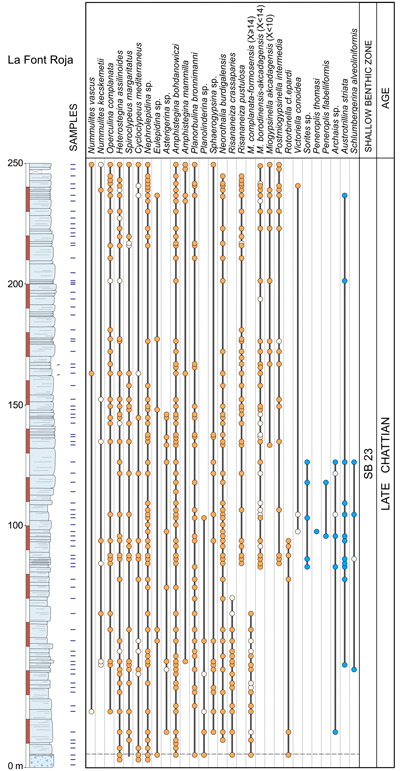
Biostratigraphic distribution of foraminiferal taxa in La Font Roja section. |
Priabonian, SB 19-20
This biozone is recognised at the base of the
Ibi section (Fig. 5 ) and is characterised by the following association of larger
Foraminifera: Nummulites fabianii,
Nummulites ex gr. N. incrassatus, Acervulina linearis, Gypsina mastelensis,
Gypsina sp., Asterigerina rotula, Discocyclina spp., Fabiania
cassis, Planorbulina bronnimanni,
Sphaerogypsina globulus, Halkyardia
minima, Gyroidinella magna, Schlosserina asterites, Chapmanina
gassinensis, Silvestriella tetraedra,
Neorotalia burdigalensis, Rotorbinella
epardi, Borelis vonderschmittii,
Orbitolites cf. cotentinensis, and
Neorhipidionina cf. spiralis
(Figs. 7
- 8 , 10 , 12 ).
Early Rupelian, SB 21
The biozone was identified in the lower part of
the Ibi section (Fig. 5 ) and is distinguished by the presence of Nummulites
fichteli, N. vascus, Gypsina cf. mastelensis,
Gypsina sp., Halkyardia minima,
Neorotalia burdigalensis, Rotorbinella
cf. epardi, Asterigerina sp., Planorbulina
bronnimanni, Austrotrillina paucialveolata,
Praebullalveolina minuta, P. oligocenica,
Sivasina egribucakensis, Penarchaias glynnjonesi, Coscinospira sivasensis,
C. elongata, Praerhapydionina delicata, Spirolinella emmae,
Peneroplis evolutus, P. peramplus, P. thomasi, P. flabelliformis, Idalina pignattii, Schlumbergerina
alveoliniformis, and Pfendericonus
globulus (Figs. 9
- 10
- 11 ,
13 ).
This assemblage also includes an indeterminate
pseudo-involute Spiroloculinidae (Fig. 11H-K ), which occurs in samples Ibi-118
to Ibi-5, corresponding to the lower-middle Rupelian (SB 21 and the basal part of SB
22A). It resembles Elazigella altineri
from the Thanetian of western Turkey (Sirel, 1999,
2015), the type
species of Subfamily Elasigellinae (Mikhalevich, 2008), but differs by
the apparent lack of apertural teeth and by the occasional presence of involute
chambers (Fig. 11K ). The scarcity of specimens and the lack of equatorial
sections prevent a more detailed characterization of this form.
Late Rupelian-Early Chattian, SB 22A-22B
This biozone is recognised in the upper part of
the Ibi section (Fig. 5 ) and is characterised by the occurrence of
Nummulites fichteli, N. kecskemetii,
Heterostegina assilinoides, Nephrolepidina
spp., Eulepidina cf. formosoides, Asterigerina
sp., Planorbulina sp.,
Planolinderina sp., Amphistegina bohdanowiczi, Neorotalia burdigalensis, Rotorbinella cf. epardi, Victoriella
conoidea, Austrotrillina striata, Sorites
sp., Borelis inflata, Borelis sp. 1,
Praerhapydionina delicata,
Peneroplis evolutus, P. thomasi, P. flabelliformis, Penarchaias
glynnjonesi, Coscinospira elongata,
C. sivasensis, Sivasina egribucakensis, Idalina
pignatti, Schlumbergerina alveoliniformis, Pfendericonus globulus, and Spiroloculinidae
indet. (Figs. 8
- 9
- 10
- 11
- 12
- 13 ).
Late Chattian SB 23, Ibi section
In the Ibi section (Fig. 5 ), this biozone is characterised by the following
association of larger Foraminifera: Nummulites
kecskemetii, Nummulites sp., Heterostegina assilinoides, Cycloclypeus
mediterraneus, Nephrolepidina
spp., Planorbulina bronnimanni, Planolinderina sp.,
Biarritzina sp., Neorotalia
burdigalensis, Risananeiza crassaparies, Elphidium cf. crispum,
Austrotrillina striata, Austrotrillina
ex gr. striata-howchini, and Schlumbergerina
alveoliniformis (Figs. 8
- 9
- 10 ,
13
- 14
- 15 ).
|
|
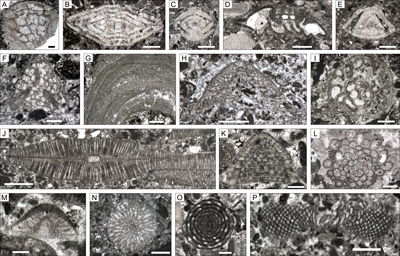
Figure 7:
Priabonian
larger Foraminifera association from the Ibi section. A) Nummulites ex gr. N.
fabianii (Prever in Fabiani), tangential section showing
reticulate septal filaments, sample Ibi-111; B)
N. fabianii, axial section (P
= 235 µm), sample Ibi-109. C)
Nummulites ex gr. N.
incrassatus (Harpe), sample Ibi-111. D)
Schlosserina asterites (Gümbel),
subaxial section, sample Ibi-111. E)
Asterigerina rotula (Kaufmann),
subaxial section, sample Ibi-107. F) Silvestriella
tetraedra (Gümbel),
oblique section, sample Ibi-106. G) Acervulina linearis Hanzawa, subaxial section, sample
Ibi-107. H) Fabiania casis (Oppenheim),
subaxial section, sample Ibi-106. I) Gyroidinella
magna Le Calvez,
equatorial section, sample Ibi-104. J)
Discocyclina sp., axial section,
sample Ibi-104. K) Chapmanina gassinensis (Silvestri), subaxial section, sample
Ibi-104. L) Planorbulina bronnimanni Bignot
& Decrouez, equatorial section, sample Ibi-116. M) Halkyardia
minima (Liebus, 1911), axial section, sample Ibi-104. N)
Sphaerogypsina globulus (Reuss),
sample Ibi-113A. O) Borelis vonderschmitti
(Schweighauser), subequatorial section, sample Ibi-108. P) Orbitolites cf. O.
cotentinensis Lehmann, sample Ibi-110. Scale bars: B-D,
F-G, I, N, P = 500 µm; J = 1 mm; rest =
200 µm. |
Late Chattian SB 23, FR section
In FR, the SB 23
is distinguished by the presence of
Nummulites vascus, Nummulites kecskemetii,
Heterostegina assilinoides, Spiroclypeus margaritatus, Cycloclypeus
mediterraneus, Operculina complanata, Nephrolepidina cf. morgani,
Nephrolepidina sp., Eulepidina
sp., Miogypsinella complanata, M. formosensis, Miogypsinella borodinensis, M.
akcadagensis, Postmiogypsinella intermedia, Asterigerina sp., Amphistegina
bohdanowiczi, A. mammilla,
Sphaerogypsina sp., Biarritzina
sp., Planorbulina bronnimanni,
Planolinderina sp., Risananeiza crassaparies, R. pustulosa, Neorotalia
burdigalensis, Rotorbinella sp.,
Sorites sp., Peneroplis thomasi, P. flabelliformis, Archaias sp.,
Austrotrillina striata, Austrotrillina ex gr. striata-howchini,
A. howchini, and Schlumbergerina
alveoliniformis (Figs. 6 ,
8
- 9
- 10
- 11
- 12 , 14
- 15
- 16 ).
More than 80 different species or Foraminifera have been distinguished in the studied sections: 25 species were identified from the Eocene and about 60 from the Oligocene. Some agglutinated Foraminifera, peneroplids, victoriellids, orthophragmines or lepidocyclinids could not be identified at the species level, so the total number of species in the assemblages is actually higher. All taxa were identified in random thin sections, which in most cases do not allow for detailed descriptions. Due to the high number of foraminiferal taxa identified, including agglutinated, porcellaneous and hyaline species of Priabonian, Rupelian, and Chattian age, we summarise here the results for those most relevant to biostratigraphy or palaeobiogeography. Taxa requiring taxonomic revision are discussed in detail in the Systematic Palaeontology section.
The suprageneric classification mainly follows Loeblich and Tappan (1987a), taking into account that the former is outdated in some aspects (e.g., the inclusion of orthophragmines, Discocyclinidae and Orbitoclypeidae within the Nummulitoidea based on the supposed presence of canal systems is incorrect). See Appendix for full species names.
Idalina pignattii
A few specimens of Idalina (Family Hauerinidae,
Subfamily Miliolinellinae) were observed in samples from the Rupelian and lower
Chattian (Ibi section). They match
Idalina pignattii Gallardo-Garcia
and Serra-Kiel from Oman (in Serra-Kiel et
al., 2016) in test size and shape, quinqueloculine-biloculine growth
pattern, and apertural structure (compare Fig. 11W
with Fig. 13.13 and 13.15 in Serra-Kiel
et al., 2016). The diameter of the
proloculus, P = 88-102 μm (N = 2) (Fig. 11W-Y ), also falls within the 70-100 μm range given in the species
diagnoses (Serra-Kiel et al., 2016). However, the adscription of this species to the genus Idalina
remains uncertain. The diagnosis of Idalina
includes a trematophorate aperture in adult growth stages (Grimsdale,
1952; Loeblich & Tappan, 1987a), a feature not clearly visible
in any of the specimens of I. pignattii
figured in the original description by Serra-Kiel et
al. (2016), nor in our material. Serra-Kiel et al.
(2016) reported a biostratigraphic range of SB 21-22 for I.
pignattii. In the Prebetic, this species occurs within this range (early
and late Rupelian) but also in SB 22B, extending its range to the early Chattian
(Fig. 5 ). Escandell
and Colom (1962) described a new species, "Idalina
laminata", from the Oligocene of Mallorca, similar to I.
pignattii. However, their illustrations lack magnification and, according to
Serra-Kiel et al. (2016), the
original material is lost. Furthermore, no reference to the type locality (other
than "beds of the Oligocene transgression" in Mallorca) is made in the
original description (Escandell & Colom,
1962, p. 127).
|
|
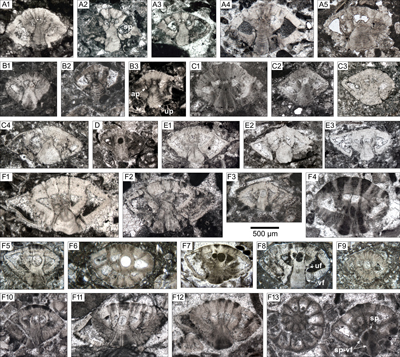
Figure 8:
Neorotalia burdigalensis (Orbigny) from the Ibi and La Font Roja
sections, Eocene and Oligocene forms at the same scale. A)
Priabonian (SB 19-20) specimens, Ibi section; B) Lower
Rupelian (SB 21) specimens, Ibi section; C)
Upper Rupelian (SB 22A) specimens, Ibi section; D) Lower Chattian (SB 22B)
specimens, Ibi section; E)
Lower-upper Chattian (SB 23) specimens, Ibi section; F)
Upper Chattian (SB 23) specimens, La Font Roja section, F1-F6) SB
23A; F7-F13) SB 23B. Samples: A1) Ibi-101, A2-A3) Ibi-102, A4) Ibi-103; A5) Ibi-104; B1)
Ibi-127, B2) Ibi-MN-7, B3) Ibi-MN-9; C1-C2)
Ibi-2, C3) SA-58, C4) SA-60; D) SA-63; E1-E2)
Ibi-9, E3) Ibi-20;F1) FR-65, F2) FR-70, F3) FR-74, F4) FR-77, F5) FR-4, F6)
FR-6; F7) FR-7, F8) FR-9, F9) FR-10, F10) FR-82, F11) FR-84, F12) FR-91, F13)
FR-96. Note that some specimens (A4, A5, C1, C4?, F1, F2, F4) are microspheric
forms. See Fig. 2 |
Peneroplis peramplus and Spirolinella emmae
These two species (Superfamily Soritoidea, Family Peneroplidae) were described in detail from samples of the
Ibi section in a previous work (Ferràndez-Cañadell, 2024). Peneroplis
peramplus (Fig. 11O ) is an evolute annular species characterised by a large
bilocular megalospheric embryo, with a protoconch measuring approximately 240 μm
and a deuteroconch up to 400 μm. The genus Spirolinella,
with the type species S. emmae (Fig. 11V ), is similar to Spirolina but
differs by its slender test, thinner walls, and its distinctive complex
aperture, petaloid to stellate in shape, with distally protruding lips forming
capsular cavities radially arranged, each with an aperture at the distal end.
Based on current knowledge, these two forms are exclusive to SB 21 (lower
Rupelian) and are considered endemic to the Prebetic (Ferràndez-Cañadell,
2024).
Archaias
The genus Archaias (Superfamily Soritoidea, Family Soritidae) has been identified in a few samples from the FR section (Figs. 6, 12A-D). The available material, although scarce and fragmentary, shows involute growth and the presence of endoskeletal pillars, but does not allow identification at the species level. Archaias originated in the Eocene (middle Eocene of the Caribbean region, according to Robinson and Wright, 1993). In the Mediterranean region up to the Middle East it ranges up to the upper Oligocene (lower Chattian), as reviewed by Seiglie et al. (1977), Hottinger (2007), and Bassi et al. (2007). Oligocene species include A. hensoni, A. kirkukensis, and two Rupelian species, A. diyarbakirensis and A. minimus, originally assigned to the genus Praearchaias (Sirel, 1997, 2003; Sirel et al., 2013; Hakyemez et al., 2016), which was later regarded as a synonym of Archaias (Hottinger, 2007). A further species, A. asmaricus differs in test architecture, which is similar to Peneroplis thomasi in the shape of chambers, and likely belongs to another genus (Bassi et al., 2007). A review of the literature reveals a lack of consensus regarding both the species assignment and their stratigraphic range. Henson (1950) reported A. operculiniformis from the lower Oligocene and A. kirkukensis and Archaias cf. aduncus from the upper Oligocene of Iraq. From the Zagros Basin in Iran, Habibi (2016a) reported A. operculiniformis from the middle Rupelian, A. kirkukensis from the middle Rupelian-middle Chattian, and A. hensoni from the Chattian. Later works reported A. operculiniformis from the lower Rupelian (Yazdi-Moghadam et al., 2023a) or Archaias sp. from the Rupelian and A. kirkukensis and A. asmaricus from the Chattian (Habibi, 2018; Habibi & Bover-Arnal, 2018; Habibi et al., 2024). Allahkarampour Dill et al. (2020) provided a biostratigraphical distribution of the species of Archaias in the Asmari Fm. in Iran, calibrated with Sr isotope stratigraphy. They concluded that A. operculiniformis occurs in the Rupelian and A. hensoni and A asmaricus in the Chattian. From the Oligocene of Turkey, Sirel (2003, 2013), followed by Hakyemez et al. (2016), reported "Praearchaias" minimus and "P." diyarbakirensis restricted to SB 21, and A. kirkukensis and A. asmaricus ranging from SB 21 to SB22. From this interval (Rupelian-early Chattian), Gedik (2014, 2015) reported A. kirkukensis and A. hensoni, whereas Kayğılı and Aksoy (2019) recognised only A. kirkukensis. From Oman and Yemen (Socotra), Serra-Kiel et al. (2016) reported two species ranging from the Bartonian to the Rupelian (SB 17-21), which they assigned to A. operculiniformis and A. diyarbakirensis.
Considering this biostratigraphic distribution, the specimens from FR section probably belong to either A. hensonii or A. kirkukensis. The main difference between these two species lies in the number of rows of pillars: one row in A. hensonii and two or more rows in A. kirkukensis (Bassi et al., 2007). This character is only properly visible in centred axial sections and could not be distinguished in our specimens.
|
|
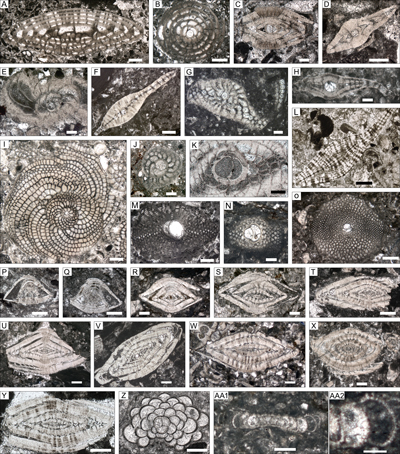
Figure 9:
Oligocene
hyaline larger Foraminifera. A-B) Nummulites
fichteli Michelotti, A) subaxial-oblique section, MN-8; B) equatorial
section (P = 240 µm), sample MN-2. C)
Nummulites vascus Joly & Leymerie,
axial section, sample MN-7. D)
Nummulites kecskemetii Less, axial section, Ibi-9. E)
Operculina complanata Defrance,
equatorial section, sample FR-29. F-G) Cycloclypeus mediterraneus Matteucci
& Schiavinotto, F)
axial section, sample Ibi-9; G) equatorial-oblique section, sample AA-2.
H-J) Heterostegina
assilinoides Blanckenhorn, H) axial section, sample FR-80; I)
equatorial section, sample FR-97; J) equatorial section, sample FR-27. K-L) Spiroclypeus margaritatus (Schlumberger),
K) equatorial section, sample FR-22; L) subaxial section, sample FR-1. M)
Eulepidina cf. formosoides
(Douvillé), sample Ibi-2.
N) Nephrolepidina
sp., equatorial section, sample FR-62. O)
Nephrolepidina cf. morgani
(Lemoine & R. Douvillé), equatorial section, sample FR-80. P-Q) Asterigerina sp., P) axial
section, sample FR-72; Q) subaxial section, sample MN-22. R-S) Amphistegina
bohdanowiczi Bieda, R) axial section, sample Ibi-9; S) subaxial
section, sample FR-27. T-Y)
Amphistegina mammilla (Fichtel
& Moll), T-U) sample Ibi-10, V sample AA-3, W) sample FR-50, X)
sample FR-72, Y) sample Ibi-10. Z) Planorbulina sp.,
equatorial section, sample Ibi-20. AA)
Planolinderina sp., subaxial section
(AA1) and detail (AA2) showing the two apertures characteristic of the genus,
sample FR-62. Scale bars: A-B, I, F, L, M, O = 500 µm; AA2 = 50 µm; rest =
200 µm. |
|
|
Figure 10:
Oligocene
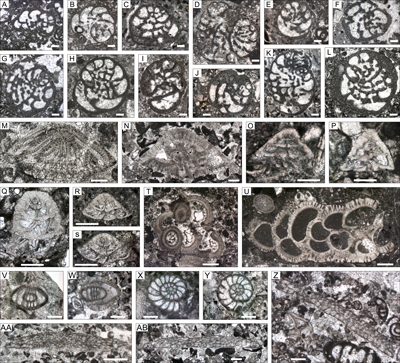
larger Foraminifera from the Ibi and La Font Roja sections. A-L) Pfendericonus
globulus Sirel & Deceviler,
lower Rupelian (SB 21); samples: A, G, L) Ibi-MN-6, B) Ibi-119, C) Ibi-121, D)
Ibi-125, E, F) Ibi-126, H) Ibi-MN-8, I) Ibi-MN-20, J,K) Ibi-127. M)
Elphidium cf. E.
crispum (Linnaeus),
subaxial-peripheral section, sample Ibi-10. N)
Rotalid indet., subaxial section, sample Ibi-116.
O-S) Rotorbinella cf. epardi
Ferràndez-Cañadell & Baumgartner-Mora; samples: O) FR-81
(SB 23), P, Q) Ibi-101 (SB 20), R) Ibi-40 (SB 22A), S) Ibi-41 (SB 22A).
T) Victoriella conoidea (Rutten),
subaxial section, sample MN-23. U) Rupertina sp.,
subaxial section, sample FR-113. V-Y) Elphidiella sp., subaxial (V, W) and
equatorial (X, Y) sections; samples: V) Ibi-128, W) Ibi-130, X) Ibi-MN-4, Y)
Ibi-129. Z-AB) Gypsina
cf. G. mastelensis Bursch,
axial section; samples: Z) Ibi-MN-6 (early Rupelian), AA, AB) Ibi-116
(Priabonian). Scale bars: M, T-U, AA = 500 µm; rest = 200 µm. |
Orbitolites
Orbitolites (Superfamily Soritoidea, Family Soritidae) occurs
in several samples from the lower (Priabonian) part of the Ibi section (Fig. 5 ).
Most specimens are fragmentary oblique sections; the largest preserved test
measures approximately 4 mm in diameter. An equatorial section (Fig.
7P ) shows a
bilocular megalospheric embryo similar in size and morphology to that of O.
cotentinensis, which has been reported from the Bartonian and Priabonian (SB
17-20) of France (Lehmann, 1961), Oman (Serra-Kiel et
al., 2016), and Crimea (Zakrevskaya,
2023). Other Priabonian occurrences of Orbitolites
have been documented from the Ebro Basin in north-eastern Spain (Travé et al.,
1996), northern Italy (Barbin, 1986, not shown in a
figure; Papazzoni & Sirotti,
1995, not shown in a figure),
northern Hungary (Vitalis-Zilahy, 1967), north-western
Turkey (Simmons et al., 2020; Sirel
et al., 2020a), and offshore India (Cotton
et al., 2019).
Sorites
Another soritid genus, Sorites, is relatively common in the Oligocene of the Prebetic (Ferràndez-Cañadell & Bover-Arnal, 2018), although it is never abundant. It occurs in the upper part (SB 22A-22B) of the Ibi section and in the middle part of the FR section (SB 23) (Figs. 6, 11A-C). Despite the large number of thin sections prepared from the richest samples from the Ibi and FR sections, as well as from the Benitatxell Range (Ferràndez-Cañadell & Bover-Arnal, 2017, 2018), no centred sections were obtained to adequately characterise the species and compare it with known taxa. The Prebetic specimens are characterised by the axial section of septula, which are thicker in the median plane and become thinner towards the lateral walls, similar to those of Sorites variabilis (sensu Hottinger et al., 1994, Pl. 84, figs. 9-10). However, the megalospheric embryo resembles that of S. orbiculus (sensu Hottinger et al., 1994), with a proloculus diameter of 76-96 μm (measured in two axial sections), followed by a wide flexostyle. These specimens also show similarities to the few Oligocene occurrences reported from the Mediterranean region (see Pl. 5, fig. 6 in Zuffardi-Comerci, 1930; Fig. 4A in Brandano et al., 2009; Fig. 2c in Pomar et al., 2014).
Praerhapydionina
Praerhapydionina
delicata (Superfamily Soritoidea,
Family Soritidae) from the Ibi section was described in detail in a previous
work (Ferràndez-Cañadell, 2024). The most significant feature discussed
there is the presence of a pseudokeriotheca-like texture on the walls, which may
serve as a useful criterion for
identifying the genus and clarifying its alleged wide geographical distribution,
reported from the Caribbean to Indonesia (Hottinger, 2007). In the Ibi
section, P. delicata occurs in
the Rupelian (SB 21-22A) (Figs. 5 ,
11U ), and its last occurrence may represent a
potential marker for the Rupelian/Chattian (SB 22A-22B) boundary (see the
discussion on biostratigraphy below).
|
|
Figure 11:
Oligocene
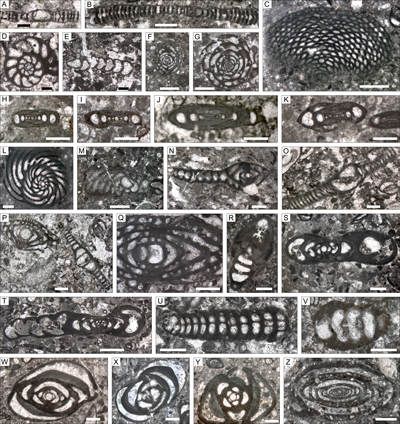
porcellaneous larger Foraminifera from the Ibi and La Font Roja sections. A-C). Sorites
sp. A, B) axial and subaxial
sections of megalospheric specimens; C)
equatorial section of a megalospheric specimen; samples: A) Ibi-6; B, C) SA-57. D)
Coscinospira sivasensis
Sirel
& Özgen-Erdem, equatorial section, sample Ibi-7. E)
Coscinospira elongata Sirel
& Özgen-Erdem, subaxial section, sample Ibi-MN-7. F)
Praebullalveolina minuta Sirel
& Özgen-Erdem, sample Ibi-MN-17. G) Praebullalveolina oligocenica Sirel & Özgen-Erdem,
sample Ibi-MN-17.
H-K) Spiroloculinidae indet., axial and subaxial
sections. Note the semi-involute test, with evolute chambers and involute walls
in H-J and the involute chambers in K; samples: H)
Ibi-MN-21, I) Ibi-120, J) Ibi-MN-6, K) Ibi-MN-14. L) Peneroplis flabelliformis
Sirel
& Özgen-Erdem, equatorial section; sample Ibi-5. M)
Peneroplis cf. evolutus Henson, equatorial-oblique section, sample Ibi-130. N)
Peneroplis thomasi
Henson, axial section, sample Ibi-6.
O) Peneroplis peramplus Ferràndez-Cañadell,
oblique section, sample Ibi-130. P) Penarchaias glynnjonesi (Henson)
(left) and Peneroplis peramplus paratype MGB 94151 LP2.1 (right),
sample Ibi-MN-6. Q) Penarchaias glynnjonesi, axial
section, note the apertures in the alar prolongations; sample Ibi-MN-6. R-T)
Sivasina egribucakensis
Sirel
& Özgen-Erdem, R)
subaxial section showing the dendritine aperture; S)
axial section, megalospheric form; T)
axial section, microspheric form; samples: R) Ibi-6; S) Ibi-127; T)
Ibi-127. U) Praerhapydionina delicata
Henson, axial-oblique section, megalospheric form; sample Ibi-129. V)
Spirolinella emmae Ferràndez-Cañadell,
subaxial section (paratype MGB 94153
LPb.1); sample Ibi-120. W-Y)
Idalina pignattii Gallardo-García & Serra-Kiel, megalospheric
forms; samples: W) SA-53, X) Ibi-121, Y) Ibi-43. Z) Schlumbergerina cf. alveoliniformis (Brady),
axial section, sample SA-53. Scale bars: C, T = 500 µm; rest = 200 µm. |
|
|
Figure 12:
Oligocene
porcellaneous larger Foraminifera from the Ibi and La Font Roja sections. A-D)
Archaias sp., subaxial sections; A-B) sample FR-91, C) sample FR-83, D)
sample FR-78. E) Neorhipidionina
cf. N. spiralis Hottinger,
subaxial-tangential section (E1) and detail (E2), sample Ibi-116. Note the
septula (black arrows) and the foramina (white arrows), with median foramina
alternating with the marginal ones. F-N) Borelis
inflata (Adams); G-I) megalospheric specimens in different
ontogenetic stages from the same sample, SA-57; J1) comparison of specimens in G-I at the
same scale, J2) photocomposition to compare specimens in Figure 12H-I (right
half of H superposed on I), note the close correspondence of whorls, chambers
and chamberlets; K) two megalospheric specimens of different ontogenetic stage
in the same thin section, sample Ibi-6; L) subequatorial section, sample Ibi-40.
M) oblique section, sample SA-57; N) subaxial section, sample Ibi-6.
O-W) Borelis
sp. 1, with morphological characters intermediate between B. inflata (Adams), B.
merici Sirel
& Gündüz and B.
pygmaea Hanzawa. Note the fusiform test (elongation index between 1.7
and 2.6), the subsphaerical initial whorls, the columellar thickening and the
absence of Y-shaped septula; O-S)
sample SA-60, T) sample Ibi-6, U) sample Ibi-5, V) sample SA-57, W) sample
SA-52. Scale bars: E2, F2 = 100 µm; rest = 200 µm. |
Neorhipidionina
The Eocene genus Neorhipidionina (Superfamily Alveolinoidea, Family Rhapydioninidae) is
characterised by a planispiral-involute nepionic stage that transitions to an
uncoiled, evolute stage with fan-shaped adult chambers of elongate-oval axial
section. The chambers are subdivided by radial septula perpendicular to the
lateral walls, leaving an annular passage in the median part where the foramina
are located. Initially, the foramina are arranged in a single row, increasing to
two or three rows in adult chambers. The foramina of the additional median row (median
foramina) alternate with those of the other two rows (marginal apertures),
positioned between the septula (Hottinger, 2007; Serra-Kiel et al.,
2016; Nafarieh et
al., 2019). Two specimens from the lower part of the Ibi section (samples
Ibi-113A and Ibi-116, Fig. 5 ) show these characters. Both are peripheral axial
sections showing the characteristic elongate-oval chamber shape and radial
septula with a central, unsubdivided passage. One specimen (Fig.
12E ) also shows
marginal foramina between septula and median apertures alternating with the
marginal ones. This specimen (Fig. 12E ) therefore shows virtually all the diagnostic characters
of Neorhipidionina according to the
original definition of the genus (Hottinger, 2007, p. 9). Based on the size and shape of the chambers,
these specimens are most similar to N.
spiralis. Neorhipidionina urensis exhibits uncoiled stages with an
oval outline, whereas
N. williamsoni has a larger test.
However, the main difference between N.
spiralis and N. williamsoni lies
in the size of the protoconch, which was not observed in our specimens. The
known range of the genus is Bartonian-Priabonian, SB 17-20 (Henson,
1948; Hottinger, 2007; Serra-Kiel et
al., 2016; Cotton et al.,
2019; Nafarieh
et al., 2019; Changaei et
al., 2022), which is consistent with the Priabonian age assigned to the
lower part of the Ibi section.
Praebullalveolina
Praebullalveolina oligocenica and P.
minuta (Superfamily Alveolinoidea,
Family Alveolinidae) were defined by Sirel and Özgen-Erdem (in Sirel et
al., 2013) from the early Rupelian, SB 21, in the Sivas Basin of central
Turkey. Both species were identified in the lower part of the Ibi section (Fig.
11F-G ). They are difficult to distinguish in partial random sections and are,
therefore, grouped together as Praebullalveolina
spp. in the biostratigraphic plot (Fig. 5 ). They occur in porcellaneous
foraminiferal facies associated with Austrotrillina
paucialveolata, Idalina pignattii, Coscinospira
elongata, C. sivasensis, Peneroplis evolutus, P. peramplus, Spirolinella emmae,
Penarchaias glynnjonesi, Sivasina egribucakensis, Praerhapydionina delicata,
and Pfendericonus globulus, interpreted
as early Rupelian, SB 21. Praebullalveolina
oligocenica was reported from the Rupelian (without differentiating between
SB 21 and 22B) of Oman and Socotra Island (Yemen) by Serra-Kiel et
al. (2016). The association, including P. delicata, C. elongata, and C.
sivasensis, suggests an early Rupelian (SB 21) age. This species
was also reported as "Praebullalveolina
sp." from the lowermost Oligocene of Priabona (northern Italy) by Barbin
et al. (1997).
|
|
Figure 13:
Austrotrillina
species and morphotypes from the Ibi section.
A-I) Austrotrillina
paucialveolata Adams. A, B) microspheric forms from the basal lower
Rupelian. C-I)
specimens showing bilocular and trilocular growth and the variability of the
exoskeleton, from a simple undulate inner surface of the wall (C-E) to protrusions variable in size and shape
and irregularly distributed (F-I). Note the flexostyle in C and
H. J-R). Austrotrillina
striata Todd & Post, with exoskeletal patterns of
asmariensis-type in J-M
(SB 21-22A), and of striata-type in N-R (SB
22A). Note bi-, tri- and quinquelocular types of growth and the flexostyle in L,
M, N, and P. Samples: A-B, G) Ibi-121; C) Ibi-120; D) Ibi-MN-19; E) Ibi-129; F,
H) Ibi-126; I) Ibi-MN-6; J, L-P)
SA-53; K) SA-57; Q) Ibi-43; R) Ibi-7. Scale bars: A-B = 1
mm; C-R = 200 µm. |
|
|
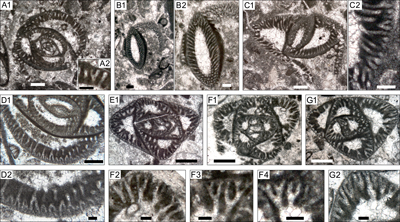
Figure 14: Austrotrillina with bifurcated
alveoli. A) Austrotrillina striata Todd
& Post, axial-oblique section (A1) and detail (a2) showing ocasional
bifurcated alveoli, sample SA-60, Ibi section. B-C)
Specimens (B1, C1) and details (B2, C2) with exoskeletal patterns
transitional between striata and howchini
morphotypes from the basal late Chattian (basal SB 23) of the Ibi section,
samples: B) Ibi-9, C) Ibi-15; the
latter, could be considered a true A.
howchini (Schlumberger). D-G) Austrotrillina
howchini (Schlumberger), D) equatorial-oblique
section (D1) and detail (D2) from La Font Roja section, sample FR-7 (SB 23); E-G
specimens (E1, F1, G1) and details (F2-F4,
G2) from Serra de l'Ombria (section under study, about 30 km SW from Ibi);
note the regular bifurcate alveoli. Scale bars: details A2, B2, C2, T2 = 100 µm;
D2, F2-F4, G2
= 50 µm; rest = 200 µm. Scale
bar = 0.5 mm. |
|
|
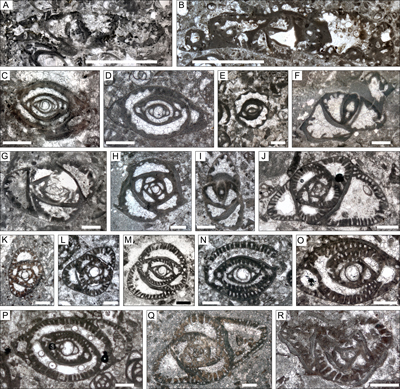
Figure 15:
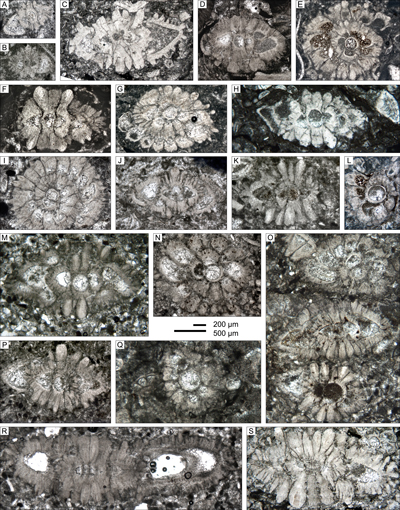
Risananeiza from the Ibi and FR sections.
A-J) Risananeiza
crassaparies Benedetti
& Briguglio, megalospheric forms. A-D) specimens from the basal SB 23A, Ibi
section; E-J) specimens from SB 23A, lower part of the FR section;
K-Q) Risananeiza
pustulosa Boukhary et
al., megalospheric forms, SB 23B,
FR section; Note the large proloculus in O (P
= 318 µm) and Q (P = 320 µm). R-S) Risananeiza
pustulosa, microspheric forms, SB 23B, FR section. All specimens at the same
magnification. Samples: A) Ibi-9, B) Ibi-15, C) Ibi-20, D) AA-3, E) FR-62, F)
FR-65, G) FR-67, H) FR-68, I) FR-69, J) FR-71; K) FR-87, L) FR-98, M) FR-103, N)
FR-105, O) FR-13, P) FR-106, Q) FR-15; R) FR-103, S)
FR-15. The scale bars apply to all photos. |
|
|
Figure 16:
Miogypsinids
from the upper Chattian (SBZ 23) from the La Font Roja section. A-B) Miogypsinella
sp., axial section, sample FR-70. C-D) Miogypsinella
cf. M. formosensis (Yabe
& Hanzawa), subequatorial section, sample FR-70.
E) Miogypsinella cf. M.
borodinensis Hanzawa,
subequatorial section, sample FR-82. F)
Miogypsinella sp., axial and subaxial
sections, sample FR-88. G) Miogypsinella
sp., axial section (top) and Postmiogypsinella
intermedia Sirel & Gedik,
subaxial section (bottom), sample FR-98. H) Miogypsinella sp.,
subaxial sections, sample FR-102. I) Miogypsinella
cf. M. formosensis, sample FR-1. J)
Miogypsinella borodinensis/M. akcadagensis
(Gedik & Sirel), sample FR-2. K)
Miogypsinella formosensis/borodensis,
sample FR-5. L) Miogypsinella
cf. formosensis, equatorial section, sample FR-22. M) Miogypsinella cf. M.
borodinensis, equatorial section, sample FR-102.
N-P) Miogypsinella
cf. M. akcadagensis, equatorial
sections; samples: N) FR-102, O) FR-103, P) FR-104. Q-R) Miogypsinella cf.
M. borodinensis, equatorial sections;
samples: Q) FR-104, R) FR-118. S-U) Postmiogypsinella
cf. M. intermedia, S) subaxial-oblique
section, megalospheric specimen, sample FR-79; T-U)
microspheric specimens, axial sections, samples: T) FR-87, U) FR-98. Scale bars
= 200 µm. |
Borelis
Borelis (Family
Alveolinidae) occurs in both the Eocene and Oligocene parts of the Ibi section. Only four specimens of Borelis were recovered from the lowermost part of the Ibi section
(Fig. 5 ). They exhibit a subspherical test measuring 0.65 to 0.83 mm in diameter
(mean = 0.77 mm, N = 4). A subequatorial section (Fig. 7O ) shows a proloculus
approximately 48 μm in diameter, followed by two (?) streptospiral whorls and
five planispiral whorls, the last whorl containing 12 chambers. These features
correspond to the Eocene species B. vonderschmitti (e.g., Benedetti,
2010; Sirel et al.,
2020a).
Most Borelis specimens from the
Oligocene part of the section (Fig. 12F-N ) exhibit the following features:
proloculus diameter between 30 and 85 μm (typically 50-60 μm), 7-9 chambers per whorl at a test
diameter of 1 mm (N
= 3), 25-29 chamberlets per 1 mm length (N = 3), an elongation index (EI
= test length/width) mostly between 1.2-1.6, Y-shaped septula completely absent,
and a thin basal layer with columellar thickening reduced or absent. These
characters correspond to the diagnostic features of B. inflata (EI
= 0.95-1.56 according to Adams, 1965; Hottinger,
1974; Bassi
et al., 2021b). The EI
values in the specimens from Ibi match those reported for B.
inflata specimens from the Rupelian of Sicily (1.13-1.27; Benedetti,
2010) and eastern Turkey (1.22-1.35; Sirel, 2003).
A second group of Oligocene specimens exhibits
columellar thickening and a notably higher EI
of 1.7-2.2, possibly reaching 2.6 in incomplete forms (Fig. 12O-W ). These EI
values are larger than those documented for B. merici
(1.3-1.8; Sirel & Gündüz,
1981; Sirel,
2003) and B.
philippinensis (1.3-1.8; Bassi
et al., 2021b), but smaller than those
for B. pygmaea (2.3-2.5
according to Sirel, 2003; 2.2-3.2 according to Bassi et
al., 2021b). They also differ from B. philippinensis by
lacking Y-shaped septula. Because these
specimens do not fit the diagnosis of any known species, they are referred to
here as Borelis sp. 1. The limited
number of available centred sections prevents a formal, detailed
characterization of a potential new species. These forms may be related to the
specimens reported from the Malatya Basin as B.
merici by Gedik (2017), which exhibit an EI
of 1.79-2.71. A graphic plotting elongation index (EI) against proloculus diameter (P) confirms that most specimens fall within the variability of B.
inflata, whereas those assigned to Borelis sp. 1 occupy
intermediate values between B. inflata/B. merici and B. pygmaea
(Fig. 17 ;
Table 1).
|
|
Figure 17:
Plot
of elongation index and megalospheric proloculus diameter (µm) for Borelis
from the Ibi and La Font Roja sections (see data in Table 1), with ranges for
Oligocene species (squares) based on the Fig. 1 in Bassi et
al. (2021b). The ranges of proloculus diameter were extended, for B.
merici Sirel & Gündüz,
from 1.35-1.56 to 1.3-1.8 µm to include data in Sirel
(2003),
and for Borelis pulchra (Orbigny)
from 25-30 to 25-50 µm to include data in Cole (1957) on
Borelis primitivus, considered a
synonym of B. pulchra by Bassi et
al. (2021b). Note that part of the specimens from Ibi and La Font Roja
sections (orange circles) fit well
within the range of B. inflata (Adams), whereas some specimens (blue circles)
fall between the ranges of B. inflata/B.
merici and B. pygmaea Hanzawa,
and are here referred to as Borelis
sp. 1. |
Table
1: Measurements
in Borelis specimens from the Ibi
section. P: Diameter of the
megalospheric proloculus, L: Test
lenght, D: Test diameter, EI:
Elongation index. (See plot in Fig. 17 ).
| Species | Sample | P (µm) | L (µm) | D (µm) | EI (L/D) |
| Borelis inflata | SA-60 | 68.0 | 552 | 524 | 1.05 |
| 45.0 | 843 | 606 | 1.39 | ||
| 37.4 | 631 | 527 | 1.20 | ||
| 69.0 | 565 | 489 | 1.16 | ||
| Ibi-57 | 62.0 | 660 | 592 | 1.11 | |
| 54.0 | 637 | 481 | 1.32 | ||
| 59.0 | 168 | 151 | 1.11 | ||
| 48.0 | 416 | 410 | 1.01 | ||
| 62.0 | 1,587 | 1,074 | 1.48 | ||
| Ibi-6 | 44.0 | 1,339 | 1,046 | 1.28 | |
| 46.0 | 1,256 | 950 | 1.32 | ||
| 51.0 | 574 | 483 | 1.19 | ||
| 50.0 | 1,138 | 974 | 1.17 | ||
| Ibi-5 | 68.0 | 336 | 303 | 1.11 | |
| SA-52 | 41.0 | 365 | 298 | 1.22 | |
| Borelis sp. 1 | SA-60 | 54.0 | 1,015 | 583 | 1.74 |
| 76.0 | 1,606 | 839 | 1.91 | ||
| 47.0 | 1,210 | 622 | 1.95 | ||
| 74.0 | 1,496 | 798 | 1.87 | ||
| 58.0 | 1,493 | 726 | 2.06 | ||
| Ibi-58 | 69.5 | 1,234 | 774 | 1.59 | |
| Ibi-5 | 52.8 | 1,732 | 950 | 1.82 | |
| Ibi-52 | 76.0 | 624 | 393 | 1.59 |
The samples from the Ibi section also include
several small subspherical forms (Fig. 12G-K ). To assess whether these represent
juveniles or a smaller species such as B. pulchra, we overlaid images of
small and large specimens from the same samples (Fig. 12J1-J2 ). As no
significant differences were observed apart from test size (they show similar
size, shape and number of chambers and chamberlets), we interpret the small
tests as juvenile forms of B. inflata. On the other hand, the occurrence
of Borelis pulchra in the Oligocene (Bassi
et al., 2021b) is questionable (see
also BouDagher-Fadel & Price,
2021). This species was
originally defined from recent material from Cuba (Orbigny,
1839) and,
according to Hottinger (1974), is known
only from modern sands in the Caribbean (Florida, Bahamas, Cuba, Jamaica) and
from Ascension Island in the Atlantic. Bassi et al.
(2021b) placed in synonymy with B. pulchra four fossil
species, B.
primitivus, B. parvula, B. boninensis,
and B. globosa, and extended its
stratigraphic range down to the Priabonian and its geographic distribution to
the Pacific (Philippines, Ogasawara Islands, Eniwetok, Saipan, Australia).
However, the adscription of these fossil species to B.
pulchra is questionable for several reasons: (1) most characters used to
define Borelis species cannot be
applied to small forms with sphaerical tests < 1 mm (e.g., number of chambers
per whorl at 1 mm test diameter, number of chamberlets per
1 mm chamber length, or elongation index, since elongated forms may initially
have a sphaerical shape); (2) contradiction in the definition of B.
pulchra by Bassi et al.
(2021b) as having a proloculus of 25-30 μm, whereas
including as a synonym B. primitivus,
defined as having a proloculus of 50 μm (Cole, 1957); (3) gaps in the
stratigraphic record (e.g., the
alleged occurrence of B. pulchra in
the Pliocene is based on an arbitrary reinterpretation of an unfigured mention
of B. melo by Matsumaru (2011);
and (4) geographic inconsistency, with recent forms in the Caribbean and
Atlantic and fossil forms in the Pacific (interpreted as homoplassic by BouDagher-Fadel & Price,
2021). The small specimens from
the Prebetic fit the diagnosis of B.
pulchra by Bassi et al.
(2021b), but also match juvenile individuals of other species, including the
Eocene B. vonderschmitti. These small
forms from the Prebetic are, therefore, interpreted as juvenile individuals of
the two recognised species: B.
inflata and Borelis sp. 1.
Amphistegina
Two species of Amphistegina
(Superfamily Asterigerinoidea, Family Amphisteginidae) were identified in the
sections studied: Amphistegina
bohdanowiczi and A. mammilla. Both
species were described in detail by Ferràndez-Cañadell and Bover-Arnal
(2017; see also Rögl & Brandstätter,
1993). Amphistegina
bohdanowiczi (Fig. 9R-S ) is very similar to Asterigerina
rotula, from which it probably originated by developing a lenticular test
with involute chambers. It occurs throughout the Oligocene (SB 21-23) and has
also been reported from the Lower Miocene (e.g.,
Rögl & Brandstätter, 1993). In the Ibi section its first
occurrence (FO) was observed in the middle part, corresponding to the SB 22A.
Its absence in the lower part may be due to the shallow-water facies of SB 21
layers, dominated by porcellaneous Foraminifera where hyaline species are scarce.
The test of A. mammilla (Fig. 9T-Y ), with its symmetrical lenticular-rhomboidal
outline and umbonal bosses on both sides, resembles that of some Nummulites,
particularly N. vascus, with which it
has sometimes been confused (e.g., Stoklosa & Simo,
2008). Chattian A. mammilla has been reported as A. hauerina (a synonym of A.
mammilla; Rögl & Brandstätter,
1993; Ferràndez-Cañadell
& Bover-Arnal, 2017) from Palestine (Henson,
1936) and the
Aquitaine Basin (Sztrákos & Steurbaut,
2017), and as A.
lessonii from Malta (Felix, 1973).
Habibi and Bover-Arnal (2018) reported Amphistegina mammilla (as A. mammilla, A. cf. mammilla, and N. vascus in their Fig. 7a, 7k, and 7d, respectively) from the Rupelian and lowermost Chattian of the Asmari Formation in Iran. However, its association with Nummulites vascus, Heterostegina assilinoides, and Eulepidina elephantina suggests a late Chattian (SB 23) age. Their interpretation of the Rupelian/Chattian boundary coincides with a marked shift to shallower facies, where hyaline associations are replaced by porcellaneous forms and miogypsinids. Wielandt-Schuster (2004) also reported Amphistegina cf. mammilla from the Rupelian of the Mesohellenic Basin (Greece). Although no specimens were illustrated, the association with Eulepidina elephantina, Heterostegina assilinoides, and Cycloclypeus droogeri suggests a late Chattian age. The report of A. mammilla from the Rupelian of Zagros (Iran) by Amirshahkarami (2013) corresponds to A. bohdanowiczi (Ferràndez-Cañadell & Bover-Arnal, 2017).
Lepidocyclinids
Nephrolepidina and Eulepidina
(Superfamily Asterigerinoidea, Family
Lepidocyclinidae) are widely used in Oligocene biostratigraphy. Both
genera were identified in samples from
the two sections studied, but species-level determination was not
possible due to the lack of loose specimens, which are necessary for a
statistically significant biometrical study based on centred equatorial
sections. One specimen was tentatively
assigned to N. cf. morgani (Fig. 9O ) because it closely matches
the specimens illustrated by Benedetti and Schiavinotto
(2023,
Figs. 7-8). The diameter of the deuteroconch in Eulepidina from
non-centred sections in the lowermost part of the basal upper Rupelian of the
Ibi section (730-845 μm, Fig. 9M ) agrees with the values of topotypes of E.
formosoides (363-1285 μm, mean = 772 μm) reported by Heck and Drooger
(1984), as well as with values from other localities in Turkey and Iran (e.g.,
Özcan et al., 2010a; Akbar-Baskalayeh et al.,
2020;
Yazdi-Moghadam et al., 2025).
Nummulitids
In the Ibi and FR sections, nummulitids (Superfamily Nummulitoidea, Family Nummulitidae) are
represented by species of Nummulites,
Heterostegina, Spiroclypeus, and Cycloclypeus.
Nummulites is scarce in the two studied sections. Specimens belonging to the N.
fabianii group (N. fabianii, N. fichteli), the N.
incrassatus group (N. incrassatus, N.
vascus), and the operculiniform N.
kecskemetii were identified. We follow the classification of
reticulate Nummulites proposed by Özcan
et al. (2009a), which has been adopted
by several authors (Özcan et al., 2010a,
2010b, 2019; Less et al.,
2011; Akbar-Baskalayeh et al.,
2020; Hadi et al.,
2023).
According to this classification, Nummulites
fabianii is characterised by having
umbo, weak granules, heavy reticulation, and a proloculus diameter of 200-300 μm.
The specimens of reticulate Nummulites
from the lower part of the Ibi section exhibit these features (Fig.
7A-B ). The
proloculus could only be measured in one axial section, with an equatorial
diameter of 235 μm. This species is associated with Nummulites of the N.
incrassatus group, which have a small proloculus (< 50 μm; Fig.
7C ),
along with Acervulina linearis,
Asterigerina rotula, Discocyclina spp.,
Fabiania cassis, Halkyardia minima, Gyroidinella
magna, Schlosserina asterites, Chapmanina gassinensis, Silvestriella
tetraedra, Rotorbinella epardi, Borelis
vonderschmittii, and Orbitolites
cf. cotentinensis.
In upper levels of the Ibi section,
N. vascus and N. kecskemetii, together with Nummulites
of the group of N. fabianii occur.
Within the latter, most specimens are characterised by a larger, smooth
reticulate test (Fig. 9A-B ). Measurements taken from an equatorial section
(Fig. 9B ) yielded the following values: P = 238
μm, outer diameter of the first two whorls = 1.135 μm, 18 post-embryonic chambers in the first two whorls,
and an index of spiral opening = 26.4.
These parameters fall within the variability of N. fichteli (e.g., Özcan
et al., 2010a).
Nummulites vascus
(Fig. 9C ) is characterised by a radiate, biconvex test with an indistinct
central knob and an acute margin. The protoconch, measured in subaxial sections,
yielded P values of 122-153 μm (N =
5), which are lower than those reported for N. vascus by Less et
al. (2011) and Sirel et al.
(2020a), possibly because the sections are not centred.
Nummulites
kecskemetii is characterised
by its very small proloculus (usually 60-90 μm in diameter), operculinid
spiral, narrow chambers, and curved septa, almost at right angle in the proximal
half and at 10°-15° where joining the spiral wall (Less,
1991). It is rare in the studied sections and was recognised only in axial
sections (Fig. 9D ) as a small operculinid nummulitid, with P values of 47-96 μm
(N = 3). Its biostratigraphic range spans the entire Chattian (SB 22A-23) (Less,
1991; Báldi et al., 1999; Wielandt-Schuster et
al., 2004; Özcan
et al., 2009a, 2010a; Parente
& Less, 2019).
Heterostegina
assilinoides and Spiroclypeus
margaritatus from the Prebetic upper Chattian were previously described (the
latter as "S. blanckenhorni")
by Ferràndez-Cañadell and Bover-Arnal
(2017). No significant
morphological or biometrical differences were observed in the specimens from the
Ibi and FR sections. Heterostegina
assilinoides (Fig. 9H-J ) occurs in the upper part of the Ibi section and
throughout the FR section (Figs. 5
- 6 ). The estimated P
values 162-247 μm (mean = 201.2 μm, N = 8) are similar to those reported for
specimens from Benitatxell in the eastern Prebetic (210-338 μm, mean = 268 μm;
Ferràndez-Cañadell & Bover-Arnal,
2017) and within the
variability documented in the literature (Henson, 1937; Özcan et al.,
2009a, 2010a; Benedetti et al.,
2018). Spiroclypeus
margaritatus occurs in the uppermost part of the Ibi section and throughout
the FR section (Fig. 9K-L ), with P
values of 296-356 μm (mean = 328.75 μm, N = 4). This species,
often reported as S. blanckenhorni (a junior synonym) in the Mediterranean region, is
not related to the Priabonian species (Özcan et al.,
2009b; Less et
al., 2018). It occurs in the upper Chattian (SB 23) across the entire Tethys
realm, from the Mediterranean to the Pacific (Cole, 1969; Cahuzac
& Poignant, 1997; Ehrenberg et al.,
2007; Less et
al., 2018), and also occurs in the lower Aquitanian of central Turkey (Özcan
et al., 2009b).
Cycloclypeus is very scarce in our
samples (Fig. 9F-G ). It occurs at the top of the Ibi section and throughout the
FR section (Figs. 5
- 6 ). The test exhibits a central swelling of flattened
lenticular shape, and the external surface is smooth, lacking granules. The
diameter of the megalospheric protoconch (P
= 114-192 μm, mean = 151 μm, N = 11) corresponds to C.
mediterraneus (120-160 μm) and differs from the smaller protoconch of C. droogeri (< 120 μm) and the very small embryo of C.
eidae (60-90 μm) (Matteucci & Schiavinotto,
1985; Özcan
& Less, 2009).
It also differs from the larger proloculus of C. pseudocarpenteri (P =
195-375 μm) described from the
lower Chattian (SB 22B) of eastern Turkey (Özcan et al.,
2010a). No significant differences were observed between
specimens from the Ibi section (P
= 162-182 μm, mean = 164 μm) and those from the FR
section (P = 128-192
μm, mean = 143.6 μm). Similar specimens assigned to C.
mediterraneus have been reported from the Prebetic and southern Spain (Laagland,
1990; Renema, 2015; Ferràndez-Cañadell & Bover-Arnal,
2017) and central Italy (Matteucci & Schiavinotto,
1977,
1985;
Renema, 2015).
Rotorbinella
Rotorbinella is a small conical rotalid (Family Rotaliidae, Subfamily Rotaliinae) with
the simplest canal system. It is a polyphyletic genus with a discontinuous
biostratigraphic record, including species known from the Cenomanian,
Coniacian-Santonian, Paleocene-Ilerdian, and Miocene-Recent intervals,
reflecting recurrent origins and extinctions (Ferràndez-Cañadell et
al., 2023a). Rotorbinella epardi
was originally defined from material of the Helvetic Alps, later recognised in
other western basins of the Tethys, and considered a characteristic species for
the Priabonian, SB 19-20 (Ferràndez-Cañadell et al.,
2023b). In the Prebetic, it occurs in the Priabonian of the
lowermost part of the Ibi section (Figs. 5 ,
10P-Q ). A similar form, here
referred to as Rotorbinella cf. epardi
also occurs throughout the Oligocene (Fig. 10O, R-S ). The limited material
prevents a conclusive species determination, but it is likely that the
biostratigraphic range of R. epardi
extends upward into the upper Chattian, as previously suggested by Ferràndez-Cañadell
et al. (2023b).
Miogypsinella and Postmiogypsinella
Western Neothethys miogypsinids (Superfamily Rotalioidea, Family Miogypsinidae) without lateral chamberlets, classically assigned to Miogypsinoides, actually belong to the genus Miogypsinella Hanzawa, which is characterised by an initial, low trochospiral coil and thinner lateral walls (Sirel, 2015; Gedik, 2020). Similarly, some reports of Miogypsina from the Chattian of the Mediterranean region may correspond to Postmiogypsinella Sirel & Gedik. This reinterpretation could explain certain age misinterpretations (e.g., the interpretation of the uppermost part of the Ibi section as Burdigalian by Geel, 1995).
Four species of Miogypsinella (= Miogypsinoides
auct.) have been differentiated based on the number of spiral chambers (factor X),
with varying limits according to different authors as well as different ranges
of variability and biostratigraphic ranges (e.g.,
Gedik & Sirel, 2009; Sirel & Gedik,
2011; Sirel
& Işik, 2011;
Gedik, 2014, 2020; Hakyemez et
al., 2016). Since our study was carried out entirely on random thin sections
(Fig. 16 ), the exact number of spiral chambers and their variability could
rarely be observed. To address this limitation, we adopted a threshold of 14
spiral chambers to differentiate M. complanata and M. formosensis (with more
than 14 spiral chambers, X > 14) from M.
borodensis and M. akcadagensis (with
14 or fewer spiral chambers, X ≤14). Some specimens with fewer than 10
spiral chambers were identified as M.
akcadagensis (Figs. 6, 16N-P). As a result, a distinct biostratigraphic
distribution was observed for the two groups
(Fig. 6 ): specimens with X > 14 occur in the lower part of the FR section,
whereas those with X ≤14 occur in the middle-upper part, associated with Postmiogypsinella.
No miogypsinids were found in the uppermost samples from the Ibi section (last
12 m; Fig. 5 ), which are interpreted as late Chattian in age based on the
presence of Risananeiza pustulosa,
Amphistegina mammilla, and Cycloclypeus
mediterraneus.
Elphidium and Elphidiella
Elphidiella (Family Elphidiellidae) differs from Elphidium
(Family Elphidiidae) by lacking retral processes and having multiple
interioareal apertures and a rounded periphery (e.g.,
Consorti et al., 2018). In our
samples Elphidiella sp. occurs in the uppermost Eocene and the lower Rupelian (SB 21)
(Figs. 5 ,
10V-X ). This species is likely the same reported as "Elphidium
sp. 1" from the lower Rupelian of the Asmari Formation in the Sepidar
Anticline (Zagros Basin, Iran) by Habibi (2016a, Pl. 2, figs. 3, 18).
Elphidium
crispum is a relatively common
species in Middle Miocene or younger rocks (e.g.,
Hansen et al., 1987; Cahuzac & Poignant,
2004).
According to Yazdi-Moghadam et al.
(2021), its earliest occurrence in Central Iran is in the Burdigalian (SBZ 25). Elphidium
cf. crispum was found in a single sample from the lowermost upper
Chattian of the Ibi section (Fig. 10M ). The occurrence of Elphidium crispum in the lowermost upper Chattian (SB 23) in the
Prebetic is in accordance with the biostratigraphic study by Sztrákos
and Steurbaut (2017) in western Aquitaine Basin. Sirel and Gedik
(2011) included "Elphidium
sp." in the assemblage characterizing the upper Chattian of Malatya Basin
(eastern Turkey), although they did not provide illustrations.
The record along a succession spanning the early Rupelian to the late Chattian has revealed new features in two genera, Austrotrillina and Risananeiza, which have implications for their systematics. Consequently, these two genera are discussed in more detail in this section. Two other genera with Eocene and Oligocene representatives, Pfendericonus and Neorotalia, also require clarification and are, therefore, also included in this section.
The genus Austrotrillina. Structure and diagnostic criteria
The extensive literature on Austrotrillina reveals diverse and often contradictory systematic interpretations and biostratigraphic ranges for its species. Based on observations of morphological features and evolutionary trends along the sections studied, together with a critical assessment of the literature, a comprehensive review of the genus is made here.
In the literature five species of Austrotrillina are currently accepted: the Eocene A. eocaenica Hottinger, and the Oligocene-Miocene species A. paucialveolata Grimsdale, A. asmariensis Adams, A. striata Todd and Post, A. brunni Marie, and A. howchini (Schlumberger). Among the Oligo-Miocene species, A. paucialveolata and A. howchini are clearly differentiated by their exoskeleton: simple and irregular or scattered in the former (and in A. eocaenica), and regular and complex with bifurcated alveoli in the latter. There is a considerable confusion with the other three species, A. asmariensis, A. striata, and A. brunni, with different species definitions and diagnostic features, partly resulting from insufficient original descriptions. Characters such as size of alveoli, spacing between alveoli, thickness of the walls between alveoli, test shape, growth type (bilocular/trilocular/quinquelocular), and diameter of the megalospheric proloculus are highly variable and, to some extent, subject to subjective interpretation. Consequently, these species do not exhibit clear patterns in their biostratigraphic ranges, nor even in their order of appearance in the geological record across different regions.
Adams (1968) carried out a first revision of the genus, checking type material, redefining species, and erecting a new one, A. asmariensis. A key conclusion of his review was the difficulty in distinguishing species due to variability and the presence of intermediate forms. The genus Austrotrillina was recently revised by Bassi et al. (2021a), who recognised only four species and concluded that A. eocaenica is the ancestor of the group, from which two species originated in the Rupelian, A. brunni and A. striata (including A. paucialveolata), with a fourth species, A. howchini, appearing in the Burdigalian.
The observations of Austrotrillina along the Ibi and FR sections, spanning from the
lowest Rupelian to the upper Chattian, revealed architectural features and
evolutionary patterns that enabled a revision and reinterpretation of the genus
taxonomy (Figs. 13
- 14 ,
18
- 19 ).
First, there is confusion regarding both the
architecture, mainly the structure of the wall, and the terminology used to
describe it (alveoli, alcoves, parapores), which needs clarification. In their
revision of Austrotrillina, Bassi
et al. (2021a) described the wall
structure not as an exoskeleton but as
a wall texture, consisting "of a
tectum and a parakeriotheca with subsutural alcoves" (Bassi et
al. (2021a, p. 15). Therefore, they considered the cavities in the wall to
be parapores, not alveoli:
"The alveole recesses are of varying depth and end blind beneath the tectum.
Consequently, they are parapores sensu
Hottinger (2006)" (Bassi et
al., 2021a, p. 6). However, Hottinger (2006) emphasised the
distinction between exosqueletal
structures (including alveoli) and wall
textures (keriotheca, pseudokeriotheca, parapores), noting the simultaneous
presence of both in some genera. He clearly stated (Hottinger,
2006, p.
6) that "Alveoles must be distinguished from parapores or parakeriothecal
cavities that are an adjunct of wall texture" and highlighted that "Among
the porcellaneous Foraminifera with alveoles, Austrotrillina
is a prominent group". The present work follows Hottinger
(2006) in
considering that the terms "parapores" and "parakeriotheca"
(wall texture) should not be applied to Austrotrillina.
A special case is A. howchini, in which the alveoli are bifurcated, with morphotypes
progressively more complex structures and levels of bifurcation. Bassi et
al. (2021a) studied in detail (using microCT) the most complex forms of the
genus, specimens of A. howchini with three orders of bifurcation in
alveoli, where the
wall structure becomes homogeneous, lacking recognizable beams or rafters, and
closely resembling pseudokeriothecal wall textures. Whereas this type of
structure might be interpreted as pseudokeriothecal wall with parapores (even illustrating a particular origin of
keriothecal wall from increasing alveolar complexity), this terminology cannot be applied to the simple
cavities in the in the walls of the other species of Austrotrillina, which are true alveoli (i.e.,
exoskeleton), not parapores (i.e., wall texture). This is evident in A. eocaenica and A.
paucialveolata, where cavities in the wall can reach 100 μm in width (Fig.
13F ) or appear as smooth, shallow depressions on the inner wall surface
(Fig. 13C-E ). The same applies to the asmariensis,
striata, and brunni morphotypes, as well as the simplest forms of A.
howchini with a single level of bifurcation in alveoli.
Second, Bassi et al. (2021a) considered, and used as a diagnostic character, that
beams are present only in A. howchini
and A. eocaenica, and therefore absent
in their concept of A. brunni (including
A. asmariensis) and A.
striata (including A. paucialveolata).
This interpretation is incorrect, because beams are conspicuous in all regular
morphotypes (striata, asmariensis, brunni),
as well as in simple howchini (Fig. 18B-D, G ). An exception occurs in the complex forms of A. howchini (with two or three bifurcation levels in alveoli), where
beams become less discernible or disappear entirely. Bassi et
al. (2021a) did not provide thin-section photographs of these complex forms,
relying exclusively on processed microCT images.
Third, Hottinger (2007) introduced the
presence of so-called "alcoves" as an architectural diagnostic
character in Austrotrillina, defined
as blind cavities formed by beams merging with the basal layer in
the chamber suture.
Subsequent authors followed Hottinger (2007), adding the presence of
alcoves into the description of Austrotrillina
species (e.g., Bassi et
al., 2021a, for A. eocaenica and A. howchini;
Serra-Kiel et al., 2016, for A.
eocaenica, A. brunni, and A. striata).
However, there are no blind cavities in the test of Austrotrillina;
the supposed alcoves are simply alveoli observed in tangential section. The few
illustrated "alcoves" in Austrotrillina
in the literature (Hottinger, 2007; Serra-Kiel et
al., 2016; Bassi et al.,
2021a) are always shown in tangential section. Sections normal to the chamber
wall show that the exoskeleton (beams) only reaches the basal layer at the
chamber junction, forming a cavity that remains open to the chamber lumen, that
is, an alveolus (Fig. 18E-H ). As noted by Hottinger
(2007), these alveoli
in the marginal part of chambers (suture) are somewhat larger and quadrangular (Fig.
18C-D, G ). The confusion may have arisen because, in the
marginal (polar) zones of the test, the walls of two adjacent chambers meet at a
closed angle along a curved suture, so that part of the section is always
tangential. It is only in this
tangential part of the section where the supposed alcoves are seen, whereas at
the opposite end of the chamber the cavities appear as open alveolus (Fig.
18E-H ). This can also be seen in the section of A. howchini in Adams
(1968, Pl. 3, fig. 6), and in Figure 9D
and 9H in Bassi et al. (2021a),
where "alcoves" appear only on one side of the chamber, whereas on the
other side the alveolus is clearly open to the chamber lumen. The conclusion is
that there are no alcoves in Austrotrillina and, therefore, they cannot
be considered a valid diagnostic character.
Fourth, according to Bassi et al. (2021a), A. howchini would be the only species lacking a flexostyle. However, in the original description of the species, based on material from Australia, Schlumberger (1893, p. 119) clearly stated that "on remarque au centre la mégasphère avec son canal", which he also illustrated in his Fig. 1. Furthermore, in his description of A. howchini, Adams (1968, p. 86) wrote: "Test comprising a subglobular proloculus (...) followed by a tube-like second chamber". The flexostyle is visible in his figured specimens (see Pl. 2, fig. 4 in Adams, 1968). Therefore, the absence of a flexostyle cannot be considered a diagnostic feature for A. howchini.
Fifth, the diameter of the megalospheric proloculus in the asmariensis, striata, and brunni morphotypes is so variable that it can hardly be used as a diagnostic character for distinguishing species. Adams (1968) noted the extreme variability in proloculus diameter (P) in A. asmariensis, reporting values ranging from 70 to 250 μm, with middle Oligocene specimens having the largest proloculi in the genus. According to his data (Adams, 1968), the range of P in A. paucialveolata (80-130 μm) falls within that in A. asmariensis (70-250 μm), A. striata (50-130 μm), and A. howchini (70-150 μm). In their diagnosis of A. brunni, Bassi et al. (2021a) included a proloculus diameter ranging from 100 to 250 μm. However, they included in the synonymy list all the specimens assigned to A. brunni by Serra-Kiel et al. (2016), who described the species as having a proloculus diameter of 60-100 μm. These two ranges are mutually exclusive. If combined, the total range would be 60-250 μm, similar to that of A. asmariensis according to Adams (1968) and nearly encompassing the known range of the genus.
In the sections studied, particularly in the Ibi section, the evolution of Austrotrillina through the Oligocene can be traced from the lowermost Rupelian to the upper Chattian. The specimens from the lower Rupelian (SB 21) are all of the A. paucialveolata type, which is replaced in the upper Rupelian and through the lower to the upper Chattian (SB 22A-23) by asmariensis/striata/brunni forms.
Tests with asmariensis
and striata/brunni exoskeletal morphotypes occur together in the same samples
(Fig. 18I ) and even within the same specimen
(Fig. 18J ). The upper samples with Austrotrillina
in the Ibi section (basal SB 23) exhibit exoskeletons transitional between striata and howchini morphotypes,
showing incipient bifurcation of alveoli (Fig. 14B-C ). Occasional specimens with
regular bifurcation of alveoli appear in the middle upper Chattian in the FR
section (Fig. 14A ). The evidence indicates a progressive phylogenetic change in
exoskeleton pattern from the asmariensis-type
to the striata-type, reflected in the
ontogeny, and subsequently evolving toward the howchini-type. That is, the different exoskeletal patterns represent
stages in a continuous, gradual evolutionary trend. Because asmariensis and striata/brunni
exoskeletal types occur together (same stratigraphic layers and even within the
same test), they cannot be used to define species.
Based on this review of the main diagnostic characteristics and the terminology to be used in descriptions, along with the observations made on the studied material and data from the literature, the currently accepted species are reviewed below.
|
|
Figure 18:
Architecture
of the test of Austrotrillina. A)
Different morphotypes of the exoskeleton of Austrillina
and the species bearing each morphotype. B-J) Architecture of the test and morphotypes in Austrotrillina.
B-D) Tangential sections showing the two exoskeletal elements that
form the alveoli, beams (bm), normal
to the chamber sutures, and rafters (rf)
normal to sutures (su); note the
larger size of alveoli beside sutures; samples: B) Ibi-9, C SA-57, D) Ibi-43. E-H) Sections showing the exoskeletal features in
the different morphotypes: asmariensis-type (E), striata-type (F) and
howchini-type (G-H). All the cavities in the wall are formed by
open cavities, i.e., alveoli. The
alleged presence of alcoves (i.e.,
blind cavities within the walls) are actually misinterpreted oblique or
tangential sections of alveoli (black arrows); when the section is normal to the
wall it is clear that all the cavities are open (white arrows). Note the
bifurcation of alveoli in G and H; samples: E-F)
SA-60, G-H) SU-2 (Serra de l'Ombria, section under study). I) Microphotograph of a thin section and details (white squares)
showing the occurrence of the two morphotypes of exoskeleton in the same sample
(SA-57), asmariensis-type (top) and striata-type (bottom). J) Equatorial-oblique section and details showing the two
morphotypes of alveoli in the same specimen, asmariensis-type in the inner
chambers (1) and striata-type in the external chambers (2); sample FR-83. Scale
bars = 200 µm. |
Austrotrillina paucialveolata and A. eocaenica
The exoskeleton in Austrotrillina paucialveolata is highly variable, ranging from a
simple rounded thickening of the wall (producing an undulate internal surface in
sections perpendicular to the wall) to alveoli that are irregular in size, shape,
and distribution (Fig. 13A-I ). As stated by Adams
(1968) in his emended
diagnosis of the species, alveoli are restricted to the last few chambers. Austrotrillina
paucialveolata is very similar to A.
eocaenica, differing by its smaller test, smaller megalospheric proloculus,
and a thinner basal layer (Hottinger, 2007; Serra-Kiel et al.,
2016).
Reported values of P in the literature are 80-130 μm (Adams, 1968), 80-100 μm (Hottinger, 2007) or 60-70 μm (Serra-Kiel et al., 2016) for A. paucialveolata; and 240-320 μm (Hottinger, 2007; "24-32 μm" in Bassi et al., 2021a) or 190-235 μm (Serra-Kiel et al., 2016) for A. eocaenica. Specimens of A. paucialveolata from the Ibi section are consistent with these values, with a Pmean = 83 μm (range = 40-140 μm, N = 16), showing an increase from Pmean = 75.08 μm in the lowermost samples (Ibi-118 to Ibi121, range = 40-106 μm, N = 6) to a Pmean = 117.5 μm in the uppermost sample (Ibi-MN20, range = 120-148 μm, N = 3; Table 2).
Bassi et al.
(2021a) considered A. paucialveolata a junior synonym of Austrotrillina
striata, stating that "No
textural and structural differences were found between A. striata and A.
paucialveolata" (Bassi
et al., 2021a, p. 12). In fact, the
size and pattern of alveoli in these two species are markedly different (Fig.
13 ). The evidence supports treating A. paucialveolata as a valid species.
It is the only Austrotrillina species
occurring in the lower Rupelian in the Ibi section and is easy to distinguish
from other Oligocene-Miocene species (A. striata, "A.
asmariensis", "A. brunni",
A. howchini) by its irregular and
rudimentary exoskeleton, which is restricted to the peripheral chambers (Figs.
13
- 14 ). In the Ibi section, a general trend towards more abundant trilocular
forms and a more developed and regular exoskeleton can be observed throughout the lower Rupelian
(Fig. 13 ). Austrotrillina paucialveolata was reported from the Rupelian of
Mallorca as "Quinqueloculina
laberynthica n. sp." by Escandell and Colom
(1962, p.
127; Fig. 16.1-16), and as "Austrotrillina
howchini" by Hottinger (1963, Pl. 1, figs. 1-2).
|
|
Figure 19:
Schematic
drawing of the alveolar lateral wall of Austrotrillina
and the different exoskeletal patterns that will be apparent depending on the
direction of the section. The same exoskeleton can appear as asmariensis-type (A-A'), more or less thicker striata-type
(B-B', C-C'), or irregular (D-D').
Photo: A. striata, Ibi section, sample
SA-57 (SB 22A, upper Rupelian). |
Table 2: Measurements of megalospheric proloculus diameter (P) in Austrotrillina from the Ibi and FR sections
| Species | Section | Sample | meter in section | P (µm) | Mean | N | range | std. dev. |
| A. striata | FR | FR-83 | 96 |
128 |
- | 1 | - | - |
| Ibi | AA-3 | 238 |
167 |
- | 1 | - | - | |
| Ibi-9 | 236 |
135 |
- | 1 | - | - | ||
| Ibi-11 | 227.5 |
67 |
- | 1 | - | - | SA-68 | 218.5 |
133, 156 |
109.25 | 2 | 133-156 | 83.07 |
| SA-63 | 188 |
49 |
- | 1 | - | - | ||
| SA-62 | 179 |
62 |
- | 1 | - | - | ||
| Ibi-45 | 171 |
83 |
- | 1 | - | - | SA-60 | 163.5 |
57, 64, 66, 73, 82, 89, 106, 109, 110, 111, 118, 122, 129, 131, 132, 136, 138, 141, 144, 144, 144, 144, 144, 149, 151, 156, 160 |
120.37 | 27 | 57-160 | 34.69 |
| SA-59 | 161 |
59, 116 |
87.50 | 2 | 59-116 | 57.00 | ||
| SA-57 | 148 |
52, 60, 66, 70, 98, 100, 104 |
78.57 | 7 | 52-104 | 32.18 | ||
| Ibi-41 | 146.5 |
86 |
- | 1 | - | - | Ibi-6 | 142 |
48, 63, 64, 78, 94, 104, 120 |
81.57 | 7 | 48-120 | 35.44 |
| Ibi-5 | 130 |
61, 65, 66, 68, 70, 74, 74, 76, 77, 81 |
71.20 | 10 | 61-81 | 19.38 | ||
| Ibi-2, SA-52 | 116.5 |
45 |
1 | |||||
| SA-53 | 127 |
94, 111, 118, 121 |
111.00 | 4 | 94-121 | 48.98 | ||
| A. paucialveolata | MN-20 | 110 |
120, 128, 148 |
132.00 | 3 | 120-148 | 65.57 | |
| Ibi-MN-19 | 108 |
82 |
- | 1 | - | - | ||
| Ibi-130 | 96.5 |
68 |
- | 1 | - | - | ||
| Ibi-129 | 94 |
72 |
- | 1 | - | - | MN-6 | 78 |
58, 70, 73 |
66.84 | 3 | 58-73 | 32.56 |
| Ibi-126 | 76 |
67 |
- | 1 | - | - | ||
| Ibi-121 | 55 |
84 |
- | 1 | - | - | Ibi-120 | 50 |
40, 56, 86, 106 |
71.88 | 4 | 40-106 | 39.79 |
| Ibi-118 | 44.5 |
79 |
- | 1 |
Austrotrillina striata, A. asmariensis, and A. brunni
The exoskeleton in these forms is regular, with
alveoli formed by the intersection of two exoskeletal elements, beams and
rafters (Figs. 13J-R ,
18B-D, I-J ), also noted by Sirel et
al. (2013). Beams are larger, protruding farther into the chamber lumen, and
oriented roughly normal to the sutures. Rafters are smaller and perpendicular to
beams. Alveoli are rounded and roughly arranged in rows following the beams. At
the sutures, alveoli are larger and quadrangular in outline (Fig.
18C-D ),
bounded only by beams that merge with the basal layer. These cavities along the
sutures correspond to the "alcoves" described by Hottinger
(2007) and Bassi et al.
(2021a). However, as discussed above, they remain open to the chamber lumen (white
arrows in Fig. 18E-H ) and are, therefore, alveoli.
The initial chambers lack an exoskeleton, a
feature that is more pronounced in microspheric forms. The ontogenetic stage at
which the exoskeleton appears in the different morphotypes could not be
determined from our material, although the number of chambers without an
exoskeleton is clearly lower than in A.
paucialveolata (compare Fig. 13A-I
with Fig. 13J-R ).
The diameter of the alveoli and, more
importantly, the thickness of the walls that delimit them are variable.
According to Adams (1968, p. 82), alveoli may be fine as in A.
asmariensis or coarse as in A. striata,
however, he did not provide measurements for alveolar diameter in these two
forms. Measurements in our material show that the diameter of the alveoli is
similar in both morphotypes (approximately 20-30 μm). The variation between
morphotypes lies in the spatial distribution of the alveoli, which is controlled
by the thickness of the walls separating them. Therefore, these two morphotypes
differ primarily in the thickness of the walls between alveoli, rather than
alveolar diameter (Fig. 18 ). Walls between alveoli are thin in the "asmariensis" type and thick in the
"striata" morphotype, resulting in more or less tightly
distributed alveoli. This character has traditionally been used as the main
criterion for distinguishing species (asmariensis vs. striata).
Although these two morphotypes appear well differentiated, variability produces
intermediate forms that are difficult to assign to either morphotype, even using
biometric criteria. Intermediate forms between asmariensis and striata
morphotypes, as well as between paucialveolata
and asmariensis, and between asmariensis and howchini morphotypes have been
reported (e.g., Adams, 1968; Belford,
1984; Riera et
al., 2019; Haig et al.,
2020). Moreover, some variability in wall thickness between alveoli (and in
alveolar diameter or spacing of alveoli, as noted by Adams,
1968), may
result from section orientation: because beams are thicker than rafters,
sections across successive rafters show thinner walls than sections across
successive beams (Fig. 19 ). Therefore, different morphotypes of alveoli (asmariensis,
striata or combinations of both) may
appear in differently oriented sections of the same specimen (Fig. 19 ). In the
Ibi section both morphotypes, asmariensis and striata, occur in the same sample (i.e., population)
(Fig. 18I ). Furthermore, both morphotypes are
present within the same test, as shown in the specimen in Figure
18E-H , where there
appears to be a transition from the "asmariensis"
type to the "striata" type
during ontogeny. Consequently, the alveolar pattern is not a reliable diagnostic
feature for differentiating or characterizing species, and Austrotrillina
asmariensis Adams should be
regarded as a junior synonym of A.
striata Todd & Post. This conclusion is consistent with Adams'
(1968, p. 85) observation: "Although typical specimens of A. asmariensis and A. striata (...)
look very different, the geographical and stratigraphic distributions of the two
are such that it is difficult to avoid the conclusion that we are really dealing
with one species and that the differences between them are not of fundamental
importance".
A third species, A. brunni, has been arbitrarily characterised (i.e., not on the basis of observations of the type material) by the presence of a large megalospheric proloculus, a smaller and more frequent trilocular test, and rounded margins in equatorial section (e.g., Sirel, 2003; Serra-Kiel et al., 2016). However, no solid morphological, biometric, or biostratigraphic criterion clearly separates A. brunni from A. striata. The supposed absence of alcoves, used by Bassi et al. (2021a) as a diagnostic character of A. brunni, is not a valid criterion because, as discussed above, alcoves are not present in the test of Austrotrillina. The proloculus diameter values reported for "A. brunni" by Serra-Kiel et al. (2016) and Bassi et al. (2021a), 60-100 μm and 100-250 μm, respectively, are mutually exclusive. In Marie's (1955) original description of A. brunni, no details on the proloculus were provided. The measurements of the proloculus diameter in Austrotrillina carried out in the present study (Table 2) show a general increase in both A. paucialveolata and A. striata, but also a high degree of variability that prevents discrimination, on this basis alone, among A. striata, A. asmariensis, and A. brunni. Furthermore, according to Adams (1968, p. 85), who examined Marie's original photographs of A. brunni, some specimens show alveoli that bifurcate toward their outer ends, a feature that Adams interpreted as corresponding to intermediate forms between "the A. striata/asmariensis group and the true A. howchini". Several authors have assigned the same biostratigraphic range to "A. asmariensis", "A. striata", and "A. brunni", or have reported their co-occurrence within the same beds (e.g., Sirel, 2003, 2015; Gedik, 2015; Serra-Kiel et al., 2016; Bassi et al., 2021a), occasionally alongside A. paucialveolata as well (e.g., Adams, 1968, p. 90). The co-occurrence and stratigraphic succession of these "species" (paucialveolata, asmariensis, striata, brunni, howchini) have been reported or interpreted in many different combinations (e.g., Adams, 1970; BouDagher-Fadel & Banner, 1999; Gedik, 2015; BouDagher-Fadel, 2018; Riera et al., 2019; Bassi et al., 2021a), with the only consistent point being that A. howchini is considered the youngest form. Intermediate specimens between all morphotypes (paucialveolata/asmariensis, asmariensis/striata, asmariensis/howchini, striata/howchini, and brunni/howchini) have been documented (e.g., Adams, 1968; Riera et al., 2019; Haig et al., 2020).
Given the lack of clear discriminatory characteristics, the presence of intermediate forms, the co-occurrence of different types of exoskeleton in the same horizons or in the same specimen, and the appearance of morphotypes in different biostratigraphic order in different areas, the three forms (asmariensis, striata, and brunni) are here merged into a single species, A. striata Todd (following the priority of the oldest name and the emended description of the topotypes by Adams, 1968). The terms asmariensis, brunni, and striata, would then refer to different morphotypes of the species A. striata, which appear to descend from A. paucialveolata and diachronically evolved into A. howchini ("the end point in the evolution of the genus", Adams, 1968, p. 93). This interpretation is consistent with the observations of Haig et al. (2020), who also used the term morphotype to describe the different forms, including transitional morphotypes between A. paucialveolata and A. asmariensis, between A. asmariensis and A. howchini, as well as as well as forms with different orders of alveolar bifurcation within A. howchini.
Taking this morphological and biostratigraphical variability of morphotypes into account, only four species can be distinguished within the genus Austrotrillina:
Austrotrillina eocaenica Hottinger: with simple and irregular alveoli in the last chambers, P = 190-320 μm, middle-late Eocene.
Austrotrillina paucialveolata Grimsdale: with simple and irregular alveoli, limited to the last chambers or beginning in the 3rd or 4th chamber, P = 40-140 μm, Rupelian.
Austrotrillina striata Todd & Post: with regular simple alveoli starting in earlier chambers and showing two main morphotypes according to the thickness of the walls between alveoli, thin in the asmariensis-type and thick in the striata-type. P = 50-250 μm, Rupelian-Serravallian.
Austrotrillina howchini (Schlumberger): with bifurcated alveoli, showing 1 to 3 orders of bifurcation. P = 70-150 μm, late Chattian-Langhian.
Because different morphotypes traditionally considered as three separated species are here merged into a single species, A. striata, an emended diagnosis is provided for this taxon.
Phylum Foraminifera Orbigny, 1826
Class Tubothalamea Pawlowski et al., 2013
Order Miliolida Delage & Hérouard, 1896
Superfamily Milioloidea Ehrenberg, 1839
Family Austrotrillinidae Loeblich & Tappan, 1986
Genus Austrotrillina Parr, 1942
Type species: Trillina howchini Schlumberger, 1893.
Austrotrillina striata Todd & Post, 1954, emended
1954 Austrotrillina striata; Todd & Post, p. 555, Pl. 198, fig. 9.
1955 Austrotrillina brunni sp.; Marie, p. 203, Pl. 9, figs. 4-8.
1968 Austrotrillina striata Todd and Post; Adams, p. 92, Pl. 3, figs. 7-9; Pl. 4, figs. 1-13; Pl. 5, figs. 2-3, 6-8; Pl. 6, fig. 9.
1968 Austrotrillina asmariensis sp. nov.; Adams, p. 82, Pl. 1, figs. 1-12.
See the supplementary data in Bassi et al. (2021a) for a comprehensive synonymy list for A. striata, A. asmariensis, and A. brunni, which should be included here as synonymies of A. striata, excluding most references to specimens assigned to A. paucialveolata, which is here considered a valid species (Grimsdale, 1952, Pl. 20, figs. 7-10; Serra-Kiel et al., 2016, Figs. 14.8-12, 15.9-20; BouDagher-Fadel, 2018, Pl. 6.9, figs. 15-17 and Pl. 6.10, figs. 1-2; and Yazdi-Moghadam et al., 2018, Fig. 8H-I).
Type material: In the original description of A. striata, Todd and Post (1954) illustrated only a single specimen in external view from wells in Bikini Atoll. Adams (1968) studied topotypes and provided a detailed description. A topotype was also illustrated by BouDagher-Fadel (2018, Pl. 7.1, fig. 6).
Emended diagnosis: An Austrotrillina species with simple (non-bifurcated) and regularly distributed alveoli.
Description: Growth biloculine, triloculine or
quinqueloculine. Initial chambers without exoskeleton, later chambers with
exoskeleton with beams and rafters and alveoli. The number of chambers without
exoskeleton is variable, likely lower in stratigraphically upper populations.
The diameter of alveoli is about 20-30 μm. The spacing and thickness of the
walls between alveoli is variable, but two main morphotypes can be distinguished
(Fig. 18A ): an asmariensis-type, with
thin alveolar walls and alveoli densely packed, and a striata-type, with thick alveolar walls and, therefore, more widely
spaced alveoli. Different morphotypes can occur together in the same
stratigraphic layer (Fig. 18I ) or in the ontogeny of a single specimen (e.g.,
Fig. 18J , with asmariensis-type alveoli in the initial chambers and striata-type
in the later ones). Subspherical proloculus with flexostyle. Diameter of the
proloculus very variable, between 40 and 250 μm, with a general but irregular
increase through time.
Remarks: In the definition of the species, Todd and Post (1954, p. 556) described the aperture of A. striata as "rather large, elongate, without a thickened rim or any internal tooth, but when the cribrate plate is absent, there appear to be numerous, small inward-projecting teeth from the outer border". These "teeth" likely correspond to elements of the exoskeleton exposed on a broken or abraded apertural face. The original interpretation of the type species as belonging to Trillina, within the group of "Miliolidées trematophorées" of Munier Chalmas (Parr, 1942), probably contributed to the widespread assumption that the aperture of Austrotrillina is cribrate. In his description of the type species, A. howchini, Schlumberger (1893) described the aperture as being covered by a perforate plate. Parr (1942) re-examined the type material and concluded that Schlumberger's statement was a misinterpretation of the internal structures, although in his diagnosis of the new genus Austrotrillina he still noted the aperture as "doubtfully cribrate" (Parr, 1942, p. 361). The specimen illustrated in Adams (1968, Pl. 1, fig. 12) shows a narrow interiomarginal slit, consistent with the description by Todd and Post (1954). No evidence has been found in the literature for a cribrate aperture in any species of Austrotrillina.
Differential diagnosis: A. eocaenica and A. paucialveolata exhibit a different exoskeletal pattern, characterised by irregular and much wider alveoli. Austrotrillina brunni was inadequately defined, based solely on test size and rounded shape, with only five non-centred sections and no data on proloculus diameter. It has subsequently been interpreted subjectively by different authors, resulting in contradictory criteria (e.g., proloculus diameter of 100-250 μm according to Bassi et al., 2021a, or 60-100 μm according to Serra-Kiel et al., 2016). The alveolar pattern and the presence of occasional bifurcate alveoli in the type material (Adams, 1968) suggests that A. brunni represents an advanced (i.e., stratigraphically higher) morphotype of A. striata, consistent with the occurrence of "Miogypsina complanata" at the type level (Marie, 1955). Austrotrillina howchini differs in having a more complex, keriothecal-like exoskeleton with bifurcate alveoli (with one to three orders of bifurcation) and thicker chamber walls.
Austrotrillina howchini (Schlumberger, 1893)
(Fig. 14D-G )
1893 Trillina howchini Schlumb. n. sp.; Schlumberger, p. 119-120, Figs. 1-2, Pl. 3, fig. 6.
1942 Austrotrillina howchini (Schlumberger); Parr, p. 361, Fig. 1.
1968 Austrotrillina howchini (Schlumberger); Adams, p. 86, Pl. 2, figs. 1-7; Pl. 5, fig. 5; Pl. 6, figs. 1-5, 7.
1973 Austrotrillina howchini (Schlumberger); Adams & Belford, p. 13, Pl. 3, fig. 7.
1973 Austrotrillina howchini (Schlumberger); Adams, Pl. 2, fig. 5.
1973 Austrotrillina howchini (Schlumberger); Binnekamp, p. 9, Pl. 1, figs. 1-4.
1974 Austrotrillina howchini (Schlumberger); Adams & Belford, p. 487, Pl. 73, fig. 7.
1984 Austrotrillina howchini (Schlumberger); Belford, Pl. 6, fig. 19.
2013 Austrotrillina howchini (Schlumberger); Amirshahkarami, Pl. 6, fig. 12; Pl. 8, figs. 5-6.
2014 Austrotrillina howchini (partim.); Novak, Fig. 2A, D-F.
2014 Austrotrillina asmariensis Adams; Gedik, Pl. 4, fig. 1.
2015 Austrotrillina asmariensis Adams; Gedik, Pl. 1, fig. 14.
2018 Austrotrillina howchini (Schlumberger); BouDagher-Fadel, Pl. 7.1, figs. 1-3, 12.
2020 Austrotrillina howchini (Schlumberger); Haig et al., Fig. 8F-H.
2020 Austrotrillina asmariensis Adams; Gedik, Fig. 14N.
2021a Austrotrillina howchini (Schlumberger); Bassi et al., p. 12, Figs. 7-9.
Type material: Schlumberger (1893), Pl. 3, fig. 6.; Parr (1942), p. 361, Fig. 1.
Diagnosis: An Austrotrillina species with regularly bifurcated alveoli. The bifurcation can be absent in the first chambers, and can be simple or with different, up to three orders of bifurcation.
Remarks: Austrotrillina howchini is considered a valid species, characterised by the presence of regularly bifurcated of alveoli. In most specimens reported in the literature, alveoli are bifurcated once, forming two subalveoli, but two (e.g., Fig. 1 in Parr, 1942) or up to three successive bifurcations (e.g., Fig. 7 in Bassi et al., 2021a) may occur in each alveolus, producing between one and four orders of alveoli and subalveoli.
According to Bassi et al. (2021a,
2024), A.
howchini is a Miocene species, first appearing in the latest Aquitanian of
Kenya, Tanzania, and Indonesia, and disappearing in the latest Langhian-early
Serravallian in the central and northern Central Indo-Pacific. In material from
the Prebetic, some specimens of A. striata
from the middle-upper Chattian (uppermost SB 22B and lower SB
23) exhibit occasional bifurcated alveoli (Fig. 14B-C ), although rare, sporadic
bifurcate alveoli were also observed in specimens from the middle Rupelian (Fig.
14A ). These specimens are interpreted as transitional forms leading to A.
howchini. Some specimens from the FR section (from the first layers
containing Risananeiza pustulosa, in
the middle part of SB 23) already display regular alveolar bifurcation and can
be assigned to A. howchini (Fig. 14D ).
Austrotrillina howchini was previously
reported from the Betic Cordillera by Hottinger (1963), although these
specimens correspond to A. paucialveolata rather than A.
striata, as stated by Bassi et
al. (2021a). Fully developed A.
howchini occurs elsewhere in the Prebetic, for example in the Serra de l'Ombria,
Elda, 38 km SW Ibi (section under study; Fig. 14E-G ).
Adams (1968) observed bifurcate alveoli in the peripheral chambers of the type material of A. brunni (originally illustrated by Marie and re-illustrated by Adams, 1968, Pl. 6, figs. 6, 8). He interpreted this material as a "very probably transition form" between A. striata and A. howchini. The age of this material, from the Pentalofon Formation in Greece, has been variably interpreted as "Oligocène supérieur ou même Aquitanien basal" (Marie, 1955), Lower Miocene (Wieland-Schuster, 2004), or upper Rupelian-Chattian (NP 24-NP25, see Ferrière et al., 2013). According to Marie (in Brunn et al., 1955), this Austrotrillina is associated with Miogypsina complanata, indicating a late Chattian age (SB 23).
Subclass Textulariana Mikhalevich, 1980
Order Textulariida Lankester, 1885
Suborder Textulariina Delage & Hérouard, 1896
Superfamily Chrysalidinoidea Neagu, 1968
Family Chrysalidinidae Neagu, 1968
Genus Pfendericonus Hottinger & Drobne, 1980
Type species: Pfendericonus makarskae (Soest, 1942)
Pfendericonus globulus Sirel & Deveciler, 2020, in Sirel et al., 2020a
(Fig. 10A-L )
1962 Valvulina cf. italica; Escandell & Colom, Fig. 23.1-4.
1997 Pfendericonus? sp.; Sirel, p. 171, Pl. 4, figs. 1-5, 13.
2016a Valvulinid sp.; Habibi, Pl. 2, fig. 13 ["12" in the figure caption].
2016b Coskinolina sp.; Habibi, Pl. 2, fig. 9.
2020a Pfendericonus globulus; Sirel & Deveciler in Sirel et al., p. 12, Figs. 5B, 6E-F, 11A-J.
Description: The test shape is globular, usually lacking
the final rectilinear uniserial stage found in other species of Pfendericonus,
only observed in one specimen (Fig. 10K ). The wall is thick and with
pseudokeriothecal texture. The endoskeleton consists of few pillars in the
central part, roughly aligned between adjacent chambers (Fig. 10G-H, L). The
megalospheric form shows a bilocular embryo with a subspherical protoconch,
followed by a second chamber of similar size. The protoconch, measured in three
megalospheric specimens (Fig. 10A, J
showed diameters of 123, 148 and 155 μm (mean
= 143.3 μm), somewhat smaller than the values of 155-175
μm reported in Priabonian (SB 19-20)
and Oligocene (SB 21) specimens by Sirel and Deveciler (in Sirel et al.,
2020a). On the
other hand, there is incoherence in the values of P reported from the Priabonian specimens, 250 μm in Sirel
(1997) and 155-175 μm in Sirel et al.
(2020a).
Distribution and age: Pfendericonus globulus occurs in the lower part of the Ibi section associated with Austrotrillina paucialveolata, Idalina pignatii, Coscinospira elongata, C. sivasensis, Peneroplis evolutus, P. peramplus, Spirolinella emmae, Penarchaias glynnjonesi, Sivasina egribucakensis, Praerhapydionina delicata, Praebullalveolina minuta, and P. oligocenica. This assemblage corresponds to the lower Rupelian (SB 21).
Remarks: The
specimens from Ibi are morphologically similar to those reported by Sirel
(1997) and Sirel et al.
(2020a)
from the Priabonian and lower Oligocene (SB 21) of southern Turkey, which Sirel
and Deveciler (in Sirel et
al., 2020a) assigned to a new species, Pfendericonus
globulus. Schlagintweit (2022) considered P. globulus a junior synonym of P.
mindanaoensis Matsumaru, from the Selandian of the Philippines. Pfendericonus
mindanaoensis
was defined based on only three non-centred sections (Pl. 4, figs. 8-9 in Matsumaru,
2017), to which Schlagintweit
(2022) added
two specimens previously reported by Matsumaru as Chrysalidina
sp., in which no endoskeleton is observable (Pl. 4, figs. 10-11 in Matsumaru,
2017). The
available data on P. mindanaoensis are insufficient to characterise the
species, as key characters, such as proloculus diameter or dimorphism are
unknown. In addition, its test is smaller and its architecture simpler than
those of the Priabonian-Oligocene
form. Based on these observations, P. globulus is considered a valid
species, to which the Rupelian specimens from the Prebetic are assigned. One
specimen from Ibi exhibits a smaller proloculus of 68 μm (Fig.
10G ). Judging from the illustrations, one of the
specimens shown in Sirel et
al. (2020a, Fig. 11F) appears to have a similarly small proloculus. The specimens reported by Escandell and Colom
(1962, Fig. 23.1-4) from the Rupelian of Mallorca as Valvulina cf. italica
Cushman likely belong to P. globulus. The occurrence of P.
globulus from the Rupelian-early
Chattian of south-western Iran,
reported as "valvulinid
sp. 1" (Habibi, 2016a, Pl. 2, fig. 13) or as "Coskinolina
sp." (Habibi, 2016b, Pl. 2, fig. 9), needs confirmation.
The Priabonian and Rupelian specimens from Turkey (Sirel, 1997; Sirel et al., 2020a), and particularly the Oligocene specimens of P. globulus from the Prebetic, are smaller, exhibit a shorter uniserial stage, and have a simpler structure (fewer pillars) than the lower-middle Eocene P. makarskae (Soest, 1942; Hottinger & Drobne, 1980; Vecchio & Hottinger, 2007; Kayğılı, 2016). Serra-Kiel et al. (2016) reported occurrences of Pfendericonus from the Bartonian-Priabonian of Oman and Socotra. They assigned these specimens to P. aff. makarskae, considered a possible new species similar to P. makarskae, but distinguished by a larger test (up to 2.3 mm in diameter), thicker test wall, and fewer pillars. This form also possesses a large protoconch, measuring 215-360 μm in diameter.
Subclass Rotaliana Mikhalevich, 1980
Order Rotaliida Lankester, 1885
Superfamily Calcarinoidea Schwager, 1876
Family Calcarinidae Orbigny, 1826
Subfamily Pararotaliinae Reiss, 1963
Genus Neorotalia Bermúdez, 1952
Type species: Rotalia mexicana Nuttall, 1928
Neorotalia burdigalensis (Orbigny, 1852)
(Fig. 8A-F )
1826 Rotalia burdigalensis n. sp.; Orbigny, p. 273, n 21, nom. nud.
1852 Rotalia burdigalensis; Orbigny, p. 157; Fig. in Fornasini (1906), Pl. 3, fig. 1.
1886 Rotalia lithothamnica n. sp.; Uhlig, p. 195-196, Pl. 5, figs. 9-11.
1957 Rotalia lithothamnica Uhlig var. schoragbjurensis var. n.; Saakyan-Gezalyan, p. 51-52, Pl. 9, figs. 1-3
1967 Rotalia viennoti; Adams & Bourgeois, p. 32, Pl. 4, fig. 1.
1974 Rotalia lithothamnica schoragbjurensis Sahakyan-Gezalyan; Akopian, p. 306, Pl. 157, figs. 1-3.
?1993 Pararotalia sp.; Matsumaru et al., p. 12, Fig. 2.5-6.
1998 Neorotalia burdigalensis (Orbigny); Poignant, p. 118, Pl. 1, figs. 18-19.
2003 Neorotalia lithothamnica Uhlig; Sirel, p. 304, Pl. 8, figs. 1-5.
2003 Neorotalia pinarensis (Cushman & Bermudez); Sirel, p. 304, Pl. 8, figs. 6-8.
2008 Rotalia viennotti; Rikhtehgarzadeh et al., Pl. 1, fig. 5.
2009 Pararotalia lithothamnica (Uhlig); Bubík, Fig. 1S
2009 Neorotalia viennoti (Greig, 1935); Sadeghi et al., Figs. 7.5, .8, 9.5?
2010 Neorotalia viennotti Greig, 1935 (partim.); Amirshahkarami & Taheri, Pl. 5, figs. 1-3, 6.
2011 Neorotalia lithothamnica (Uhlig); Yazdi-Moghadam, Pl. 1, figs. 9-10.
2013 Neorotalia tethyana, new species; BouDagher-Fadel & Price, p. 195, Fig. A1b-d, A2b.
2014 Neorotalia sp.; Karevan et al., Fig. 6G
2016b Neorotalia viennoti (Greig); Habibi, Pl. 1, fig. 3
2018 Neorotalia viennoti (Greig); Habibi, p. 1294, Pl. 2, fig. 8; Pl. 4, figs. 8-9.
2018 Neorotalia viennoti (after Greig, 1935); Habibi & Bover-Arnal, Fig. 7f, j.
2018 Neorotalia sp.; Yazdi-Moghadam, Fig. 6A-C.
Description: Trochospiral test of lenticular shape; dorsal surface smooth or with low, flat piles; ventral side with a single, rarely compound, large, protruding knob; sometimes with small pustules or short, rounded spines on the periphery. Umbilical flap separating the main chamber lumen from an umbilical spiral canal, with axial ventral furrows around the umbilical plug.
Distribution
and age: Neorotalia burdigalensis occurs throughout the Ibi and La Font Roja sections,
spanning the Priabonian, Rupelian, and Chattian (Figs. 5
- 6 ).
Remarks: Neorotalia burdigalensis is a common species in the Oligocene and Lower Miocene of the Western and Central Tethys. Oligocene forms are frequently reported in the literature as "N. viennoti" or "N. lithothamnica" (e.g., Sadeghi et al., 2009; Amirshahkarami & Taheri, 2010; Yazdi-Moghadam, 2011; Habibi, 2016a, 2018; Ferràndez-Cañadell & Bover-Arnal, 2017; Habibi & Bover-Arnal, 2018) or assigned to other genera, such as Pararotalia (e.g., Cahuzac & Poignant, 1987) or Nummulites (see Fig. 7 in Al Menoufy et al., 2024). Following revision of the type material, N. lithothamnica was considered a junior synonym of N. burdigalensis by Poignant and Pujol (1978). This synonymy was later formally established by Poignant (1998), who revised the type material of Rotalia burdigalensis Orbigny and designated a lectotype. Her description of the material matches that of N. lithothamnica by Uligh (1886) and the morphological features of our material and differs from that of N. viennoti. Neorotalia tethyana (BouDagher-Fadel & Price, 2013) is also most likely a junior subjective synonym of N. burdigalensis.
In the sections studied, Neorotalia occurs in Eocene and Oligocene samples and is characterised by a trochospiral test with a smooth dorsal surface and a single large, protruding knob on the umbilical side, occasionally accompanied by small pustules or short rounded spines, mainly along the periphery. These features correspond to the description of "N. lithothamnica" by Uhlig (1886) as well as those of the Oligocene R. lithothamnica var. schoragbjurensis by Saakyan-Gezalyan (1957) and Akopian (1974) which are considered here as belonging to the same species, N. burdigalensis. In contrast, the test of N. viennoti is flatter and less trochospiral, entirely covered with small pustules on both dorsal and ventral sides and along the periphery, and the umbilical side bears several piles rather than the single large umbilical knob characteristic of N. burdigalensis (see Hottinger et al., 1991; Hottinger, 2014). No specimens clearly assignable to a second Neorotalia species were observed in the examined samples from the Prebetic.
The biostratigraphic ranges reported for both "N. lithothamnica" and N. viennoti extend from the middle Eocene to the Middle Miocene (Greig, 1935; Reiss & Merling, 1958; Poignant & Pujol, 1976, 1978; Hottinger et al., 1991; Cahuzac & Poignant, 1993, 1996, 1997; Bubík, 2009; Hottinger, 2014; Tomassetti et al., 2016; Sztrakos et al., 2017), despite the clearly different forms assigned to these species by different authors. The range of N. burdigalensis appears to extend from the late Eocene (Saakyan-Gezalyan, 1957; Sztrakos et al., 2017) to the Burdigalian (Poignant, 1998). It is common in the Oligocene of Western and Central Tethys, but its geographic distribution may be wider, extending as far as Japan (see Fig. 2.5-6 in Matsumaru et al., 1993), and potentially reaching the American bioprovince, as Poignant (1998) also regarded R. mexicana Nuttall as a junior synonym of N. burdigalensis.
Neorotalia
burdigalensis occurs throughout
the Ibi and FR sections, from the Priabonian to the upper Chattian, showing a
general increase in test size together with a reduction in trochospirality (Fig. 8A-F ). Hottinger (2014) noted that a taxonomic reassessment of Eocene-Miocene Neorotalia
species could reveal potential biostratigraphic applications. A biometrical
study of the megalospheric proloculus in specimens from the Ibi-La Font Roja
succession, although based on a relatively small number of specimens from random
sections, demonstrates a steady increase of P values,
from 45-60 μm in Eocene specimens to 130-180 μm in upper Chattian
specimens (Fig. 20 ,
Table 3). Notably, a marked increase is observed between
specimens from biozones SB 22B and 23, with
P values rising from < 85 μm in the uppermost Rupelian specimens to
≥120 μm in the lowermost Chattian specimens. These observations suggest
that proloculus diameter in N. burdigalensis may provide a useful criterion for identifying the
Rupelian/Chattian boundary (Fig. 20 ).
Saakyan-Gezalyan (1957; see also Akopian, 1974) reported a rich assemblage of "Rotalia" from the late Eocene and Oligocene of Armenia, including "R. lithothamnica", in which two subspecies (varieties) were distinguished: the late Eocene "R. lithothamnica lithothamnica" and the Oligocene "R. lithothamnica schoragbjurensis". He also erected several new species, such as the late Eocene "Rotalia denseornata", similar to "R. lithothamnica" but with a rough ornamentation. These forms, described solely from external morphology, are likely attributable to Neorotalia and may represent ecophenotypes of N. burdigalensis. The description by Uligh (1886) was based on Eocene material from the Polish Carpathians and also included the new species "Heterostegina carpatica", now accepted as Spiroclypeus carpaticus, which characterises SB 20, late Priabonian (Less & Özcan, 2008). Poignant (1998) noted that R. burdigalensis is more common in the Oligocene than in the Miocene. However, according to Szczechura and Pożaryska (1974, p. 65), the lineage may extend back to the Paleocene, with small forms that "easily fall into the limits of variability of Rotalia lithothamnica" and "seem to be morphologically transitional between typical representatives of R. lithothamnica Uhlig and their presumable ancestors, Pararotalia tuberculifera (Reuss, 1862)". Many reports of these forms are based solely on external morphology. Examination of internal characters, such as the canal system and proloculus diameter, would provide additional criteria to confirm the generic assignment, better characterise species, and potentially reveal biostratigraphic value within this group.
Table
3: Measurements
of the equatorial diameter of protoconch (P)
in Neorotalia burdigalensis (Orbigny) along the
composite stratigraphic section of Ibi-La Font Roja. (See plot in Fig. 20 ).
| Section | Sample | meter in the composed section | P (µm) |
| FR | FR-96 | 395 | 180.7 |
| FR-95 | 392.4 | 159.6 | |
| FR-95 | 392.4 | 150.8 | |
| FR-9 | 372 | 146.8 | |
| 372 | 147.5 | ||
| FR-84 | 348 | 155.1 | |
| FR-7 | 336.3 | 138 | |
| FR-77 | 328 | 144.4 | |
| 328 | 142.2 | ||
| 328 | 163.3 | ||
| 328 | 154 | ||
| FR-6 | 320 | 179 | |
| FR-74 | 302.5 | 130 | |
| FR-4 | 296 | 177 | |
| FR-70 | 290.5 | 133.7 | |
| FR-65 | 265 | 154 | |
| Ibi | Ibi-10 | 238 | 128.3 |
| Ibi-20 | 236 | 119.8 | |
| Ibi-9 | 236 | 126 | |
| SA-63 | 188 | 103.7 | |
| SA-63 | 188 | 108 | |
| SA-58 | 156 | 79.6 | |
| MN-22 b | 114 | 73.8 | |
| MN-9 | 84.5 | 72.7 | |
| Ibi-127 | 80 | 82.3 | |
| MN-2 | 71 | 58.8 | |
| Ibi-104 | 12 | 60 | |
| 12 | 44.3 | ||
| Ibi-102 | 6 | 46.5 | |
| 6 | 52.4 | ||
| Ibi-101 b | 5 | 53.5 |
|
|
Figure 20:
Plot
of megalospheric proloculus diameter (P)
in Neorotalia burdigalensis (Orbigny)
along about 400 m of the composite stratigraphic successions of Ibi and Font
Roja. A) Note the steady and progressive increase (R2 = 0.9) in
P, from the upper Eocene to the upper
Chattian, without a noticeable shift between the basal Chattian of the Ibi
section and the early Chattian of the La Font Roja section. B)
The diameter of the proloculus could possibly be used to identify the
Rupelian/Chattian (SB 22A/22B) boundary (red line of P = 95 µm) and the
lower/upper Chattian (SB 22B/23) boundary (orange line of P = 115 µm).
Measurements were made on thin section specimens; see data in Table
3.
Illustrated specimens from samples Ibi-102, Priabonian (bottom), and FR-4, upper
Chattian (above). |
Subclass Rotaliana Mikhalevich, 1980
Order Rotaliida Lankester, 1885
Superfamily Calcarinoidea Schwager, 1876
Family Calcarinidae Orbigny, 1826
Subfamily Pararotaliinae Reiss, 1963
Genus Risananeiza Boukhary et al., 2008
Type species: Risananeiza pustulosa Boukhary et al., 2008
Risananeiza is a marker for the upper Chattian, SB 23 (see Boukhary et al., 2008; Benedetti & Briguglio, 2012, and Ferràndez-Cañadell & Bover-Arnal, 2017, for further descriptions of the genus). It has been reported from Egypt (Boukhary et al., 2008), Italy (Renz, 1936; Bassi et al., 2007; Benedetti & Briguglio, 2012; Brandano et al., 2009; Marino et al., 2022), Turkey (Sancay et al., 2006; Işik, 2010; Işik & Hakyemez, 2011; Sirel & Işik, 2011; Gedik, 2020), southern and south-eastern Spain (Didon et al., 1961; Ferràndez-Cañadell & Bover-Arnal, 2017; Bolívar Feriche, 2022; Granero et al., 2022), and Iran (Rahaghi, 1980; Daneshian & Hosseinzadeh, 2010; Maghfouri Moghadam et al., 2014; Sadr, 2017; Holakouee et al., 2018; Sarfi & Yazdi-Moghadam, 2024), and often assigned to other genera such as Neorotalia, Pararotalia, Rotalia, or Bozorgniella. The report of R. crassaparies and R. pustulosa from Kurdistan (north-eastern Iraq) by Ghafor and Ahmad (2019) requires confirmation. The figured specimen (Ghafor & Ahmad, 2019, Fig. 7g) appears to be a peneroplid, whereas the specimens reported as Miogypsinoides sp. in Ghafor and Ahmad (2021, Pl. 2, figs. f-g) are likely Risananeiza.
Two species of Risananeiza are currently recognised: R. pustulosa, the type species (Boukhary et al., 2008), and R. crassaparies (Benedetti & Briguglio, 2012). They are primarily distinguished based on the diameter of the megalospheric proloculus and the size of the test, including micro- and megalospheric forms. The ranges of P values for the two species largely overlap. The diameter of the proloculus was defined as 90-225 μm for R. crassaparies (N = 12, mean = 159 μm, holotype = 173 μm; Benedetti & Briguglio, 2012), and 150-250 μm for R. pustulosa (Boukhary et al., 2008). The later was extended to 140-286 μm after Işik (2010) and Ferràndez-Cañadell and Bover-Arnal (2017). The overlapping range of P is therefore 140-225 μm. Similarly, the ranges of the megalospheric test diameters overlap, with R. crassaparies measuring 1.10-1.81 mm (Benedetti & Briguglio 2012), which falls within the range of 0.925-2.9 mm documented for R. pustulosa (Boukhary et al., 2008).
All previous studies of the genus reported only one of the two species, both considered to be late Chattian (SB 23) in age. Based on a revision of the microfacies from which the two species have been reported, Benedetti et al. (2025) concluded that they possibly represent two different ecomorphotypes: R. pustulosa, inhabiting the innermost to uppermost middle ramp, and R. crassaparies the high-energy zones of the inner and middle ramp.
Together, the two Prebetic sections studied
here recorded a long succession of upper Chattian age, with the lower boundary
(SB 22B/23) and 12 m of the basal upper Chattian outcrop exposed at the Ibi
section, and a continuous 250 m-thick succession at the FR section. Most samples
in this succession bear Risananeiza
tests, which allows the examination of biometrical and morphological trends. A
steady increase in P values is
observed throughout the succession (Fig. 20 ). Specimens from the Ibi section and
the lower part of the FR section fall within the variability of R.
crassaparies. In the remaining specimens, from the middle and upper parts of
the FR section, the minimum P values correspond well with those diagnostic for R. pustulosa,
whereas the maximum values greatly exceed both the 250 μm
maximum reported in the original description and the 286 μm maximum reported
from the Prebetic in a previous work (Ferràndez-Cañadell & Bover-Arnal,
2017), with two specimens reaching proloculus diameters of 318 and 320 μm (Fig.
15O, Q ;
Table 4).
The data (Fig. 20 ) indicate a gradual increase
in test and proloculus size of Risananeiza
throughout the upper Chattian, with the early stages corresponding to R.
crassaparies and the middle-upper stages to R.
pustulosa. In other words, the two species defined so far actually
correspond to different, partial intervals of an anagenetic species (in the original sense, i.e., a species evolving gradually, not in the sense commonly used
in island biogeography studies, see Emerson & Patiño,
2018a, 2018b). The biometrical boundaries used to define the two species are, therefore,
contingent, reflecting only the partial interval of gradual evolution recorded
in each study. Although a third species could be defined for specimens with
maximum P values between 250 and 320
μm, this is not considered necessary or useful. Instead, the diagnosis of the
genus and of R. pustulosa is emended
to include these larger specimens.
Table
4: Measurements
of the equatorial diameter of protoconch (P)
in Risananeiza from the Ibi and La
Font Roja sections. (See plot in Fig. 21 ).
| Section | Sample | meter in section | P (µm) | Mean |
| FR | FR-17 | 237 | 200 | - |
| FR-23 | 234 | 218 | - | |
| FR-20 | 225 | 203 | - | FR-15 | 223 | 187, 217, 246, 240, 249, 306, 233 | 239.7 |
| FR-106 | 182 | 198 | - | |
| FR-13 | 178 | 237 | - | FR-105 | 176.5 | 168, 172, 180, 212, 219, 221, 224, 248, 252, 250 | 214.6 |
| FR-104 | 172.5 | 156 | - | FR-103 | 167 | 226, 253, 259 | 246.0 |
| FR-101 | 163.5 | 184, 238 | 211.0 | |
| FR-12 | 162.5 | 192 | - | |
| FR-98 | 149.8 | 266 | - | |
| FR-96 | 145 | 200 | - | |
| FR-87 | 106.5 | 178 | - | FR-72 | 44 | 167, 195 | 181.0 |
| FR-71 | 42.6 | 139 | - | |
| FR-70 | 40.5 | 128 | - | |
| FR-69 | 39 | 181 | - | |
| FR-67 | 33 | 174 | - | |
| FR-66 | 26 | 152 | - | |
| FR-65 | 15 | 162 | - | |
| FR-62 | 5.5 | 181 | - | |
| IBI | Ibi-15 | 241.5 | 84 | - |
| AA-3 | 238 | 153 | - | |
| Ibi-9 | 236 | 133 | - |
Genus Risananeiza Boukhary et al., 2008, emended
Type species: Risananeiza pustulosa Boukhary et al., 2008
Emended diagnosis: Test lenticular, planispiral to very low trochospiral, wall calcareous hyaline, with numerous large piles on both sides and heavily granulated lateral surfaces. Dimorphism is pronounced. Chambers higher than wide; sutures strongly incised. Aperture interiomarginal, triangular in shape (Pl. 1, fig. 11 in Boukhary et al., 2008). Canal system consisting of intraseptal canals with marginal sutural canals at the lateral walls of the interlocular space, spiral interlocular canals, and axial funnels between the piles in both dorsal and ventral sides; cover plate in the chamber of last whorl (Benedetti & Briguglio, 2012; Işik, 2010; Sirel & Işik, 2011). Megalospheric proloculus of paraboloid shape, elongated along axial direction, subcircular in equatorial section and elliptical in axial section, with an elongation index (axial diameter/equatorial diameter) of around 1.2.
Remarks: The genus Risananeiza was established by Boukhary et al. (2008) and placed in the Superfamily Rotaliaceae (a synonym of Rotalioidea). It was later assigned to the family Rotaliidae (Benedetti & Briguglio, 2012) and subsequently to the Ornatorotaliidae (Benedetti, 2015; Benedetti et al., 2025), and within the subfamilies Cuvillierininae (Benedetti, 2015) and Pararotaliinae (Hayward et al., 2021, in Benedetti et al., 2025). According to Benedetti et al. (2025) the family Ornatorotaliidae, including Risananeiza, Ornatorotalia, and Granorotalia, should be maintained, differing from Pararotaliinae by the presence of open dorsal canals.
The two known species, R. pustulosa and R. crassaparies, are actually chronosubspecies, each corresponding to a contingent, biometrically defined, partial range within a continuous gradual (anagenetic) increase throughout the late Chattian. They could be formally treated as subspecies, R. pustulosa pustulosa and R. pustulosa crassaparies, as is done for other anagenetic species, such as in orthophragminae (Less, 1987) or Heterostegina (Herb, 1978; Less et al., 2008). A third, stratigraphically higher and larger subspecies could also be defined for specimens with maximum P values > 250 μm. However, such a classification would introduce unnecessary terminological complexity, and, given the limited occurrences of these forms, could be difficult to apply to specimens outside the Prebetic domain. For these reasons, the two species are maintained, with the understanding that they correspond to arbitrarily defined evolutionary stages of an anagenetic series. The diagnosis of R. pustulosa is emended below to include the specimens from the FR section with large proloculi exceeding the range given in previous works (Boukhary et al., 2008; Ferràndez-Cañadell & Bover-Arnal, 2017), whereas the diagnosis of R. crassaparies is retained as originally established (Benedetti & Briguglio, 2012). The two species are thus redefined as follows:
Risananeiza crassaparies: P between 90 and 225 μm
Risananeiza pustulosa: P between 150 and 320 μm
Other features, such as the test size and shape
of megalospheric and microspheric forms, do not appear to be useful for
characterizing or differentiating the two species. The maximum diameter of the
microspheric form observed in R. crassaparies is 3.82 mm (Benedetti
& Briguglio, 2012), smaller than the average diameter of that in R.
pustulosa
of about 5.375 mm (Boukhary et al., 2008). In the material from
the Prebetic, the largest observed test, including a few microspheric forms of R.
pustulosa, measured 3.67 mm (Fig. 15R ). Test shape, including thickness/diameter ratio,
protrusion of piles and pustules, and axial shape of chambers, are highly
variable, and no significant differences were observed between the two species.
According to data from the Ibi and FR sections
and data from the literature, it can be concluded that R. crassaparies occurs in the lower part of SB 23, whereas R.
pustulosa (with a P range extended
up to 320 μm) occurs in the upper part (Fig. 21 ). The biometrics of Risananeiza,
thus, allow subdivision of the upper Chattian into two biozones, SB 23A and SB
23B (see below).
|
|
Figure 21:
Plot
of megalospheric proloculus diameter in upper Chattian Risananeiza along ~300 m of the stratigraphic sections of Ibi
(uppermost part) and La Font Roja. The biometrical limits of the two known
species of Risananeiza are shown at
the bottom of the figure: 90-225 µm for R.
crassaparies (Benedetti & Briguglio,
2012), and 150-250 µm
for R. pustulosa (Boukhary et
al., 2008). A steady increase in proloculus diameter is observed from the
basal upper Chattian (basal SB 23) to the upper Chattian (upper SB 23),
excluding the uppermost Chattian. Specimens from the lower interval fall within
the range of R. crassaparies Benedetti & Briguglio, whereas
those from the upper part correspond to R.
pustulosa Boukhary et al..
Measurements were made on thin section specimens; see data in Table
4. |
Risananeiza crassaparies Benedetti & Briguglio, 2012
(Fig. 15A-J )
2010 Risananeiza postulosa Boukhary, Kuss & Abdelraouf; Işik, p. 74-76, Pl. 7, figs. 1-16; Pl. 8, figs. 1-20.
2012 Risananeiza crassaparies n. sp.; Benedetti & Briguglio, Figs. 3 a-g, 4 a-e, Pl. 1, figs. 1-13; Pl. 2, figs. 1-15.
2017 Rotalia sp.; Sadr, Pl. 6, fig. 6.
2020 Risananeiza crassaparies Benedetti & Briguglio, 2012; Gedik, p. 393, Fig. 9 A-G.
2023c Risananeiza postulosa Boukhary, Kuss & Abdelraouf (partim.); Yazdi-Moghadam et al., Fig. 11 F-H.
2024 Risananeiza pustulosa Boukhary, Kuss & Abdelraouf; Sarfi & Yazdi-Moghadam, Fig. 7 I-J.
Type material: Holotype (MPUR NS161.1; Fig 3 a-g), and 38 paratypes (9 microspheric and 29 megalospheric specimens, MPUR NS161.2-38; Fig. 4 a-e, Pl. 1, figs. 1-13), deposited in the micropaleontological collection of the Museo di Paleontologia, Dipartimento di Scienze della Terra, Università di Roma 'La Sapienza' (Benedetti & Briguglio, 2012).
Diagnosis: A small species of Risananeiza with P values between 90 and 225 μm. Microspheric test up to 3.82 mm in diameter (Benedetti & Briguglio, 2012). Megalospheric test up to 2.38 mm.
Remarks: Benedetti and Briguglio (2012) reported the largest megalospheric test diameter as 1.81 mm. However, a few megalospheric specimens from the FR section (samples FR-68 to FR-75) exceeded 2 mm in diameter, with the largest specimen reaching 2.38 mm. The specimens reported as "R. postulosa" by Işik (2010) show P values of 140-220 μm, which fall within the 90-225 μm range of R. crassaparies.
The megalospheric specimens assigned to R. pustulosa figured in Yazdi-Moghadam (2023c, Fig. 11F-H; the first two reproduced in Sarfi & Yazdi-Moghadam, 2024, Fig. 7I-J) exhibit test diameters of c. 1.52, 1.98, and 1.46 mm, with proloculus diameters of 162, 184, and 145 μm, respectively. Based on their relatively small test sizes and the associated miogypsinid species (M. complanata and M. formosensis), which are characteristic of the lower part of SB 23 (see below), these specimens most likely correspond to R. crassaparies. An axial section of Risananeiza crassaparies (with P about 120 μm) from the top of the Castro Limestone (Salento, southern Italy) was illustrated as "Neorotalia" in Pomar et al. (2014, Fig. 2c bottom left).
Risananeiza pustulosa Boukhary et al., 2008, emended
(Fig. 15K-S )
1980 Rotalia viennoti Greig; Rahaghi, Pl. 8, figs. 1(?), 2.
2008 Risananeiza pustulosa n. sp.; Boukhary, Kuss & Abdelraouf, p. 184-186, Pl. 1, figs. 1-18.
2011 Risananeiza pustulosa Boukhary, Kuss & Abdelraouf; Sirel & Işik, p. 40-42, Pl. 3, figs. 1-15; Pl. 4, figs. 1-19.
2017 Risananeiza pustulosa Boukhary, Kuss & Abdelraouf; Ferràndez-Cañadell & Bover-Arnal, p. 102, Figs. 3J, 14A-N.
2017 Neorotalia viennoti (Greig, 1935); Le Coze in Hayward et al., WoRMS Photogallery, album 772, pics 119136, 119137.
2023c Risananeiza postulosa Boukhary, Kuss & Abdelraouf (partim.); Yazdi-Moghadam et al., Fig. 11I.
Type material: Holotype (Pl. 1, fig. 8) and 40 paratypes (3 microspheric and 47 megalospheric specimens) in 47 thin sections plus 37 additional thin sections deposited at the Geochronology group of the University of Bremen (Germany) and at the stratigraphy group of Ain Shams University Cairo, Egypt (Boukhary et al., 2008).
Emended diagnosis: A large species of Risananeiza with P values between 150 and 320 μm. Microspheric test initially low trochospiral changing to very low trochospiral or planispiral, up to 5.37 mm in diameter (Boukhary et al., 2008). Megalospheric test very low trochospiral to planispiral, up to 3 mm in diameter.
Remarks: In the original description by Boukhary
et al. (2008), the protoconch size of R.
pustulosa was set between 150 and 225 μm. Specimens with larger proloculus
diameters, up to 286 μm, were reported by Ferràndez-Cañadell and Bover-Arnal
(2017). The specimens from the FR section described here show even larger
protoconch diameters, reaching up to 320 μm (Fig. 15O, Q ;
Table 4), whereas still maintaining minimum P
values above 150 μm. The largest microspheric specimen observed in this section
measures 3.67 mm.
The specimens from Iran identified as "Rotalia viennoti" by Rahaghi (1980, Pl. 8, figs. 1-2) show P values (measured from the photographs) of c. 166 and 276 μm, which correspond to R. pustulosa. The specimen with a smaller proloculus could also belong to R. crassaparies; Rahagi did not provide the precise stratigraphical position of the specimens. He reported the species as being associated either with Spiroclypeus or "Miogypsinoides complanatus" (Rahaghi, 1980, p. 19 and p. 42, respectively). The specimen illustrated in Sadr (2017, Pl. 6, fig. 6) from the Chattian of Central Iran (Qom Formation) clearly belongs to Risananeiza, most likely R. crassaparies (P≈140 μm, measured from the photograph). As noted above, the specimens reported by Işik (2010) as "R. postulosa", as well as those illustrated as R. pustulosa by Sarfi and Yazdi-Moghadam (2024) and by Yazdi-Moghadam et al. (2023c, Fig. 11F-H), are likely R. crassaparies. However, the megalospheric specimen in Fig. 11I in Yazdi-Moghadam (2023c) has a proloculus diameter of c. 264 μm, which is consistent with R. pustulosa.
Biostratigraphy
Larger Foraminifera are a useful tool in Paleogene biostratigraphy. Their high abundance and taxonomic diversity during this period, particularly from the late Paleocene to the middle Eocene, enabled the development of a precise biozonation for sedimentary rocks, initially based on Alveolina and Nummulites species (Hottinger et al., 1964; Schaub, 1981). Additional groups were incorporated later, such as orthophragmines (Less, 1987). The synthesis of these biozonations, complemented by other genera, calibrated with planktic foraminiferal and calcareous nannoplankton biozones, as well as with magnetostratigraphy, resulted in the Shallow Benthic (SB) biozonation for the Paleocene-Eocene interval (Serra-Kiel et al., 1998a, 1998b) and the Oligocene (Cahuzac & Poignant, 1997, 1998). The SB biozonation has since been continually refined (see Papazzoni et al., 2017; Pignatti and Papazzoni, 2017). However, whereas the SB biozones (often referred to as "SBZ") provide high temporal resolution for the Thanetian-Bartonian interval, those defined for the upper Paleogene are less precise due to the progressive decline in larger foraminiferal diversity (e.g., Hottinger, 1998; BouDagher-Fadel, 2018). Some stratigraphic boundaries, such as the middle-upper Priabonian (SB 19-20), are biostratigraphically defined by very few species. Furthermore, key stage boundaries, including the Bartonian-Priabonian and Rupelian-Chattian, are difficult to identify based solely on larger foraminiferal assemblages and are currently placed between sub-biozones SB 18A/18B and SB 22A/22B, respectively. The results of this study increase the number of known taxa in Priabonian and Oligocene assemblages of the Western Tethys and contribute to a more accurate characterization of the Oligocene biozones SB 21-23, as well as improved correlations between palaeobioprovinces.
The Priabonian-Oligocene larger foraminiferal assemblages from the Prebetic include several species not known from other parts of the Western Tethys. Among the porcellaneous forms, a rich assemblage was previously reported from the lower Rupelian (Ferràndez-Cañadell, 2024), including two new species, Spirolinella emmae and Peneroplis peramplus, which have so far been described only from the Prebetic, and are interpreted as endemic to the region. We report for the first time the occurrence of Neorhipidionina cf. spiralis in the Priabonian; Pfendericonus globulus in the Rupelian; Idalina pignatti in the Rupelian-lower Chattian; and Austrotrillina howchini and Archaias sp. in the upper Chattian of the westernmost Tethys. The latter is rather scarce and could not be identified to species level. Among the hyaline species, the miogypsinids are assigned to the genera Miogypsinella and Postmiogypsinella. The co-occurrence of the two known species of Risananeiza, R. crassaparies and R. pustulosa, within the same section is documented for the first time, enabling a revision and reinterpretation of the genus. Among the nummulitids, the presence of N. vascus and N. kecskemetii in the upper Chattian (SB 23) of the Prebetic, previously reported by Ferràndez-Cañadell and Bover-Arnal (2017), is confirmed. The oldest documented occurrence of Elphidium crispum, previously placed in the Burdigalian (SB 25) of Central Iran, is here reassigned to the upper Chattian (SB 23) in the Ibi section. The lepidocyclinids (Nephrolepidina and Eulepidina), widely used in Oligocene biostratigraphy, could not be studied in detail owing to the lack of loose specimens required for statistically meaningful biometric analyses. Nonetheless, a few species could be tentatively identified (Nephrolepidina cf. morgani, Eulepidina cf. formosoides).
The revision of the foraminiferal assemblages from the Ibi and FR sections allowed us to revise the age of the stratigraphic succession. Martín-Martín et al. (2025) and Miclăuş et al. (2025) interpreted the uppermost Eocene layers of the Ibi section as Lutetian in age (SB 13 or 14). In fact, these layers correspond to the Priabonian, as previously interpreted by Geel (2000). Höntzsch et al. (2013) interpreted the Ibi section as spanning from the middle Eocene to the middle Oligocene, whereas Geel initially dated the uppermost limestones as Burdigalian (Geel, 1995) and later reassigned them to the middle Oligocene (Geel, 2000). Here, we demonstrate that the upper part of the Ibi section encompasses the entire Rupelian, the lower Chattian, and part of the upper Chattian. A summary and discussion of the updated foraminiferal assemblages is provided below.
Upper Eocene (Priabonian)
The upper Eocene (Priabonian) is recognised by the occurrence of Nummulites fabianii, which, in the Western Tethys (Mediterranean Region and Turkey), indicates a Priabonian to early Rupelian age, SB 19-21 (e.g., Özcan et al., 2010a, 2010b, 2019; Less et al., 2011), and by Borelis vonderschmitti, which is restricted to the Priabonian. Previous reports of B. vonderschmitti from the upper Bartonian were based on its association with Nummulites species then considered Bartonian (SB 18 in Serra-Kiel et al., 1998a), such as N. biedai (e.g., Bassi & Loriga Broglio, 1999), but these taxa are now interpreted as lowermost Priabonian, SB 18B-C (e.g., Yücel et al., 2020, and references therein). These two species, N. fabianii and B. vonderschmitti, occur together with other Eocene taxa which, although characteristic components of Priabonian assemblages, have longer biostratigraphic ranges extending back to the Bartonian. These include Nummulites cf. incrassatus, Orbitolites cf. cotentinensis, Neorhipidionina cf. spiralis, Acervulina linearis, Asterigerina rotula, Fabiania cassis, Chapmanina gassinensis, Gyroidinella magna, Schlosserina asterites, Silvestriella tetraedra, Neorotalia burdigalensis, and Rotorbinella cf. epardi (e.g., Hottinger et al., 1964; Hottinger, 1974; Drobne et al., 1985; Bassi & Loriga Broglio, 1999; Sirel, 2003; Özcan et al., 2010a; Less & Özcan, 2012; Sirel, 2015; Serra-Kiel et al., 2016; Akbar-Baskalayeh et al., 2020; Sirel et al., 2020a; Ferràndez-Cañadell et al., 2023b; Zakrevskaya, 2023).
We found no reliable criteria to discriminate between SB 19 and 20, which are currently based mainly on species and subspecies of Heterostegina (Less et al., 2008, 2011), Spiroclypeus (Less & Özcan, 2008; Zakrevskaya et al., 2020), and Virgasterocyclina (Ferràndez-Cañadell et al., 2023b).
According to the regional study by Geel (1995, 2000), uplift following the deposition of the upper Eocene carbonates produced angular unconformities, erosional surfaces, and localised karstification. Geel identified eight sedimentary cycles (E1 to E8) in the Eocene series of the region, including the Ibi section. He interpreted the upper cycles, E6 to E8, as upper Eocene (post-extinction of Alveolina and Assilina), with the last cycle (E8), a very thin unit, representing "an abortive one of fossiliferous limestones on top of a hardground" (Geel, 2000, p. 222). We did not identify the hardground reported by Geel (2000). The uppermost Eocene in the Ibi section is considerably reworked, indicating a stratigraphic discontinuity. Given our limited data, the SB biozone cannot be discriminated with confidence, and it is likely that part of the Priabonian record was removed by erosion. However, based on both our observations and the interpretations of Geel (2000), the major stratigraphic gap proposed by Martín-Martín et al. (2025) and Miclăuş et al. (2025), spanning the early Lutetian to the Rupelian, would be restricted to only a portion of the Priabonian.
Lower Rupelian
The lower Rupelian (SB 21) is currently characterised by the occurrence of Nummulites (N. fichteli, N. vascus) in the absence of lepidocyclinids. In the Prebetic, SB 21 is marked by a small number of hyaline species (N. fichtelli, N. vascus, Halkyardia minima, Neorotalia burdigalensis) and a rich assemblage of porcellaneous species, some of which (Praebullalveolina minuta, P. oligocenica, Austrotrillina paucialveolata) are restricted to this biozone (Barbin et al., 1997; Sirel et al., 2013). The porcellaneous assemblage closely matches that of the Central Tethys (Turkey, Oman, Iraq, Iran), except for Spirolinella emmae and Peneroplis peramplus, which are regarded as endemic to the Prebetic (Ferràndez-Cañadell, 2024). Peneroplis flabelliformis occurs in SB 21-22 in Turkey (Sirel et al., 2013; Sirel, 2015). The presence of Peneroplis evolutus and P. thomasi in the lower Rupelian has been reported from Turkey and Iran (Yazdi-Moghadam, 2011; Sirel, 2015; Yazdi-Moghadam et al., 2023a), with a biostratigraphic range extending into the lower Burdigalian (SB 25; Yazdi-Moghadam et al., 2021, 2023b, 2025).
Two species, Idalina pignattii and Pfendericonus globulus, are reported here for the first time from the Western Tethys. The earliest occurrence of Schlumbergerina alveoliniformis, previously placed in the late Chattian (SB 23; Ferràndez-Cañadell & Bover-Arnal, 2017), is revised downward to the lower Rupelian (SB 21; sample Ibi-120, Ibi section). Austrotrillina paucialveolata is a characteristic species of SB 21 in the Prebetic.
Upper Rupelian-lower Chattian
The first occurrence
of Nephrolepidina and Eulepidina is considered to mark the base of
SB 22A, upper Rupelian (Cahuzac & Poignant,
1997, 1998). In the Ibi section, the first occurrence of both genera (Nephrolepidina
sp., Eulepidina cf. formosoides) coincides with the FO of Amphistegina bohdanowiczi,
Borelis
inflata, Borelis sp. 1,
Sorites, and with the replacement of Austrotrillina paucialveolata
by A. striata (Fig. 5 ). The Rupelian/Chattian boundary
corresponds to a major sea-level fall (TA/TB supercycle boundary of Haq et
al., 1987, 1988; Ch1 Megacycle in Gradstein et
al., 2020) associated with the Oligocene Glacial Maximum (Simaeys,
2004). The boundary has been formally defined based on planktic Foraminifera and
calcareous nannofossils (Coccioni et
al., 2018), but it is still not clearly resolved using larger foraminiferal
biostratigraphy (SB 22A/22B). In the sections studied, it is expressed by a
change in depositional environment, reflected in a shift from dominance of
porcellaneous forms to hyaline forms. This shift complicates recognition of the
boundary because apparent biostratigraphic events (first or last occurrences)
may, instead, reflect local environmental changes. The difficulty of
distinguishing the Rupelian/Chattian boundary (SB 22A/22B) based on larger
Foraminifera has been noted by other authors (e.g.,
Sirel et al., 2013). Indeed,
several studies of Oligocene larger Foraminifera have reported no clear
differences between the associations of SB 22A and 22B (e.g.,
Sirel et al., 2013; Gedik,
2015; Serra-Kiel et al.,
2016).
Different criteria have been proposed to characterise SB 22B in different
basins, such as the first occurrence of Miogypsinoides (Less et
al., 2018) or of Eulepidina dilatata
and Nummulites kecskemetii (Parente
& Less, 2019). In the assemblage studied, dominated by porcellaneous
forms, with hyaline taxa scarce and miogypsinids absent, these criteria cannot
be applied, making recognition of the boundary particularly challenging. We
tentatively place the boundary at a change within the porcellaneous association,
marked by the near-simultaneous last occurrences of several species (Praerhapydionina
delicata, Coscinospira spp., Peneroplis spp., Penarchaias
glynnjonesi, and Sivasina egribucakensis), while other taxa persist (Borelis
spp., Sorites sp., Idalina pignatti,
Austrotrillina striata). This change, however, may also reflect
palaeoenvironmental change, because several of the taxa that disappear in the
Ibi section are known from younger intervals elsewhere. For example, Peneroplis
flabelliformis occurs at the lower Chattian (SB 22B; Sirel,
2015),
and Sivasina egribucakensis is reported from the lower Chattian (Sirel et al.,
2013; Sirel, 2015) and
even from the Lower Miocene (Yazdi-Moghadam et al.,
2023b; also documented as "Dendritina rangi" in Amirshahkarami et
al., 2010). The last occurrence of Penarchaias
glynnjonesi is placed either in SB 21 (e.g.,
Sirel, 2015; Yazdi-Moghadam et
al., 2018) or SB 22A (Serra-Kiel et
al., 2016). Hottinger (2007) did not specify the upper
biostratigraphic range of this species. In the Prebetic (Ibi section), the last
occurrence of P. glyjonnesi coincides
with those of Praerhapydionina delicata
and several other porcellaneous species, including Coscinospira
elongata, C. sivasensis, and
Spirolinella emmae. The latter is more likely endemic to the Prebetic,
whereas C. elongata and C.
sivasensis are restricted to SB 21 in Turkey (Sirel et
al., 2013; Sirel, 2015).
On the other hand, the last occurrence of P. delicata at the Rupelian/Chattian (SB 22A/22B) boundary was previously reported in the Prebetic by Falces-Delgado and Gianetti (2023), in Iran by Yazdi-Moghadam et al. (2018), in Oman and Yemen by Serra-Kiel et al. (2016), and in Indonesia and south-east Asia by Renema (2002, 2007). Also, in Malta, the last occurrence of Praerhapydionina precedes the FO of Miogypsinoides complanatus (Felix, 1973), and in Jamaica the genus is restricted to the lower Oligocene (Robinson & Wright, 1993). The alleged early Oligocene age of the foraminiferal association containing P. delicata from Bahamas (Fischer et al., 2015) is debatable and is here reinterpreted as Rupelian. Therefore, in the absence of miogypsinids, the most reliable criterion for identifying the Rupelian/Chattian boundary appears to be the last occurrence of Praerhapydionina delicata.
Our biometric analysis of Neorotalia burdigalensis (Fig. 20 ) provides an additional criterion
for recognizing this boundary. Upper Rupelian specimens show P
values < 90 μm, whereas lower Chattian specimens yield values > 100 μm.
This threshold in proloculus diameter, situated around 95 μm, should be
verified in other sections, but it may offer a straightforward means of
identifying the Rupelian/Chattian
boundary.
The FO in the Ibi section of Planolinderina in SB 22B aligns with the observations of Freudenthal (1969) and Akbar-Baskalayeh et al. (2020) from the Oligocene of Crete and the Qom Formation in, Iran respectively. In our samples, Planolinderina occurs in the uppermost part of SB 22B and in the lower half of SB 23. In eastern Turkey (Kelereşdere Section), Özcan et al. (2010a) reported P. escornebovensis in the late Chattian (SB 23).
Similarly, the FO of Heterostegina assilinoides in SB 22B is consistent with the findings
of Benedetti et al. (2018) and Özcan
et al. (2010a). Özcan et
al. (2009a) reported a population (Heterostegina
aff. 1 assilinoides) exhibiting
ancestral characteristics compared to typical H.
assilinoides from the basal Chattian (lower part of SB 22B) in south-west
Turkey. The basal SB 22B would also be characterised by the exclusive presence
of Nummulites bormidiensis and
transitional populations between E.
formosoides and E. dilatata (Hadi
et al., 2023; Özcan et
al., 2009a, 2010a), although the transition between these two Eulepidina
species was likely diachronous, occurring earlier in the Central Tethys (Akbar-Baskalayeh
et al., 2020; Yazdi-Moghadam
et al., 2025). In the Prebetic (Ibi
section), we did not observe any reticulate Nummulites
or ancestral forms of Heterostegina in
the lower part of SB 22B; typical H.
assilinoides firsts appears in the middle-lower
part of SB 22 (Fig. 5 ).
In the Central Tethys (Oman, Iran) and the Indo-Pacific, the range of both N. vascus and N. fichteli is limited to the Rupelian (SB 21-22A; Ehrenberg et al., 2007; Renema, 2007; Laursen et al., 2009; Buchem et al., 2010; Yazdi-Moghadam, 2011; Amirshahkarami, 2013; Maghfouri Moghadam et al., 2014; Serra-Kiel et al., 2016; Matsumaru, 2017; Yazdi-Moghadam et al., 2018, 2023a; Akbar-Baskalayeh et al., 2020; Mohammadi, 2023, 2024), as confirmed by age calibration using Sr-isotope stratigraphy (Ehrenberg et al., 2007; Laursen et al., 2009; Buchem et al., 2010). On the other hand, the biostratigraphic range of these two species in Turkey and the Mediterranean region is mainly interpreted as Rupelian-lower Chattian (SB 21-22B; Drooger & Laagland, 1986; Less, 1991; Cahuzac & Poignant, 1997, 1998; Báldi et al., 1999; Sirel, 2003, 2015, 2020a; Bassi et al., 2007; Gedik, 2008, 2014, 2015; Braga & Bassi, 2011; Sirel et al., 2013; Zoeram et al., 2013, 2015; Gedik & Karadenizli, 2021). The last occurrence of N. fichteli has been reported in the late Rupelian (SB 22A) of Greece (Wielandt-Schuster, 2004) and offshore southern Iran (Yazdi-Moghadam et al., 2025), or in the lowermost Chattian in Anatolia (Gedik & Karadenizli, 2021) and the Aquitaine Basin (Sztrákos & Steurbaut, 2017). According to Hadi et al. (2023), Less et al. (2018), and Özcan et al. (2009a, 2010a), the last representatives of the N. fichteli lineage in the SB 22B of Iran, western India, and Turkey correspond to N. bormidiensis. Nummulites vascus has also been reported from SB 23 in Turkey (Işik, 2010; Işik & Hakyemez, 2011; Sirel & Işik, 2011). In the Prebetic, the last occurrence of N. fichteli is at the base of SB 22A (Ibi section), whereas N. vascus occurs from SB 21 to late SB 23.
Idalina pignattii was known only from the Rupelian (SB 21-22A) of Oman and Socotra (Serra-Kiel et al., 2016), the one reported from the Rupelian of NE Iraq (Karim & Hama, 2019, Fig. 15c) is actually a Schlumbergerina. In the Prebetic, the range of Idalina pignattii extends from the early Rupelian SB 21 to the early Chattian, SB 22B.
Sorites has traditionally been considered to range from the Miocene to the Recent (e.g., Cole, 1965, 1969; Adams, 1967; Loeblich & Tappan, 1987b; Renema, 2002, 2007). However, several studies document its presence in Oligocene rocks from Australia (Chaproniere, 1981), Japan (Ogasawara Islands; Matsumaru, 1996), north-eastern Iraq (as "Archaias kirkukensis" in Al-Qayim et al., 2016, Fig. 11a, d, f; as "Archaias asmaricus" in Karim et al., 2012, Fig. 12i; as Sorites sp. 1, Pl. 3, fig. 9, and S. orbiculus? in Henson, 1950), Syria (Henson, 1950, Pl. 3, fig. 8), Malta (as "Archaias kirkukensis" in Brandano et al., 2009, Fig. 4A), southern Italy (Pomar et al., 2014, Fig. 2c; as "Orbitolites" in Zuffardi-Comerci, 1930, Pl. 5, fig. 6), France (BouDagher-Fadel, 2008, Pl. 6.10, fig. 6), and south-eastern Spain (Ferràndez-Cañadell & Bover-Arnal, 2017; Granero et al., 2020, 2022). Other reports of Oligocene Sorites are doubtful, such as those from the Rupelian-Chattian of Iran, which likely represent peneroplids (see Fig. 6e in Shabafrooz et al., 2015), or from the Chattian of southern Pakistan (see Fig. 6F in Mariani et al., 2025). Remarkably, Sorites is absent from the Rupelian of Oman and Yemen (Serra-Kiel et al., 2016) and has never been reported from the extensively studied Oligocene of Turkey and Iran. The earliest confirmed occurrences of Sorites in the Tethys are in the Rupelian of north-eastern Iraq (Henson, 1950; Al-Qayim et al., 2016). Chattian occurrences extend from the Prebetic to Iraq and Japan in the late Chattian (Matsumaru, 1996). In France, the Oligocene occurrence of Sorites is limited to the reference by BouDhager-Fadel (2008, Pl. 6.10, fig. 6; 2018, Pl. 6.12, fig. 6), who did not specify the age, locality, or associated Foraminifera. Sorites was not included in the definition of the Oligocene-Miocene Shallow Benthic Zones (Cahuzac & Poignant, 1997, 1998) and was not reported by Sztrákos and Steurbaut (2017) in their exhaustive revision of foraminiferal biostratigraphy in the Aquitaine Basin (southern France). Its first appearance in the Oligocene across the Tethys, from the westernmost Tethys to the Pacific, makes Sorites a valuable biostratigraphic marker that should be incorporated into the definition of the SB biozonation. In the Mediterranean region, its FO corresponds to SB 22A.
Upper Chattian
In the Prebetic, the upper Chattian (SB 23) is marked by the FO of Risananeiza (R. crassaparies), Amphistegina mammilla, Spiroclypeus margaritatus, Cycloclypeus mediterraneus, Elphidium crispum, Archaias sp., and Miogypsinella (M. complanata, M. formosensis). Other characteristic species of this biozone include Risananeiza pustulosa, Miogypsinella borodinensis, M. akcadagensis, Postmiogypsinella intermedia, and Planolinderina sp. Additionally, based on data from the eastern Prebetic (Ferràndez-Cañadell & Bover-Arnal, 2017), Eulepidina dilatata, E. elephantina, and Victoriella conoidea also occur in this interval. Hakyemez et al. (2016) placed Miogypsinella complanata, M. borodinensis, and Postmiogypsinella intermedia in SBZ 23, which is correlated with planktic zone O6 (Berggren & Pearson, 2005). This zone is characterised by the presence of "Globigerina ciperoensis" and "Globigerinoides primordius" (= Ciperoella ciperoensis and Trilobatus primordius, Spezzaferri et al., 2015; Olsson et al., 2018), along with the absence of Paragloborotalia opima. Miogypsinella (= Miogypsinoides auct.) complanata is the most common and indicative species for the late Chattian in the western basins of the Tethys (e.g., Hakyemez et al., 2016), and its FO defines SB 23 (Cahuzac & Poignant, 1997). According to Sirel and Gedik (2011), the last occurrences of M. borodinensis and M. akcadagensis defines the upper boundary of SB 23.
In the Ibi section, however, the lower boundary
of SB 23 is characterised by the FO of Risananeiza pustulosa, Amphistegina
mammilla, and Cycloclypeus mediterraneus
(Fig. 5 ). The FO of miogypsinids (Miogypsinella
complanata, M. formosensis) seems
to occur slightly higher, in the lowermost part of the FR section (Fig. 6 ). It
remains to be determined whether this lag reflects palaeoenvironmental factors
or represents distinct biostratigraphic ranges. If the latter is the case, the
lower boundary of SB 23 could be redefined by the FO of Risananeiza, a genus exclusive of this zone.
The FO of Amphistegina mammilla and Elphidium crispum should be also considered for defining SB 23 in the Western Tethys. This is consistent with the inclusion of Amphistegina sp. and Elphidium sp. as characteristic taxa of SB 23 in Malatya Basin (Sirel & Gedik, 2011) and with the FO of E. crispum at the base of the upper Chattian in the Aquitaine Basin (Sztrákos & Steurbaut, 2017). The occurrence of A. mammilla in the upper Chattian of the Prebetic, as well as in Turkey, Palestine, and Iran, was discussed by Ferràndez-Cañadell and Bover-Arnal (2017). Further evidence comes from Iran (Sadr, 2017; Habibi & Bover-Arnal, 2018), Egypt (Kuss & Boukhary, 2008, Pl. 2, fig. 6), Greece (Wielandt-Schuster, 2004), and the Aquitaine Basin in southern France (Sztrákos & Steurbaut, 2017).
Our biometric study of Neorotalia burdigalensis (Fig. 20 ,
Table 3) draws a potential new
criterion: specimens with P values
> 115 μm may indicate the onset of the late Chattian. This threshold, however,
is based on limited data and requires further confirmation.
Subdivision of Shallow Benthic zone 23
Based on the new data from the upper Chattian,
two distinct associations can be recognised, primarily defined by miogypsinids (Miogypsinella
and Postmiogypsinella) and the two
species of Risananeiza. Accordingly,
SB 23 in the Prebetic can be subdivided into two biozones, characterised as
follows (Fig. 22 ):
Subzone SB 23A: Characterised by Risananeiza crassaparies (P ≤ 225 μm) and Miogypsinella species with X values (number of spiral chambers) > 14 (M. complanata, M. formosensis). Available data (Özcan et al., 2010a; Ferràndez-Cañadell & Bover-Arnal, 2017) suggest that Eulepidina elephantina may be exclusive to this sub-biozone. The lower boundary of SB 23 is currently defined by the FO of miogypsinids (Cahuzac & Poignant, 1997). As discussed above, in the Ibi section, the FO of Risananeiza pustulosa, Amphistegina mammilla, and Cycloclypeus mediterraneus predates the FO of miogypsinids (M. complanata/M. formosensis) in the lowermost part of the FR section. Another potential indicator, which requires confirmation, is the occurrence of Neorotalia burdigalensis with P > 115 μm.
Subzone SB 23B: Characterised by Risananeiza pustulosa, Postmiogypsinella intermedia, and Miogypsinella species with X values < 14 (M. borodinensis, M. akcadagensis).
|
|
Figure 22:
Biostratigraphic markers for the upper Chatian in the Prebetic Range and
subdivision of Shallow Benthic biozone 23 into two sub-biozones, 23A and 23B,
based on the stratigraphic distribution of Risananeiza
and miogypsinid species. |
Based on data from the Benitatxell Range (Ferràndez-Cañadell
& Bover-Arnal, 2017), the late Chattian assemblage of SB 23 in the
Prebetic also includes Nummulites vascus,
N. kecskemetii, Operculina complanata, Heterostegina assilinoides, Spiroclypeus
margaritatus, Cycloclypeus mediterraneus, Neorotalia burdigalensis, Victoriella
conoidea, Carpenteria sp., Biarritzina sp., Elphidium
crispum, Amphistegina mammilla, A. bohdanowiczi, Asterigerina sp., Nephrolepidina
sp., E. dilatata, E. raulini, Planorbulina bronnimanni, Planolinderina sp., Sphaerogypsina sp., Austrotrillina
striata, Sorites sp., Archaias
sp., Peneroplis thomasi, P.
flabelliformis, and Schlumbergerina
alveoliniformis. Additional potential criteria, which require confirmation,
include the occurrence of Neorotalia
burdigalensis with P values
> 130 (Fig. 20 ) and the FO of Austrotrillina
howchini (with regular bifurcation
of alveoli, Fig. 14D ). Özcan et
al. (2010a) suggested that in eastern Turkey, Eulepidina
dilatata was replaced in the lower part of SB 23 by immigrant E.
anatolica and E. elephantina. In the shallow facies of the Ibi and FR sections, Eulepidina
is very rare, and the large E. elephantina
is absent. However, in the Benitatxell Range, E.
dilatata is found together with E.
elephantina, while E. anatolica is
absent (Ferràndez-Cañadell & Bover-Arnal,
2017). Based on
these data, we tentatively restrict E.
elephantina to SB 23A in the Prebetic (Fig. 22 ).
The subdivision of SB 23 proposed here is in agreement with the biostratigraphic data from the Aquitaine Basin reported by Sztrákos and Steurbaut (2017). They set the FO of "Amphistegina hauerina" (= A. mammilla, see Rögl and Brandstätter, 1993) at the base of the upper Chattian and distinguish two assemblages of Miogypsinoides, with the FO of four species (M. bantamensis, M. dehaartii, M. lateralis, and M. mauretanicus) in the middle part of the upper Chattian. Despite the differences in taxonomic interpretation, they recognised a change in the assemblage of miogypsinid species in the middle of SB 23 that likely corresponds to the subdivision proposed here.
According to the original description by Benedetti and Briguglio (2012), Risananeiza crassaparies is associated with "Miogypsinoides" formosensis, Nephrolepidina morgani, Eulepidina dilatata, Operculina complanata, Spiroclypeus margaritatus, Heterostegina assilinoides, and Nummulites kecskemetii, which, based on the miogypsinid species, corresponds to the association characteristic of SB 23A. Gedik (2020) reported the occurrence of R. crassaparies in the Rupelian-lower Chattian of Turkey. She interpreted as Rupelian-lower Chattian the association of R. crassaparies, Archaias kirkukensis, Austrotrillina asmariensis, Nephrolepidina sp., N. praemarginata, Nummulites cf. vascus, H. assilinoides, B. pygmaea, Neoplanorbulinella malatyaensis, N. matsumarui, and Neorotalia burdigalensis as "upper Chattian SBZ 23" the association of Miogypsinella borodinensis, M. akcadagensis, M. cf. complanata, Postmiogypsinella intermedia, and Nephrolepidina morgani. These two assemblages could both be of upper Chattian age and may be interpreted as SB 23A and 23B, respectively. Sarfi and Yazdi-Moghadam (2024) reported an upper Chattian foraminiferal assemblage with Miogypsinoides complanatus, M. formosensis, Spiroclypeus margaritatus, Operculina complanata, and Risananeiza pustulosa from the Qom Formation in Central Iran (Dobaradar section). As stated above, measurements of their two figured megalospheric specimens (Fig. 7I-J in Sarfi & Yazdi-Moghadam, 2024) show test and proloculus diameters within the common range for the two species. Based on both their relatively small test size and the associated miogypsinid species, these specimens are most likely R. crassaparies, and the assemblage corresponds to SB 23A. Yazdi-Moghadam et al. (2023c) and Sarfi and Yazdi-Moghadam (2024) reported further Risananeiza occurrences from the upper Chattian of the Qom Formation in Central Iran. Based on measurements of their figured specimens, both, R. crassaparies and R. pustulosa, occur in their stratigraphic series. Furthermore, according to the sample locations, R. crassaparies is replaced by R. pustulosa, providing a sequence that records the anagenetic evolution of this monospecific genus and its potential use to distinguish the lower and upper parts of SB 23. Further occurrences of the two Risananeiza species in Iran are found in the sections described by Rahaghi (1980), where Risananeiza (reported as "Rotalia viennoti") is associated either with "Miogypsinoides complanatus" or with Spiroclypeus.
Comparison with the literature shows that the FO of Spiroclypeus margaritatus in SB 23 agrees with Özcan et al. (2009b), who noted that Spiroclypeus is unknown from Rupelian and lower Chattian deposits and extended its range to the lower Aquitanian. According to Özcan et al. (2010a), Heterostegina assilinoides is replaced by Spiroclypeus margaritatus in SB 23. The reported "Spiroclypeus carpathicus" from the Rupelian of Oman (Serra-Kiel et al., 2016) is probably an Heterostegina, as no lateral compartments are visible (see Fig. 48.1-5 in Serra-Kiel et al., 2016). Allahkarampour et al. (2020) reported the first occurrence of Spiroclypeus as simultaneous with that of Miogypsinoides in the basal Chattian of the Asmari Formation (Zagros Basin, Iran), calibrated using Sr-isotope stratigraphy.
The reference sections for SB 23A and SB 23B sub-biozones are the Ibi and La Font Roja sections described here, which report, for the first time, the occurrence of the two species of Risananeiza in the same locality, as discrete stages of the same anagenetic species. The stratigraphical replacement of R. crassaparies by R. pustulosa is accompanied by a replacement in miogypsinid species.
Other sections in the Prebetic Domain: The sections of the Benitatxell Range and Rebaldí, in the Prebetic of the eastern part of Alacant province (Ferràndez-Cañadell & Bover-Arnal, 2017). Our observations in other sections under study show that this subdivision of SB 23 would be of use for the Prebetic. To date, there are no sections in the Oligocene of the External Prebetic with data on nannofossils or magnetostratigraphy, nor with correlatable studies on planktic Foraminifera.
In other areas, a revision of the systematics of Risananeiza (often reported under other genera, Neorotalia, Pararotalia etc.) and miogypsinids (often reported as Miogypsinoides) should be performed to check if these sub-biozones are recognized. Possible sections in which the sub-biozones might be identified are:
Aquitaine basin (southern France): A similar replacement of miogypsinids at the middle part of the upper Chattian was observed by Sztrákos and Steurbaut (2017) in sections of the western Aquitaine basin, although they did not include detailed associations for each of the sections studied.
Turkey: The Edilme section, complemented by the Karamağara section, both in the Malatya Basin reported by Gedik (2020) record a similar faunal distribution, with R. crassaparies in the lower part and P. intermedia, M. borodinensis, and M. akcadagensis in the upper part. Although interpreted as lower and upper Chattian, respectively by Gedik (2020) they could correspond to SB 23A and 23B.
Central Iran: Based on measurements of the figured specimens in Sarfi and Yazdi-Moghadam (2024), both, R. crassaparies and R. pustulosa, occur in the upper Chattian of the Dobaradar section (Qom Fm., Central Iran). A biometrical revision of Risananeiza specimens in this section could compare the correlation of the replacement of Risananeiza species with that of miogypsinids and hence would be useful to check the use of these new sub-biozones in Central Iran and the possible correlation with the Prebetic. Further occurrences of the two Risananeiza species (reported as "Rotalia viennoti") in Iran are found in the sections described by Rahaghi (1980) as "Aquitanian" of the same Qom Formation: Section No. 1 S. of Daghan and Section No. 3 W, Kahak, in Qom-Kashan area.
Oligocene species in the Miocene of the External Betics
A recent paper by Bolivar-Feriche et al. (2025) claims that in the Sierra de Marmolance (External Zones of the Betic Cordillera, Granada province), several species currently considered as Oligocene, such as Eulepidina dilatata, E. formosoides, Nephrolepidina praemarginata, Nummulites fichteli, N. vascus, N. kecskemetii, Neorotalia "viennoti" (= N. burdigalensis), and Risananeiza crassaparies, extend to the Middle Miocene, up to the Serravallian. The age assignment is based on planktic Foraminifera contained in the marls that underlie and laterally grade into the limestones hosting the larger Foraminifera. Bolivar-Feriche et al. (2025) interpreted the larger foraminiferal assemblages as autochthonous-parautochthonous, arguing that they lack sedimentary structures "characteristic of coarse-grained sediment gravity flows", and noting both the preservation state of foraminiferal tests and the absence of mixing up of species from different facies.
Their interpretation strongly contradicts the
biostratigraphic ranges documented for these species elsewhere in the Tethys.
All the taxa mentioned above are widespread in other parts of the Tethys, and in
all cases they are restricted to the Oligocene. As discussed previously,
although in the Prebetic Nummulites vascus
and N. kecskemetii occur up to the
upper Chattian, their highest occurrences in the wider Tethys are in the upper
Rupelian or the lower Chattian, and that of N. fichteli is even earlier, in the upper Rupelian. Neorotalia
burdigalensis is considered to become extinct at the end of the Oligocene or
in the basal Aquitanian (e.g., Cahuzac
& Poignant, 1993). In the Western and Central Tethys, Heterostegina
assilinoides is limited to the lower Chattian and is replaced in the upper
Chattian by Spiroclypeus margaritatus (Özcan
et al., 2010a). The latter
species occurs in the upper
Chattian and only locally into the lower Aquitanian (central Turkey; Özcan
et al., 2009b).
Risananeiza is likewise known only from the upper Chattian in the Western
and Central Tethys. The proloculus diameters reported for Risananeiza
from the Sierra de Marmolance (70
to 95 μm; Bolivar-Feriche et al., 2025) correspond to R. crassaparies and fall at the very base of the variability of the
genus. They
are comparable to the values observed in the lowermost upper Chattian of the
Prebetic, whereas in higher stratigraphic beds the diameters increase
progressively (Fig. 21 ). In addition to larger Foraminifera, the coralline alga Subterraniphyllum
thomasii provides further evidence, as it is also limited to the Oligocene (Bassi
& Nebelsick, 2000; Bassi et
al., 2000; Basso et al.,
2019).
The assemblages reported by Bolivar-Feriche et al. (2025) consist mainly of Oligocene larger Foraminifera, with only one species, Nephrolepidina tournoueri, being attributable to the Miocene (Aquitanian-Burdigalian). Notably, the Marmolance assemblages lack species that are characteristic of the Lower and Middle Miocene, such as Miogypsina spp. or Borelis melo. The Miocene record of the Prebetic is rich in Heterostegina and Amphistegina, with the latter represented by large species such as A. mammilla and A. lessonii. However, in Bolivar-Feriche et al. (2025) Amphistegina is neither determined at species level nor illustrated. The specimen of Heterostegina figured by Bolivar-Feriche et al. (2025, Fig. 10h) shows a small megalospheric embryo, a characteristic feature of Miocene species. In contrast, the Oligocene species H. assilinoides possesses a megalosheric proloculus that is three to four times larger.
The assemblages from the Sierra de Marmolance reported by Bolivar-Feriche et al. (2025) include species with different biostratigraphical ranges: Rupelian-lower Chattian (N. fichteli, N. praemarginata), upper Chattian-lower Aquitanian (Risananeiza, Spiroclypeus), and Aquitanian-Burdigalian (N. tournoueri). However, species of different ages are found in the same layers (e.g., N. fichteli with E. formosoides and N. tournoueri), strongly suggesting reworking. The geological context in the External Betics during the Middle Miocene was synorogenic (e.g., Vera, 2000), with olistostromes and debrites documented in the nearby Castril area during the Langhian and Serravallian. In the Sierra Marmolance, calcareous breccias with erosive bases and debris-flow deposits, dated to the Serravallian-Tortonian, were formed by the deposition of eroded material from nearby uplifts onto a shallow carbonate platform (Lupiani Moreno et al., 2006). This suggest a context in which reworking of Oligocene materials would not be unexpected. The apparent absence of mixing between species from different facies could result from the slow, steady erosion of successive layers.
Although explaining such discrete reworking may be challenging, we favor this interpretation because it is more parsimonious than the unlikely scenario of local survival during the Serravallian of numerous species that went extinct at the end of the Oligocene elsewhere in the Tethys, particularly given the absence of typical Miocene species.
Chronostratigraphy and sedimentary evolution
The two sedimentary successions studied developed within the same carbonate platform system (Fig. 1B), consistent with Geel (2000), although they differ in age (Figs. 3, 5-6). Previous studies in the Ibi section dated the uppermost part of the succession underlying the Miocene deposits as Burdigalian (Geel, 1995), early Chattian (Geel, 2000) or Rupelian (Höntzsch et al., 2013). Our biostratigraphic data indicate that the uppermost part of the Ibi section, directly below the unconformity, is of upper Chattian age. The preserved upper Chattian record in Ibi is 12 m thick, whereas the upper Chattian record in the FR is at least 250 m thick (Fig. 3). In Ibi, the upper Chattian platform carbonates capped by an erosional surface (Figs. 3A, 4E-F), are overlain by Miocene siliciclastic-influenced deposits. This erosional surface is characterised by widespread bioerosional features (Fig. 4F), indicating that it acted as a hard substrate during a transgressive event, most likely following a phase of subaerial exposure and erosion. Accordingly, this irregular surface is interpreted as a subaerial unconformity that, during a Miocene transgression, developed into a rockground (sensu Fürsich, 1979). This suggests that the FR represents a more distal depositional environment, whereas the Ibi section reflects a more proximal platform setting, which was subjected to significant erosion under subaerial exposure conditions. This interpretation is supported by palaeontological evidence: the Rupelian to Chattian strata in Ibi contain abundant porcellaneous Foraminifera and corals (Fig. 3A), indicative of a proximal, shallow-marine environment (e.g., Hottinger, 1997; Buchem et al., 2010), also indicated by the presence of hook-shaped rhodophytes that suggests the development of seagrass meadows (see e.g., Sola et al., 2013). In contrast, the FR section is dominated by hyaline Foraminifera, typical of more distal and slightly deeper marine settings (e.g., Hottinger, 1997). Consistent with this interpretation, sixteen beds bearing Microcodium have been identified in the Ibi section (Figs. 3A, 4D; see also Geel, 1995). Microcodium is a microproblematica typically associated with continental and pedogenic environments, and its occurrence in a carbonate platform succession is commonly interpreted as an indicator of subaerial exposure (e.g., Kabanov et al., 2008). According to Geel (2000), in Ibi Microcodium would occur on top of fans forming islands in the back-reef zone. In contrast, only two reworked Microcodium fragments were identified in two beds at the FR (Figs. 3B, 5E), most likely transported from proximal areas into this more distal depositional environment. Furthermore, the FR succession exhibits a higher siliciclastic input (Fig. 3B), reflecting greater detrital influence, whereas the Ibi succession is more carbonate-dominated (Fig. 3A), suggesting deposition in a relatively protected setting with limited coarse siliciclastic influx. Nevertheless, the lower part of the upper Chattian succession at the FR also recorded a major regression, which led to subaerial exposure, meteoric dissolution, and the formation of a brecciated horizon (Figs. 3B, 5A-B). However, it remains uncertain whether this breccia horizon is genetically related to the subaerial unconformity capping lower-upper Chattian platform carbonates at Ibi (Figs. 3A, 4E-F).
Despite the differences in sedimentary facies, both successions display an overall aggradational stacking pattern, indicating comparable long-term trends in accommodation and carbonate production during the Rupelian and Chattian stages. Given that the more proximal sectors of the carbonate platform system, particularly at Ibi, culminated in subaerial exposure and erosion, the aggradational architecture observed in both successions is most consistent with deposition during a highstand stage of relative sea level. The inner parts of a highstand platform are typically stacked in an aggrading pattern and are prone to subaerial exposure even during minor, lower-order relative sea-level falls, whereas the platform margin tends to prograde outward (e.g., Eberli & Ginsburg, 1989; Eberli et al., 2004).
This scenario within the External Prebetic Unit of the Betic Cordillera is consistent with observations from the Rebaldí-Benitatxell Range area (see Bover-Arnal et al., 2017), located approximately 60 km east of Ibi and La Font Roja, within the Internal Prebetic Zone. There, Chattian proximal platform carbonates overlying a Cretaceous substrate were subaerially exposed and eroded at the Rebaldí locality. The top of these preserved Chattian carbonates also contain Microcodium and evolve basinward into a more distal, slightly deeper, and more continuous Rupelian-Chattian succession, giving rise to the Benitatxell Range. The platform carbonates from both Rebaldí and the Benitatxell Range mainly developed during a highstand normal regression. The occurrence of Chattian platform carbonates directly overlying Cretaceous palaeotopographic highs in parts of the Prebetic Zone also suggests deposition during a highstand stage of relative sea level.
According to the eustatic transgressive-regressive megacycles proposed by Speijer et al. in Gradstein et al. (2020), the Priabonian was characterised by a major cycle (Pr1), which ended with a major regression near the Priabonian/Rupelian boundary. The Rupelian was also marked by a transgressive-regressive cycle (Ru1), which ended in the upper part of the stage. The late Rupelian experienced a pronounced transgressive event, followed by a long-term, progressive regression that extended through most of the Chattian Stage, culminating in a maximum regression near the Chattian/Aquitanian boundary (Ch1 cycle; see Gradstein et al., 2020). In the study area, the sedimentary expression of these major transgressive-regressive cycles is not evident, because the succession is characterised by an overall aggrading stacking pattern. This masking of the eustatic signal may be attributed to active tectonic subsidence in the area, related to the opening of the València Trough (e.g., Roca & Desegaulx, 1992; Geel, 1995; Geel et al., 1999), and a high carbonate production rate, which filled the available accommodation during the Priabonian-Chattian interval. Nevertheless, Martín-Martín et al. (2020), based on data from other sections from the Internal Prebetic Zone, mainly interpreted the development of the Oligocene-Aquitanian succession as being controlled by eustasy.
The Cenozoic succession from the Internal Prebetic Domain (the studied successions are located in the External Prebetic Unit) is interpreted as a syn-contractional tectonostratigraphic sequence and includes two regional unconformities, mainly corresponding to upper Priabonian-lower Rupelian and Aquitanian-Burdigalian gaps (e.g., Martín-Martín et al., 2018, 2020). A notable example is the major unconformity identified in El Carxe and La Pila ranges, south-west of the study area (Murcia province), which is associated with an erosional gap spanning part of the Bartonian, Priabonian, and Rupelian. This gap has been linked to an intraplate contractional episode affecting the Iberian Peninsula (Martín-Martín et al., 2018, 2020). Miclăuş et al. (2025) and Martín-Martín et al. (2025) interpreted the uppermost Eocene layers of the Ibi section as Lutetian (SB 13-14) in age. Here we show that the upper part of the Eocene in the Ibi section is of Priabonian age, thus reducing their major stratigraphic gap spanning the early Lutetian to Rupelian to just the upper part of the Priabonian.
The studied area is of particular significance, as it preserves a rather continuous stratigraphic record extending from the lower Eocene to Priabonian and from the lowermost Rupelian to the upper Chattian within the External Prebetic Zone of Alacant, an interval that appears to be less continuous in the internal areas of the Prebetic Zone (e.g., Martín-Martín et al., 2018, 2020). The subaerial unconformity overlain by Miocene deposits observed at Ibi (Figs. 3A, 4E-F) could also correspond to the regional Lower Miocene unconformity documented in the Internal Prebetic Unit. This unconformity has been associated with the contractional deformation event that gave rise to the External Betics fold-and-thrust belt (e.g., Geel, 1995; Martín-Martín et al., 2020).
Therefore, the new biostratigraphic results have implications for the tectonostratigraphic evolution of the Prebetic, because they help delineate the age and geographic extent of the tectonic phases that shaped the Prebetic shallow marine stratigraphic record. A review of regional tectonostratigraphic events is beyond the scope of this article.
Larger Foraminifera evolution and palaeobiogeography
The new data from the studied sections, together with a systematic review and critical assessment of data in the literature, allow a re-evaluation of the evolution, phylogeny, and palaeobiogeography of certain taxa during the late Eocene and the Oligocene.
Neorhipidionina
The
genus Neorhipidionina is known from the Bartonian-Priabonian
of the Central Tethys: Iraq (Henson, 1948), Iran (Hottinger,
2007;
Nafarieh et al., 2019; Changaei
et al., 2022), Oman and Socotra (Robinet
et al., 2013; Serra-Kiel et al.,
2016), and the
western offshore of India (Cotton
et al., 2019). According to Hottinger
(2007), it is also present in the material from Somalia in Azzaroli
(1950) and from the offshore Tunisia in Bonnefous and Bismuth
(1982). Its occurrence in the Priabonian of the Prebetic (Ibi section, Figs.
5 ,
12E1-E2 ) extends the palaeobiogeographical range of the genus to the westernmost
Tethys.
Pfendericonus
The available data suggest that Pfendericonus originated in the Thanetian with small, simple forms (P. mindanaoensis; Matsumaru, 2017), which evolved into larger, more complex forms in the early-middle Eocene (P. makarskae; Soest, 1942; Hottinger & Drobne, 1980; Vecchio & Hottinger, 2007; Kayğılı, 2016) and the earliest Priabonian (P. aff. makarskae in Serra-Kiel et al., 2016, with P = 215-360 μm) and then experienced a reduction in size and complexity in the late Priabonian and Rupelian (P. globulus; Sirel & Deveciler in Sirel et al., 2020a). This trend is similar to that observed in Austrotrillina across the Eocene/Oligocene boundary (see below). Although the definition of P. globulus includes both Priabonian and Rupelian specimens, it is mainly based on the former, and both the holotype and the type locality are of Priabonian age. A comparative study of Eocene and Oligocene specimens may reveal sufficient differences to distinguish two species. In the Ibi section, the proloculus diameter of Rupelian Pfendericonus appears smaller than those reported in the species diagnosis of P. globulus (Sirel & Deveciler, 2020). The scarcity of data, derived from random thin sections, prevents a consistent differentiation between Priabonian and Oligocene specimens.
Pfendericonus globulus has previously been reported from the Priabonian and Rupelian of eastern Turkey (Sirel, 1997; Sirel et al., 2020a). Its occurrence in the lower Rupelian of the Ibi section extends its palaeobiogeographical range by c. 2,500 km to the westernmost Neothethys. The reported occurrence in the lower Chattian of south-eastern Iran (as "valvulinid sp." in Habibi, 2016a) needs confirmation.
Idalina pignattii
Idalina pignattii was previously known only from the Rupelian (SB 21-22A) of Oman and Socotra Island (Serra-Kiel et al., 2016). Its occurrence in the Prebetic extends both its stratigraphic range to early Chattian (SB 22B) and its palaeobiogeographic distribution from the Central Tethys to the westernmost Tethys, nearly 6,000 km westwards. The Rupelian "Idalina laminata" reported by Escandell and Colom (1962) likely corresponds to I. pignattii. A possible additional occurrence, which requires confirmation, is from the late Chattian-Aquitanian of Cephalonia, Greece (see Fig. 4L15 in Accordi et al., 2014). The I. pignatti reported from the Rupelian of north-east Iraq (Fig. 15c in Karim & Hama, 2019) is likely a Schlumbergerina.
Austrotrillina
Austrotrillina paucialveolata is easily distinguished from other Oligocene-Miocene
species by its irregular and rudimentary exoskeleton, restricted to the
peripheral chambers. In the Prebetic (Ibi section), A. paucialveolata occurs in the lower Rupelian (SB 21) and is
replaced in the late Rupelian by A.
striata, which has a regular
exoskeleton (asmariensis or striata morphotypes) that develops earlier in
ontogeny. Therefore, A. paucialveolata and
A. striata are distinguished both by their morphostructure and by their
different biostratigraphic ranges, and the former should not be considered a
synonym of the latter as stated by Bassi et al.
(2021a). Austrotrillina
paucialveolata is very similar to A.
eocaenica, from which it differs by a smaller test, smaller megalospheric
proloculus, and a thinner basal layer (Hottinger, 2007; Serra-Kiel et
al., 2016). According to Hottinger (2007), followed by Boudagher-Fadel
(2018), the larger test and proloculus, together with the "more
differentiated exoskeleton" in A. eocaenica, rule out a direct
ancestral phylogenetic relationship with A. paucialveolata. However,
following the environmental crisis at the Eocene/Oligocene boundary that led to
the extinction of several major groups of larger Foraminifera, a general
reduction in test and proloculus size in surviving miliolid species would not be
unexpected. Such a reduction is observed in other larger Foraminifera that
survived extinction events (e.g., in Orbitolites above
the Bartonian/Priabonian boundary; see Hottinger et
al., 1964). A second example is found in Pfendericonus,
as discussed above. Further support for
a phylogenetic relationship between A. paucialveolata and A. eocaenica
comes from the size of their microspheric forms. According to Serra-Kiel et
al. (2016), the microspheric form of A. eocaenica is large, reaching
up to 2.8 mm, while no microspheric forms of Oligocene A. paucialveolata
were observed. In our study, we
identified microspheric specimens of A. paucialveolata in samples from
the Ibi section. Two specimens from sample Ibi-121 (at
55 m) are particularly large, reaching 2.2 and 3 mm in length (Fig.
13A-B ).
Although the megalospheric forms of A. paucialveolata are smaller than
those of A. eocaenica, the unusually large microspheric forms suggest
that this trait could be a retained feature from the ancestral species, A.
eocaenica.
The earliest occurrences of A. paucialveolata are reported from the lower Rupelian of Iraq (Grimsdale, 1952), Iran (Adams, 1968; Habibi, 2016b), Oman and Socotra (Gallardo et al., 2001; Serra-Kiel et al., 2016), eastern Turkey (Sirel, 2015), Somalia (Silvestri, 1937), Malta and Gozo (Felix, 1973), and the Prebetic (this study). It has also been reported, although not shown in a figure, from the lower Rupelian of Priabonia, in northern Italy (Barbin et al., 1997), and from the Rupelian (SB21-22A) of Zakynthos Island in Greece (Di Carlo et al., 2010). Adams (1968) documented the co-occurrence of A. paucialveolata and A. asmariensis in Iraq. In the Ibi section, A. asmariensis replaces A. paucialveolata, without transitional forms, at the SB 21/22 boundary, suggesting immigration rather than in-situ evolution. This pattern indicates that A. paucialveolata likely originated in the Central Tethys, somewhere between eastern Turkey, Oman, and Iran. Transitional forms between A. paucialveolata and A. asmariensis appear much later, during the Burdigalian, in south-western Australia (Haig et al., 2020). The derivation of A. paucialveolata from A. eocaenica in the Central Tethys is consistent with the biogeographic distribution of the latter, which includes Iran (Hottinger, 2007; Nafarieh et al., 2019; Rahaghi, 1980, reported as A. paucialveolata), Oman and Socotra (Gallardo et al., 2001; Serra-Kiel et al., 2016), eastern Turkey (Avşar, 1991; Booth et al., 2013; Sirel, 2015, p. 39), offshore Tunisia (Bonnefous & Bismuth, 1982), and possibly western Pakistan (Bukhari et al., 2016).
Austrotrillina paucialveolata gave rise to A. striata in the late Rupelian in the Central-Western Tethys, and subsequently spread across the Tethys, reaching Japan by the latest Rupelian-earliest Chattian (Matsumaru, 1996, updated biostratigraphy according to Wade et al., 2018).
As pointed out by Adams (1968, p. 93): "There can be no doubt that A. howchini evolved from A. striata". Transitional forms between A. striata (asmariensis/striata/brunni morphotypes) and A. howchini have been reported from the Rupelian-lower Chattian (SB 21-22) of Turkey as "A. asmariensis" (Gedik, 2014, Pl. 4, fig. 1; 2015), or as "Austrotrillina sp." (in Kayğılı, 2016, Pl. 19, fig. 8); from the upper Chattian or the uppermost Chattian-lower Aquitanian of Iran, as "A. howchini" (Amirshahkarami, 2013, Pl. 6, fig. 9; Taheri et al., 2017, Fig. 12.8); from the Lower Miocene (upper Te) of India, Indonesia, and Papua New Guinea (Adams, 1968; Adams & Belford, 1973; Binnekamp, 1973; Belford, 1984; Lunt & Allan, 2004; Haig et al., 2020); and from the Middle Miocene (upper Tf) of Christmas Island (as "A. howchini" in Adams & Belford, 1974, Pl. 3, fig. 7) and western Australia (Chaproniere, 1984; Riera, 2019). Adams (1968) considered that transitional forms between A. striata and A. howchini occur in the upper Te, with true A. howchini mainly in the lower Tf. Considering the different correlations and chronostratigraphic interpretations of the Letter stages (e.g., Chaproniere, 1981; BouDhager-Fadel & Banner, 1999; Lunt & Allan, 2004; Renema, 2007; Matsumaru, 2011), the transition from A. striata to A. howchini in the Indo-Pacific can be roughly placed in the Middle Miocene. However, this transition seems to be diachronic in this area, becoming younger toward the east. Adams (1968, p. 88) dated the Indonesian transitional specimens to the "Zone N8 of Banner & Blow (1965)", which corresponds to the upper Burdigalian-lower Langhian (Hoshi et al., 2019; Gradstein et al., 2020). Transitional specimens from western Australia were dated to the Langhian (Chaproniere, 1984) and the Langhian-early Serravallian (Riera et al., 2019). On the other hand, A. howchini does not replace A. striata. Both species occur together, although the former becomes progressively more abundant, to the point that its relative abundance (A. striata/A. howchini abundance ratio) has been proposed as a biostratigraphic indicator for the Aquitanian-Burdigalian of Indonesia (Novak, 2014).
This draws a diachronic origin of transitional forms between A. striata and A. howchini, beginning in the Rupelian-early Chattian in Turkey, followed by occurrences westwards (Prebetic) and eastwards (Iran) during the late Chattian, and extending into the Indo-Pacific in the Early Miocene, with the younger forms in the Middle Miocene of western Australia, where "real A. howchini were not recorded" (Riera, 2019, p. 330). This westward migratory trend was already observed by Crespin (1952) in the Miocene of Australia. Crespin (1952) noted differences in the biostratigraphic range of A. howchini between Indonesia (Java, Borneo) and Australia, as well as a general trend toward younger occurrences and lower abundance, also documented in other genera (Nephrolepidina, Cycloclypeus, Miogypsina, Flosculinella) from the north-west (Carnavon Basin) through south-central Australia (Adelaide Basin) to the south-west (Victoria). According to Crespin (1952), this south-western occurrence marks the most easterly extension of typical Indo-Pacific assemblages.
According to Bassi et al. (2021a), Austrotrillina howchini originated in the Burdigalian in western India and has not been recorded in the Mediterranean and Middle East regions. However, Austrotrillina with simple bifurcated alveoli occurs in the Rupelian-lower Chattian of eastern Turkey (Gedik, 2014, 2015; Kayğılı, 2016), in the upper Chattian of the Prebetic (this paper) and the Asmari Formation of the Zagros Basin, eastern Iran (Amirshahkarami, 2013). Occurrences of A. howchini elsewhere are of Lower or Middle Miocene age (Kenya, Tanzania, India, Indonesia, Philippines), with the easternmost records in the Middle-Upper Miocene of south-eastern Australia (BouDagher-Fadel, 2018). The occurrence of morphotypes of A. howchini with additional levels of alveolar bifurcation is poorly documented, but their origin also seems diachronic. Austrotrillina howchini with alveoli exhibiting two to three bifurcation levels was illustrated by BouDhager-Fadel (2018, Pl. 7.1, fig. 1) from the Pata Limestone of Australia, of Middle-Late Miocene age (Gallagher & Gourley, 2007). Specimens showing alveoli with three successive bifurcations in Bassi et al. (2021a, Fig. 7) are from Kalimantan (Indonesia), of middle-late Langhian and Serravallian age, the latter (and younger) showing a more regular and densely packed alveolar pattern.
Summing up the above data, we conclude that A. paucialveolata originated from A. eocaenica in the Central Tethys (Turkey, Oman, Iran) during the earliest Rupelian, from where it migrated westwards, reaching the westernmost Tethys (Prebetic), and possibly also eastwards to Pakistan (Khan, 1967). Austrotrillina paucialveolata evolved diachronically into A. striata and then into A. howchini. The different geographical and biostratigraphic ranges of the morphotypes (asmariensis / striata / brunni) can be explained by the combination of migration evens and diachronic parallel evolution.
Peneroplis
Peneroplis evolutus, P. thomasi, and P. flabelliformis have been considered species of the Central Tethys region, occurring in Iran, Iraq, and Turkey (e.g., Henson, 1950; Adams & Bourgeois, 1967; Radoiĉić, 1981; Yazdi-Moghadam, 2011; Amirshahkarami, 2013; Zoeram et al., 2015; Hoseinzadeh et al., 2015; Habibi, 2016a, 2016b; Yazdi-Moghadam et al., 2021, 2023a). According to Serra-Kiel et al. (2016), Peneroplis thomasi is absent in Oman (Dhofar and Socotra), where the genus is instead represented by P. flabelliformis, P. cf. evolutus, and other smaller species. The westernmost occurrences of P. thomasi and P. evolutus reported in the literature are unfigured records from the Oligocene of Malta (Felix, 1973), northern Italy (Barbin & Bignot, 1986; Barbin et al., 1997), and southern Italy (Sartorio & Venturini, 1988, p. 167). Subsequent studies of the Attard Formation in Malta (Brandano et al., 2009; Gatt, 2022; and references therein) did not recognise these larger Peneroplis species. The presence of P. flabelliformis, P. evolutus, and P. thomasi in the Prebetic extends their palaeobiogeographical distribution to the westernmost Tethys. The presence of two additional Peneroplidae, Peneroplis peramplus and Spirolinella emmae, is particularly noteworthy, as it suggests that the Prebetic functioned as a sub-bioprovince, hosting both immigrant and endemic species.
Sorites
The systematics of Sorites (Soritidae) remain difficult to resolve. No consensus has been reached regarding the definition of either fossil or recent species (see Cole, 1965; Crapon de Caprona d'Ersu & Benier, 1985; Loeblich & Tappan, 1987a; Gudmundsson, 1994; Hottinger, 2001). Molecular studies of different species and their symbiotic algae (Holzmann et al., 2001; Pochon et al., 2001; Garcia-Cuetos et al., 2005; Merkado et al., 2013) have revealed substantial genetic divergence both between geographic regions and among habitats. Merkado et al. (2013) concluded that Sorites is polyphyletic, and Pochon and Pawlowski (2006) argued that the considerable cryptic diversity in recent Sorites prevents reliable species identification based solely on morphological features, which are largely shaped by ecological conditions. In this context, characterizing the species from the Prebetic Oligocene is unlikely to provide significant insight into the systematics of the genus, other than extending the issue to the Oligocene.
There is multiple evidence for the presence of Sorites in rocks of Oligocene age (Table 5). However, the palaeobiogeographical distribution of Sorites in the Oligocene Tethys is discontinuous. While Sorites is abundant in upper Rupelian and Chattian beds in the Prebetic, its occurrence in the Oligocene of France is limited to a reference by BouDagher-Fadel (2008), who did not specify the age, locality, or faunal association. Sorites was not included in the definition of the Oligocene-Miocene Shallow Benthic zones by Cahuzac and Poignant (1997, 1998), nor was it reported by Sztrákos and Steurbaut (2017) in their exhaustive revision of the foraminiferal biostratigraphy of the Aquitaine Basin (southern France). In the Central Tethys, evidence of Oligocene Sorites from Syria and northern Iraq (Henson, 1950; Al-Qayim et al., 2016), but it is absent in the Rupelian of Oman and Yemen (Serra-Kiel et al., 2016) and has never been reported from the extensively studied Oligocene of Turkey and Iran. Beyond the Tethys, Sorites occurs in the upper Oligocene of the Indo-Pacific, including south-eastern Japan, eastern Australia and western Papua. This discontinuous distribution is puzzling and suggests a polyphyletic origin, consistent with the conclusions of Merkado et al. (2013) based on molecular phylogenetic analyses of soritids and their algal symbionts.
The abundance of Sorites in the Oligocene of the Prebetic, compared with its minor occurrences in Italy, France and Malta suggests a possible origin in the westernmost Tethys. The few records of Oligocene Sorites in the Mediterranean, already noted by Adams (1978, p. 62), are likely related to the rarity of shallow platform facies. However, Oligocene shallow-water carbonate facies are well-developed in Turkey, Oman, and Iran, where Sorites has never been reported. This distribution (Table 5) suggests that two lineages of Sorites originated during the Oligocene: one in the Prebetic, which migrated eastward as far as Iraq, and a second in the Indo-Pacific (Japan, Australia, Papua). The Miocene-Recent Sorites, with its cosmopolitan distribution including the Caribbean, may therefore include descendants of these two lineages.
Table 5: Oligocene occurrences of Sorites. References: 1) Ferràndez-Cañadell & Bover-Arnal (2018), this study; 2) BouDagher-Fadel (2008); 3) Zuffardi-Comerci (1930); 4 De Castro (1987); 5) Pomar et al. (2014); 6) Brandano et al. (2009); 7) Henson (1950); 8) Karim et al. (2012); 9) Al-Qayim et al. (2016); 10) Chaproniere (1984); 11) Lunt (in Hesemann, 2017); 12) Matsumaru (1996).
| Locality | Referred to as | Reported age | Reference and figured specimens |
| SE Iberia | Sorites sp. | Late Rupelian-Chattian | (1) Figs. 9a-c |
| S France | Sorites sp. | Oligocene | (2) Pl. 6.10, fig. 6 |
| S Italy | Orbitolites | Senonian | (3) Pl. 5, fig. 6 |
| ?Sorites | Oligocene | (4) Pl. 5, fig. 1 | |
| Sorites sp. 1 | lower Chattian | (5) Figs. 2c, 6B, 10A | |
| Malta | Archaias kirkukensis | upper Rupelian | (6) Fig. 4b |
| Syria | Sorites sp. 1 | Upper Oligocene | (7) Pl. 3, fig. 8 |
| NW Iraq | Archaias asmaricus | Late Oligocene | (8) Fig. 12i |
| NE Iraq | Archaias kirkukensis | Rupelian | (9) Figs. 11a, d, f |
| Sorites sp. 1 | Upper Oligocene | (7) Pl. 3, fig. 9 | |
| S. orbiculus? | Lower Oligocene-Middle Miocene | (7) only Miocene forms figured | |
| Eastern Australia | Sorites sp. | Late Oligocene-Middle Miocene | (10) Pl. 14, figs. 8-10 |
| Western Papua | Sorites sp. | Oligocene Td (≈SB 22) | (11) FEU-1009899 |
| Ogasawara, Japan | Sorites orbiculus | Late Oligocene | (12) Pl. 87, figs. 11-13 |
| Amphisorus hemprichii | Late Oligocene | (12) Pl. 86, figs. 6-10 |
Archaias
The genus Archaias originated in the middle Eocene of the Caribbean region (Robinson & Wright, 1993) and ranged into the lower Chattian (Seiglie et al., 1977; Bassi et al., 2007; Hottinger, 2007).
In the Tethys Realm, Oligocene Archaias has been reported mainly from the Central Tethys: from the Bartonian-Rupelian of Oman and Socotra (Gallardo et al., 2001; Serra-Kiel et al., 2016), from the Rupelian and Chattian of central and eastern Turkey (Turnovsky, 1955; Sirel, 1997, 2003; Sirel et al., 2013; Gedik, 2014, 2015; Hakyemez et al., 2016; Kayğılı, 2016; Habibi, 2016a, 2018; Kayğılı & Aksoy, 2019), from Iran and Iraq (Smout & Eames, 1958; Henson, 1950; Habibi 2016a; Habibi & Bover-Arnal, 2018; Nafarieh et al., 2019; Habibi et al., 2024), and from the Rupelian of Pakistan (Khan, 1967). In the Mediterranean region, Archaias has been documented from the Chattian of north-eastern Italy (Bassi, 2007). Other reports from this region are debatable, such as those from the upper Rupelian of Mallorca (Colom, 1935) or from the Chattian of Malta by Felix (1973, not shown in a figure) and Brandano et al. (2009, Fig. 4A, most likely a Sorites). The reference to Archaias from the upper Oligocene of Apulia in southern Italy by Cahuzac and Poignant (1992), based on Sartorio and Venturini (1988), is incorrect; the latter only figures Austrotrillina, Spirolina, and peneroplids (Peneroplis thomasi, see p. 167 in Sartorio & Venturini, 1988). The presence of Archaias in the FR section extends the palaeobiogeographical distribution of the genus to the westernmost Tethys.
Praebullalveolina
Praebullalveolina originated in the upper Eocene (SB 19-20) with the type species P. afyonica (Sirel & Acar, 1982; Serra-Kiel et al., 1998a; Sirel, 2015). It is represented in the lower Oligocene SB 21 by two species, P. oligocenica and P. minuta, in central and eastern Turkey (Sirel & Acar, 1982; Sirel, 2015). The former was reported from the Rupelian (without distinguishing between SB 21 and 22B) of Dhofar (Oman) and Socotra (Yemen) by Serra-Kiel et al. (2016). The Praebullalveolina specimens reported from the uppermost Eocene to earliest Oligocene of Priabona (Italy) by Barbin et al. (1997, Pl. figs. 1-6) likely belong to the Eocene P. afyonica. These specimens are associated with Praerhapydionina delicata and A. paucialveolata; the latter (not illustrated in Barbin et al., 1997) may correspond to A. eocaenica. The occurrence of both P. oligocenica and P. minuta in the lower Rupelian of the Prebetic (Ferràndez-Cañadell, 2024; this study) extends their known palaeobiogeographical range to the westernmost Tethys.
Praebullalveolina differs from the Rupelian genus Bullalveolina (Reichel, 1937) in the number of rows of alveoli and apertures, one or two in the former, and two or three in the latter (Hottinger, 1974; Sirel & Acar, 1982). However, Bullalveolina has been rarely reported since Reichel (1937) erected the genus. Documented occurrences are restricted to southern France, southern Spain, central Italy, Sicily, and Crete (e.g., Reichel, 1936; Hottinger, 1974, 2006; Poignant, 1998). Two reports need confirmation: Bullalveolina sp. from north-western Iran (Yazdi-Maghadam, 2011) and B. boninensis from the Oligocene of Ogasawara Islands, Japan (Matsumaru, 1996). The latter was insufficiently illustrated, and no diagnostic characters of Bullalveolina are visible in the published photographs.
Another species, Praebullalveolina curdica, traditionally considered a Borelis species, was recently transferred to the genus Praebullalveolina by Sirel et al. (2020b) based on the presence, in topotypes, of several characters, such as the alternate pattern of Y-shaped septula and supplementary chamberlets with secondary apertures, shared with P. afyonica, P. oligocenica, and P. minuta. Recent studies have followed this generic adscription to Praebullalveolina (e.g., Sharifi et al., 2023; Yazdi-Moghadam et al., 2023b). This species appears in the late Early Miocene, however, there are no records of Praebullalveolina (nor Bullalveolina) from the Chattian and the Aquitanian. The occurrence of P. aff. oligocenica in SB 23 of the eastern Prebetic (Ferràndez-Cañadell & Bover-Arnal, 2017) was based on a single specimen and requires confirmation.
Praebullalveolina-Bullalveolina and Borelis represent two parallel lineages that originated in the Eocene and persisted into the Oligocene. The alleged origin of the Praebullalveolina-Bullalveolina lineage from Eocene Borelis (BouDagher-Fadel & Price, 2021) is debatable, as the lineages exhibit different characters (e.g., aligned vs. alternate septula). Hottinger (1974) noted that B. bulloides does not usually occur together with Borelis, suggesting that they had a different ecological distribution, the former being adapted to deeper environments. Whereas the Borelis lineage has a continuous record from the Middle Eocene to extant species (e.g., Bassi et al., 2021b), the Praebullalveolina-Bullalveolina lineage is discontinuous, with species documented from the Priabonian (P. afyonica), Rupelian (P. minuta and P. oligocenica, B. bulloides), and Burdigalian-Tortonian (P. curdica). Additional data are required to clarify the phylogeny, as well as the biostratigraphic and palaeobiogeographical distribution, of this lineage.
Borelis
Oligocene Borelis includes two widely recognised species, B. inflata and B. pygmaea. Although B. inflata was originally defined from Borneo (Adams, 1965), it occurs mainly in the Western Tethys, including Sicily, southern Italy, Greece, and eastern Turkey (Bassi et al., 2021b). Borelis pygmaea occurs in the Central Tethys and the Indo-Pacific and is the only species reported from the Oligocene of Oman and Socotra (Serra-Kiel et al., 2016) and Iran (Seyrafian et al., 2011; Mohammadi et al., 2015; Mohammadi, 2023). Two additional Oligocene species have more restricted distribution: B. merici, known only from Turkey (Sirel & Gündüz, 1981; Gedik, 2017), and Borelis sp. 1 from the Prebetic.
A
main characteristic of the Prebetic Borelis
is the absence of B. pygmaea.
This species has been reported from southern Italy (De Castro,
1987; Bassi
et al., 2021b) and south-eastern Spain (Braga & Bassi,
2007). However, the latter record is highly dubious and can be discarded, as it
is based on a single section with an oval test and no evident axial thickening.
Specimens from southern Italy show some notable particularities: some lack the
characteristic axial thickening of B.
pygmaea and are probably B. inflata
(B. philippinensis according to Bassi
et al., 2021b), whereas others display
Y-shaped septula (see Pl. 4, figs. 1, 4-5 in De Castro,
1987), a feature
characteristically absent in this species. In our samples, B.
inflata occurs alongside a second species, Borelis
sp. 1, which differs from B. inflata in
having a higher elongation index and from B.
pygmaea in having a smaller EI and
poorly developed axial thickening (Fig. 17 ). A possible explanation is that only
B. inflata reached this westernmost
part of the Tethys, subsequently diverging into other morphotypes or species:
those from south-eastern Italy reported by De Castro
(1987) and Borelis
sp. 1 from the Prebetic. The latter is similar, although more elongated, to
specimens assigned to B. merici from
Turkey, which occur together with B.
inflata and B. pygmaea. Borelis
pygmaea occurs in the Central Tethys and the Indo-Pacific, and is the only
species recorded in the Oligocene of Oman and Socotra (Serra-Kiel et
al., 2016) as well as in Iran (Seyrafian
et al., 2011; Mohammadi et
al., 2015; Mohammadi, 2023).
We conclude that only B. inflata reached the westernmost part of the Tethys, where it diverged into distinct morphotypes or species: those from south-eastern Italy described by De Castro (1987), and Borelis sp. 1 from the Prebetic. A similar endemic divergence may have originated B. merici in Turkey.
The systematics of Borelis remain unresolved. Studies of Oligocene Borelis are based on random thin sections, and the species diagnoses rely on very limited data. The recent revision by Bassi et al. (2021b) represents a valuable attempt to clarify the systematics, phylogeny, and palaeobiogeography of the genus, but it is hampered by this scarcity of data. Moreover, the different species of Borelis have been defined based on different diagnostic characters. For example, Hottinger (1974) used the number of chambers per whorl at test diameter of 1 mm to define B. inflata, and the number of chamberlets per 1 mm chamber length to define B. pygmaea. These two characters are visible in different sections (equatorial and axial, respectively), are not mutually exclusive, and cannot be applied to the small species B. pulchra, which never attains 1 mm in test diameter. Both Hottinger (1974) and Bassi et al. (2021b) considered the presence of Y-shaped septula as a diagnostic character. The latter author used this character to distinguish two groups: one derived from the Eocene B. vonderschmitti, in which Y-shaped septula are absent (including B. inflata, B. pulchra, and B. pygmaea), and a second group characterised by the presence of Y-shaped septula (including B. philippinensis, B. melo, B. curdica, and B. schlumbergeri). The presence of Y-shaped septula in B. philippinensis is ambiguous: they appear only sporadically, restricted to the outer whorls, and may be entirely absent in random sections of adult specimens (e.g., see Fig. 6A-B in Bassi et al., 2021b). Furthermore, B. curdica has recently been transferred to Praebullalveolina by Sirel et al. (2020b), based on the revision of topotypes, and recent publications follow this generic assignment (e.g., Sharifi et al., 2023; Yazdi-Moghadam et al., 2023b). The specimens illustrated in Sirel et al. (2020b) show alternate septula, consistent with those figured in the original description of "Neoalveolina melo curdica" (see Reichel, 1937, Pl. 10, fig. 7). Most reports of Borelis curdica in the literature rely on the variable presence of Y-shaped septula and do not provide sufficiently clear sections to distinguish whether the septula are alternate or aligned. Consequently, the assignment of these specimens to either Borelis or Praebullalveolina remains uncertain. Some specimens attributed to Borelis curdica (e.g., Bassi et al., 2021b, Figs. 9-11) exhibit aligned septula, characteristic of Borelis rather than Praebullalveolina, and only a few Y-shaped septula. These Y-shaped forms represent irregular septula that locally converge or diverge with adjacent ones, rather than true bifurcations forming intercalated alveoli as in Praebullalveolina or Bullalveolina. Gagić (1984) reported the co-occurrence of Borelis melo and B. curdica throughout the Badenian (= uppermost Burdigalian-middle Serravallian; Hohenegger et al., 2015) of Serbia. Some of the specimens he figured as B. curdica show aligned septula together with Y-shaped septula, indicating that they are true Borelis (see Pl. 2, fig. 2, in Gagić, 1984). Therefore, the presence of Y-shaped septula may represent a sporadic feature in populations of B. melo, and three similar morphotypes (Borelis with and without Y-shaped septa, and Praevullalveolina with Y-shaped septa) likely coexisted during the Miocene.
Another character used in the systematics of Borelis, the axial (columellar) thickening, appears to be variable and possibly related to test elongation. Although it is generally regarded as a characteristic trait of Oligocene species, especially B. pygmaea, axial thickenings are already present in the new Priabonian species B. dizerae and B. sozerii, recently described by Acar and Bozkurt (2025) from the upper Priabonian of eastern Turkey, despite their small, subspherical to ovoid tests.
Considering all the above, the classification and phylogeny of Borelis proposed by Bassi et al. (2021b) remain open to debate. The taxonomic difficulties associated with Borelis are further complicated by similar issues in Praebullalveolina and Bullalveolina, because the Miocene 'curdica' species may include both Borelis and Praebullalveolina species, and because the Chattian-Aquitanian record of these alveolinids in the Central and Western Tethys is incomplete. The Borelis specimens reported here do not provide a solution; instead, they suggest plastic (ecophenotypic?) variability in test morphology, particularly in elongation index and axial thickening. A more robust species definition based on additional characters, especially those related to the initial chambers, is needed, and this will depend on a substantial expansion of the available quantitative data.
The Oligocene species of Borelis probably originated from Priabonian ones. According to Bassi et al. (2021b), Borelis inflata, B. pulchra, and B. pygmaea show morphological affinities with B. vonderschmitti, mainly based on the absence of Y-shaped septula. The reported occurrence of B. pygmaea in the Priabonian (Bassi et al., 2021b, p. 17, Fig. 2), based on Matsumaru (2011, not shown in a figure), requires confirmation. On the other hand, Bassi et al. (2021b) placed the origin of B. pygmaea either in the Priabonian (Bassi et al., 2021b, p. 17, Fig. 2) or in the Rupelian (Bassi et al., 2021b, Table 1), and did not consider the other two species (B. globosa and B. parvula) reported as Priabonian by Matsumaru (2011), whom they regarded, instead, as Miocene species originating in the Aquitanian.
Although the two late Priabonian species recently described by Acar and Bozkurt (2025) are practically identical, it is particularly noteworthy that this Borelis population exhibits axial thickenings, a feature previously considered exclusive to Oligocene species (characteristic of B. pygmaea). A second character highlighted by Acar and Bozkurt (2025), the presence of Y-shaped septula in B. laxispira, B. dizerae, and B. sozerii, is debatable. Nevertheless, the characters displayed by these new species challenge the phylogenetic scheme proposed by Bassi et al. (2021b), which relies on the presence of Y-shaped septula, and, instead, suggest the existence of a second late Priabonian lineage of Borelis that may be related to the Rupelian B. pygmaea. The morphological variability observed among geographically distinct populations of Borelis, in terms of elongation index, axial thickening, and Y-shaped septula, points toward mosaic evolution, in which different Oligocene populations independently developed one character or another. Species with well-developed axial thickening and elongated tests (B. pygmaea) occur mainly in the Central Tethys and the Indo-Pacific and represent the only form in the Oligocene of Oman and Socotra (Serra-Kiel et al., 2016) as well as in Iran (Seyrafian et al., 2011; Mohammadi et al., 2015; Mohammadi, 2023). Forms lacking axial thickening tend to have less elongated tests and are distributed throughout the Tethys (e.g., B. inflata, B. philippinensis, and B. merici). Populations with intermediate characters, i.e., poorly developed axial thickening and variable elongation indices (B. merici, Borelis sp. 1), are found in the Mediterranean region and Turkey.
Axial thickening is a character already present in Eocene species, which are likely monophyletic, and is, to some extent, allometrically linked with highly elongated tests. Therefore, it could theoretically appear in any Oligocene population colonizing a new geographical area. This may be the case for Borelis sp. 1, which could have arisen from an immigrant population of B. inflata in the westernmost Tethys. Although this hypothesis complicates the interpretation of Borelis phylogeny, and particularly its biostratigraphy, it likely represents a more realistic explanation of the genus' evolutionary patterns. The picture becomes even more complex when the other Eocene-Oligocene alveolinid lineage, Praebullalveolina-Bullalveolina, is considered. The recent reassignment of the Miocene (Burdigalian-Tortonian) Borelis curdica to Praebullalveolina (Sirel et al., 2020b) clarifies the distinction between forms with and without Y-shaped septula, which would belong to different genera. However, this reassignment also introduces an additional challenge, as there are no known records of Praebullalveolina or Bullalveolina from the Chattian and Aquitanian. According to Bassi et al. (2021b), "B. curdica" originated from B. melo, which in turn derived from westwards migrants of B. philippinensis. This hypothesis is based on the alleged presence of Y-shaped septula in B. philippinensis and B. melo. However, as stated above, topotypes of "Borelis" curdica from Reichel's locality (Derge section, south-eastern Turkey) show characters (Y-shaped septula with supplementary chamberlets, a secondary aperture with alveoli, and alternating septula) that are inconsistent with the genus Borelis and instead correspond to Praebullalveolina (Sirel et al., 2020b). However, based on the available data, the sporadic presence of specimens with Y-shaped septula in populations of B. melo, co-occurring with Praebullalveolina cannot be ruled out.
Nummulites vascus and N. fichteli
The last occurrences of N. vascus (see above) suggests a diachronous extinction, beginning at the end of the Rupelian (SB 22A) in the Indo-Pacific and, to some extent, in the Central Tethys (Iran-Oman), and generally progressing westwards. The reported last occurrences of N. vascus are placed in the lower Chattian (SB 22B) in eastern Turkey (Sirel, 2003, 2015), the Vienna Basin (Báldi et al., 1999), and northern Italy (Braga & Bassi, 2011), and in the upper Chattian (SB 23) in south-central Turkey (Işik, 2010; Işik & Hakyemez, 2011; Sirel & Işik, 2011). The last occurrence of the reticulate Nummulites (N. fichteli/"N. intermedius"/N. bormidiensis) in the central-western Tethys has been reported in the upper Rupelian (SB 22A) of offshore southern Iran (Yazdi-Moghadam et al., 2025) and Greece (Wielandt-Schuster, 2004), and in the lower Chattian (SB 22B) in western India (Less et al., 2018), Iran (Hadi et al., 2023), eastern and western Turkey (Sirel, 2003; Gedik, 2008; Özcan et al., 2009a, 2010a; Gedik & Karadenizli, 2021), the Vienna Basin (Báldi et al., 1999), and the Aquitaine Basin (Sztrákos & Steurbaut, 2017). In the Prebetic, the last occurrence of N. fichteli was observed at the base of SB 22A in the Ibi section, whereas N. vascus persists into the uppermost part of SB 23.
Nummulites kecskemetii
Nummulites kecskemetii has been reported from the Chattian (SB 22B-23) of Hungary (Less, 1991, 1999; Báldi et al., 1999), southern France (as N. bouillei in Butt, 1966; Drooger et al., 1971, and Cahuzac & Poignant, 1997; see Báldi et al., 1999), northern Spain (Ferràndez-Cañadell et al., 1999), the Prebetic (Ferràndez-Cañadell & Bover-Arnal, 2017; this study), southern Italy (Parente & Less, 2019), north-western Greece (Wielandt-Schuster et al., 2004), eastern and south-western Turkey (Özcan et al., 2009a, 2010a), Central Iran (Akbar-Baskalayeh et al., 2020), and western India (Less et al., 2018; Saraswati et al., 2018). According to Less et al. (2018) and Parente and Less (2019), this species shows no significant morphological change across its entire stratigraphic range. Nummulites kecskemetii has been considered an immigrant from the Caribbean (Less, 1991; Less et al., 2018; Akbar-Baskalayeh et al., 2020), based on its unusually small proloculus and its similarity to the American Nummulites panamensis. Whereas this hypothesis is difficult to confirm, it is equally difficult to dismiss. It is consistent with the biostratigraphic range of these morphologically similar Caribbean forms and forms from the Tethys.
Heterostegina
According to Less et al. (2008), no Heterostegina are recorded from the Rupelian of the Western Tethys, and the Oligocene H. assilinoides is not related to the Bartonian-Priabonian lineages of H. reticulata or H. gracilis. Less et al. (2018) placed the FO of H. assilinoides in the SB 22A in western India, whereas Özcan et al. (2009a) reported an ancestral population (Heterostegina aff. 1 assilinoides) from the basal part of SB 22B in south-western Turkey. In the Prebetic (Ibi section), typical H. assilinoides firsts appears in the lower-middle part of SB 22. Taken together, these data suggest that this Oligocene lineage of Heterostegina originated in the late Rupelian in the Central Tethys and migrated westward, reaching western Turkey by the earliest Chattian and, somewhat later, the westernmost Tethys in the early Chattian.
Cycloclypeus
The
postulated replacement of C. mediterraneus
by the immigrant C. eidae in the early
or middle Chattian (Laagland, 1990; Cahuzac & Poignant,
1997; Özcan & Less,
2009; Renema, 2015) was not observed in
the studied sections, where Cycloclypeus is
scarce. All the specimens in our samples can be attributed to C.
mediterraneus (Fig. 9F-G ).
Risananeiza
A review of the literature shows that Risananeiza (previously reported as Neorotalia, Pararotalia, Rotalia, or Bozorgniella) is mainly restricted to Spain (Didon et al., 1961; Ferràndez-Cañadell & Bover-Arnal, 2017; Granero et al., 2022; Bolivar-Feriche et al., 2025), Italy (Renz, 1936; Bassi et al., 2007; Brandano et al., 2009; Benedetti & Briguglio, 2012; Marino et al., 2022), and Egypt (Boukhary et al., 2008). Its presence in the Central Tethys is restricted to eastern Turkey (Sancay et al., 2006; Işik, 2010; Işik & Hakyemez, 2011; Sirel & Işik, 2011; Gedik, 2020), Iran (Rahaghi, 1980; Daneshian & Hosseinzadeh, 2010; Holakouee et al., 2018; Maghfouri Moghadam et al., 2014; Sadr, 2017; Sarfi & Yazdi-Moghadam, 2024), and probably north-eastern Iraq (see Pl. 2, figs. f, h in Ghafor & Ahmad, 2021). Risananeiza is absent in Oman and Socotra (Serra-Kiel et al., 2016).
The two known species, R. pustulosa and R. crassaparies, had not previously been found in the same succession and have been interpreted as different ecomorphotypes, with R. pustulosa inhabiting the middle ramp and R. crassaparies the high-energy zones of the inner and middle ramp (Benedetti et al., 2025). Here, we show that the smaller species, R. crassaparies, occurs in the lower part of SB 23, associated with Miogypsinella with X values > 14, whereas R. pustulosa, is found in the upper part of SB 23, associated with Miogypsinella with X values < 14 and Postmiogypsinella. The two species therefore represent different stages of an anagenetic lineage spanning the late Chattian.
Postmiogypsinella
Postmiogypsinella, represented by a single species, P. intermedia, has been reported from the Malatya Basin (from where it was originally described; Sirel & Gedik, 2011) and the Sivas Basin in eastern Turkey (Hakyemez et al., 2016), from Central Iran (Yazdi-Moghadam et al., 2023c), and from the Prebetic Domain in the south-eastern Iberian Peninsula (Ferràndez-Cañadell & Bover-Arnal, 2017; this study). It is likely that some reports of "Miogypsina" or "Miogypsinoides" from this area in the literature actually correspond to Postmiogypsinella (e.g., see Pl. 6, figs. 3-4 in Sadr, 2017).
The proposed origin of Postmiogypsinella from Risananeiza
(Gedik, 2020) is debatable (e.g.,
Benedetti
et al., 2025). This hypothesis is based mainly on the supposed
occurrence of R. crassaparies in the
Rupelian (discussed above). Furthermore, according to Gedik
(2020) Postmiogypsinella
would be the ancestor of Miogypsinella.
This scenario is unlikely, as it would require a complex form (with lateral
chambers) to evolve into a simpler form (without lateral chambers), which is
also contradicted by their biostratigraphic ranges (Fig. 22 ). An alternative
hypothesis to explain the structural similarities among Miogypsinella,
Postmiogypsinella, and Risananeiza, as well as the scarce occurrence of apparent intermediate forms (e.g.,
see Fig. 12A in Ferràndez-Cañadell & Bover-Arnal,
2017), is
that these genera descended from a common ancestor, with one lineage giving rise
to Risananeiza and a second lineage
giving rise to Miogypsinella and
subsequently to Postmiogypsinella.
Eulepidina
According to Akbar-Baskalayeh et al. (2020) and Yazdi-Moghadam et al. (2025), the transition from Eulepidina formosoides to E. dilatata was likely diachronous, occurring earlier in the Western Tethys and later in the Central Tethys. Özcan et al. (2010a) suggested that in eastern Turkey, E. dilatata was replaced in the lower part of SB 23 by immigrant E. anatolica and E. elephantina. According to Lemoine and R. Douvillé (1904) and Laagland (1990), microspheric forms of E. dilatata have sometimes been confused with E. elephantina, which Cahuzac and Poignant (1997) considered a synonym of the former. Wielandt-Schuster (2004, p. 193), who summarised the geographic reports of E. elephantina, from the Aquitaine Basin to the Middle East and East Africa, also recommended treating these citations with caution because the species name has been widely applied to large lepidocyclinids, even those in random sections. In the shallow facies of the Ibi and FR sections, Eulepidina is very rare, and the large E. elephantina is absent. However, in the Benitatxell Range (eastern Prebetic), E. dilatata occurs together with E. elephantina, while E. anatolica is absent (Ferràndez-Cañadell & Bover-Arnal, 2017).
Amphistegina mammilla
The first occurrence of Amphistegina mammilla can be placed in the late Chattian of the Western and Central Tethys, with records from Iran (Sadr, 2017; Habibi & Bover-Arnal, 2018), Palestine (Henson, 1936), northern Syria(?) (Henson, 1937), Egypt (Kuss & Boukhary, 2008), Greece (Wielandt-Schuster, 2004), the Aquitaine Basin in southern France (Sztrákos & Steurbaut, 2017), and the Prebetic (Ferràndez-Cañadell & Bover-Arnal, 2017). As noted previously (Ferràndez-Cañadell & Bover-Arnal, 2017), this contradicts the current hypothesis that set the origin of A. mammilla in the Lower Miocene of the Indo-Pacific region, from where it supposedly migrated westward to the Central Paratethys (Vienna Basin) in the Middle Miocene (e.g., Rögl & Brandstätter, 1993; Harzhauser & Piller, 2007). Instead, we conclude that A. mammilla originated in the Western Tethys or the western part of the Central Tethys during the late Chattian.
Lilliput effect across the Eocene/Oligocene boundary?
The large Bartonian and early Priabonian Pfendericonus species (P. makarskae, P. aff. makarskae of Serra-Kiel et al., 2016) are replaced in the late Priabonian and Rupelian by the smaller and simpler P. globulus (Sirel, 1997; Sirel et al., 2020a; this study). A similar reduction in size and complexity is observed in the replacement of the middle-upper Eocene Austrotrillina eocaenica by the Rupelian A. paucialveolata. Comparable trends have been documented in other larger Foraminifera, such as Orbitolites across the Lutetian-Bartonian and Bartonian-Priabonian boundaries (e.g., Hottinger et al., 1964). This reduction in size appears to correspond to the phenomenon described as the Lilliput effect (Urbanek, 1993), which has been observed in other foraminiferal groups as well as in invertebrates and vertebrates following extinctions event (e.g., Keller & Abramovich, 2009; Song et al., 2011, and references therein).
Diversity
In the Western Tethys, the marine Oligocene is scarcely represented, particularly in shallow-water carbonate platform facies (e.g., Hottinger, 1963; Sirel, 1997; Bassi et al., 2007). This scarcity has contributed to the general perception of low to very low diversity of porcellaneous Foraminifera in the Western Tethys during the late Paleogene. Our results offer a new perspective. During Oligocene times, carbonate shallow-water platforms developed along the southern margin of the Iberian Peninsula. These platforms host rich assemblages of porcellaneous larger Foraminifera, revealing high diversity that includes species previously known only from the Central Tethys, as well as taxa likely endemic to this region. The newly documented occurrence of Oligocene taxa in the Prebetic, together with the revision of several genera (Austrotrillina, Borelis, Risananeiza), provides new insights into the patterns of origin, evolution, diversity, and migration of larger Foraminifera during the late Eocene and Oligocene.
The
lower Rupelian (SB 21) assemblage of porcellaneous Foraminifera was reported in
a previous study (Ferràndez-Cañadell,
2024), and included two new species, Spirolinella
emmae and Peneroplis peramplus,
which are potentially endemic to the Prebetic realm. Two additional species, Idalina
pignattii and Pfendericonus globulus, reported for the first time from the
Western Tethys, are now added to this assemblage, along with Schlumbergerina
alveoliniformis, previously considered to originate in the upper Chattian
(SB 23; Ferràndez-Cañadell & Bover-Arnal,
2017). The complete lower Rupelian assemblage of
larger Foraminifera, thus, comprises 15 species of porcellaneous taxa, in
addition to indetermined peneroplids, indeterminate Spiroloculinidae (Fig.
11H-K ),
miliolids, and ophthalmidids.
A considerable change in the foraminiferal assemblage in the upper Rupelian-lower Chattian (SB 22), is marked by the disappearance of Spirolinella emmae and Peneroplis peramplus and the replacement of Austrotrillina paucialveolata by A. striata, and the FO of Borelis, Sorites, Nephrolepidina, Eulepidina, and Amphistegina bohdanowiczi. Despite these changes, the overall diversity of porcellaneous foraminifers in terms of species number remains constant. The Eocene/Oligocene boundary (SB 22A/22B) is not biostratigraphically evident, as it corresponds to a facies change in which the dominant forms shift from porcellaneous to hyaline species, potentially masking true first and last occurrences.
The dominance of hyaline Foraminifera continued into uppermost Chattian (SB 23), the beginning of which is indicated by the FO of several taxa, including Risananeiza, Spiroclypeus, Cycloclypeus, Miogypsinella, Amphistegina mammilla, Elphidium crispum, and Victoriella conoidea. Porcellaneous taxa become scarce or rare, represented by Austrotrillina striata, Austrotrillina ex. interc. striata-howchini, and the FO of Archaias sp.
The Oligocene assemblage of Foraminifera thus includes 22 porcellaneous species, some previously unreported in the Western Tethys and some endemic to this realm. Considering that certain species could not be determined (e.g., lepidocyclinids, victoriellids), a rough estimate of foraminiferal diversity in the Ibi and the FR sections includes more than 20 species in the Priabonian, over 40 species in the Rupelian, and about 40 in the Chattian. The Rupelian and Chattian assemblages differ in composition (as do the associations of Shallow Benthic zones 21, 22, and 23), but they share some species, resulting in a total amount of at least 60 different species recognised throughout the Oligocene of the Prebetic.
Geological context
The scarcity of upper Eocene-Oligocene shallow platforms with porcellaneous Foraminifera, as well as their low diversity in the Western Tethys, represents, to some extent, a biased record. During this interval, the western Mediterranean was extensively affected by the Alpine orogeny, coupled by a major sea-level rise. In the Alpine domain (south-eastern France, Switzerland, northern Italy), the Priabonian record, limited to SB 19-20 biozones, was dominated by nummulitid and orthophragmine facies, which were overlain by deeper "Globigerina marls". This facies change was diachronous, beginning in the late Eocene in the eastern sector and in the Oligocene in the west (Ferràndez-Cañadell et al., 2023b). By the early Priabonian, the south Pyrenean foreland basin became endorheic, and the marine record was replaced by continental facies. In northern Iberia (Cantabria), the Pyrenean orogeny reactivated Hercynian faults, and the remnants of the Oligocene carbonate platform is preserved within flysch deposits, including mass flows and olistoliths, where Oligocene larger Foraminifera are intermixed with Eocene and Cenomanian species (Ferràndez-Cañadell et al., 1999). The Alpine domain extended towards the south-east with the collision of the African, Alboran, Iberian plates. Furthermore, carbonate platforms rich in Oligocene larger Foraminifera were mainly destroyed under this compressional context. Shallow platform deposits of the Internal Betics of south-western Spain, which also were very rich in larger Foraminifera, are preserved only in Miocene-Pliocene conglomerates (Ferràndez-Cañadell, pers. obs.). Taken together, this evidence suggests that tectonics and eustasy were the main factors explaining the poor record of upper Eocene-Oligocene larger Foraminifera in the Western Tethys, both due to the scarcity of shallow platforms and the widespread destruction of the few that did exist. The apparently low diversity of porcellaneous forms in the Western Tethys is therefore, likely an artifact, as indicated by the rich Oligocene porcellaneous foraminiferal fauna recorded in the Prebetic.
The poor fossil record of Oligocene larger Foraminifera, particularly porcellaneous species, in the Western Tethys has contributed to the prevailing view that their diversity was low compared to the Central Tethys. To some extent, this perception is an artefact resulting from the scarcity and underdevelopment of shallow-water carbonate facies in the Mediterranean region during the Oligocene, or of their subsequent destruction during the Alpine orogeny, combined with the effects of eustatic megacycles.
The Prebetic in south-eastern Iberia represents an exception. The succession cropping out in Ibi and La Font Roja, spanning from the lowermost Rupelian to the upper Chattian (SB 21-23), contains a remarkable diversity of larger Foraminifera throughout the entire Oligocene. Several genera traditionally considered restricted to the Middle East are documented here for the first time in this area, providing new insights into the palaeobiogeography of the upper Eocene and Oligocene larger Foraminifera. This study builds upon previous results from the Ibi section (Ferràndez-Cañadell, 2024) and from the Rebaldí-Benitatxell Range area (Ferràndez-Cañadell & Bover-Arnal, 2017).
The rich diversity of the Oligocene Internal Prebetic, which includes some potential endemic forms, challenges current hypotheses regarding the origin and early diversification of species that later spread across the Tethys. The continuity of the succession throughout almost the entire Oligocene enabled the study of the evolutionary history of several genera, providing new insights into their evolutionary trends and introducing new biometrical criteria for biostratigraphy. Comparison with biostratigraphic records of similar age reveal diachronic evolutionary patterns in different parts of the Tethys for certain genera, such as Austrotrillina, with implications for biostratigraphic interpretation and correlation, as well as in migration pathways.
The main results of this study are summarised below:
Several species of larger Foraminifera are reported for the first time in the westernmost Tethys: Neorhipidionina in the Priabonian; Pfendericonus globulus in the lower Rupelian; Idalina pignatti, Peneroplis evolutus, P. flabelliformis, and P. thomasi in the Rupelian-lower Chattian; and Austrotrillina howchini, Elphidium cf. crispum, and Archaias sp. in the upper Chattian.
Pfendericonus globulus is a valid species occurring in the Priabonian and Oligocene, distinct from Thanetian-middle Eocene forms. Detailed study could reveal differences between Priabonian and Rupelian forms, which could be useful in biostratigraphy.
Neorotalia burdigalensis is characteristic of the Oligocene Tethys, but ranges from the Eocene to the Lower Miocene, showing a gradual increase in proloculus size. A detailed biometrical study could provide a new biostratigraphic marker for the Priabonian-Chattian interval.
In absence of miogypsinids, the last occurrence of Praerhapydionina delicata appears to be the best criterion for identifying the Rupelian/Chattian boundary. The FO of Heterostegina assilinoides may also indicate SB 22B, but a revision of Oligocene Heterostegina is needed. A further proposed criterion is the occurrence of Neorotalia burdigalensis with P > 90 μm.
Four Austrotrillina species are considered valid: A. eocaenica, A. paucialveolata, A. striata, and A. howchini. The Rupelian A. paucialveolata is most probably a descendant of the Priabonian A. eocaenica. The species currently considered, A. asmariensis, A. striata, and A. brunni, are actually morphotypes of a single A. striata. The high variability in growth type and protoconch diameter prevents the use of these characters in species diagnoses. Austrotrillina howchini, characterised by a complex exoskeleton with bifurcated alveoli and narrow chamber lumina (and not by the absence of flexostyle), originated diachronically from A. striata, with earliest occurrences in the Chattian of the Prebetic and the Middle East, and later occurrences in the Middle Miocene of Australia. Previously considered an Indo-Pacific Miocene species, A. howchini probably originated in the late Rupelian-early Chattian of Turkey.
In the Prebetic, Borelis is represented by two species, B. inflata and Borelis sp. 1. The latter shows characters intermediate between B. inflata/B. merici and B. pygmaea. Small Borelis specimens from the Prebetic are interpreted as juvenile forms, and the current diagnoses and biostratigraphic interpretation of B. pulchra are questioned.
Praebullalveolina-Bullalveolina and Borelis are two parallel lineages of alveolinids that originated in the Eocene and extend into the Oligocene. Praebullalveolina-Bullalveolina is known from the Priabonian and the Rupelian, whereas Borelis ranges from the Priabonian to the Recent. The recent re-assignment of topotypes of the Miocene species Borelis curdica to Praebullalveolina (Sirel et al., 2020b) implies a gap in the fossil record of the latter genus spanning the Chattian-Aquitanian. The re-assignment also calls into question the reliability of Y-shaped septula as a diagnostic character and further complicates the interpretation of phylogenetic relationships between the two lineages.
The genus Sorites seems to be polyphyletic. Its abundance in the Oligocene of the Prebetic, compared with minor occurrences in Italy, Malta and France and its absence in the Oligocene of Turkey, Oman, and Iran, suggests a possible origin in the westernmost Tethys. A second, parallel lineage seems to have originated in the Indo-Pacific (Japan, Australia, Papua). This polyphyletic origin is consistent with molecular phylogenetic data from recent species.
In the Prebetic, the last occurrence of N. fichteli was observed at the base of SB 22A in the Ibi section. In contrast, N. vascus and N. kecskemetii persist up to the latest SB 23. The last occurrences of N. vascus suggest a diachronous extinction, beginning at the end of the Rupelian (SB 22A) in the Indo-Pacific and roughly progressing westwards.
The Western Neothethys miogypsinids lacking lateral chamberlets, traditionally assigned to Miogypsinoides, actually belong to the genus Miogypsinella. Four species of Miogypsinella (= Miogypsinoides auct.), which differ in the number of spiral chambers, together with Postmiogypsinella intermedia, occur in the Chattian of the Prebetic.
The two known species of Risananeiza, R. crassaparies and R. pustulosa, recently interpreted as ecophenotypic forms of the same species, actually correspond to partial intervals of a continuous, anagenetic species that spans the entire late Chattian (SB 23).
The stratigraphic distribution of the two Risananeiza species, combined with that of miogypsinid species, allowed us to differentiate two sub-biozones within Shallow Benthic zone 23: The lower sub-biozone, SB 23A, is characterised by Risananeiza crassaparies, Miogypsinella complanata, M. formosensis, and Eulepidina elephantina. The upper sub-biozone, SB 23B, is characterised by Risananeiza pustulosa, Miogypsinella borodinensis, M. akcadagensis, and Postmiogypsinella intermedia.
Pfendericonus and Austrotrillina experienced a Lilliput effect through the Eocene-Oligocene transition, marked by a reduction in test size, proloculus size, and overall morphological complexity.
The evolution of larger Foraminifera species is gradual and diachronic, as evidenced by morphological changes in Austrotrillina and by the varying timing of transitional forms and new morphotypes across the Tethys. Diachronic evolution in foraminiferal species or lineages must be considered when establishing biostratigraphic correlations between distant regions.
Amphistegina bohdanowiczi originated from Asterigerina during the Rupelian and evolved into A. mammilla in the late Chattian. The presence of A. mammilla in the earliest late Chattian in the Ibi section challenges the current interpretation that places its origin in the Indo-Pacific and its migration to the Western Tethys during the Miocene.
The studied sections reveal a remarkable diversity of Foraminifera: more than 20 species in the Priabonian, over 40 species in the Rupelian, and about 40 in the Chattian, with a total of approximately 62 species recognised throughout the entire Oligocene. Furthermore, the Oligocene Prebetic was likely a centre of origin of several taxa, such as Austrotrillina, Sorites or Amphistegina, which later expanded eastwards to the Central Tethys.
As previously shown for other genera, the evolution and extinction of larger Foraminifera species in different bioprovinces are diachronic, and polyphyletism occurs (e.g., Merkado et al., 2013; Renema, 2015; Ferràndez-Cañadell et al., 2023a, 2023b). Biostratigraphic correlations across bioprovinces must therefore account for possible diachronism in evolutionary and extinction patterns. Assigning the same species name to populations from different bioprovinces with a similar anagenetic development can be misleading and may lead to erroneous interpretations of biostratigraphy, palaeobiogeography, and migration events.
Biostratigraphic correlation and the interpretation of palaeobiogeographical distribution and migration events are strongly influenced, and often distorted, by several factors:
a) Subjective systematics, which may lead different authors to assign the same form to different species, or to changes in taxonomy as knowledge of the groups improves. Examples include the varying species assignments of Austrotrillina populations or the occurrences of the genus Risananeiza prior to its formal erection in 2008, when they were reported as other rotaliid genera.
b) Local absence or lack of depositional environments with favourable conditions for certain groups. For instance, the general scarcity of shallow facies of Priabonian and Oligocene age in the Western Tethys.
c) Erroneous biostratigraphic interpretations of faunal changes caused by abrupt environmental shifts. An example is the transition from porcellaneous-dominated to hyaline-dominated facies in several Oligocene sections, linked to eustatic transgressive-regressive megacycles.
d) Changes in chronostratigraphic interpretations based on new relative or numerical dating. For example, historical revisions of the term "Aquitanian" (e.g., Eames, 1953; Drogger, 1964) or the redefinition of the Priabonian GSSP and the Eocene/Oligocene boundary using isotopic, planktic foraminiferal, and calcareous nannoplankton events, which affect the timing of Eocene larger foraminiferal extinctions (e.g., the extinction of orthophragminids now placed in the lowermost Oligocene).
e) Diachronic parallel evolution and extinction of species, as well as polyphyletic origin of genera.
Palaeobiogeographic and diversity studies should therefore go beyond an uncritical compilation of literature citations. They must include a review of historical changes in systematics, phylogeny, biostratigraphy, chronostratigraphy, and the specific chronostratigraphic history of each locality. This study addresses some of these biases and misinterpretations and offers a new perspective on the Oligocene of the Western Tethys. Nevertheless, several questions remain unresolved, such as the origin and possible polyphyletism of Sorites and Amphistegina. In addition, several forms observed in the samples could not be identified due to the low number of specimens or the absence of loose specimens suitable for biometric analysis on centred sections, particularly in lepidocyclinids. Future research should address these limitations to refine the biostratigraphy and biodiversity of the Prebetic, thereby improving our understanding of the palaeobiogeography of Oligocene larger Foraminifera from the Tethys.
This study is a contribution to projects CGL2015-69805-P and PID2020-113912GB-100, funded by the Spanish Ministry of Science and Innovation and the European Regional Development Fund (ERDF); the I+D+i research project IBERCAFO (PID2024-159218NB-I00), funded by MCIN/AEI/10.13039/501100011033 and the European Regional Development Fund (ERDF), and the Grup de Recerca Reconegut per la Generalitat de Catalunya 2021 SGR-Cat 00349 "Geologia Sedimentària". The authors are grateful to Alejandro Gallardo Garcia (Laboratory of Palaeontology, Faculty of Earth Sciences, University of Barcelona) for his fine work preparing the thin sections. We would like to thank the reviewers, Lorenzo Consorti and Mohsen Yazdi-Moghadam, as well as the editors George Pleş and Robert Scott for their constructive comments which helped to improve the manuscript.
Acar S. & Bozkurt A. (2025).- New larger foraminiferal taxa (Hereceina n. gen. and new Borelis species) from upper Priabonian of eastern Türkiye (Turkey): Biostratigraphic and paleoecological implications.- Palaeoworld, Beijing, vol. 34, no. 6, article 200970, 19 p.
Accordi G., Carbone F., Di Carlo M. & Pignatti J. (2014).- Microfacies analysis of deep-water breccia clasts: A tool for interpreting shallow- vs. deep-ramp Paleogene sedimentation in Cephalonia and Zakynthos (Ionian Islands, Greece).- Facies, Erlangen, vol. 60, p. 445-466.
Adams C.G. (1965).- The Foraminifera and stratigraphy of the Melinau Limestone, Sarawak, and its importance in Tertiary correlations.- The Quarterly journal of the Geological Society of London, vol. 121, p. 283-338.
Adams C.G. (1967).-Tertiary Foraminifera in the Tethyan, American, and Indo-Pacific
provinces. In: Adams C.G. & Ager D. (eds.), Aspects of Tethyan biogeography.-
The Systematics Association, London, Publication no. 7, p. 195-217. URL:
https://archive.org/details/aspectsoftethyan0000unse
Adams C.G. (1968).- A revision of the Foraminiferal genus Austrotrillina Parr.- Bulletin of the British Museum (Natural History), Geology, London, vol. 16, no. 2, p. 1-97.
Adams C.G. (1970).- A reconsideration of the East Indian letter classification of the Tertiary.- Bulletin of the British Museum (Natural History), London, Geology, vol. 19, no. 3, p. 87-137. URL: https://www.biodiversitylibrary.org/part/83440
Adams C.G. (1973).- Some Tertiary Foraminifera. In: Hallam A. (ed.), Atlas of palaeobiogeography.- Elsevier, Amsterdam, p. 453-468.
Adams C.G. (1978).- Larger Foraminifera and the late Cenozoic history of the Mediterranean region.- Palæogeography, Palæoclimatology, Palæoecology, vol. 20, nos. 1-2, p. 47-66.
Adams C.G. & Belford D.J. (1973).- Foraminiferal biostratigraphy of the Oligocene/Miocene limestones of Christmas Island (Indian Ocean).- Bulletin of the Bureau of Mineral Resources, Geology and Geophysics, Canberra, Record 1973/49, 42 p. URL: https://www.ga.gov.au/metadata-gateway/metadata/record/12873/
Adams C.G. & Belford D.J. (1974).- Foraminiferal biostratigraphy of the Oligocene-Miocene limestones of Christmas Island (Indian Ocean).- Palaeontology, London, vol. 17, no. 3, p. 475-506 (Pls. 71-74). URL: https://archive.org/details/biostor-165150/mode/2up
Adams C.G. & Bourgeois F. (1967).- Asmari biostratigraphy.- Iranian Oil Operating Companies Geological and Exploration Division, Tehran, Report no. 1074, 45 p.
Akbar-Baskalayeh N., Less G. Ghasemi-Nejad E., Yazdi-Moghadam M. & Pignatti J. (2020).- Biometric study of late Oligocene larger benthic Foraminifera (Lepidocyclinidae and Nummulitidae) from the Qom Formation, Central Iran (Tajar-Kuh section).- Journal of Paleontology, Eaton - CO, vol. 94, no. 4, p. 593-615.
Akopian V.T. (ed., 1974).- Атлас ископаемой фауны Армянской ССР [Atlas of the fossil fauna from the Armenian SSR].- Academy of Sciences of the Armenian SSR, Yerevan, 836 p. (199 Pls.) [in Russian].
Al Menoufy S., Abd El-Gaied I.M. & Abd El-Aziz S.M. (2024).- Eocene‒Oligocene larger Foraminifera from Libya and their palaeoecologic context.- Historical Biology, vol. 36, no. 1, p. 147-164.
Al-Qayim B., Ibrahim A. & Kharajiany S.O. (2016).- Microfacies and sequence stratigraphy of the Oligocene-Miocene sequence at Golan Mountian, Kurdistan, Iraq.- Carbonates and Evaporites, vol. 31, no. 3, p. 259-276.
Alimen H. & Lucas G. (1945).- Sur la présence d'Archiacina armorica dans le Bassin de Paris.- Bulletin de la Société Géologique de France (5e série), Paris, t. XV, nos. 4-6, p. 201-206.
Allahkarampour Dill M., Vaziri-Moghaddam H., Seyrafian A., Behdad A. & Shabafrooz R. (2020).- A review of the Oligo-Miocene larger benthic Foraminifera in the Zagros basin, Iran; New insights into biozonation and palaeogeographical maps.- Revue de Micropaléontologie, Paris, vol. 66, article 100408, 24 p.
Almela A., Gómez E., Quintero I. & Mansilla H. (1973).- Alcoy, hoja nº 821. Mapa Geológico de España 1:50.000. 2ª Serie. 1ª Edición. Servicio de Publicaciones, Ministerio de Industria y Energía, Madrid, 31 p. URL: https://info.igme.es/cartografiadigital/geologica/Magna50Hoja.aspx?intranet=false&id=821
Amirshahkarami M. (2013).- Revision in the paleontology and distribution of the larger benthic Foraminifera in the Oligocene-Miocene deposits of the Zagros Basin, southwest Iran.- Historical Biology, vol. 25, no. 3, p. 339-361.
Amirshahkarami M. & Taheri A. (2010).- Biostratigraphy characterization of the Rupelian-Burdigalian carbonate succession at the Chaman-Bolbol area in the Zagros Basin.- Stratigraphy and Sedimentology Researches, Isfahan, vol. 40, no. 3, p. 119-136.
Avşar N. (1991).- Presence of Nummulites fabianii (Prever) group (Nummulites ex gr. fabianii) and associated foraminifers in the Elazlğ region.- Bulletin of the Mineral Research and Exploration, Ankara, vol. 112, p. 71-76. URL: https://dergipark.org.tr/en/download/article-file/44597
Azéma J. (1977).- Étude géologique des zones externes des cordillères bétiques aux confins des provinces d'Alicante et Murcie (Espagne).- Thèse de Doctorat d'État, Université Pierre et Marie Curie, Paris, 396 p.
Azéma J., Devriès A. & Magné J. (1969).- Observations sur les formations oligocènes supérieures à Échinodermes des Sierras du Horna et du Monteagudo (Province d'Alicante, Espagne).- Bulletin de la Societé géologique de France (7e série), Paris, t. XI, no. 1, p. 5-48.
Azzaroli A. (1950).- I macroforaminiferi della serie del Carcàr (Eocene medio e superiore) in Somalia.- Palaeontographia Italica (n.s.), Pisa, vol. XVII, p. 99-131. URL: http://hdl.handle.net/2307/3161
Báldi T., Less G. & Mandic O. (1999).- Some new aspects of the lower boundary of the Egerian stage (Oligocene, chronostratigraphic scale of the Paratethys area).- Abhandlungen der Geologischen Bundesanstalt, Wien, vol. 56, no. 2, p. 653-668.
Banner F.T. & Blow W.H. (1965).- Progress in the planktonic foraminiferal biostratigraphy of the Neogene.- Nature, vol. 208, p. 1164-1166.
Barbin V. (1986).- Présence d'Alveolina et d'Orbitolites (Foraminifères) dans le Priabonien stratotypique (Vicentin, Italie du Nord). In: 11ème Réunion des Sciences de la Terre, Clermont-Ferrand.- Societé Géologique de France, Paris, p. 10.
Barbin V. & Bignot G. (1986).- New proposal for an Eocene-Oligocene boundary according to microfacies from the Priabonian-Type Section. In: Pomerol Ch. & Premoli-Silva I. (eds.), Terminal Eocene events.- Developments in Paleontology and Stratigraphy, vol. 9, p. 49-52.
Barbin V., Decrouez D. & Menkveld-Gfeller U. (1997).- Présence de Praebullalveolina à la limite Eocène supérieur/Oligocène dans la région de Priabona Vicentin, Italie, Alpes méridionales.- Revue de Paléobiologie, Genève, vol. 16, no. 1, p. 139-144.
Bassi D., Aftabuzzaman Md., Bolivar-Feriche M., Braga J.C., Aguirre J., Renema W., Takayanagi H. & Iryu Y. (2021a).- Biostratigraphical and palaeobiogeographical patterns of the larger porcelaneous foraminifer Austrotrillina Parr, 1942.- Marine Micropaleontology, vol. 169, article 102058, 18 p.
Bassi D., Braga J.C., Di Domenico G., Pignatti J., Abramovich S., Hallock P., Könen J., Koács Z., Langer M.R., Pavia G. & Iryu Y. (2021b).- Palaeobiogeography and evolutionary patterns of the larger foraminifer Borelis de Montfort (Borelidae).- Papers in Palaeontology, vol. 7, part 1, p. 377-403. DOI: 10.1002/spp2.1273
Bassi D., Braga J.C., Pignatti J., Fujita K., Nebelsick J.H., Renema W., Iryu Y. (2024).- Porcelaneous larger foraminiferal responses to Oligocene-Miocene global changes.- Palæogeography, Palæoclimatology, Palæoecology, vol. 634, article 111916, 13 p. DOI: 10.1016/j.palaeo.2023.111916
Bassi D., Hottinger L. & Nebelsick J.H. (2007).- Larger Foraminifera from the upper Oligocene of the Venetian area, north-east Italy.- Palaeontology, vol. 50, no. 4, p. 845-868. DOI: 10.1111/j.1475-4983.2007.00677.x
Bassi D. & Loriga Broglio C. (1999).- Alveolinids at the middle-upper Eocene boundary in northeastern Italy (Veneto, Colli Berici, Vicenza).- Journal of Foraminiferal Research, Lawrence - KS, vol. 29, no. 3, p. 222-235.
Bassi D. & Nebelsick J.H. (2000).- Calcareous algae from the lower Oligocene Gornji Grad beds of northern Slovenia.- Rivista Italiana di Paleontologia e Stratigrafia, Milano, vol. 106, no. 1, p. 99-122. DOI: 10.13130/2039-4942/5392
Bassi D., Woelkerling W.J. & Nebelsick J.H. (2000).- Taxonomic and biostratigraphical re-assessments of Subterraniphyllum Elliott (Corallinales, Rhodophyta).- Palaeontology, vol. 43, no. 3, p. 405-425.
Basso D., Coletti G. Bracchi V.A. & Yazdi-Moghadam M. (2019).- Lower Oligocene coralline algae of the Uromieh section (Qom Formation, NW Iran) and the oldest record of Titanoderma pustulatum (Corallinophycidae, Rhodophyta).- Rivista Italiana di Paleontologia e Stratigrafia, Milano, vol. 125, no. 1, p. 197-218. DOI: 10.13130/2039-4942/11382
Belford D.J. (1984).- Tertiary Foraminifera and age of sediments, Ok Tedi-Wabag, Papua New Guinea.- Bulletin of the Bureau of Mineral Resources, Geology and Geophysics, Canberra, vol. 216, 57 p. URL: https://d28rz98at9flks.cloudfront.net/16/Bull_216.pdf
Benedetti A. (2010).- Biostratigraphic remarks on the Caltavuturo Formation (Eocene-Oligocene) cropping out at Portella Colla (Madonie Mts., Sicily).- Revue de Paléobiologie, Genève, vol. 29, no. 1, p. 197-216.
Benedetti A. (2015).- The new family Ornatorotaliidae (Rotaliacea, Foraminiferida).- Micropaleontology, Flushing - NY, vol. 61, no. 3, p. 231-236.
Benedetti A. & Briguglio A. (2012).- Risananeiza crassaparies n. sp. from the Late Chattian of Porto Badisco (southern Apulia).- Bollettino della Societa Paleontologica Italiana, Modena, vol. 51 no. 3, p. 167-176. URL: https://www.paleoitalia.it/wp-content/uploads/2024/07/02_BenedettiBriguglio_2012_BSPI_513.pdf
Benedetti A., Briguglio A., Consorti L. & Papazzoni C.A. (2025).- Paleoecological and paleoenvironmental insights from Ornatorotaliidae (larger Foraminifera).- Marine Micropaleontology, vol. 194, article 10242, 15 p. DOI: 10.1016/j.marmicro.2024.102423
Benedetti A., Less G., Parente M., Pignatti J., Cahuzac B., Torres-Silva A.I. & Buhl D. (2018).- Heterostegina matteuccii sp. nov. (Foraminiferida: Nummulitidae) from the lower Oligocene of Sicily and Aquitaine: A possible transatlantic immigrant.- Journal of Systematic Palaeontology, vol. 16, no. 2, p. 87-110.
Benedetti A. & Schiavinotto F. (2023).- Evolutionary trends in the Mediterranean Nephrolepidina: New chronosubspecies and biostratigraphic constraints.- Historical Biology, vol. 35, no. 4, p. 518-536.
Berggren W.A. & Pearson P.N. (2005).- A revised tropical to subtropical Paleogene planktonic foraminiferal zonation.- Journal of Foraminiferal Research, Lawrence - KS, vol. 35, no. 4, p. 279-298.
Berggren W.A. & Prothero D.R. (1992).- Eocene-Oligocene climatic and biotic evolution: An overview. In: Prothero D.R. & Berggren W.A. (eds.), Eocene-Oligocene climatic and biotic evolution.- Princeton University Press, p. 1-28.
Binnekamp J.G. (1973).- Tertiary larger Foraminifera from New Britain, Papua New Guinea.- Bulletin of the Bureau of Mineral Resources, Geology and Geophysics Australia, Paleontological Papers, Canberra, vol. 140, p. 1-26. URL: https://d28rz98at9flks.cloudfront.net/107/Bull_140.pdf
Bolivar-Feriche M., Reolid J., Aguirre J., Bassi D. & Braga J.C. (2025).- Chronostratigraphic ranges of Early-Middle Miocene larger benthic Foraminifera calibrated by planktonic foraminiferal assemblages (Sierra de Marmolance, Granada, SE Spain).- Journal of Micropalaeontology, vol. 44, no. 2, p. 573-599. DOI: 10.5194/jm-44-573-2025
Bombita G. (1980).- Sur la présence d'Archiacina dans l'Oligocène de Transylvanie (Roumanie).- Revue de Micropaléontologie, Paris, vol. 22, no. 3, p. 125-133.
Bonnefous J. & Bismuth H. (1982).- Les faciès carbonatés de plate-forme de l'Éocène moyen et supérieur dans l'offshore tunisien nord-oriental et en Mer Pélagienne : Implications paléogéographiques et analyse micropaléontologique.- Bulletin des Centres de Recherches Exploration-Production elf-Aquitaine, Pau, vol. 6, no. 2, p. 337-403.
Booth M.G., Robertson A.H.F., Kemal Tasli K., Inan N., Ünlügenç U.C. & Vincent S. (2013).- Two-stage development of the Late Cretaceous to Late Eocene Darende Basin: Implications for closure of Neotethys in central eastern Anatolia (Turkey).- Geological Society, London, Special Publications, vol. 372, p. 385-419.
BouDagher-Fadel M.K. (2008).- The Cenozoic larger benthic Foraminifera: The Neogene. In: Wignall P.B. (ed.), Evolution and geological significance of Larger Benthic Foraminifera.- Developments in Palaeontology and Stratigraphy, vol. 21, p. 277-303.
BouDagher-Fadel M.K. (2018).- Evolution and geological significance of Larger Benthic Foraminifera (2nd Edition).- UCL Discovery, London, 693 p. DOI: 10.14324/111.9781911576938
Boudagher-Fadel M.K. & Banner F.T. (1999).- Revision of the stratigraphic significance of the Oligocene-Miocene "Letter-Stages".- Revue de Micropaléontologie, Paris, vol. 42, no. 2, p. 93-97.
Boudagher-Fadel M.K. & Price D.G. (2013).- The phylogenetic and palaeogeographic evolution of the miogypsinid Larger Benthic Foraminifera.- Journal of the Geological Society, London, vol. 170, p. 185-208.
BouDagher-Fadel M.K. & Price D.G. (2021).- The geographic, environmental and phylogenetic evolution of the Alveolinoidea from the Cretaceous to the present day.- UCL Open Environment, London, 34 p. DOI: 10.14324/111.444/ucloe.000015
Boukhary M., Kuss J. & Abdelraouf M. (2008).- Chattian larger Foraminifera from Risan Aneiza, northern Sinai, Egypt, and implications for Tethyan paleogeography.- Stratigraphy, Flushing - NY, vol. 5, no. 2, p. 179-192.
Bover-Arnal T., Ferràndez-Cañadell C., Aguirre J., Esteban M., Fernández-Carmona J., Albert-Villanueva A. & Salas R. (2017).- Late Chattian platform carbonates with benthic Foraminifera and coralline algae from the SE Iberian plate.- Palaios, Lawrence - OK, vol. 32, no. 1, p. 61-82.
Braga J.C. & Bassi D. (2011).- Facies and coralline algae from Oligocene limestones in the Malaguide Complex (SE Spain).- Annalen des Naturhistorischen Museums in Wien (Serie A), Bd. 113, p. 291-308.
Brandano M., Frezza V., Tomassetti L. & Cuffaro M. (2009).- Heterozoan carbonates in oligotrophic tropical waters: The Attard member of the lower coralline limestone formation (Upper Oligocene, Malta).- Palæogeography, Palæoclimatology, Palæoecology, vol. 274, nos. 1-2, p. 54-63.
Brunn J.H., Chevalier J.P. & Marie P. (1955).- Quelques formes nouvelles de polypiers et foraminifères de l'Oligocène et du Miocène du NW de la Grèce.- Bulletin de la Société Géologique de France (6e Série), Paris, t. V, nos. 1-3, p. 193-205.
Bubík M. (2009).- Některé význačné i málo známé vápnité bentické foraminifery eocénu z vrtů MND na jižní oravě [Some distinct as-well-as less known calcareous benthic Foraminifera from the Eocene of the MND boreholes in the south Moravia].- Geologické výzkumy na Moravě a ve Slezsku, Brno, Roč. 16, p. 58-61. URL: https://journals.muni.cz/gvms/article/view/4780/3846
Buchem F.S.P. van, Allan T.L., Laursen G., Lotfpour M., Moallemi A., Monibi S., Motiei H., Pickard N., Tahmasbi A., Vedrenne V. & Vincent B. (2010).- Regional stratigraphic architecture and reservoir types of the Oligo-Miocene deposits in the Dezful Embayment (Asmari and Pabdeh formations) SW Iran.- Geological Society, London, Special Publications, no. 329, p. 219-263.
Bukhari S.W.H., Mohibullah M., Kasi A.K. & Iqbal H. (2016).- Biostratigraphy of the Eocene Nisai Formation in Pishin Belt, Western Pakistan.- Journal of Himalayan Earth Sciences, Peshawar, vol. 49, no. 1, p. 17-29.
Cahuzac B. & Poignant A. (1987).- Sur la présence dans l'Oligocène supérieur d'Aquitaine (Sud- Ouest de la France), de Cycloclypeus et de Pararotalia à loges équatoriales supplémentaires (Foraminiferida) signalés pour la première fois en France.- Comptes Rendus de l'Academie des Sciences (Série II), Paris, vol. 304, no. 8, p. 387-390. URL: https://gallica.bnf.fr/ark:/12148/bpt6k5664623d
Cahuzac B. & Poignant A. (1992).- Les foraminifères benthiques intéressant la limite l'Oligocène-Miocène en Aquitaine (sud-ouest de la France) - Comparaisons avec la Mésogée occidentale.- Paleontologia i Evolució, Sabadell, nos. 24-25, p. 15-28.
Cahuzac B. & Poignant A. (1993).- Répartition des foraminifères benthiques dans les gisements de surface du Miocène d'Aquitaine (SW de la France). In: 1st Congress of Regional Committee on Atlantic Neogene Stratigraphy, Lisbonne, October 1992.- Ciências da Terra, Lisboa, no. 12, p. 71-81.
Cahuzac B. & Poignant A. (1996).- Foraminifères benthiques et Microproblematica du Serravallien d'Aquitaine (Sud-Ouest de la France).- Géologie de la France, Orléans, vol. 3, p. 35-55. URL: https://rgf.brgm.fr/sites/websites/rgf.brgm.fr/files/documents/2025-03/revues_articles_gf3-3-1996.pdf
Cahuzac B. & Poignant A. (1997).- Essai de biozonation de l'Oligo-Miocène dans les bassins européens à l'aide des grands foraminifères néritiques.- Bulletin de la Société Géologique de France, Paris, t. 168, no. 2, p. 155-169.
Cahuzac B. & Poignant A. (1998).- Larger benthic Foraminifera (Neogene). In: Graciansky P.C. de, Hardenbol J., Jacquin T. & Vail P.R. (eds.), Mesozoic-Cenozoic sequence stratigraphy of European basins.- Society for Sedimentary Geology (SEPM), Special Publication, Tulsa - OK, vol. 60, p. 766-767.
Cahuzac B. & Poignant A. (2004).- Les foraminifères du Burdigalien moyen à supérieur de la région sud-Aquitaine (golfe de Saubrigues, SW France).- Revue de Micropaléontologie, Paris, vol. 47, no. 4, p. 153-192.
Changaei K., Babazadeh S.A., Arian M. & Pirbaloti B.A. (2022).- Systematic paleontology of Bartonian Larger Benthic Foraminifera from Shahrekord region in High Zagros, Iran.- Paleontological Research, Tokyo, vol. 27, no. 1, p. 73-84.
Chaproniere G.C.H. (1981).- Australasian mid-Tertiary larger foraminiferal associations and their bearing on the East Indian Letter Classification.- BMR Journal of Australian Geology Geophysics, Canberra, vol. 6, p. 145-151. URL: https://d28rz98at9flks.cloudfront.net/81070/Jou1981_v6_n2_p145.pdf
Chaproniere G.C.H. (1984).- Oligocene and Miocene larger Foraminiferida from Australia and New Zealand.- Bulletin of the Bureau of Mineral Resources, Geology and Geophysics, Canberra, vol. 188, 98 p. (27 Pls.). URL: https://d28rz98at9flks.cloudfront.net/15/Bull_188.pdf
Coccioni R., Montanari A., Bice D.M., Brinkhuis H., Deino A., Frontalini F., Lirer F., Maiorano P., Monechi S., Pross J., Rochette P., Sagnotti L., Sideri M., Sprovieri M., Tateo F., Touchard Y., Simaeys S. van & Williams G.L. (2018).- The Global Stratotype Section and Point (GSSP) for the base of the Chattian Stage (Paleogene System, Oligocene Series) at Monte Cagnero, Italy.- Episodes, Seoul, vol. 41, no. 1, p. 18-32. DOI: 10.18814/epiiugs/2018/v41i1/018003
Cole W.S. (1957).- Larger Foraminifera from Eniwetok Atoll drill holes.- U.S. Geological Survey Professional Paper, vol. 260-V, p. 743-784. URL: http://pubs.usgs.gov/pp/0260v/report.pdf
Cole W.S. (1965).- Structure and classification of some recent and fossil peneroplids.- Bulletins of American Paleontology, Ithaca - NY, vol. 49, no. 219, p. 5-37.
Cole W.S. (1969).- Larger Foraminifera from deep drill holes on Midway Atoll.- U.S. Geological Survey Professional Paper, Washington - DC, vol. 680-C, p. 1-15. URL: https://pubs.usgs.gov/pp/0680c/report.pdf
Colodrón I. & Ruiz V. (1980).- Villajoyosa, hoja nº 847. Mapa Geológico de España 1:50.000. 2ª Serie. 1ª Edición. Ministerio de Industria y Energía, Madrid, 26 p. URL: https://info.igme.es/cartografiadigital/geologica/Magna50Hoja.aspx?intranet=false&id=847
Colom G. (1929).- Nota sobre las calizas con Miliolas del Estampiense de Mallorca.- Memorias de la Real Sociedad Española de Historia Natural, Madrid, vol. 15, p. 237-240.
Colom G. (1935).- Las especies de la familia Peneroplidae actuales y fósiles de las Baleares.- Boletín de la Sociedad Española de Historia Natural, Madrid, vol. 35, p. 83-102.
Colom G. (1957).- Sobre la existencia de Archiacina armorica (Foram., Peneroplidae) en el Oligoceno superior de Mallorca.- Cursillos y Conferencias del Instituto Lucas Mallada, Madrid, vol. 4, p. 1923.
Consorti L., Schlagintweit F. & Rashidi K. (2018).- Palaeoelphidium gen. nov. (type species: Elphidiella multiscissurata Smout 1955): The oldest Elphidiellidae (benthic Foraminifera) from Maastrichtian shallow-water carbonates of the Middle East.- Cretaceous Research, vol. 86, p. 163-169.
Cotton L., Wright V.P., Barnett A. & Renema W. (2019).- Larger benthic Foraminifera from the Panna and Mukta fields offshore India: Paleobiogeographical implications.- Journal of Foraminiferal Research, Lawrence - KS, vol. 49, no. 3, p. 243-258.
Crapon de Caprona d'Ersu A. & Benier C. (1985).- Contribution à l'étude des Sortidae actuels (Foraminifères). III : Sous-familles des Archaiasinae, Meandropsinae et Soritinae et conclusions générales.- Revue de Paléobiologie, Genève, vol. 4, no. 2, p. 347-390.
Crespin I. (1952).- Migration of Foraminifera in Tertiary times in Australia.- Bureau of Mineral Resources, Geology and Geophysics Australia, Canberra, Records 1952/61, 9 p. URL: https://d28rz98at9flks.cloudfront.net/9341/Rec1952_061.pdf
Daneshian J. & Hosseinzadeh M. (2010).- Report of the species Bozorgniella qumiensis from the Asmari Formation in the Alamdar section, northeast of Behbahan.- Quarterly Journal of Applied Geology, Zahedan, vol. 6, no. 2, p. 102-107 [in Farsi]. URL: https://sid.ir/fileserver/jf/21413890202.pdf
De Castro P. (1987).- Observations sur Praealveolina osimoi (Zuffardi Comerci, 1930).- Bollettino del Museo Regionale di Scienze Naturali Torino, vol. 5, no. 1, p. 113-134.
Di Carlo M., Accordi G., Carbone F. & Pignatti J. (2010).- Biostratigraphic analysis of Paleogene lowstand wedge conglomerates of a tectonically active platform margin (Zakynthos Island, Greece).- Journal of Mediterranean Earth Sciences, vol. 2, p. 31-92. DOI: 10.3304/JMES.2010.004
Didon J., Durand Delga M., Fontboté J.M., Magné J. & Peire Y. (1961).- El Oligoceno del Bético de Málaga (Andalucía).- Notas y Comunicaciones del Instituto Geológico y Minero de España, Madrid, vol. 61, p. 115-130.
Dimou V.G., Koukousioura O., Less G., Triantaphyllou M.V., Dimiza M.D., Syrides G. & Langer M.R. (2024).- Microfacies and species richness analysis of upper Bartonian and Priabonian carbonate shelf deposits from the Thrace Basin (Tethyan Ocean, Greece): Paleoenvironmental evolution and species-richness hotspot revealed.- Marine and Petroleum Geology, vol. 170, article 107126, 19 p.
Drobne K., Pavlovec R., Drobne F., Cimerman F. & Sikic L. (1985).- Some larger Foraminifera from the Upper Eocene and the basal Oligocene beds in North Slovenia.- Geološki Glasnik, Sarajevo, vol. 28, no. 2, p. 77-117.
Drooger C.W. (1964).- Problems of Mid-Tertiary stratigraphic interpretation.- Micropaleontology, Flushing - NY, vol. 10, no. 3, p. 369-374.
Drooger C.W. & Laagland H. (1986).- Larger foraminiferal zonation of the European-Mediterranean Oligocene.- Proceedings of the Koninklijke Nederlandse Akademie van Wetenschappen (Series B), Amsterdam, vol. 89, p. 135-148.
Drooger C.W., Marks P. & Papp A. (1971).- Smaller radiate Nummulites of northwestern Europe.- Utrecht Micropaleontological Bulletins, vol. 5, 137 p. (5 Pls.).
Durand Delga M. & Magné J. (1958).- Données stratigraphiques et micropaléontologiques sur le Nummulitique de l'Est des Cordillères Bétiques (Espagne).- Revue de Micropaléontologie, vol. 1, no. 3, p. 155-175.
Eames F.E. (1953).- The Miocene/Oligocene boundary and the use of the term Aquitanian.- Geological Magazine, Cambridge(UK), vol. 90, no. 6, p. 388-392.
Eberli G.P., Anselmetti F.S., Betzler C., Konijnenburg J.H. van & Bernoulli D. (2004).- Carbonate platform to basin transitions on seismic data and in outcrops: Great Bahama Bank and the Maiella Platform margin, Italy. In: Eberli G.P., Masaferro J.L. & Sarg J.F. (eds.), Seismic imaging of carbonate reservoirs and systems.- American Association of Petroleum Geologists (AAPG) Memoir, Tulsa - OK, vol. 81, 207-250.
Eberli G.P. & Ginsburg R.N. (1989).- Cenozoic progradation of northwestern Great Bahama Bank, a record of lateral platform growth and sea-level fluctuations. In: Crevello P.D., Wilson J.L., Sarg J.F. & Read J.F. (eds.), Controls on carbonate platform and basin development.- Society of Economic Paleontologists and Mineralogists (SEPM), Special Publication, Tulsa - OK, vol. 44, p. 339-351.
Ehrenberg S., Pickard N., Laursen G., Monibi S., Mossadegh Z., Svånå T., Aqrawi A., McArthur J. & Thirlwall M. (2007).- Strontium isotope stratigraphy of the Asmari Formation (Oligocene-Lower Miocene), SW Iran.- Journal of Petroleum Geology, vol. 30, no. 2, p. 107-128.
Emerson B.C. & Patiño J. (2018a).- Anagenesis, cladogenesis, and speciation on Islands.- Trends in Ecology and Evolution, London, vol. 33, no. 7, p. 488-491.
Emerson B.C. & Patiño J. (2018b).- Babies, bathwater, and straw men? Not quite: A response to Meiri et al.- Trends in Ecology and Evolution, London, vol. 33, no. 12, p. 896-897.
Emiliani C. (1991).- Planktic/planktonic, nectic/nektonic, benthic/benthonic.- Journal of Paleontology, Eaton - CO, vol. 65, no. 2, p. 329. DOI: 10.1017/S0022336000020576
Escandell B. & Colom G. (1962).- Una revisión del Nummulítico mallorquín.- Notas y Comunicaciones del Instituto Geológico y Minero de España, Madrid, vol. 66, p. 73-142.
Falces-Delgado S. & Giannetti A. (2023).- Integrating taphonomy and facies analysis to assess the palaeoecology of Oligocene Kuphus-beds (Prebetic, Southeastern Spain).- Historical Biology, vol. 36, no. 2, p. 389-405.
Felix R. (1973).- Oligocene-Miocene stratigraphy of Malta and Gozo.- Mededelingen Landbouwhogeschool Wageningen,vol. 73, no. 20, 103 p. URL: https://edepot.wur.nl/290729
Ferràndez-Cañadell C. (2024).- New early Rupelian endemic porcellaneous larger Foraminifera from the Prebetic Range, westernmost Tethys. Discussion on Praerhapydionina.- Journal of Foraminiferal Research, Lawrence - KS, vol. 54, no. 1, p. 20-35. DOI:10.61551/gsjfr.54.1.20
Ferràndez-Cañadell C., Baumgartner-Mora C. & Baumgartner P.O. (2023a).- Polyphyletism and parallel evolution in Foraminifera: Two new examples from the Priabonian of the Helvetic Alps. In: Papazzoni C.A. & Petrizzo M.R. (eds.), International Symposium on Foraminifera FORAMS 2023 - Abstracts with Program.- Grzybowski Foundation Special Publication, Krakow, 27, p. 109-110. URL: https://gf.tmsoc.org/Documents/GFSP27-Forams%202023-Abstracts
Ferràndez-Cañadell C., Baumgartner-Mora C., Baumgartner P.O. & Epard J.L. (2023b).- Priabonian (upper Eocene) larger Foraminifera from the Helvetic Nappes of the Alps (Western Switzerland): New markers for Shallow Benthic zones 19-20.- Micropaleontology, Flushing - NY, vol. 69, nos. 4-5, p. 407-455.
Ferràndez-Cañadell C. & Bover-Arnal T. (2017).- Late Chattian larger Foraminifera from the Prebetic Domain (SE Spain). New data on Shallow Benthic Zone 23.- Palaios, Lawrence - KS, vol. 32, no. 1, p. 83-109.
Ferràndez-Cañadell C. & Bover-Arnal T. (2018).- Oligocene Sorites from the western Tethys. Implications for systematics and paleobiogeography.- FORAMS-2018, International Symposium on Foraminifera, Edinburgh (Scotland), p. 17-22.
Ferràndez-Cañadell C., Tosquella J. & Serra-Kiel J. (1999).- Reworked Discocyclina occurring together with Lepidocyclina in the Oligocene of San Vicente de la Barquera (Northern Spain).- Revista Española de Micropaleontología, Madrid, vol. 31, no. 3, p. 232-330.
Ferrière J. Chanier F. Reynaud J., Pavlopoulos A., Ditbanjong P. & Coutand I. (2013).- Evolution of the Mesohellenic Basin (Greece): A synthesis. In: Skourtsos E. (ed.), The geology of Greece, Part II.- Journal of the Virtual Explorer, Electronic Edition, Canberra, vol. 45, paper 1, 51 p. URL: https://virtualexplorer.com.au/system/files/papers/308/assets/mesohellenic-basin-synthesis.pdf
Fischer G., Godefroid F., Kindler P. & Baldessin E. (2015).- Biostratigraphic and geochemical evidence for a tectonically induced change in the aggradation rate of the Mayaguana Bank (SE Bahamas) during the early Miocene. In: Glumac B. & Savarese M. (eds.), Proceedings of the 16th Symposium on the Geology of the Bahamas and other Carbonate Regions.- Gerace Research Center, San Salvador Island, Bahamas, p. 1-12.
Fornasini C. (1906).- Illustrazione di specie orbignyane di Rotalidi istituite nel 1826.- Memorie della Reale Accademia delle Scienze dell'Istituto di Bologna (Serie VI), t. III, p. 61-70. URL: https://www.biodiversitylibrary.org/page/39147810
Freudenthal Th. (1969).- Stratigraphy of Neogene deposits in the Khania Province, Crete, with special reference to Foraminifera in the family Planorbulinidae and the genus Heterostegina.- Utrecht Micropaleontological Bulletins, vol. 1, 208 p. (15 Pls.). URL: http://hdl.handle.net/1874/205781
Fürsich F.T. (1979).- Genesis, environments, and ecology of Jurassic hardgrounds.- Neues Jahrbuch für Geologie und Paläontologie Abhandlungen, Stuttgart, vol. 158, p. 1-63.
Gagić N. (1984).- Borelis curdica (Reichel) u sedimentima badenskog kata u Jugoslaviji [Borelis curdica (Reichel) in Badenian sediments in Yugoslavia].- Vesnik Zavod za Geološka I Geofizička Istraživanja, Serija A. Geologija, Belgrade, vol. 42, p. 119-129 [in Croatian].
Gallagher S.J. & Gourley T.L. (2007).- Revised Oligo-Miocene stratigraphy of the Murray Basin, southeast Australia.- Australian Journal of Earth Sciences, vol. 54, no. 6, p. 837-849.
Gallardo A., Serra-Kiel J., Ferràndez-Cañadell C., Razin Ph., Roger J., Boix C. & Caus E. (2001).- Macroforaminíferos porcelanados del Eoceno Superior-Oligoceno Inferior del Dhofar (Sultanato de Omán). In: Meléndez G., Herrera Z., Delvene G. & Azanza B. (eds.), Los fósiles y la paleogeografía. Actas de las 17 Jornadas de la Sociedad Española de Paleontología, Albarracín (Teruel).- Publicaciones del Seminario de Paleontología de Zaragoza (SEPAZ), vol. 5, no. 1, p. 83-89.
Garcés M., López-Blanco M., Valero L., Beaumud E., Muñoz J.-A., Oliva-Urciae B., Vinyoles A., Arbués P., Cabello P. & Cabrera L. (2020).- Paleogeographic and sedimentary evolution of the South Pyrenean foreland basin.- Marine and Petroleum Geology, vol. 113, article 104105, 20 p. DOI: 10.1016/j.marpetgeo.2019.104105
Garcia-Cuetos L., Pochon X. & Pawlowski J. (2005).- Molecular evidence for host-symbiont specificity in Soritid Foraminifera.- Protist, vol. 156, no. 4, p. 399-412.
García-Hernández M., López-Garrido A.C., Rivas P., Sanz De Galdeano C. & Vera J.A. (1980).- Mesozoic palaeogeographic evolution of the external zones of the Betic Cordillera.- Geologie en Mijnbouw, Amsterdam, vol. 59, no. 2, p. 155-168. URL: https://njgjournal.nl/index.php/njg/article/view/13711/20414
Gatt P. (2022).- Facies, depositional environments and drowning of Tethyan isolated carbonate platforms: The Paleogene carbonates of Malta.- Facies, Erlanhen, vol. 68, article 9, 23 p.
Gedik F. (2008).- Foraminiferal description and biostratigraphy of the Oligocene shallow marine sediments in Denizli region SW Turkey.- Revue de Paléobiologie, Genève, vol. 27, no. 1, p. 25-41.
Gedik F. (2014).- Benthic foraminiferal fauna of Malatya Oligo-Miocene Basin (Eastern Taurids, Eastern Turkey).- Bulletin of the Mineral Research and Exploration, Ankara, vol. 149, p. 93-136. URL: https://dergi.mta.gov.tr/files/articles/117/eng/20141217071124_117_104a9808.pdf
Gedik F. (2015).- Benthic foraminiferal biostratigraphy of Malatya Oligo-Miocene succession (eastern Taurids, eastern Turkey.- Bulletin of the Mineral Research and Exploration, Ankara, vol. 150, p. 19-50. URL: https://dergi.mta.gov.tr/files/articles/120/eng/20150622165026_120_104e8814.pdf
Gedik F. (2017).- First record of the new Neoplanorbulinid species (Foraminifera) from the Early Oligocene in Turkey, Malatya Basin, Eastern Taurids.- Geodiversitas, vol. 39, no. 2, p. 273-284. URL: https://sciencepress.mnhn.fr/sites/default/files/articles/hd/geodiversitas-39-2-2017-g2017n2a6.pdf
Gedik F. (2020).- An example of evolutionary trends in the Miogypsinidae (Foraminiferida) from Turkey.- Historical Biology, vol. 32, no. 3, p. 386-408.
Gedik F. & Karadenizli L. (2021).- Oligocene Larger Benthic Foraminifera and sedimentation of the Burdur Basin, SW Anatolia, Turkey.- Geodiversitas, Paris, vol. 43, no. 13, p. 377-389. URL: https://sciencepress.mnhn.fr/sites/default/files/articles/pdf/g2021v43a13.pdf
Gedik F. & Sirel E. (2009).- New species "Miogypsinoides akcadagensis n. sp." from a Chattian deposit from Akçadağ region, Malatya, Turkey.- Bulletin of the Mineral Research and Exploration, Ankara, vol. 138, p. 35-43. URL: https://dergi.mta.gov.tr/files/articles/230/eng/20150406134356_230_227cbd1b.pdf
Geel T. (1995).- Oligocene to early Miocene tectono-sedimentary history of the Alicante region (SE Spain): Implications for the Western Mediterranean evolution.- Basin Research, vol. 7, no. 4, p. 313-336.
Geel T. (2000).- Recognition of stratigraphic sequences in carbonate platform and slope deposits: Empirical models based on microfacies analysis of Palaeogene deposits in southeastern Spain.- Palæogeography, Palæoclimatology, Palæoecology, vol. 155, nos. 3-4, p. 211-238.
Geel T. & Roep Th.B. (1999).- Oligocene to Middle Miocene basin development in the Vélez Rubio Corridor - Espuña (Internal-External Zone Boundary; Eastern Betic Cordilleras, SE Spain).- Geologie en Mijnbouw, Amsterdam, vol. 77, p. 39-61. URL: https://drive.google.com/open?id=0B7j8bPm9Cse0ek1nUnhWa1B1YU0
Geel T., Roep Th.B., Hinte J.E. van & Vail P.R. (1999).- Eocene tectono-sedimentary patterns in the Alicante Region (southeastern Spain). In: Graciansky P.C. de, Hardenbol J., Jacquin T. & Vail P.R. (eds.), Mesozoic-Cenozoic sequence stratigraphy of European basins.- Society for Sedimentary Geology (SEPM), Special Publication, Tulsa - OK, vol. 60, p. 289-302.
Ghafor I.M. & Ahmad P.M. (2019).- Biostratigraphy and paleoecology of the Anah Formation (upper Oligocene) in the Sangaw area, Sulaimania governorate, Kurdistan region, NE Iraq.- Iraqi Bulletin of Geology and Mining, Baghdad, vol. 15, no. 2, p. 1-15. URL: https://ibgm-iq.org/ibgm/index.php/ibgm/article/view/390
Ghafor I.M. & Ahmad P.M. (2021).- Stratigraphy of the Oligocene-Early Miocene successions, Sangaw area, Kurdistan Region, NE-Iraq.- Arabian Journal of Geosciences, vol. 14, article 454, 17 p.
Gradstein F.M., Ogg J.G., Schmitz M.D. & Ogg G.M. (2020).- Geologic Time Scale 2020.- Elsevier, Amsterdam, 1390 p.
Granero P., Ferràndez-Cañadell C. & Hidalgo C. (2020).- Larger Foraminifera biostratigraphy and sedimentary evolution of a Paleogene succession of the Prebetic domain (SE Spain).- 2nd Palaeontological Virtual Congress, Valencia, Book of Abstracts, p. 171.
Granero Ordóñez P., Ferràndez-Cañadell C. & Herrero Matesanz C. (2022).- Cenozoic larger Foraminifera and palaeoenvironmental reconstruction from the Prebetic Domain (SE Spain).- EGU General Assembly 2022, Vienna, Austria, 23-27 May 2022, EGU22-1086, 12 p. DOI: 10.5194/egusphere-egu22-1086
Greig D.A. (1935).- Rotalia viennoti, an important foraminiferal species from Asia Minor and western Asia.- Journal of Paleontology, Eaton - CO, vol. 9, p. 523-526.
Grimsdale T.F. (1952).- Cretaceous and Tertiary Foraminifera from the Middle East.- Bulletin of the British Museum (Natural History), Geology, vol. 1, no. 8, p. 223-247.
Gudmundsson G. (1994).- Phylogeny, ontogeny and systematics of Recent Soritacea Eherenberg 1839 (Foraminiferida).- Micropaleontology, Flushing - NY, vol. 40, p. 101-155.
Habibi T. (2016a).- Bio- and sequence stratigraphy and microfacies analysis of the Oligocene Asmari Formation at Sepidar Anticline, Interior Fars sub-Basin, SW Iran.- Historical Biology, vol. 28, no. 4, p. 519-532.
Habibi T. (2016b).- Biostratigraphy, paleoenvironment and foraminiferal associations of the Rupelian-Chattian sediments in Zagros Basin, SW Iran.- Journal of African Earth Sciences, vol. 123, p. 370-380.
Habibi T. (2018).- Biostratigraphy and systematic paleontology of the Oligocene Larger Benthic Foraminifera from Fars Province, Zagros Basin, SW Iran.- Iranian Journal of Science and Technology, Transactions A: Science, vol. 42, no. 3, p. 1285-1308.
Habibi T. & Bover-Arnal T. (2018).- Larger foraminiferal biostratigraphy and facies analysis of the Oligocene─Miocene Asmari Formation in the western Fars sub-basin, Zagros Mountains, Iran.- Acta Geologica Sinica, vol. 92, no. 6, p. 2079-2097.
Habibi T., Pereira E., Rodrigues R. & Veiga de Oliveira L.C. (2024).- Oligocene biostratigraphy, depositional patterns, and stable isotope values in the eastern Zagros basin: Novel insight into the signature of regional and global events.- Marine and Petroleum Geology, vol. 162, article 106665, 18 p.
Hadi M., Forouzande S.K., Consorti L., Parandavar M. & Vahidinia M. (2023).- Extending the stratigraphic range of Nummulites bormidiensis Tellini in the Neo-Tethys (Zagros basin, SE Iran) through biometry and calcareous nannofossil biostratigraphy.- Micropaleontology, Flushing - NY, vol. 69, nos. 4-5, p. 509-526.
Haig D.W., Smith M.G., Riera R. & Parker J. H. (2020).- Widespread seagrass meadows during the Early Miocene (Burdigalian) in southwestern Australia paralleled modern seagrass distributions.- Palæogeography, Palæoclimatology, Palæoecology, vol. 555, article 109846, 25 p.
Hakyemez A., Özgen-Erdem N. & Kangal Ö. (2016).- Planktonic and benthic foraminiferal biostratigraphy of the Middle Eocene-Lower Miocene successions from the Sivas Basin (Central Anatolia, Turkey).- Geologica Carpathica, Batislava, vol. 67, no. 1, p. 21-40. DOI: 10.1515/geoca-2016-0002
Hansen H.J., Müller C. & Rögl F. (1987).- Paleobathymetry of Middle Miocene (Badenian) marine deposits at the Weissenegg quarry (Styrian Basin, Austria).- Annalen des Naturhistorischen Museums in Wien, vol. 89(A), p. 15-36. URL: http://verlag.nhm-wien.ac.at/pdfs/89A_015036_Hansen.pdf
Haq B.U., Hardenbol J. & Vail P.R. (1987).- The chronology of fluctuating sea level since the Triassic.- Science, vol. 235, no. 4793, p. 1156-1167.
Haq B.U., Hardenbol J., Vail P.R., Stover L.E., Colin J.-P., Ioannides N.S., Wright R.C., Baum G.R., Gombos A.M. Jr, Pflum C.E., Loutit T.S., Jan du Chêne R., Romine K.K., Sarg J.F., Posamentier H.W. & Morgan B.E. (1988).- Mesozoic and Cenozoic chronostratigraphy and cycles of sea-level change.- Society of Economic Paleontologists and Mineralogists (SEPM), Special Publication, Tulsa - OK, vol. 42, p. 71-108.
Harzhauser M. & Piller W.E. (2007).- Benchmark data of a changing sea. Palaeogeography, palaeobiogeography and events in the Central Paratethys during the Miocene.- Palæogeography, Palæoclimatology, Palæoecology, vol. 253, nos. 1-2, p. 8-31.
Hayward B.W., Le Coze F., Vachard D. & Gross O. (2017).- World Foraminifera Database. Neorotalia viennoti (Greig, 1935). URL: https://www.marinespecies.org/Foraminifera/aphia.php?p=taxdetails&id=933304 (last accessed 29 May 2026).
Hayward B.W., Le Coze F., Vachard D. & Gross O. (2025).- World Foraminifera Database. Pfendericonus globulus Sirel & Deveciler, 2020. URL: https://www.marinespecies.org/Foraminifera/aphia.php?p=taxdetails&id=1538957 (last accessed 29 May 2026).
Heck S.E. van & Drooger C.W. (1984).- Primitive Lepidocyclina from San Vicente de la Barquera (N. Spain).- Koninkijke Nederlandse Akademie van Wetenschappen, Amsterdam, vol. 87, no. 3, p. 301-318.
Henson F.R.S. (1936).- Les grands foraminifères de l'Oligocène de Palestine.- Comptes Rendus de l'Académie des Sciences, Paris, vol. 202, no. 10, p. 861-863.
Henson F.R.S. (1937).- Larger Foraminifera from Aintab, Turkish Syria.- Eclogae geologicae Helvetiae, Basel, Band 30,Heft 1, p. 45-57. DOI: 10.5169/seals-159717
Henson F.R.S. (1948).- Larger imperforate Foraminifera of south-western Asia. Families Lituolidae, Orbitolinidae and Meandropsinidae.- British Museum (Natural History), London, 127 p.
Henson F.R.S. (1950).- Middle Eastern Tertiary Peneroplidae (Foraminifera) with remarks on the phylogeny and taxonomy of the family.- West Yorkshire Printing Co., Mirfield, 70 p.
Herb R. (1978).- Some species of Operculina and Heterostegina from the Eocene of the Helvetic nappes of Switzerland and from Northern Italy.- Eclogae geologicae Helvetiae, Basel, Band 71, Heft 3, p. 745-767. DOI: 10.5169/seals-164754
Hesemann M. (2017).- Foraminifera.eu Project Database. URL: https://Foraminifera.eu/tskepala.html (last accessed 29 May 2026)
Hohenegger J., Ćorić S. & Wagreich M. (2014).- Timing of the Middle Miocene Badenian Stage of the Central Paratethys. Geologica Carpathica, Bratislava, vol. 65, no. 1, p. 55-66. DOI: 10.2478/geoca-2014-0004
Holakouee Z., Moghaddam I.M, Yazdi M. & Yeganeh B.Y. (2018).- Biostratigraphy and microfacies of Qom Formation in Urumieh - Dokhtar Zone, Iran.- International Journal of Engineering and Technology, Tetovo (North Macedonia), vol. 10, no. 4, p. 1052-1066. DOI: 10.21817/ijet/2018/v10i4/181004216
Holzmann M., Hohenegger J., Hallock P., Piller W.E. & Pawlowski J. (2001).- Molecular phylogeny of large miliolid Foraminifera (Soritacea Ehrenberg 1839).- Marine Micropaleontology, vol. 43, nos. 1-2, p. 57-74.
Höntzsch S., Scheibner C., Brock J.P. & Kuss J. (2013).- Circum-Tethyan carbonate platform evolution during the Palaeogene: The Prebetic platform as a test for climatically controlled facies shifts.- Turkish Journal of Earth Sciences, Ankara, vol. 22, no. 6, p. 891-918. DOI: 10.3906/yer-1207-8
Hoseinzadeh M., Daneshian J., Moallemi S.A. & Solgi A. (2015).- Facies analysis and depositional environment of the Oligocene-Miocene Asmari Formation, Bandar Abbas hinterland, Iran.- Open Journal of Geology, Wuhan, vol. 5, p. 175-187. DOI: 10.4236/ojg.2015.54016
Hoshi H., Iwano H., Danhara T., Oshida H., Hayashi H., Kurihara Y. & Yanagisawa Y. (2019).- Age of the N7/N8 (M4/M5) planktonic Foraminifera zone boundary: Constraints from the zircon geochronology and magnetostratigraphy of early Miocene sediments in Ichishi, Japan.- Chemical Geology, vol. 530, article 119333, 16 p.
Hottinger L. (1963).- Quelques foraminifères porcelanés oligocènes dans la série sédimentaire prébétique de Moratalla (Espagne méridionale).- Eclogae Geologicae Helvetiae, Basel, Band 56, Heft 2, p. 963-972.DOI: 10.5169/seals-163053
Hottinger L. (1974).- Alveolinids, Cretaceous-Tertiary larger Foraminifera.- Esso Production-Research-European Laboratories, Basel, Rapport EPR-E-1SP74, 2 vols., 84 p. (106 Pls.).
Hottinger L. (1997).- Shallow benthic foraminiferal assemblages as signals for depth of their deposition and their limitations.- Bulletin de la Société Géologique de France, Paris, t. 168, no. 4, p. 491-505.
Hottinger L. (1998).- Shallow benthic Foraminifera at the Paleocene-Eocene boundary.- Strata, Toulouse (Série 1), vol. 9, p. 61-64. URL: https://strata.fr/pdf/strata1998-1.9-limite_paleocene.pdf
Hottinger L. (2001).- Archaiasinids and related porcelaneous larger Foraminifera from the Late Miocene of the Dominican Republic.- Journal of Paleontology, Eaton - CO, vol. 75, no. 3, p. 475-512.
Hottinger L. (2006).- Illustrated glossary of terms used in foraminiferal research.- Carnets Geol., Madrid, vol. 6, no. M02, CG2006_M02, 126 p. DOI: 10.4267/2042/5832
Hottinger L. (2007).- Revision of the foraminiferal genus Globoreticulina Rahaghi, 1978, and of its associated fauna of larger Foraminifera from the late Middle Eocene of Iran.- Carnets Geol., Madrid, vol. 7, no. A06, CG2007_A06, 51 p. DOI: 10.4267/2042/9213
Hottinger L. (2014).- Paleogene larger rotaliid Foraminifera from the western and central Neotethys.- Springer International Publishing, 196 p.
Hottinger L. & Drobne K. (1980).- Early Tertiary conical imperforate Foraminifera.- Razprave IV razreda SAZU, Ljubljana, vol. 22, p. 188-276.
Hottinger L., Halicz E. & Reiss Z. (1991).- The foraminiferal genera Pararotalia, Neorotalia, and Calcarina: Taxonomic revision.- Journal of Paleontology, Eaton - CO, vol. 65, p. 18-33.
Hottinger L., Halicz E. & Reiss Z. (1994).- Recent Foraminiferida from the Gulf of Aqaba, Red Sea.- Slovenska Akademija Znanosti in Umetnosti classis IV, Dela, Ljubljana, vol. 33, 179 p.
Hottinger L., Lehman R. & Schaub H. (1964).- Données actuelles sur la biostratigraphie du Nummulitique Méditerranéen. In: Colloque sur le Paléogène, Bordeaux, 1962.- Mémoires du Bureau de Recherches Géologiques et Minières (BRGM), Orléans, vol. 28, p. 611-652.
Işik U. (2010).- Kahramanmaraş-Adıyaman havzaları sığ denizel sedimanlarının Oligo-Miyosen bentik foraminifer biyostratigrafisi [Biostratigraphy of Oligo-Miocene shallow-water sediments of Kahramanmaraş and Adıyaman basins].- PhD thesis, Ankara University, 234 p. [in Turkish]. URL: https://tez.yok.gov.tr/UlusalTezMerkezi/tezDetay.jsp?id=VIqOTvC5Za90YVuIsv-0JQ&no=Em6r3tNFIbGgWXlzBrrEBw
Işik U. & Hakyemez A. (2011).- Integrated Oligocene-Lower Miocene larger and planktonic foraminiferal biostratigraphy of the Kahramanmaraş Basin (Southern Anatolia, Turkey).- Turkish Journal of Earth Sciences, Ankara, vol. 20, no. 2, p. 185-212. DOI: 10.3906/yer-1001-43
Jovane L. Coccioni R. Marsili & Acton G. (2009).- The late Eocene greenhouse-icehouse transition: Observations from the Massignano global stratotype section and point (GSSP). In: Koeberl C. & Montanari A. (eds.), The late Eocene Earth-Hothouse, icehouse, and impacts.- Geological Society of America Special Paper, Boulder - CO, p. 149-168.
Kabanov P., Anadón P. & Krumbein W.E. (2008).- Microcodium: An extensive review and a proposed non-rhizogenic biologically induced origin for its formation.- Sedimentary Geology, vol. 205, nos. 3-4, p. 79-99.
Karevan M., Vaziri-Moghaddam H., Mahboubi A. & Moussavi-Harami R. (2014).- Biostratigraphy and paleo-ecological reconstruction on Scleractinian reef corals of Rupelian-Chattian succession (Qom Formation) in northeast of Delijan area.- Geopersia, Tehran, vol. 4, p. 11-24.
Karim K.H. & Hama B.A. (2019).- Chronicle of the Oligocene succession (Kirkuk Group) in Duhok Governorate, Kurdistan Region, North Iraq.- Journal of Zankoy Sulaimani, Sulaymaniyah, vol. 21, no. 1, p. 75-90. DOI: 10.17656/jzs.10746
Karim K.H., Khanqa P.A., Ismail K.M. & Sissakian V.K. (2012).- Facies analysis of the Oligocene succession in Sharwaldir anticline, NW of Kalar town, NW Iraq.- Iraqui Bulletin of Geology and Mining, Baghdad, vol. 8, no. 2, p. 1-19. URL: https://ibgm-iq.org/ibgm/index.php/ibgm/article/view/187
Kayğılı S. (2016).- Develi (Akçadağ-Malatya batisi) çevresi Paleojen istifinin bentik foraminiferlerinin mikropaleontolojik incelemesi ve ortamsal yorumu [Micropaleontologic examination of benthic Foraminifera and environmetal interpretation of Paleogene sequences around Develi (Akçadağ, west of Malatya)].- PhD thesis, Firat University, Elazığ, 162 p. [in Turkish]. URL: https://tez.yok.gov.tr/UlusalTezMerkezi/tezDetay.jsp?id=AGR251NMg54rYtz0fDlPxw&no=8tq0-zxb09R4tGN_BgE6jQ
Kayğılı S. & Aksoy E. (2019).- Interpretation of sea level change using paleobiodiversity analysis: The Darende Formation of the Eocene (Malatya Basin, East Turkey).- Turkish Journal of Earth Sciences, Ankara, vol. 28, no. 1, p. 146-170. DOI: 10.3906/yer-1802-3
Keller G. & Abramovich S. (2009).- Lilliput effect in late Maastrichtian planktic Foraminifera: Response to environmental stress.- Palæogeography, Palæoclimatology, Palæoecology, vol. 284, nos. 1-2, p. 47-62.
Khan M.H. (1967).- Time-hiatus at the Oligocene/Eocene boundary in Sind.- Pakistan Journal of Scientific and Industrial Research, Karachi, vol. 10, no. 4, p. 287-295. URL: https://pjsir.org/multidisciplinary-archive/Volume%2010%201967/Issue%204/Article%2017%20Vol%2010%20Issue%204%201967.pdf
Kuss J. & Boukhary M.A. (2008).- A new upper Oligocene marine record from northern Sinai (Egypt) and its paleogeographic context.- GeoArabia, Manama, vol. 13, no. 1, p. 59-84. DOI: 10.2113/geoarabia130159
Laagland H. (1990).- Cycloclypeus in the Mediterranean Oligocene.- Utrecht Micropaleontological Bulletins, vol. 39, 171 p. URL: http://hdl.handle.net/1874/205898
Lankester E.R. (1885).- Protozoa.- Encyclopaedia Britannica (9th ed.), vol. 19, p. 830-866.
Laursen G.V., Monibi S., Allan T. L., Pickard N.A.H., Hosseiney A., Vincent B., Hamon Y., Buchem F.S.P. van, Moallemi A. & Druillion G. (2009).- The Asmari Formation revisited: Changed stratigraphic allocation and new biozonation.- First International Petroleum Conference & Exhibition, Shiraz, Iran, 4-6 May 2009, 5 p.
Lehmann R. (1961).- Strukturanalyse einiger Gattungen der Subfamilie Orbitolitinae.- Eclogae geologicae Helvetiae, Basel, Band 54, Heft 2, p. 599-667. DOI: 10.5169/seals-162829
Lemoine P. & Douvillé R. (1904).- Sur le genre Lepidocyclina Gümbel.- Mémoires de la Société géologique de France, Paris, t. XII, fasc. II, no. 32, p. 1-41 (Pls. I-III). URL: https://www.biodiversitylibrary.org/page/42310401
Less G. (1987).- Paleontology and stratigraphy of the European orthophragminae.- Geologica Hungarica (Series Paleontologica), Budapest, vol. 51, p. 49-373. URL: https://real-j.mtak.hu/id/eprint/17541
Less G. (1991).- Upper Oligocene larger foraminifers of the Bükk Mountains.- Magyar Állami Földtani Intézet Évi Jelentése az 1989-ről, Budapest, p. 436-465.
Less G. (1999).- The late Paleogene larger foraminiferal assemblages of the Bükk Mountains (NE Hungary).- Revista Española de Micropaleontología, Madrid, vol. 31, no. 3, p. 347-356.
Less G., Frijia G., Özcan E., Saraswati P.K., Parente M. & Kumar P. (2018).- Nummulitids, lepidocyclinids and Sr-isotope data from the Oligocene of Kutch (western India) with chronostratigraphic and paleobiogeographic evaluations.- Geodinamica Acta, vol. 30, no. 1, p. 183-211. DOI: 10.1080/09853111.2018.1465214
Less G. & Özcan E. (2008).- The late Eocene evolution of nummulitid foraminifer Spiroclypeus in the Western Tethys.- Acta Palaeontologica Polonica, Varsaw, vol. 53, no. 2, p. 303-316. DOI: 10.4202/app.2008.0211
Less G. & Özcan E. (2012).- Bartonian-Priabonian larger benthic foraminiferal events in the Western Tethys.- Austrian Journal of Earth Sciences, vol. 105, no. 1, p. 129-140. URL: https://www.ajes.at/images/AJES/archive/Band%20105_1/less_oezcan_ajes_v105_1.pdf
Less G., Özcan E. & Okay A. (2011).- Stratigraphy and Larger Foraminifera of the Middle Eocene to Lower Oligocene Shallow-Marine Units in the Northern and Eastern Parts of the Thrace Basin, NW Turkey.- Turkish Journal of Earth Sciences, Ankara, vol. 20, no. 6, p. 793-845. DOI: 10.3906/yer-1010-53
Less G., Özcan E., Papazzoni C.A. & Stockar R. (2008).- The middle to late Eocene evolution of nummulitid foraminifer Heterostegina in the Western Tethys.- Acta Palaeontologica Polonica, vol. 53, no. 2, p. 317-350. DOI: 10.4202/app.2008.0212
Liu Z., Pagani M., Zinniker D., DeConto R., Huber M., Brinkhuis H., Shah S.R., Leckie M. & Pearson A. (2009).- Global cooling during the Eocene-Oligocene Climate Transition.- Science, Washington - DC, vol. 323, no. 5918, p. 1187-1190. DOI: 10.1126/science.1166368
Loeblich A.R. Jr & Tappan H. (1987a).- Foraminiferal genera and their classification.- Van Nostrand Reinhold, New York, vol. 2, 970 p. (847 Pls.).
Loeblich A.R. Jr & Tappan H. (1987b).- Case 2600 - Sorites Ehrenberg, 1839 (Foraminiferida): Proposed designation of Nautilus orbiculus Forskål, 1775 as type species.- The Bulletin of Zoological Nomenclature, Singapore, vol. 44, no. 3, p. 160-161.
Lunt P. (2017).- Sorites sp., central Kepala Burung, West Papua, Oligocene Td, dataset number: FEU-1009899. In: Hesemann M. (2017), The Foraminifera.eu database (2026). URL: https://foraminifera.eu/singlea.php?no=1009899&aktion=suche (last accessed 29 May 2026).
Lunt P. & Allan T. (2004).- Larger Foraminifera in Indonesian biostratigraphy, calibrated to isotopic dating.- Geological Research and Development Centre Museum Workshop on Micropalaeontology, June 2004, Bandung (Indonesia), 109 p.
Lupiani Moreno E., Roldán García F.J. & Villalobos Megía M. (2006).- Mapa Geológico de España Escala 1:50.000, hoja 950 (Huéscar), Memoria. Instituto Geológico y Minero de España (IGME), Madrid, 85 p. URL: https://info.igme.es/cartografiadigital/geologica/Magna50Hoja.aspx?intranet=false&id=950
Maghfouri Moghadam I., Borji S., Amini E., Azadbakht S. & Taherpour-Khalil-Abad M. (2014).- Microbiostratigraphy of the Qom Formation in southwestern Tafresh, Central Iran.- Iranian Journal of Earth Sciences, Mashhad, vol. 6, no. 2, p. 52-63. URL: https://oiccpress.com/ijes/article/view/5749
Mariani L., Coletti G., Ali M., Iqbal M., Shumail M., Raza Hassan H.A. & Bosellini F.R. (2025).- Quantitative biofacies analysis of Upper Oligocene reef-coral neritic carbonates (southern Pakistan).- Geosciences, Basel, vol. 15, no. 4, article 129, 30 p.
Marie P. (1955).- Quelques formes nouvelles de polypiers et de foraminifères de l'Oligocène et du Miocène du N.W. de la Grèce.- Bulletin de la Société géologique de France(6e série), Paris, t. V, nos. 1-3, p. 193-205 (Pls. VIII-X).
Marino M., Muraro C., Papasodaro F., Putignano M.L., Cannata D., Cesarano M. & Mancini M. (2022).- Note illustrative della Carta Geologica d'Italia alla scala 1:50.000 Foglio 337 Norcia. Servizio Geologico d'Italia, Instituto Superiore per la Protezione e la Ricerca Ambientale (ISPRA), Roma, 342 p.
Martín-Chivelet J. & Chacón B. (2007).- Event stratigraphy of the upper Cretaceous to lower Eocene hemipelagic sequences of the Prebetic Zone (SE Spain): Record of the onset of tectonic convergence in a passive continental margin.- Sedimentary Geology, vol. 197, nos. 1-2, p. 141-163.
Martín-Martín M., Guerrera F., Rodríguez-Estrella T., Serrano F., Alcalá F.J., Raffaelli G. & Tramontana M. (2018).- Miocene tectono-sedimentary evolution of the eastern external Betic Cordillera (Spain).- Geodinamica Acta, vol. 30, no.1, p. 265-286.
Martín-Martín M., Guerrera F., Tosquella J. & Tramontana M. (2021).- Middle Eocene carbonate platforms of the westernmost Tethys.- Sedimentary Geology, vol. 415, article 105861, 25 p. DOI: 10.1016/j.sedgeo.2021.105861
Martín-Martín M., Guerrera F. & Tramontana M. (2020).- Tectono-sedimentary evolution of the Cenozoic basins in the eastern External Betic Zone (SE Spain).- Geosciences, Basel, vol. 10, no. 10, article 394, 20 p.
Martín-Martín M., Miclăuş C., Tent-Manclús J.E., Tosquella J., Serrano F., Samsó J.M. & Martín-Pérez J.A. (2025).- Paleocene-Eocene evolution of the Prebetics (South Iberian Margin, South Spain) and comparison with other western Tethyan margins.- Marine and Petroleum Geology, vol. 176, article 107300, 16 p. DOI: 10.1016/j.marpetgeo.2025.107300
Martínez W., Colodrón I. & Núñez A. (1977).- Castalla, hoja nº 846. Mapa Geológico de España 1:50.000. 2ª Serie. 1ª Edición. Servicio de Publicaciones, Ministerio de Industria y Energía, Madrid, 32 p. URL: https://info.igme.es/cartografiadigital/geologica/Magna50Hoja.aspx?Id=846&language=es
Martínez del Olmo W. & Benzaquen M. (1973).- Onteniente, hoja nº 820. Mapa Geológico de España 1:50.000. 2ª Serie. 1ª Edición. Servicio de Publicaciones, Ministerio de Industria y Energía, Madrid, 49 p. URL: https://info.igme.es/cartografiadigital/geologica/Magna50Hoja.aspx?Id=820&language=es
Martinsson A. (1979).- Planktic versus planktonic once more.- Lethaia, Oslo, vol. 12, no. 3, p. 244. DOI: 10.1111/j.1502-3931.1979.tb01003.x
Matteucci R. & Schiavinotto F. (1977).- Studio biometrico di Nephrolepidina, Eulepidina e Cycloclypeus in due campioni dell'Oligocene di Monte La Rocca, L'Aquila (Italia Centrale).- Geologica Romana, vol. XVI, p. 141-171.
Matteucci R. & Schiavinotto F. (1985).- Two new species for the Mediterranean inornate Cycloclypeus lineage.- Proceedings of the Koninklijke Nederlandse Akademie van Wetenschappen (Series B), Amsterdam, vol. 88, p. 123-130.
Matsumaru K. (1996).- Tertiary larger Foraminifera (Foraminiferida) from the Ogasawara Islands, Japan.- Palaeontological Society of Japan Special Papers, no. 36, 239 p. URL: https://www.palaeo-soc-japan.jp/download/SP/SP36.pdf
Matsumaru K. (2011).- A new definition of the Letter Stages in the Philippine Archipelago.- Stratigraphy, Flushing - NY, vol. 8, no. 4, p. 237-252.
Matsumaru K. (2017).- Larger Foraminifera from the Philippine Archipelago.- Micropaleontology, Flushing - NY, vol. 63, nos. 2-4, p. 77-253.
Matsumaru K., Thein M. & Ogawa Y. (1993).- Early Miocene (Aquitanian) larger Foraminifera from the Shimizu Formation, Ashizuri Cape, Kochi prefecture, Shikoku, Japan.- Transactions and Proceedings of the Palaeontological Society of Japan (N.S.), Tokyo, vol. 169, p. 1-14. URL: https://www.palaeo-soc-japan.jp/download/TPPSJ/TPPSJ_NS169.pdf
Merkado G., Holzmann M., Apothéloz-Perret-Gentil L., Pawlowski J., Abdu U., Almogi-Labin A., Hyams-Kaphzan O., Bakhrat A. & Abramovich S. (2013).- Molecular evidence for Lessepsian invasion of soritids (larger symbiont bearing benthic Foraminifera).- PLoS ONE, San Francisco - CA, vol. 8, no. 10, article e77725, p. 1-12. DOI: 10.1371/journal.pone.0077725
Miclăuş C., Tent-Manclús J.E., Tosquella J., Martín-Martín M. & Serrano F. (2025).- Eocene stratigraphic sequences in the Prebetic of Alicante (SE Spain) and their correlation with global sea-level and climatic curves.- Journal of Marine Science and Engineering, Basel, vol. 13, no. 6, article 1031, 19 p.
Mikhalevich V.I. (1980).- Sistematika i evolyuciya foraminifer v svete novyikh dannyikh po ih citologii i ul'trastrukture [Systematics and evolution of the Foraminifera in view of the new data on their cytology and ultrastructure].- Trudy Zoologicheskogo Instituta Akademiya Nauk SSSR (Proceedings of the Zoological Institute, Academy of Sciences of the USSR), Saint Petersburg, vol, 94, p. 42-61 [in Russian].
Mikhalevich V.I. (2008).- Novye podsemejstva podotrjada Miliolina (Foraminifera) [New subfamilies of the suborder Miliolina (Foraminifera).- Zoologicheskij Zhuurnal, Moscow, vol. 87, no. 11, p. 1-6 [in Russian].
Mohammadi E. (2023).- Foraminiferal biozonation, biostratigraphy and trans-basinal correlation of the Oligo-Miocene Qom Formation, Iran (northeastern margin of the Tethyan Seaway).- Palaeoworld, Beijing, vol. 32, no. 1, p. 156-173.
Mohammadi E. (2024).- The Oligo-Miocene Qom Formation (Iran): Re-examination of biostratigraphy and age interpretations in the Sanandaj-Sirjan and Central Iran basins (NE margin of the Tethyan seaway).- Journal of Foraminiferal Research, Lawrence - KS, vol. 54, no. 3, p. 202-216.
Mohammadi E., Reza Vaziri M. & Dastanpour M. (2015).- Biostratigraphy of the nummulitids and lepidocyclinids bearing Qom Formation based on larger benthic Foraminifera (Sanandaj-Sirjan fore-arc basin and Central Iran back-arc basin, Iran).- Arabian Journal of Geosciences, vol. 8, p. 403-423.
Nafarieh E., Boix C., Cruz-Abad E., Ghasemi-Nejad E., Tahmasbi A. & Caus E. (2019).- Imperforate larger benthic Foraminifera from shallow-water carbonate facies (Middle and Late Eocene), Zagros Mountains, Iran.- Journal of Foraminiferal Research, Lawrence - KS, vol. 49, no. 3, p. 275-302.
Novak V. (2014).- Larger benthic Foraminifera in Miocene carbonates of Indonesia.- Utrecht Studies in Earth Sciences, vol. 64, 213 p. URL: http://hdl.handle.net/1874/300544
Olsson R.K., Hemleben Ch., Coxall H. & Wade B.S. (2018).- Chapter 7. Taxonomy, biostratigraphy, and phylogeny of Oligocene Ciperoella n. gen.- Cushman Foundation Special Publication, Glen Allen - VA, no. 46, p. 215-230. URL: https://www.ucl.ac.uk/mathematical-physical-sciences/sites/mathematical_physical_sciences/files/Chapter_7.pdf
Orbigny A.D. d' (1826).- Tableau méthodique de la classe des Céphalopodes.- Annales des Sciences Naturelles, Paris, t. VII, p. 245-314 (17 Pls).
Orbigny A.D. d' (1839).- Foraminifères. In: Sagra R. de la (ed.), Histoire physique, politique et naturelle de l'ile de Cuba.- Arthus Bertrand, Paris, 224 p. (12 Pls).
Orbigny A.D. d' (1852).- Prodrome de paléontologie stratigraphique universelle des animaux mollusques et rayonnés, faisant suite au cours élémentaire de paléontologie et de géologie stratigraphiques, vol. 3.- Victor Masson, Paris, 191 p. URL: https://www.biodiversitylibrary.org/item/98989#page/9/mode/1up
Özcan E. & Less G. (2009).- First Record of the co-occurrence of Western Tethyan and Indo-Pacific Larger Foraminifera in the Burdigalian of the Mediterranean Province.- Journal of Foraminiferal Research, Lawrence - KS, vol. 39, no. 1, p. 23-39.
Özcan E., Less G., Báldi-Beke M., Kollány K. & Acar F. (2009a).- Oligo-Miocene foraminiferal record (Miogypsinidae, Lepidocyclinidae and Nummulitidae) from the Western Taurides (SW Turkey): Biometry and implications for the regional geology.- Journal of Asian Earth Sciences, 34, p. 740-760.
Özcan E., Less G., Báldi-Beke M. & Kollányi K. (2010a).- Oligocene hyaline larger Foraminifera from Kelereşdere Section (Muş, Eastern Turkey).- Micropaleontology, Flushing - NY, vol. 56, no. 5, p. 465-493.
Özcan E., Less G. & Baydogan E. (2009b).- Regional implications of biometric analysis of Lower Miocene larger Foraminifera from Central Turkey.- Micropaleontology, Flushing - NY, vol. 55, p. 559-588.
Özcan E., Less G., Okay A.I., Baldi-Beke M., Kollányi K. & Yilmaz I.Ö. (2010b).- Stratigraphy and Larger Foraminifera of the Eocene Shallow-marine and Olistostromal Units of the Southern Part of the Thrace Basin, NW Turkey.- Turkish Journal of Earth Sciences, Ankara vol. 19 no. 1, p. 27-77. DOI: 10.3906/yer-0902-11
Özcan E., Yücel A.O., Erbay S., Less G., Kaygili S., Ali N. & Hanif M. (2019).- Reticulate Nummulites (N. fabianii linage) and age of the Pellatispira-beds of the Drazinda Formation, Sulaiman Range, Pakistan.- International Journal of Paleobiology & Paleontology, Novi - MI, vol. 2, no. 1, 10 p. URL: https://medwinpublishers.com/IJPBP/IJPBP16000105.pdf
Pälike H., Norris R.D., Herrle J.O., Wilson P.A., Coxall H.K., Lear C.H., Shackleton N.J., Tripati A.K. & Wade B.S. (2006).- The heartbeat of the Oligocene climate system.- Science, vol. 314, no. 5807, p. 1894-1898.
Papazzoni C.A., Ćosović C.V., Briguglio A. & Drobne K. (2017).- Towards a calibrated larger foraminifer biostratigraphic zonation: Celebrating 18 years of the application of Shallow Benthic Zones.- Palaios, Lawrence - KS, vol. 32, no. 1, p. 1-4.
Papazzoni C.A. & Sirotti A. (1995).- Nummulite biostratigraphy at the Middle/Upper Eocene boundary in the Northern Mediterranean area.- Rivista Italiana di Paleontologia e Stratigrafia, Milano, vol. 101, no. 1, p. 63-80. DOI: 10.13130/2039-4942/8566
Parente M. & Less G. (2019).- Nummulitids, Lepidocyclinids and strontium isotope stratigraphy of the Porto Badisco Calcarenite (Salento Peninsula, southern Italy). Implications for the biostratigraphy and paleobiogeography of Oligocene larger benthic Foraminifera.- Italian Journal of Geosciences, Roma, vol. 138, no. 2, p. 239-261.
Parr W.J. (1942).- New genera of Foraminifera from the Tertiary of Victoria.- Mining and Geological Journal, Victoria (Australia), vol. 2, p. 361-363. URL: https://ia600408.us.archive.org/12/items/biostor-265744/biostor-265744.pdf
Pawlowski J., Holzmann M. & Tyszka J. (2013).- New supraordinal classification of Foraminifera: Molecules meet morphology.- Marine Micropaleontology, vol. 100, p. 1-10.
Pignatti J.S. (1995).- Biostratigrafia dei macroforaminiferi del Paleogene della Maiella nel quadro delle piattaforme periadriatiche.- Studi Geologici Camerti, Naples, Special Publication (1994), p. 359-405.
Pignatti J. & Papazzoni C.A. (2017).- Oppelzones and their heritage in current larger foraminiferal biostratigraphy.- Lethaia, Oslo, vol. 50, no. 3, p. 369-380. DOI: 10.1111/let.12210
Pochon X. & Pawlowski J. (2006).- Evolution of the soritids-Symbiodinium symbiosis.- Symbiosis, vol. 42, no. 2, p. 77-88.
Pochon X, Pawlowski J, Zaninetti L. & Rowan R. (2001).- High genetic diversity and relative specificity among Symbiodinium-like endosymbiotic dinoflagellates in soritid foraminiferans.- Marine Biology, vol. 139, p. 1069-1078.
Poignant A. (1998).- Révision des espècies de foraminifères signalées par d'Orbigny en Aquitaine (S.O. France) dans le "Tableau méthodique de la classe des Céphalopodes" (1826).- Revue de Micropaléontologie, Paris, vol. 41, no. 2, p. 107-149.
Poignant A. & Pujol C. (1976).- Nouvelles données micropaléontologiques (foraminifères planctoniques et petits foraminifères benthiques) sur le stratotype de l'Aquitanien.- Géobios, Villeurbanne, vol. 9, no. 5, p. 607-663.
Poignant A. & Pujol C. (1978).- Nouvelles données micropaléontologiques (foraminifères planctoniques et petits foraminifères benthiques) sur le stratotype bordelais du Burdigalien.- Géobios, Villeurbanne, vol. 11, no. 5, p. 655-712.
Pomar L., Mateu-Vicens G., Morsilli M. & Brandano M. (2014).- Carbonate ramp evolution during the Late Oligocene (Chattian), Salento Peninsula, southern Italy.- Palæogeography, Palæoclimatology, Palæoecology, vol. 404, p. 109-132.
Radoiĉić R. (1981).- Some new data about subsurface biostratigraphy of the Western Iraqi desert (Block 7).- Bulletin de l'Académie Serbe des Sciences et des Arts (Sciences naturelles et Mathématiques), Belgrade, vol. 75, no. 21, p. 115-137.
Rahaghi A. (1980).- Tertiary faunal assemblages of Qum-Kashan, Sabzerwar and Jahrum areas.- Publications of the National Iranian Oil Company, Geological Laboratory, Tehran, vol. 8, 64 p.
Reichel M. (1936).- Bemerkungen über einige von O. Renz im zentralen Apennin gesammelten Foraminiferen.- Eclogae geologicae Helvetiae, Basel, Band 29,Heft 1, p. 136-149. DOI: 10.5169/seals-159606
Reichel M. (1937).- Étude sur les Alvéolines.- Mémoires de la Société Paléontologique Suisse, Basel, vol. 57, p. 93-147.
Reiss Z. & Merling P. (1958).- Structure of some Rotaliidea.- Bulletin of the Geological Survey of Israel, Jerusalem, vol. 21, p. 1-19.
Renema W. (2002).- Larger Foraminifera as marine environmental indicators.- Scripta Geologica, Leiden, vol. 124, 230 p. URL: https://repository.naturalis.nl/pub/219196
Renema W. (2007).- Fauna development of larger benthic Foraminifera in the Cenozoic of Southeast Asia. In: Renema W. (ed.), Biogeography, time and place: Distributions, barriers and islands.- Springer-Verlag, Berlin, p. 179-215.
Renema W. (2015).- Spatiotemporal variation in morphological evolution in the Oligocene-Recent larger benthic Foraminifera genus Cycloclypeus reveals geographically undersampled speciation.- GeoResJ, vol. 5, p. 12-22. DOI: 10.1016/j.grj.2014.11.001
Renz O. (1936).- Über Aufarbeitung von Foraminiferen im Jungtertiär östlich des Trasimenischen Sees (Umbrien).- Eclogae geologicae Helvetiae, Basel, Band 29, Heft 2, p. 325-335. DOI: 10.5169/seals-159618
Riba O., Reguant S. & Villena J. (1983).- Ensayo de síntesis estratigráfica y evolutiva de la Cuenca terciaria del Ebro. In: Comba J.A. (coord.) Geología de España, vol. 2.- Instituto Geológico y Minero de España (IGME), Madrid, p. 131-157.
Riera R., Haig D.W. & Bourget J. (2019).- Stratigraphic revision of the Miocene Trealla Limestone (Cape Range, western Australia): Implications for Australasian foraminiferal biostratigraphy.- Journal of Foraminiferal Research, Lawrence - KS, vol. 49, no. 3, p. 318-338.
Rikhtehgarzadeh M., Seyrafian A., Safari A. & Vaziri-Moghaddam H. (2008).- Biostratigraphy, microfacies and depositional environment the Asmari formation in north of the Mokhtar anticline, northwest Yasuj.- Research Journal of University of Isfahan "Science" (Geology), vol. 34, p. 55-78.
Robinet J., Razin Ph., Serra-Kiel J., Gallardo-García A., Leroy S., Roger J. & Grelaud C. (2013).- The Paleogene pre-rift to syn-rift succession in the Dhofar margin (northern Gulf of Aden): Stratigraphy and depositional environments.- Tectonophysics, vol. 607, p. 1-16.
Robinson E. (1996).- Occurrence in Jamaica of the foraminiferal genus Halkyardia Heron-Allen and Earland.- Caribbean Journal of Science, Kingston (Jamaica), vol. 32, no. 1, p. 72-77.
Robinson E. & Wright R.M. (1993).- Jamaican Paleogene larger Foraminifera. In: Wright R.M. & Robinson E. (eds.), Biostratigraphy of Jamaica.- Geological Society of America Memoir, Boulder - CO, no. 182, p. 283-345.
Roca E. & Desegaulx P. (1992).- Analysis of the geological evolution and vertical movements in the València Trough area, western Mediterranean.- Marine and Petroleum Geology, vol. 9, no. 2, p. 167-185. DOI: 10.1016/0264-8172(92)90089-W
Rögl F. & Brandstätter F. (1993).- The Foraminifera genus Amphistegina in the Korytnica Clays (Holy Cross Mts, Central Poland) and its significance in the Miocene of the Paratethys.- Acta Geologica Polonica, Varsaw, vol. 43, nos. 1-2, p. 121-146. URL: https://geojournals.pgi.gov.pl/agp/article/view/13637
Saakyan-Gezalyan N.A. (1957).- Фораминиферы третичных отложений Ереванского бассейна [Foraminifera from Tertiary sediments of the Yerevan basin].- Academy of Sciences of the Armenian SSR., 139 p. [in Russian]. URL: https://www.geo-fund.am/files/library/1/15112640656008.pdf
Sadeghi R., Vaziri-Moghaddam H. & Taheri A. (2009).- Biostratigraphy and paleoecology of the Oligo-Miocene succession in Fars and Khuzestan areas. (Zagros Basin, SW Iran).- Historical Biology, vol. 21, nos. 1-2, p. 17-31.
Sadr F.D. (2017).- Evolution of the Tethyan seaway during the Oligocene and Miocene: Constraints from foraminiferal faunas of the Qom Formation, Iran.- PhD thesis, Universitity of Hamburg, Germany, 98 p. URL: https://ediss.sub.uni-hamburg.de/handle/ediss/7601
Sancay R.H., Bati Z., Isik U., Kirici S. & Akça N. (2006).- Palynomorph, Foraminifera, and calcareous nannoplankton biostratigraphy of Oligo-Miocene sediments in the Mus Basin, eastern Anatolia, Turkey.- Turkish Journal of Earth Sciences, Ankara, vol. 15, no. 3, p. 259-319. URL: https://journals.tubitak.gov.tr/earth/vol15/iss3/2/
Saraswati P.K., Khanolkar S. & Banerjee S. (2018).- Paleogene stratigraphy of Kutch, India: An update about progress in foraminiferal biostratigraphy.- Geodinamica Acta, vol. 30, no. 1, p. 100-118.
Sarfi M. & Yazdi-Moghadam M. (2024).- On the occurrence of Neoplanorbulinella Matsumaru, 1976 (Foraminifera) from the late Oligocene of Central Iran (Qom Formation).- Palaeobiogeographic implications.- Journal of Palaeogeography, Beijing, vol. 13, no. 1, p. 80-91. DOI: 10.1016/j.jop.2023.09.002
Sartorio D. & Venturini S. (1988).- Southern Tethys biofacies.- AGIP (Azienda generale italiana petroli), 235 p.
Schaub H. (1981).- Nummulites et Assilines de la Téthys paléogène. Taxinomie, phylogénèse et biostratigraphie.- Schweizerische Paläontologische Abhandlungen, Basel, vol. 104, p. 1-236, 18 Pls.; vols. 105-106, 87 Pls.
Schlagintweit F. (2022).- Large benthic Foraminifera Pfendericonus globulus Sirel & Deceviler in Sirel et al., 2020 (Priabonian of Turkey): A junior synonym of Pfendericonus mindanaoensis Matsumaru, 2017 (Thanetian? of the Philippine Archipelago).- Acta Palaeontologica Romaniae, Cluj-Napoca, vol. 18, no. 1, p. 49-50. DOI: 10.35463/j.apr.2022.01.05
Schlumberger Ch. (1893).- Note sur les genres Trillina et Linderina.- Bulletin de la Société géologique de France (3e série), Paris, t. XXI, no. 2, p. 118-123.
Seiglie G.A., Grove K. & Rivera J.A. (1977).- Revision of some Caribbean Archaiasinae, new genera, species and subspecies.- Eclogae geologicae Helvetiae, Basel, Band 70,Heft 3, p. 855-883. DOI: 10.5169/seals-164647
Serra-Kiel J., Gallardo-Garcia A., Razin Ph., Robinet J., Roger J., Grelaud C., Leroy S. & Robin C. (2016).- Middle Eocene-Early Miocene larger Foraminifera from Dhofar (Oman) and Socotra Island (Yemen).- Arabian Journal of Geosciences, vol. 9, article 344, 95 p.
Serra-Kiel J., Hottinger L., Caus E, Drobne K., Ferràndez C., Jauhri A.K., Less Gy., Pavlovec R., Pignatti J., Samsó J.M., Schaub H., Sirel E., Strougo A., Tambareau Y., Tosquella J. & Zakrevskaya E. (1998a).- Larger foraminiferal biostratigraphy of the Tethyan Paleocene and Eocene.- Bulletin de la Société Géologique de France, Paris, t. 169, no. 2, p. 281-299.
Serra-Kiel J., Hottinger L., Drobne K., Ferrández C., Less G., Jahuri A., Pignatti J., Samsó J.M., Schaub H., Sirel E., Tambareau Y., Tosquella J. & Zakrevskaya E. (1998b).- Larger Benthic Foraminifera (Paleogene). In: Hardenbol J., Thierry J., Farley M.B., Jacquin Th., Graciansky P.C. de & Vail P.R. (eds.), Mesozoic and Cenozoic Sequence Chronostratigraphic Framework of European Basins.- Society of Economic Paleontologists and Mineralogists (SEPM), Special Publication, Tulsa - OK, vol. 70, Appendix, p. 767, Chart 3.
Seyrafian A., Vaziri-Mogh H., Arzani N. & Taheri A. (2011).- Facies analysis of the Asmari Formation in central and north-central Zagros basin, southwest Iran: Biostratigraphy, paleoecology and diagenesis.- Revista Mexicana de Ciencias Geológicas, Querétaro, vol. 28, no. 3, p. 439-458.
Shabafrooz R., Mahboubi A., Vaziri-Moghaddam H., Ghabeishavi A. & Moussavi-Harami R. (2015).- Depositional architecture and sequence stratigraphy of the Oligo-Miocene Asmari platform; Southeastern Izeh Zone, Zagros Basin, Iran.- Facies, Erlangen, vol. 61, article 423, 32 p.
Sharifi J., Nasiri Y., Badpa M., Taghdisi Nikbakht S., Sarkar S. & Hadi M. (2023).- Depositional environment and sequence stratigraphy of the Qom Formation (Miocene) from the Ghalibaf section, Central Iran.- Boletín de la Sociedad Geológica Mexicana, vol. 75, no. 3, article A061023, 28 p. DOI: 10.18268/bsgm2023v75n3a061023
Silvestri A. (1937).- Foraminiferi dell' Oligocene e del Miocene della Somalia.- Palaeontographia Italica, Pisa, vol. 32, suppl. 2, p. 45-264.
Simmons M.D., Bidgood M.D., Connell P.G, Ćorić S., Okay A.I., Shaw D., Tulan E., Mayer J. & Tari G.C. (2020).- Biostratigraphy and paleoenvironments of the Oligocene succession (İhsaniye Formation) at Karaburun (NW Turkey).- Turkish Journal of Earth Sciences, Ankara, vol. 29, no. 8, p. 28-63. DOI: 10.3906/yer-1907-7
Sirel E. (1997).- Praearchaias, a new soritid genus (Foraminiferida) and its Oligocene shallow water foraminiferal assemblage from the Diyarbakır region (SE Turkey).- Geologica Romana, vol. XXXII, p. 167-181.
Sirel E. (1999).- Four new genera (Haymanella, Kayseriella, Elazigella and Orduella) and one new species of Hottingerina from the Paleocene of Turkey.- Micropaleontology, Flushing - NY, vol. 45, no. 2, p. 113-137.
Sirel E. (2003).- Foraminiferal description and biostratigraphy of the Bartonian, Priabonian and Oligocene shallow-water sediments of the southern and eastern Turkey.- Revue de Paléobiologie, Genève, vol. 22, no. 1, p. 269-339.
Sirel E. (2015).- Reference Sections and Key Localities of the Paleogene stage and discussion C-T, P-E and E-O boundaries by the very shallow-shallow water Foraminifera in Turkey.- Faculty of Engineering, Department of Geological Engineering, Ankara University, 171 p.
Sirel E. & Acar S. (1982).- Praebullalveolina, a new foraminiferal genus from the Upper Eocene of the Afyon and Çanakkale region (W of Turkey).- Eclogae geologicae Helvetiae, Basel, Band 75, Heft 3, p. 821-839. DOI: 10.5169/seals-165256
Sirel E., Ayyildiz T. & Deceviler A. (2020a).- Foraminifera of shallow and very shallow facies from the upper Eocene-lower Oligocene Kazandere Member, Soğucak Formation, Thrace Basin, northwest Turkey.- Geologica Acta, Barcelona, vol. 18, p. 1-21. DOI: 10.1344/GeologicaActa2020.18.14
Sirel E. & Gedik F. (2011).- Postmiogypsinella, a new Miogypsinidae (Foraminifera) from the Late Oligocene in Malatya Basin, Turkey.- Revue de Paléobiologie, Genève, vol. 30, no. 2, p. 591-603.
Sirel E. & Gündüz H. (1981).- Description of new species of Borelis from the Hatay (South of Turkey) and Elazıg regions (East of Turkey).- Bulletin of the Mineral Research and Exploration, Ankara, vol. 92, p. 70-74. URL: https://dergipark.org.tr/en/download/article-file/44492
Sirel E. & Işik U. (2011).- Marasella n. gen. (Miogypsinidae, Foraminiferida) and re-description of Risananeiza Boukhary, Kuss & Abdelraouf (2008) from the Late Chattian of the Maras Region (S of Turkey).- Revue de Paléobiologie, Genève, vol. 30, no. 1, p. 31-43.
Sirel E., Özgen-Erdem N. & Kandal Ö. (2013).- Systematics and biostratigraphy of Oligocene (Rupelian-Early Chattian) Foraminifera from lagoonal-very shallow water limestone in the eastern Sivas Basin (central Turkey).- Geologia Croatica, Zagreb, vol. 66, no. 2, p. 83-109. DOI: 10.4154/GC.2013.07
Sirel E., Özgen-Erdem N. & Sinanoğlu D. (2020b).- Foraminiferal description of the Miocene shallow-water limestone from the Diyarbakir and Siirt Areas of Southeast Turkey.- Journal of the Palaeontological Society of India, Lucknow, vol. 65, no. 2, p. 131-148. DOI: 10.1177/0971102320200202
Smout A. & Eames F.E. (1958).- The genus Archaias (Foraminifera) its stratigraphical distribution.- Palaeontology, London, vol. 1, part 3, p. 207-225. URL: https://archive.org/details/biostor-164794
Soest J. van (1942).- Geologie und Palaeontologie des Zentralen Biokovo (Dalmatien). Geographische en geologische Mededeelinger.- Physiographisch-geologische Reeks (Ser. II), Utrecht, vol. 3, p. 1-42.
Sola F., Braga J.C. & Aguirre J. (2013).- Hooked and tubular coralline algae indicate seagrass beds associated to Mediterranean Messinian reefs (Poniente Basin, Almería, SE Spain).- Palæogeography, Palæoclimatology, Palæoecology, vol. 374, p. 218-229.
Song H., Tong J. & Chen Z.Q. (2011).- Evolutionary dynamics of the Permian-Triassic foraminifer size: Evidence for Lilliput effect in the end-Permian mass extinction and its aftermath.- Palæogeography, Palæoclimatology, Palæoecology, vol. 308, nos. 1-2, p. 98-110.
Spezzaferri S., Kucera M., Pearson P.N., Wade B.S., Rappo S., Poole C.R., Morard R. & Stalder C. (2015).- Fossil and genetic evidence for the polyphyletic nature of the planktonic Foraminifera "Globigerinoides", and description of the new genus Trilobatus.- PLOS ONE, San Francisco - CA, vol. 10, no 5, article e0128108, 20 p. DOI: 10.1371/journal.pone.0128108
Stoklosa M. & Simo J.A. (2008).- Tectonic controls on Oligocene carbonate platform-basin deposition, Costa Blanca, southeast Spain. In: Lukasik J. & Simo J.A. (eds.), Controls on carbonate platform and reef development.- Society of Economic Paleontologists and Mineralogists (SEPM), Special Publication, Tulsa - OK, vol. 89, p. 171-184.
Simaeys S. van (2004).- The Rupelian-Chattian boundary in the North Sea Basin and its calibration to the international time-scale.- Netherlands Journal of Geosciences, Utrecht, vol. 83, no. 3, p. 241-248. DOI: 10.1017/S0016774600020308
Szczechura J. & Pożaryska K. (1974).- Foraminiferida from the Paleocene of Polish Carpathians (Babica Clays).- Palaeontologia Polonica, Warsaw, no. 31, 141 p. (XXXVIII Pls.). URL: https://www.palaeontologia.pan.pl/Archive/1974_31.pdf
Sztrákos K. & Steurbaut E. (2017).- Révision lithostratigraphique et biostratigraphique de l'Oligocène d'Aquitaine occidentale (France).- Geodiversitas, Paris, vol. 39, no. 4, p. 741-781. URL: https://sciencepress.mnhn.fr/sites/default/files/articles/pdf/g2017n4a6.pdf
Taheri M.R., Vaziri-Mogaddam H., Taheri A. & Ghabeishavi A. (2017).- Biostratigraphy and paleoecology of the Oligo-Miocene Asmari Formation in the Izeh zone (Zagros Basin, SW Iran).- Boletín de la Sociedad Geológica Mexicana, Ciudad de México, vol. 69, no. 1, p. 59-85. URL: https://www.scielo.org.mx/scielo.php?script=sci_arttext&pid=S1405-33222017000100059
Todd R. & Post R.J. (1954).- Bikini and nearby atolls, Marshall Islands; paleontology: Smaller Foraminifera from Bikini drill holes.- United States Geological Survey Professional Papers, Washungton - DC, vol. 260, p. 547-568. URL: https://pubs.usgs.gov/publication/pp260N
Tomassetti L., Benedetti A. & Brandano M. (2016).- Middle Eocene seagrass facies from Apennine carbonate platforms (Italy).- Sedimentary Geology, vol. 335, p. 136-149.
Travé A., Serra-Kiel J. & Zamarreño I. (1996).- Paleoecological interpretation of transitional environments in Eocene carbonates (NE Spain).- Palaios, Lawrence - KS, vol. 11, p. 141-160.
Turnovsky K. (1955).- Doğu Anadoluda bulunan Peneroplidae'ler hakkında not [Note on the Peneroplidae found in Eastern Anatolia].- Türkiye Jeoloji Bülteni, Ankara, vol. 6, no. 1, p. 160-161 [in Turkish]. URL: https://test.acarindex.com/pdfs/29819
Uhlig V. (1886).- Über eine Mikrofauna aus dem Alttertiär derwestgalizischen Karpathen.- Jahrbuch der Kaiserlich-Königlichen Geologischen Reichsanstalt, Leipzig, vol. 36, p. 141-214.
Urbanek A. (1993).- Biotic crises in the history of Upper Silurian graptoloids: A palaeobiological model.- Historical Biology, vol 7, no. 1, p. 29-50.
Vecchio E. & Hottinger L. (2007).- Agglutinated conical Foraminifera from the Lower-Middle Eocene of the Trentinara formation (southern Italy).- Facies, Erlangen, vol. 53, no. 4, p. 509-533.
Vegas R. (1992).- The Valencia Trough and the origin of the Western Mediterranean basins.- Tectonophysics, vol. 203, nos. 1-4, p. 49-261.
Vera J.A. (2000).- El Terciario de la Cordillera Bética: Estado actual de conocimientos.- Revista de la Sociedad Geológica de España, Madrid, vol. 13, no. 2, p. 345-373.
Vitalis-Zilahy L. (1967).- Felsőeocén foraminiferák Felsőtárkány Környékéről (Dny-Bükk) [Upper Eocene Foraminifera from the Felsőtárkány area (South-Bükk)].- Magyar Állami Földtani Intézet Évi Jelentése, 1965, p. 393-441 [in Hungarian with English and Russian summaries].
Wade B.S., Olsson R.K., Pearson P.N., Huber B.T. & Berggren W.A. (2018).- Atlas of Oligocene planktonic Foraminifera.- Cushman Foundation Special Publication, Glen Allen - VA, vol. 46, 524 p. URL: https://www.ucl.ac.uk/mathematical-physical-sciences/earth-sciences/research-earth-sciences/research-groups-and-affiliated-institutes/micropalaeontology/our-research/atlas-oligocene-planktonic-foraminifera
Wielandt-Schuster U. (2004).- Neogene larger Foraminifera of the Mesohellenic Basin, Greece.- Courier Forschungsinstitut Senckenberg, Frankfurt-am-Main, Band 248, p. 183-225.
Wielandt-Schuster U., Schuster F., Harzhauser M., Mandic O., Kroh A., Rögl F., Reisinger J., Liebetrau V., Steininger F.F. & Piller W.E. (2004).- Stratigraphy and palaeoecology of Oligocene and Early Miocene sedimentary sequences of the Mesohellenic Basin (NW Greece).- Courier Forschungsinstitut Senckenberg, Frankfurt-am-Main, Band 248, p. 1-55.
WoRMS (2025).- World Register of Marine Species. Foraminifera. URL: https://www.marinespecies.org/
Yazdi-Moghadam M. (2011).- Early Oligocene Larger Foraminiferal Biostratigraphy of the Qom Formation, South of Uromieh (NW Iran).- Turkish Journal of Earth Sciences, Ankara, vol. 20, p. 847-856. DOI: 10.3906/yer-0910-6
Yazdi-Moghadam M., Sadeghi A., Adab M.H. & Tahmasbi A. (2018).- Stratigraphy of the lower Oligocene nummulitic limestones, north of Sonqor (NW Iran).- Rivista Italiana di Paleontologia e Stratigrafia, Milano, vol. 124, no. 2, p. 407-416. DOI: 10.13130/2039-4942/10271
Yazdi-Moghadam M., Sarfı M., Ghasemi-Nejad E., Sadeghi A. & Sharif M. (2021).- Early Miocene larger benthic Foraminifera from the northwestern Tethyan Seaway (NW Iran): New findings on Shallow Benthic Zone 25.- International Journal of Earth Sciences, vol. 110, p. 719-740.
Yazdi-Moghadam M., Sarfi M., Naghusi M., Sharifi M., Aharipour R. & Khairy H. (2025).- Systematic palaeontology and biostratigraphy of early Oligocene larger benthic Foraminifera, offshore, southern Iran (Asmari Formation).- Journal of Palaeogeography, Beijing, vol. 14, no. 3, article 100252, p. 1-13. DOI: 10.1016/j.jop.2024.08.013
Yazdi-Moghadam M., Sarfi M., Sharifi M. & Jahani Z. (2023a).- Larger Benthic Foraminifera and biostratigraphy of the lower Oligocene Asmari Formation: Offshore and onshore southern Iran (Zagros belt).- Micropaleontology, Flushing - NY, vol. 69, nos. 4-5, p. 527-542.
Yazdi-Moghadam M., Sarfi M., Sharifi M. & Naghusi M. (2023b).- Foraminiferal distribution and biostratigraphy of the Lower Miocene Qom formation, north of Bijar, NW Iran.- Revue de Micropaléontologie, vol. 81, article 100747, 8 p.
Yazdi-Moghadam M., Sarfi M., Sharifi M. & Taghipour A. (2023c).- Postmiogypsinella intermedia Sirel and Gedik 2011 from the upper Oligocene of Central Iran (Qom Formation): Paleogeography and paleoenvironmental implications.- Journal of Palaeogeography, Beijing, vol. 12, no. 2, p. 246-262. DOI: 10.1016/j.jop.2023.02.002
Yücel A.O., Özcan E. & Erbil Ü. (2020).- Latest Priabonian larger benthic foraminiferal assemblages at the demise of the Soucak Carbonate Platform (Thrace Basin and Black Sea shelf, NW Turkey): Implications for the shallow marine biostratigraphy.- Turkish Journal of Earth Sciences, Ankara, vol. 29, p. 85-114. DOI: 10.3906/yer-1904-19
Zachos J., Pagani M., Sloan L., Thomas E. & Billups K. (2001).- Trends, rhythms, and aberrations in global climate 65 Ma to Present.- Science, vol. 292, no. 5517, p. 686-693.
Zakrevskaya E.Y. (2023).- The first find of Orbitolites (Foraminifera: Family Soritidae) in the Eocene of Armenia.- Paleontological Journal, vol. 57, no. 3, p. 244-255.
Zoeram Z., Vahidinia M., Mahboubi A. & Bakhtiar H.A. (2013).- Facies analysis and sequence stratigraphy of the Asmari Formation in the northern area of Dezful Embayment, south-west Iran.- Studia UBB Geologia, Cluj-Napoca, vol. 58, no. 1, p. 45-56. DOI: 10.5038/1937-8602.58.1.4
Zoeram Z., Vahidinia M., Sadeghi A., Mahboubi A. & Bakhtiar H.A. (2015).- Larger benthic Foraminifera: A tool for biostratigraphy, facies analysis and paleoenvironmental interpretations of the Oligo-Miocene carbonates, NW Central Zagros Basin, Iran.- Arabian Journal of Geosciences, vol. 8, p. 931-949.
Zuffardi-Comerci R. (1930).- Sulle faune del Sopracretacico in Puglia con particolare riguardo a quella di S. Cesarea.- Bolletino del Regio Ufficio Geologico d'Italia, Firenze, vol. 55, no. 7, p. 1-35.
List of species cited:
Acervulina linearis Hanzawa, 1947
Amphistegina bohdanowiczi Bieda, 1936
Amphistegina hauerina Orbigny, 1846
Amphistegina lessonii Orbigny in Deshayes, 1830
Amphistegina mammilla (Fichtel & Moll, 1798)
Archaias asmaricus Smout & Eames, 1958
Archaias diyarbakirensis (Sirel, 1997)
Archaias hensonii Smout & Eames, 1958
Archaias kirkukensis Henson, 1950
Archaias minimus (Sirel, 2004)
Asterigerina rotula (Kaufmann, 1867)
Austrotrillina asmariensis Adams, 1968
Austrotrillina brunni Marie, 1955
Austrotrillina eocaenica Hottinger, 2007
Austrotrillina howchini (Schlumberger, 1893)
Austrotrillina paucialveolata Grimsdale, 1952
Austrotrillina striata Todd & Post, 1954
Borelis boninensis Matsumaru, 1996
Borelis dizerae Acar & Bozkurt, 2025
Borelis inflata (Adams, 1965)
Borelis laxispira Sirel & Deveciler, 2020
Borelis merici Sirel & Gündüz, 1981
Borelis parvulus Hanzawa, 1949
Borelis peybernesi De Castro in De Castro & Peybernès, 1983
Borelis philippinensis Hanzawa, 1949
Borelis primitivus Cole, 1957
Borelis pulchra (Orbigny, 1839)
Borelis pymaea Hanzawa, 1930
Borelis sozerii Acar & Bozkurt, 2025
Borelis vonderschmitti (Schweighauser, 1951)
Bozorgniella qumiensis Rahaghi, 1973
Bullalveolina bulloides (Orbigny in Guérin-Méneville, 1832)
Chapmanina gassinensis (Silvestri, 1905)
Ciperoella ciperoensis (Bolli, 1954)
Coscinospira elongata Sirel & Özgen-Erdem in Sirel et al., 2013
Coscinospira sivasensis Sirel & Özgen-Erdem in Sirel et al., 2013
Cycloclypeus droogeri Matteucci & Schiavinotto, 1985
Cycloclypeus eidae Tan, 1930
Cycloclypeus mediterraneus Matteucci & Schiavinotto, 1985
Cycloclypeus pseudocarpenteri Özcan & Less, 2010
Elazigella altineri Sirel, 1999
Elphidium crispum (Linnaeus, 1758)
Eulepidina dilatata (Michelotti, 1861)
Eulepidina formosoides (H. Douvillé, 1925)
Fabianina cassis (Oppenheim, 1896)
Gypsina mastelensis Bursch, 1947
Gyroidinella magna Le Calvez, 1949
Halkyardia minima (Liebus, 1911)
Heterostegina assilinoides Blanckenhorn, 1890, emend. Henson, 1937
Idalina laminata Escandell & Colom, 1962
Idalina pignattii Gallardo-García & Serra-Kiel, 2016
Miogypsinella akcadagensis (Gedik & Sirel, 2009)
Miogypsinella borodinensis Hanzawa, 1940
Miogypsinella complanata (Schlumberger, 1900)
Miogypsinella formosensis (Yabe & Hanzawa, 1928)
Miogypsinoides bantamensis Tan, 1936
Miogypsinoides dehaartii (Vlerk, 1924)
Miogypsinoides mauretanicus (Brönnimann, 1940)
Miogypsinoides lateralis Hanzawa, 1940
Neorhipidionina spiralis Hottinger, 2007
Neorhipidionina urensis (Henson, 1948)
Neorotalia burdigalensis (Orbigny, 1852)
Neorotalia lithothamnica (Uhlig, 1886)
Neorothalia tethyana Boudagher-Fadel & Price, 2013
Neorotalia viennoti (Greig, 1935)
Nephrolepidina morgani (Lemoine & R. Douvillé, 1904)
Nephrolepidina praemarginata (R. Douvillé, 1908)
Nephrolepidina tournoueri (Lemoine & R. Douvillé, 1904)
Nummulites incrasatus (Harpe, 1883)
Nummulites fabianii (Prever in Fabiani, 1905)
Nummulites fichteli Michelotti, 1841
Nummulites kecskemetii Less, 1991
Nummulites panamensis Cushman, 1918
Nummulites vascus Joly & Leymerie, 1848
Operculina complanata Defrance, 1824
Orbitolites cotentinensis Lehmann, 1961
Paragloborotalia opima (Bolli, 1957)
Pararotalia tuberculifera (Reuss, 1862)
Penarchaias glynnjonesi (Henson, 1950)
Peneroplis dusenburyi Henson, 1950
Peneroplis evolutus Henson, 1950
Peneroplis farsensis Henson, 1950
Peneroplis flabelliformis Sirel & Özgen-Erdem in Sirel et al., 2013
Peneroplis peramplus Ferràndez-Cañadell, 2024
Peneroplis thomasi Henson, 1950
Pfendericonus globulus Sirel & Deceviler in Sirel et al., 2020
Pfendericonus makarskae (Soest, 1942)
Pfendericonus mindanaoensis Matsumaru, 2017
Planolinderina escornebovensis Freudenthal, 1969
Planorbulina bronnimanni Bignot & Decrouez, 1982
Postmiogypsinella intermedia Sirel & Gedik, 2011
Praebullalveolina afyonica Sirel & Acar, 1982
Praebullalveolina curdica (Reichel, 1937)
Praebullalveolina minuta Sirel & Özgen-Erdem in Sirel et al., 2013
Praebullalveolina oligocenica Sirel & Özgen-Erdem in Sirel et al., 2013
Praerhapydionina delicata Henson, 1950
Quinqueloculina laberynthica Escandell & Colom, 1962
Risananeiza crassaparies Benedetti & Briguglio, 2012
Risananeiza pustulosa Boukhary et al., 2008
Rotalia denseornata Saakyan-Gezalyan, 1957
Rotalia fungiformis Saakyan-Gezalyan, 1957
Rotalia hantkeninaeformis Saakyan-Gezalyan, 1957
Rotalia mexicana Nuttall, 1928
Rotalia minima Saakyan-Gezalyan, 1957
Rotalia plana Saakyan-Gezalyan, 1957
Rotalia triangulicamerata Saakyan-Gezalyan, 1957
Rotalia tuberculata Kacharava, 1969
Rotalina pustulosa Terquem, 1882
Rotorbinella epardi Ferràndez-Cañadell & Baumgartner-Mora, 2023
Trilobatus primordius (Blow & Banner, 1962)
Schlosserina asterites (Gümbel, 1870)
Schlumbergerina alveoliniformis (Brady, 1879)
Silvestriella tetraedra (Gümbel, 1870)
Sivasina egribucakensis Sirel & Özgen-Erdem in Sirel et al., 2013
Sorites orbiculus (Forsskål in Niebuhr, 1775): Hayward B., Le Coze F., Vachard D. & Gross O. (2025).- World Foraminifera Database. Accessed through: World Register of Marine Species at: https://www.marinespecies.org/aphia.php?p=taxdetails&id=112823 on 2025-04-08 (last accessed 29 May 2026)
Sorites variabilis Lacroix, 1940: Hayward B.W., Le Coze F., Vachard D. & Gross O. (2025).- World Foraminifera Database. Accessed through: World Register of Marine Species at: https://www.marinespecies.org/aphia.php?p=taxdetails&id=490016 on 2025-04-08 (last accessed 29 May 2026)
Sphaerogypsina globulus (Reuss, 1848)
Spiroclypeus blanckenhorni Henson, 1937
Spiroclypeus carpaticus (Uhlig, 1886)
Spiroclypeus margaritatus (Schlumberger, 1902)
Spirolinella emmae Ferràndez-Cañadell, 2024
Subterraniphyllum thomasii Elliott et al., 1957
Victoriella conoidea (Rutten, 1914)