◄ Carnets Geol. 26 (5) ►
Outline:
[1. Introduction]
[2. Stratigraphy]
[3. Zircon U-Pb geochronology]
[4. Conclusions] and ...
[Bibliographic references]
Escuela de Ciencias de la Tierra, Faculty of Engineering, Universidad Andres Bello-Viña del Mar (Chile)
Escuela de Ciencias de la Tierra, Faculty of Engineering, Universidad Andres Bello-Viña del Mar (Chile)
Sub-Dirección Nacional de Geología, Servicio Nacional de Geología y Minería, Avda Santa María 0104, Santiago (Chile)
Published online in final form (pdf) on February 24, 2026
DOI:
10.2110/carnets.2026.2605

[Editors:
José Noel Pérez Asensio & Beatriz Bádenas; language editor: Robert W. Scott; technical editor: Bruno
R.C. Granier]

The Triassic to Early Jurassic fore-arc basin successions of the coastal region of Central Chile (approximately 32°14' South latitude) form a continuous belt of sedimentary and volcanic rocks, younging to the south. This belt includes, from north to south, the El Quereo, Pichidangui, El Puquén, and Los Molles formations. This note addresses: i) the facies associations and tectonic setting of the El Puquén Formation and the uppermost strata of the underlying Pichidangui Formation, and ii) the first two Rhaetian zircon U-Pb laser-ablation dates of approximately 201 to 208 Ma on volcanic samples from the former, which are younger than the currently accepted Norian-Carnian ages. Basaltic-andesitic lava domes, hyaloclastites and peperites in the uppermost facies of the Pichidangui Formation were emplaced in a subaqueous environment (lacustrine or marine?). Currently these are considered a subduction-related, bimodal volcanic succession synchronous with rifting. Seven facies associations are identified in the conformably overlying lacustrine deposits of the El Puquén Formation, including storm deposits accumulated in a synsedimentary graben approximately 15 m wide, slump deposits, turbidites, pyroclastic intercalations, sedimentary dikes, peperites, and hyaloclastites.
• volcano-sedimentary facies;
• Triassic basin;
• volcanic arc;
• Central Chile;
• U-Pb zircon ages
Suárez M., Gressier J.B. & De la Cruz R. (2026).- Triassic (Rhaetian) El Puquén Formation, Chile: Synsedimentary graben, soft-sediment deformation, volcanism, and U-Pb Zircon ages in a near-arc basin.- Carnets Geol., Madrid, vol. 26, no. 5, p. 107-123. DOI: 10.2110/carnets.2026.2605
Formation El Puquén (Rhaétien, Trias), Chili : Graben synsédimentaire, déformations de sédiments meubles, volcanisme et datations U-Pb sur zircons dans un bassin proche d'un arc volcanique.- La succession géologique du Trias au Jurassique inférieur le long de la côte centrale du Chili forme une ceinture continue de roches sédimentaires et volcaniques avec des faciès variés dans un contexte tectonique lié à la subduction et au rifting. Des datations récentes indiquent que certains volcans seraient d'âge rhétien, plus jeunes que suspecté. Les faciès volcaniques de la Formation Pichidangui, déposés dans un environnement subaquatique, reflètent une activité bimodale associée à la subduction. La Formation El Puquén présente plusieurs associations de faciès lacustres, témoignant d'un environnement dynamique avec des dépôts de tempête, des turbidites, des intercalations pyroclastiques, des dykes et des hyaloclastites, autrefois classés différemment.
•
faciès volcano-sédimentaires ;
• bassin triassique ;
• arc volcanique ;
• Chili central ;
• datations U-Pb sur zircons
Triassic
rocks, exceeding 5,000 m in thickness (Morata
et al., 2000), are exposed in the coastal area of central Chile, from Los
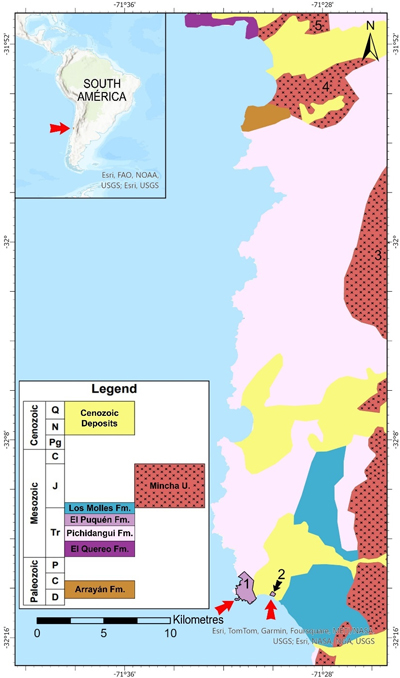
Molles to Los Vilos (ca. 32° S latitude, Fig. 1  ). These rocks include
continental and marine sedimentary and volcanic deposits that accumulated in
southwestern Gondwana (see Cecioni & Westermann,
1968; Rivano &
Sepúlveda, 1991). This thick succession is subdivided into the
following formations, listed from base to top (Cecioni & Westermann,
1968;
Fig. 1 ):
). These rocks include
continental and marine sedimentary and volcanic deposits that accumulated in
southwestern Gondwana (see Cecioni & Westermann,
1968; Rivano &
Sepúlveda, 1991). This thick succession is subdivided into the
following formations, listed from base to top (Cecioni & Westermann,
1968;
Fig. 1 ):
|
|
Figure 1: Location
map of the section studied in Los Molles, La Ligua, Fifth Region, Chile.
Modified from Rivano and Sepúlveda,
1991; Rivano
et al., 1993. Red arrows show the studied areas. 1: El Puquén Formation,
Los Lobos area (Cecioni & Westermann,
1968), 2: El Puquén Formation, El Chivato area (Cecioni y Westermann,
1968), 3: Location of K-Ar 164±4 Ma quartz
monzodiorite (Espiñeira,
1989; Rivano et al., 1993), in
general from 156 to 170 Ma, 4: Location of Rb-Sr 200±10 Ma (Nasi
Prado et
al., 1985; Brook et al., 1986; Parada
et al., 1988) and 5: Location of Rb-Sr 203±15 Ma (Brook
et al., 1986) and location of K-Ar 173±20 Ma granodiorite (Munizaga,
1972). |
These
Triassic-Jurassic successions crop out to the south and west of the Mincha
Superunit, an Early-Middle Jurassic plutonic association (Brook
et al., 1986; Rivano & Sepúlveda,
1991; Fig. 1 ). Rifting during the Triassic in southwestern Gondwana has
been widely proposed by several authors (e.g.,
Charrier, 1979; Bell & Suárez,
1995); however, "the extensional faults that control the basins in Chile
have not been clearly identified" (see Charrier et al.,
2014). In this note, we present data supporting
synsedimentary extensional tectonism at the base of the El Puquén Formation,
complemented by facies studies indicative of intra- and fore-arc deposition. The
Late Triassic age previously assigned to these rocks, based on stratigraphic and
paleontological data (Fuenzalida, 1938; Azcárate & Fasola,
1970; Troncoso &
Herbst, 1999; Melchor & Herbst,
2000; Herbst &
Troncoso, 2014), is corroborated here by two new laser-ablation U-Pb zircon dates. This article also contributes to the understanding of the
geology of an area that, despite being a classic locality with excellent
exposures of Upper Triassic and Lower Jurassic sedimentary and volcanic rocks
located near major cities such as Santiago and Viña del Mar, has a limited
geological literature (Fuenzalida, 1938; Cecioni & Westermann,
1968; Azcárate &
Fasola,
1970; Bell & Suárez,
1995; Melchor & Herbst,
2003; Suárez
et al., 2018).
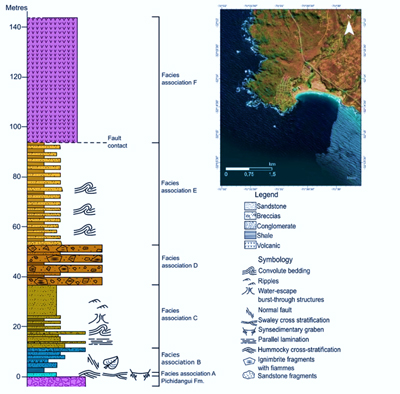
The
main stratigraphic elements of the upper strata of the Pichidangui Formation,
the El Puquén Formation, and the lower horizons of the Los Molles Formation are
presented in Figure
2 .
|
|
Figure 2: Facies
associations of the El Puquén Formation. Inset, Google satellite image of the
studied area.
|
The
Pichidangui Formation is a subduction-related volcanic succession (Ibáñez,
2021) comprising basalts, andesitic basalts, rhyolites, and dacites (Vergara
et al., 1991; Cancino, 1992; Ibáñez,
2021). It is up to
4,000 to 5,000 m thick, exhibiting a bimodal magmatic pattern inferred to be
synchronous with rifting (Morata et
al., 2000). "Marine sedimentary rocks predominate in its lower section,
whereas rocks characteristic of paralic conditions of sedimentation are found at
the top, where temporary continental conditions are reported" (Cecioni
& Westerman, 1968; Vicente,
1976; Charrier, 1979; Vergara et al.,
1991, 1995; Morata et al., 2000). The
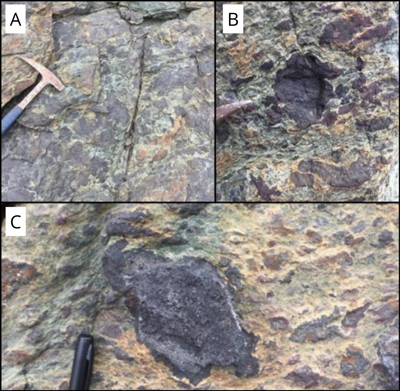
upper horizons of the Pichidangui Formation are primarily products of
hydrovolcanism, including hyaloclastites and peperites (Fig.
3 ) (Suárez
et al., 2018; Ibáñez, 2021). Some of the volcaniclastic beds
exhibit fragments with morphology interpreted as the result of subaerial bombs (Fig.
3.B-C ) Other fragments resemble cauliflower bombs. Coherent
andesitic-basaltic rocks and possible pillow lavas have also been reported (Ibáñez,
2021). The uppermost beds assigned to the Pichidangui Formation are clast-supported conglomerates, pervasively silicified. The clasts are
interpreted as fragments of ignimbrites based on the macroscopic identification
of fiamme-like structures, which, however, could not be corroborated in
thin-section due to intense silicification.
|
|
Figure 3: Volcaniclastic deposits of the Pichidangui
Formation at the El Puquén area: A) hyaloclastite; B) volcanic fragment
interpreted as a bomb showing a form due to aerodynamic shaping during rotation;
C) fragment with a darker rim (probably a chilled margin). |
Upper
Triassic sedimentary rocks exposed in three separate areas near the town of Los
Molles were assigned to the El Puquén Formation by Cecioni and Westermann
(1968; Fig. 1 ). From north to south, these are:
i) a succession of
approximately 27.5 meters of minimum thickness (Melchor & Herbst,
2000) on the continental coast northeast of Los Lobos
Island, and in fault contact with the Pichidangui Formation; ii) the sedimentary
strata overlying the Pichidangui Formation, cropping out from a few tens of
meters south of El Puquén up
to the northern side of the Los Molles beach,
and iii) exposures cropping out between the Estero Los Molles and Estero El
Chivato, partly in the area of the present-day El Chivato camp site, with a
thickness of 200 m (Cecioni & Westermann,
1968). These authors indicate a total
thickness of 500-1,000 m for these rocks. A succession of mainly monolithologic
volcanic breccias, which were included in the La Caleta Formation by Cecioni
and Westermann (1968), is herein tentatively incorporated as another
facies (facies F) of the El Puquén Formation. Initially, these authors
suggested that the latter beds were deposited in a Carboniferous
glaciolacustrine environment; however, Cecioni later referred them to the
Middle? Triassic based on the presence of plant remains assigned to that age (in
Stipanicic, 1983, see Melchor & Herbst,
2000).
The thinly-bedded shales and fine-grained sandstones exposed in the El Chivato camp site resemble some of the Los Molles Formation strata, but in this work are incorporated in the El Puquén Formation (as Facies association G) based on the presence of lapilli air-fall intercalations considering the absence of pyroclastic beds in the Los Molles Formation. This facies association is in turn overlain, with a covered contact-probably conformably, considering the near parallelism of the beds-by the Los Molles Formation exposed to the south. The lower beds of the Los Molles Formation at this locality include two paleochannels filled with quartz-rich conglomerates separated by shale and fine-grained sandstone, some with hummocky cross bedding. Melo (2020) interpreted these beds as a subaqueous facies of a delta system. Hettangian ammonites (Cecioni & Westermann, 1968), in fine-grained sandstones tens of meters stratigraphically above these paleochannels, suggest a Late Triassic age for these basal beds. Higher up in the Los Molles Formation, trace fossils indicate a shallow sea (Covacevich et al., 1987), followed by deepening of the basin with contourites and turbidites that thicken stratigraphically upwards. Some of these facies and the presence of slump horizons have been interpreted as representing slope-trench deposits by Bell and Suárez (1995).
A Late Triassic Triassic age for the El Puquén Formation is confirmed here by U-Pb zircon laser-ablation dating (see below). The base of the El Puquén Formation is marked by the first sandstone overlying, apparently in conformity, a clast-supported conglomerate composed of subrounded silicified clasts interpreted as fragments of ignimbrites. The latter is based on the presence of fiamme-like structures, measuring ca. 5 cm in length and assigned herein to the Pichidangui Formation.
Seven
facies associations are recognized in the El Puquén Formation (Fig.
2 ;
Table 1).
Table 1: Facies association of the El Puquén Formation.
| Late Triassic paleoenvironments of the upper Pichidangui, El Puquén and lower Los Molles formations | ||||
| Los Molles Formation | Basal Member | Subaqueous delta-front paleochannels in a fore-arc basin | Fore-arc basin | |
| El Puquén Formation | Fag | Shales, sandstones and lapilli air-fall deposits | Late Triassic marine transgression and distant explosive volcanism | Near-arc lacustrine-marine basin |
| Faf | Subaqueous hydrovolcanism and surtseyan volcanoes indicated by hyaloclastites and air-fall pyroclasts | Intra-arc lacustrine basin | ||
| Fae | Basin floor accumulation of sandstones alternance alternating with shales, near the roots of volcanoes as indicated by the peperite dikes emplaced in shales | Near-arc lacustrine basin | ||
| Fad | Heterogenous, mixed-up pyroclastic flow, accumulated in the basin floor, thin-bedded turbidites | Slope apron | Near-arc lacustrine basin | |
| Fac | Slope-apron facies with mass flow deposits, slumps, olistolith, synsedimentary dikes, convolute bedding | Synsedimentary deformed sediments | ||
| Fab | Deeper lake accumulation as suggested by the predominance of dark shales, probably anoxic as inferred from the absence of trace fossils, with air-fall tuff intercalations. Thin bedded turbidites | Post-graben, during extensional tectonism | Near-arc lacustrine basin | |
| Faa | Storm-prone, shallow lacustrine environment as indicated by hummocky cross laminations and the inverse to normally graded pyroclastic-rich sandstones interpreted as tempestites | Synsedimentary graben | Near-arc lacustrine basin | |
| Pichidangui Formation | Subaqueous volcanoes, occasionally emerging above the water-surtseyan volcanoes in an intra-arc basin | Intra-arc basin | ||
A syn-extensional tectonic sedimentary succession, 160 cm-thick, forms the base of
the El Puquén Formation approximately 200 meters south of the El Puquén site.
It conformably overlies a clast-supported conglomerate composed of subrounded
silicified clasts of ignimbrites, which are assigned herein to the Pichidangui
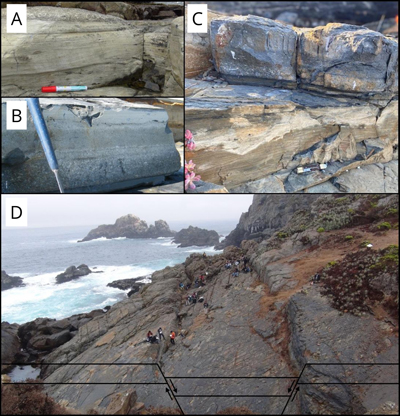
Formation. From base to top, these beds include a 40 cm- thick layer with
hummocky and swaley cross-stratification in fine-grained sandstones, with
laminae thickening into swales and thinning over hummocks, with a wavelength of
approximately 100 cm (Fig. 4.A ). These strata are overlain by grey
parallel-laminated shale, 8 cm-thick, and two pyroclastic-rich, coarse volcanic
sandstones, 10-20 cm in thickness, that exhibit normal grading (Fig.
4.B-C ).
These sediments are interpreted as having formed in shallow waters by storms (tempestites),
although heavy waves due to volcanism in coastal areas might also generate
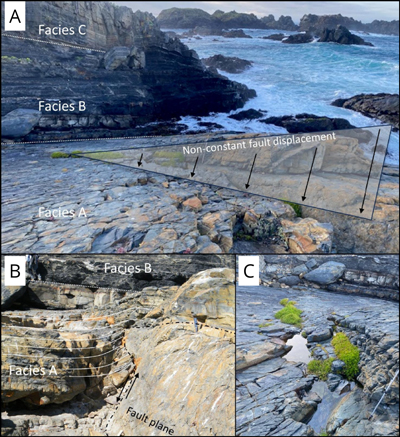
similar sedimentary structures. These strata were deformed by a pair of
well-developed extensional faults while the sediments were still unconsolidated,
resulting in the formation of a synsedimentary graben (Fig. 4.D ). The
graben is flanked by normal faults, exposed along a 30 meters length, with
attitudes of 120/60 (strike/dip) (the western fault) and 074/45 (the eastern
fault), separated by a distance of up to 15 m. These are scissor faults, covered
by low-angle dipping sedimentary beds of facies association B. This depositional
contact supports the synsedimentary nature of the graben. The
western fault shows a variable displacement along the fault, with a westward
increasing offset from an initial point of no offset (Fig. 5.A ). The
faulted sedimentary rocks exhibit a gradual change from folding above the fault
to no deformation at the initial point of no offset (Fig. 5.B ). At the
point of no offset, the beds of facies association B cover the fault with no
deformation (Fig. 5.C ).
|
|
Figure 4: A) Hummocky and swaley cross stratification
in fine grained sandstones with laminae thickening into swales and thinning over
hummocks, overlain by coarse grained volcanic sandstone locally with reverse to
normal grading (tempestites); B-C) parallel-laminated shales, that
exhibit normal grading; D) synsedimentary graben bounded by normal faults
separated by approximately 13-15 meters, with a vertical throw of less than 2
meters. |
|
|
Figure 5: A) scissor fault shows variable displacement
along the fault from an initial point of no offset; B) sedimentary beds
draping the fault and gradual upward decreasing of the dip of the faulted
sedimentary strata; C) blanketing of the fault by overlying beds of facies
association B. |
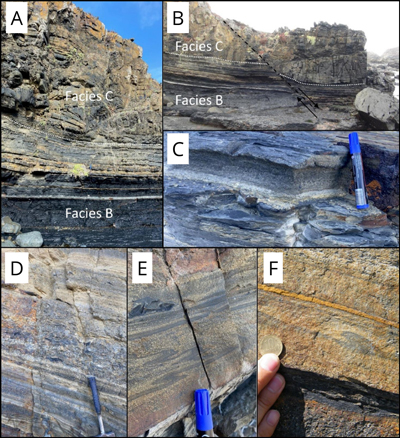
A
10 m thick succession of alternating dark grey shales, sandstones, normally
graded thin volcanic sandstones, and thin light grey tuff intercalations covers
the synsedimentary faults of the graben (Fig. 6.A ). Healed and short (less
than 4 m in length) normal faults cut through these beds (Fig.
6.B ). The
main sedimentary beds within this facies association are (Fig.
6 ):
i) Thin
parallel-laminated and massive dark shales, less than 2 cm thick, in horizons
ranging from 3 to 210 cm thick, some with fossil plant remains (Cecioni
& Westermann, 1968); ii) Thin-
and medium-bedded (1-10 cm thick), normally graded and massive fine to
medium-grained turbidites, some with mud flakes (Fig. 6.C ); iii) White
airfall pyroclastic intercalations, 1-4 cm thick (Fig. 6.A ); iv)
Parallel-laminated sandstones; v) Synsedimentary breccia with rip-up fragments
of shale (Fig. 6.D ). Dewatering features are locally present: load casts,
initially interpreted as originating from currents (the flames of Plate I, fig.
1 of Cecioni & Westermann,
1968) and convolute bedding, some overturned (Fig. 6.E-F ). The absence of
any signs of trace fossils in the dark shales may suggest an anoxic environment
in a relatively deep lake environment, where turbidites and ash falls accumulate.
|
|
Figure 6: A)
coarse synsedimentary breccia at the base
of facies association C overlying a thin-bedded succession of facies association
B; B) thin- and medium- bedded turbidites, shale, white thin layers of
ash-fall tuff of facies association B, covered by synsedimentary coarse breccias
of facies association C, with a small healed synsedimentary normal fault cutting
both facies associations; C) thinly bedded normal and inverse to normally
graded volcaniclastic turbidites; D) synsedimentary breccia with rip-up
fragments of shale; E) overturned convolute bedding; F)
flame-load-cast at the base of thin-bedded turbidite (see Plate I, fig. 1 of Cecioni
& Westermann, 1968). |
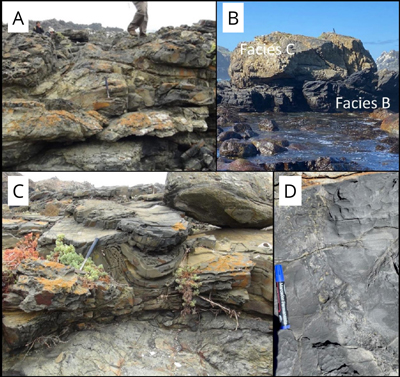
)This
facies association, approximately 25 m thick, is mainly formed by mass flow and
slumped deposits (Fig. 7.A ). It conformably overlies facies association B
(lower strata in Fig. 6.A ), with a 470 cm thick basal horizon, of
coarse-grained sandstones, granule conglomerates, some filling paleochannels,
parallel-laminated sandstones, and synsedimentary breccias. These beds are
commonly contorted and formed by slumped beds (Fig. 7.A ). Some facies of
this association are an olistolith (Fig. 7.B ); c) Slumped sediments,
including folded beds and synsedimentary breccias; d) A sedimentary dike
probably formed by overpressure related to the superposition of slumped beds on
sedimentary strata or by seismicity associated with volcanic eruptions (Fig.
7.D ); e) Convolute bedding and water-escape burst-through structures at the
top of sandstone turbidites (Fig. 7.C ).
|
|
Figure 7: A) slumped beds;
B)
olistolith; C)
convolute bedding; D) synsedimentary dike of facies C. |
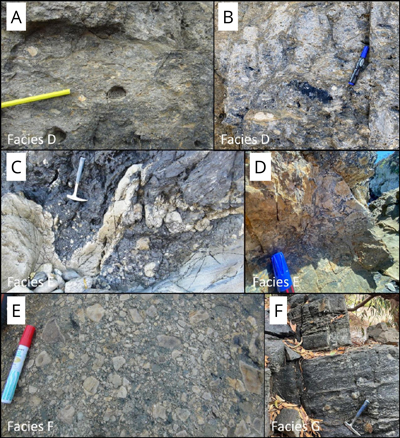
Facies
association D is separated from the rest of the succession to emphasize the
presence of a heterogeneous breccia, including large boulders of ignimbrite
fragments with fiammes (1.5 x 2.0 m), shales, and stratified sandstone layers 30
cm-long (Fig. 8.A-B ). This bed is interpreted as the result of mixing
between a pyroclastic flow and unconsolidated and semiconsolidated sediments on
the floor of a lacustrine basin. The underlying sedimentary beds are deformed, probably
due to overpressure generated by the arrival of the pyroclastic flow while the
sediments were still wet. A Late Triassic U-Pb zircon laser ablation date from
a sample of these rocks is presented in this note (sample LMM-4, see below).
|
|
Figure 8:
A-B) heterogeneous breccia of facies
association D, with intermingling of ignimbrite blocks with eutaxitic foliation
and sedimentary fragments (A) and shale inclusions in the breccia (B); C) peperite dike emplaced in fine and medium-grained sandstones and
shales; D) brecciation of margin of peperite dike, E) monolithologic
volcanic breccia interpreted as hyaloclastites, weakly foliated of facies
association F; F) thinly bedded sandstones and shales with intercalations
of monolithologic lapilli beds of the facies association G. |
Facies
association E is a ca. 40 m-thick succession conformably overlying facies
association D and is composed of alternating shales and massive and normally
graded sandstones (10-150 cm thick), interpreted as turbidites, with occasional
convolute bedding, and synsedimentary breccias with rip-up shale fragments. This
succession was intruded by peperite dikes (Fig. 8.C-D ). Some of these
dikes are tabular, 4 m wide, with a NW trend, while others are irregular in
shape. Synsedimentary dikes, 10-40 cm thick, developed along some of the
contacts of the peperite dikes with the cover rocks. These synsedimentary dikes
were likely formed as a result of processes related to the emplacement of the
peperites.
A
succession of monolithologic volcanic breccias, in fault
contact with facies association E, included in the La Caleta Formation by Cecioni
and Westermann (1968), is tentatively incorporated herein as a
distinct facies of the El Puquén Formation. The contact fault is poorly exposed,
which prevented the identification of its nature and any inference about
stratigraphic relationship of both facies associations. A sedimentary structure
shown in a photograph from this succession was published by Cecioni and Westermann
(1968: Pl. I, fig. 2, p. 55) who interpreted it as resulting from "isolated
angular pebbles which apparently tumbled down as a 'rain' on the
unconsolidated very fine laminated limy-sandy sediment, so that in sinking, the
laminae were moulded around it. This phenomenon suggests rafting, possibly by
floating ice." Based on this interpretation, Cecioni and Westermann
(1968) suggested a Carboniferous age for these strata, considering the
glaciation of that time. However, the timing of these strata was revised when
Late Triassic fossil leaves were found (Cecioni in Stipanicic,
1983, 2001). Our interpretation of this structure is of an impact-sag feature
caused by a volcanic bomb in the non-lithified bottom sediment of the El Puquén
Formation basin. Most of the coastal exposures of this facies association are
monolithologic volcanic breccias, interpreted herein as hyaloclastites (Fig.
8 ), probably the products of surtseyan volcanism. A Late Triassic U-Pb
zircon laser ablation date from a sample of these rocks is presented in this
note (sample LMM-6, see below).
A
succession of thinly bedded sandstones and shales with 60 cm-thick
intercalations of monolithologic lapilli beds, 200 m-thick, representing
air-fall deposits, and exposed between Estero Los Molles and Estero El Chivato (at
the El Chivato camping site), represents the southern beds assigned to the El
Puquén Formation (Fig. 8.E ). Although an area with no outcrops separates
these strata from those of Facies F to the north and from the base of the Los
Molles Formation to the south, they are interpreted as the youngest association
of this formation (Cecioni & Westermann,
1968), based on the general southward
younging succession of the El Puquén Formation. The latter authors indicated
that "the interbedding of plant-bearing beds with sediments bearing marine
faunas ['Los Molles flora' and 'Nevadites' (Sandlingites) of Fuenzalida,
1938] suggests alternation between lacustrine and marine environments." An
area with no exposure separates these beds from the overlying Los Molles
Formation. This association is lithologically similar to the basal facies of the
Los Molles Formation, except for the distinct lapilli-tuff intercalations.
The Laser Ablation Zircon U-Pb analyses were conducted at the Isotopic Geology unit of the Servicio Nacional de Geología y Minería (SERNAGEOMIN), Chile (laboratorios@sernageomin.cl). The U-Pb dating method using laser ablation inductively coupled plasma mass spectrometry (LA-ICP-MS) was conducted by F. Llona, Marco Suárez, and A. Bustos. Sample preparation involved crushing, grinding, and obtaining fragments of less than 500 μm, followed by the concentration of heavy minerals using a Gemini table, leading to the manual separation of zircons under UV light or dense liquids. Zircons were mounted on a 2.5 cm diameter epoxy resin briquette, polished to expose the crystal interiors, with 30 to 120 crystals installed per sample depending on the dating objectives. Cathodoluminescence images were obtained to identify internal zircon structures, and backscattered electron images visualized fractures and inclusions, using a Zeiss MA-10 scanning electron microscope. The briquettes were then placed in a Photon Machines Analyte 193.G2 laser ablation system, with standards GJ-1. The resulting material was transported via helium and argon gases to a Thermo Fischer Element XR mass spectrometer for isotope measurement. Data reduction was performed with Iolite software, with isotopic fractionation and instrumental drift corrected using the primary standard. Secondary standards were treated as unknowns for quality control. Final age results were calculated and organized using the Isoplot add-in for Microsoft Excel, employing constants adopted from the 25th International Geological Congress in 1976, Sydney, Australia, subsequently published by Steiger and Jäger (1977) [λ(238U)=1.55125x10⁻¹⁰ year-1, λ(235U)=9.8485x10⁻¹⁰ year-1, atomic ratio 238U/235U=137.88].
Two samples of igneous rocks from the El Puquén Formation were analyzed:
Sample LMM-4 (262242-6430389) is from an
ignimbrite fragment from a synsedimentary volcaniclastic breccia from facies
association E, interpreted as the result of the collapse of a pyroclastic flow
along the slope of a lake, incorporating shales and sandstones as rip-up
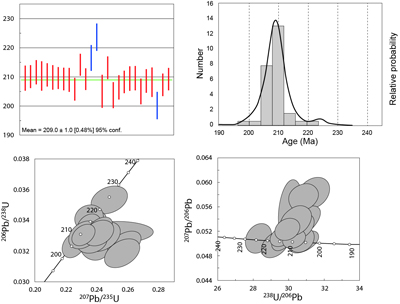
fragments. Twenty-seven zircon grains were analyzed that gave 206Pb/238Pb
ages of 223±4.7 to 200.1±4.7 Ma (Fig. 9 ,
Table 2). The youngest nine
gave a near-Rhaetian age ranging from 208.3±3.8 to 200.1±4.7 Ma, interpreted
as autocrystic zircons, formed near the eruption time. Older Norian radiometric
ages ranging from 209.2±3.7 to 223.5±4.7 Ma, with a weighted mean of the 206Pb/238U ages for 24 analyses gave a Norian age of 209±1.0 Ma, may
represent antecrystic grains from "slightly" older magmas.
|
|
Figure 9: Radiogenics ages of sample
LMM-4. |
Table 2: Sample LMM-4.
| Radiogenic | Ages (Ma) | Corrected Ages (Ma) | |||||||||||||||||||||
| Grain. Spot | U (ppm) |
Pb (ppm) |
Th (ppm) |
207Pb/ 235U |
± | 206Pb/ 238U |
± | rhoc | 207Pb/ 206Pb |
± | 207Pb/ 235U |
± | 206Pb/ 238U |
± | 207Pb/ 206Pb |
± | 206Pb/ 238U |
± | 207Pb/ 206Pb |
||||
| 1 | 54 | 18 | 37 | 0.2409 | 0.0083 | 0.0332 | 0.0007 | 0.1840 | 0.0543 | 0.0017 | 219.1 | 6.7 | 210.6 | 4.2 | 303 | 60 | 209.6 | 4.3 | 0.84944 | ||||
| 2 | 128 | 64 | 139 | 0.2355 | 0.0073 | 0.0332 | 0.0006 | 0.1617 | 0.0522 | 0.0015 | 214.7 | 5.7 | 210.6 | 4.0 | 247 | 52 | 210.1 | 4.0 | 0.84944 | ||||
| 3 | 77 | 30 | 65 | 0.2415 | 0.0070 | 0.0334 | 0.0007 | 0.4862 | 0.0524 | 0.0012 | 219.6 | 5.6 | 212.1 | 4.1 | 290 | 49 | 211.6 | 4.1 | 0.84954 | ||||
| 4 | 103 | 42 | 87 | 0.2388 | 0.0080 | 0.0333 | 0.0008 | 0.4315 | 0.0528 | 0.0013 | 217.5 | 6.5 | 210.9 | 5.0 | 286 | 49 | 210.3 | 5.1 | 0.84946 | ||||
| 7 | 174 | 118 | 254 | 0.2425 | 0.0056 | 0.0333 | 0.0006 | 0.4633 | 0.0532 | 0.0010 | 220.5 | 4.5 | 211.5 | 4.0 | 311 | 39 | 210.7 | 4.0 | 0.84950 | ||||
| 8 | 57 | 23 | 52 | 0.2311 | 0.0076 | 0.0331 | 0.0007 | 0.3628 | 0.0513 | 0.0015 | 211.1 | 6.2 | 210.0 | 4.2 | 242 | 58 | 209.8 | 4.3 | 0.84940 | ||||
| 9 | 60 | 22 | 47 | 0.2520 | 0.0200 | 0.0332 | 0.0006 | 0.0620 | 0.0546 | 0.0032 | 228.2 | 6.6 | 210.7 | 3.7 | 257 | 59 | 209.6 | 3.8 | 0.84945 | ||||
| 10 | 150 | 72 | 158 | 0.2333 | 0.0057 | 0.0331 | 0.0006 | 0.4794 | 0.0521 | 0.0010 | 212.9 | 4.7 | 209.8 | 3.8 | 278 | 42 | 209.3 | 3.9 | 0.84938 | ||||
| 11 | 92 | 49 | 108 | 0.2365 | 0.0066 | 0.0330 | 0.0007 | 0.4589 | 0.0523 | 0.0012 | 215.5 | 5.3 | 209.5 | 4.2 | 291 | 48 | 209.0 | 4.1 | 0.84936 | ||||
| 12 | 55 | 18 | 38 | 0.2368 | 0.0078 | 0.0326 | 0.0006 | 0.2495 | 0.0541 | 0.0016 | 215.8 | 6.3 | 206.8 | 3.9 | 334 | 56 | 205.8 | 3.9 | 0.84918 | ||||
| 13 | 135 | 74 | 158 | 0.2385 | 0.0060 | 0.0338 | 0.0006 | 0.3765 | 0.0518 | 0.0011 | 217.2 | 4.8 | 214.6 | 3.7 | 260 | 44 | 214.2 | 3.7 | 0.84971 | ||||
| 14 | 157 | 74 | 163 | 0.2339 | 0.0053 | 0.0330 | 0.0006 | 0.4675 | 0.0517 | 0.0010 | 213.4 | 4.4 | 209.6 | 3.7 | 262 | 40 | 209.2 | 3.7 | 0.84937 | ||||
| 15 | 65 | 24 | 51 | 0.2350 | 0.0075 | 0.0342 | 0.0007 | 0.1544 | 0.0515 | 0.0016 | 214.3 | 6.0 | 216.6 | 4.4 | 209 | 58 | 216.3 | 4.5 | 0.84984 | ||||
| 16 | 59 | 25 | 49 | 0.2481 | 0.0095 | 0.0353 | 0.0008 | 0.3065 | 0.0521 | 0.0018 | 225.0 | 7.6 | 223.9 | 4.7 | 268 | 67 | 223.5 | 4.7 | 0.85034 | ||||
| 17 | 115 | 66 | 138 | 0.2392 | 0.0084 | 0.0325 | 0.0009 | 0.0756 | 0.0555 | 0.0019 | 217.8 | 6.2 | 206.4 | 5.6 | 335 | 59 | 205.0 | 5.6 | 0.84915 | ||||
| 18 | 113 | 50 | 106 | 0.2351 | 0.0063 | 0.0336 | 0.0007 | 0.2595 | 0.0516 | 0.0012 | 214.4 | 5.1 | 213.3 | 4.0 | 236 | 48 | 213.0 | 4.1 | 0.84962 | ||||
| 19 | 68 | 29 | 58 | 0.2577 | 0.0088 | 0.0324 | 0.0007 | 0.4669 | 0.0581 | 0.0016 | 232.8 | 7.0 | 205.8 | 4.5 | 506 | 59 | 203.8 | 4.5 | 0.84911 | ||||
| 20 | 64 | 23 | 50 | 0.2275 | 0.0081 | 0.0326 | 0.0007 | 0.3398 | 0.0520 | 0.0016 | 208.1 | 6.5 | 206.9 | 4.2 | 262 | 59 | 206.4 | 4.2 | 0.84919 | ||||
| 21 | 126 | 62 | 135 | 0.2368 | 0.0063 | 0.0329 | 0.0006 | 0.3687 | 0.0521 | 0.0012 | 215.8 | 5.1 | 208.8 | 3.8 | 279 | 49 | 208.3 | 3.8 | 0.84931 | ||||
| 22 | 104 | 44 | 97 | 0.2302 | 0.0060 | 0.0331 | 0.0007 | 0.4435 | 0.0516 | 0.0010 | 210.3 | 4.9 | 209.8 | 4.2 | 240 | 40 | 209.4 | 4.2 | 0.84938 | ||||
| 23 | 130 | 64 | 141 | 0.2311 | 0.0062 | 0.0331 | 0.0007 | 0.4133 | 0.0515 | 0.0012 | 211.1 | 4.9 | 209.8 | 4.1 | 237 | 47 | 209.5 | 4.1 | 0.84939 | ||||
| 24 | 193 | 109 | 242 | 0.2249 | 0.0060 | 0.0324 | 0.0007 | 0.3137 | 0.0518 | 0.0011 | 206.0 | 4.9 | 205.5 | 4.4 | 225 | 41 | 205.1 | 4.4 | 0.84910 | ||||
| 25 | 82 | 31 | 66 | 0.2309 | 0.0068 | 0.0329 | 0.0007 | 0.4287 | 0.0517 | 0.0012 | 210.9 | 5.5 | 208.9 | 4.0 | 252 | 47 | 208.6 | 4.1 | 0.84933 | ||||
| 26 | 83 | 34 | 75 | 0.2439 | 0.0093 | 0.0330 | 0.0008 | 0.3518 | 0.0535 | 0.0018 | 221.6 | 7.4 | 209.0 | 5.0 | 340 | 71 | 208.2 | 5.0 | 0.84933 | ||||
| 27 | 53 | 17 | 31 | 0.2563 | 0.0093 | 0.0319 | 0.0008 | 0.3998 | 0.0587 | 0.0019 | 231.7 | 7.5 | 202.2 | 4.8 | 494 | 65 | 200.1 | 4.7 | 0.84887 | ||||
| 28 | 54 | 20 | 43 | 0.2304 | 0.0080 | 0.0327 | 0.0006 | 0.2606 | 0.0514 | 0.0016 | 210.5 | 6.4 | 207.6 | 3.8 | 251 | 61 | 207.3 | 3.8 | 0.84924 | ||||
| 30 | 116 | 51 | 110 | 0.2336 | 0.0063 | 0.0330 | 0.0006 | 0.4231 | 0.0517 | 0.0012 | 213.1 | 5.2 | 209.6 | 3.8 | 272 | 48 | 209.2 | 3.8 | 0.84937 | ||||
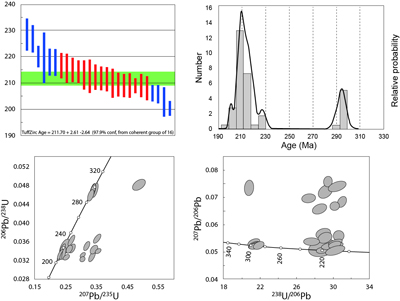
,
Table 3). The five youngest zircon grains gave a Rhaetian age ranging from 208.1±4.4
to 200.5±2.7 Ma, interpreted as autocrystic zircons and indicative of the
eruption age. Twenty grains gave Norian ages ranging from 209.0±4.3 to 226.9±5.1
Ma, with a weighted mean of the 206Pb/238U ages giving a Norian age of
211.70 ± 2.61-2.64 Ma, may represent antecrystic grains from an older crystallization
from the same magma and/or as inherited zircons derived from older magmas. Six
Permian ages ranging from 289.0±6.2 to 296.0±7.5 Ma, represent some inherited
zircons from older rocks (Table 3).|
|
Figure 10: Radiogenics ages of sample LMM-6. |
Table 3: Sample LMM-6.
| Radiogenic | Ages (Ma) | Corrected Ages (Ma) | |||||||||||||||||||
| Grain. Spot | U (ppm) |
207Pb/ 235U |
± | 206Pb/ 238U |
± | rhoc | 207Pb/ 206Pb |
± | 207Pb/ 235U |
± | 206Pb/ 238U |
± | 207Pb/ 206Pb |
± | 206Pb/ 238U |
± | 207Pb/ 206Pb | ||||
| 1 | 300 | 0.3053 | 0.0071 | 0.03315 | 0.00047 | 0.58385 | 0.0657 | 0.0011 | 270.5 | 5.6 | 210.2 | 2.9 | 791 | 34 | 206.2 | 2.9 | 0.84941 | ||||
| 2 | 210 | 0.3549 | 0.0081 | 0.03398 | 0.00045 | 0.47009 | 0.0743 | 0.0014 | 308.4 | 6.0 | 215.4 | 2.8 | 1040 | 38 | 209.0 | 2.8 | 0.84976 | ||||
| 3 | 191 | 0.3375 | 0.0069 | 0.04679 | 0.00120 | 0.70849 | 0.05214 | 0.00067 | 295.3 | 5.2 | 294.8 | 7.2 | 288 | 30 | 294.8 | 7.5 | 0.85518 | ||||
| 4 | 213 | 0.3041 | 0.0070 | 0.03230 | 0.00043 | 0.2096 | 0.0676 | 0.0015 | 269.6 | 5.6 | 204.9 | 2.7 | 857 | 45 | 200.5 | 2.7 | 0.84906 | ||||
| 5 | 128 | 0.2301 | 0.0047 | 0.03302 | 0.00070 | 0.44182 | 0.0499 | 0.00097 | 210.3 | 3.9 | 209.4 | 4.4 | 181 | 43 | 209.5 | 4.4 | 0.84936 | ||||
| 6 | 102 | 0.2613 | 0.0083 | 0.03437 | 0.00073 | 0.41152 | 0.0549 | 0.0016 | 235.7 | 6.6 | 217.9 | 4.5 | 397 | 61 | 216.7 | 4.6 | 0.84993 | ||||
| 7 | 164 | 0.3180 | 0.0083 | 0.03509 | 0.00081 | 0.56781 | 0.0664 | 0.0013 | 280.4 | 6.4 | 222.3 | 5.0 | 826 | 42 | 218.0 | 5.0 | 0.85023 | ||||
| 9 | 190 | 0.2682 | 0.0093 | 0.03620 | 0.00095 | 0.762 | 0.0537 | 0.0014 | 241.3 | 7.3 | 229.3 | 5.9 | 346 | 57 | 228.4 | 5.9 | 0.85070 | ||||
| 10 | 338 | 0.2286 | 0.0053 | 0.03311 | 0.00084 | 0.78905 | 0.05064 | 0.00061 | 209.1 | 4.3 | 210.0 | 5.2 | 224 | 28 | 209.9 | 5.3 | 0.84940 | ||||
| 11 | 128 | 0.2382 | 0.0061 | 0.03406 | 0.00086 | 0.68568 | 0.0514 | 0.001 | 216.9 | 4.9 | 215.9 | 5.3 | 250 | 45 | 215.7 | 5.4 | 0.84980 | ||||
| 12 | 74 | 0.2299 | 0.0064 | 0.03280 | 0.00070 | 0.516 | 0.0502 | 0.0011 | 210.1 | 5.2 | 208.0 | 4.3 | 203 | 49 | 208.1 | 4.4 | 0.84927 | ||||
| 13 | 303 | 0.3412 | 0.0100 | 0.03433 | 0.00076 | 0.44353 | 0.0701 | 0.0018 | 298.1 | 7.6 | 217.6 | 4.7 | 941 | 53 | 212.3 | 4.7 | 0.84991 | ||||
| 14 | 232 | 0.2399 | 0.0053 | 0.03365 | 0.00086 | 0.67652 | 0.05127 | 0.00081 | 218.3 | 4.3 | 213.3 | 5.4 | 251 | 36 | 213.1 | 5.4 | 0.84962 | ||||
| 15 | 135 | 0.2704 | 0.0083 | 0.03458 | 0.00079 | 0.50964 | 0.0554 | 0.0012 | 243.0 | 6.6 | 219.2 | 4.9 | 416 | 45 | 217.8 | 4.9 | 0.85002 | ||||
| 16 | 146 | 0.2414 | 0.0047 | 0.03393 | 0.00073 | 0.61406 | 0.05045 | 0.00082 | 219.6 | 3.8 | 215.1 | 4.5 | 210 | 36 | 215.1 | 4.6 | 0.84974 | ||||
| 17 | 170 | 0.3351 | 0.0088 | 0.03286 | 0.00089 | 0.6721 | 0.072 | 0.0014 | 293.5 | 6.6 | 208.4 | 5.5 | 993 | 40 | 202.8 | 5.4 | 0.84929 | ||||
| 18 | 80 | 0.3517 | 0.0097 | 0.03663 | 0.00083 | 0.712 | 0.0683 | 0.0012 | 306.0 | 7.2 | 231.9 | 5.1 | 878 | 39 | 226.9 | 5.1 | 0.85088 | ||||
| 19 | 90 | 0.3373 | 0.0083 | 0.04698 | 0.00100 | 0.77526 | 0.0527 | 0.00086 | 295.1 | 6.3 | 295.9 | 6.3 | 310 | 37 | 295.8 | 6.2 | 0.85526 | ||||
| 23 | 198 | 0.2298 | 0.0048 | 0.03341 | 0.00070 | 0.70905 | 0.05042 | 0.00081 | 210.1 | 3.9 | 211.9 | 4.3 | 209 | 37 | 211.9 | 4.4 | 0.84952 | ||||
| 24 | 251 | 0.2311 | 0.0045 | 0.03337 | 0.00071 | 0.7168 | 0.0507 | 0.0008 | 211.1 | 3.6 | 211.6 | 4.4 | 220 | 35 | 211.5 | 4.5 | 0.84951 | ||||
| 26 | 232 | 0.3455 | 0.0086 | 0.04698 | 0.00120 | 0.62917 | 0.05209 | 0.00094 | 301.3 | 6.5 | 295.9 | 7.4 | 283 | 42 | 296.0 | 7.5 | 0.85526 | ||||
| 27 | 362 | 0.2408 | 0.0043 | 0.03382 | 0.00067 | 0.78016 | 0.05074 | 0.00054 | 219.1 | 3.6 | 214.4 | 4.2 | 228 | 25 | 214.3 | 4.2 | 0.84970 | ||||
| 28 | 135 | 0.4872 | 0.0170 | 0.04811 | 0.00100 | 0.47072 | 0.0717 | 0.0023 | 403.0 | 11.0 | 302.9 | 6.4 | 989 | 66 | 295.7 | 6.1 | 0.85575 | ||||
| 29 | 324 | 0.2427 | 0.0063 | 0.03358 | 0.00100 | 0.73534 | 0.05133 | 0.0009 | 220.7 | 5.0 | 212.9 | 6.2 | 254 | 41 | 212.7 | 6.3 | 0.84960 | ||||
| 30 | 293 | 0.2437 | 0.0045 | 0.03306 | 0.00068 | 0.56062 | 0.05284 | 0.00081 | 221.4 | 3.7 | 209.7 | 4.2 | 314 | 35 | 209.0 | 4.3 | 0.84938 | ||||
| 31 | 61 | 0.3309 | 0.0081 | 0.04584 | 0.00100 | 0.50409 | 0.0519 | 0.0011 | 290.2 | 6.1 | 289.0 | 6.2 | 273 | 47 | 289.0 | 6.2 | 0.85478 | ||||
| 32 | 431 | 0.3407 | 0.0054 | 0.04664 | 0.00083 | 0.67283 | 0.05325 | 0.00058 | 297.7 | 4.0 | 293.8 | 5.0 | 338 | 25 | 293.5 | 5.2 | 0.85512 | ||||
| 33 | 422 | 0.2322 | 0.0053 | 0.03302 | 0.00067 | 0.74822 | 0.05128 | 0.00072 | 212.0 | 4.3 | 209.4 | 4.2 | 251 | 33 | 209.1 | 4.2 | 0.84936 | ||||
| 34 | 151 | 0.2464 | 0.0140 | 0.03471 | 0.00150 | 0.52482 | 0.0517 | 0.0021 | 223.7 | 11.0 | 220.0 | 9.5 | 257 | 88 | 219.7 | 9.4 | 0.85007 | ||||
| 36 | 173 | 0.2422 | 0.0053 | 0.03474 | 0.00063 | 0.66374 | 0.05061 | 0.00081 | 220.2 | 4.4 | 220.2 | 3.9 | 216 | 36 | 220.1 | 4.0 | 0.85009 | ||||
| 37 | 175 | 0.2518 | 0.0080 | 0.03268 | 0.00051 | 0.4735 | 0.0559 | 0.0014 | 228.1 | 6.4 | 207.3 | 3.2 | 438 | 52 | 205.8 | 3.2 | 0.84922 | ||||
| 38 | 137 | 0.2394 | 0.0061 | 0.03303 | 0.00071 | 0.62493 | 0.05207 | 0.00098 | 217.9 | 4.9 | 209.5 | 4.4 | 279 | 43 | 209.1 | 4.5 | 0.84937 | ||||
Triassic regression-transgression episodes. The subaqueous environment of the El Puquén and Los Molles formations is evident. The absence of marine fossils in the El Puquén Formation and the presence of fossil leaves suggest a lacustrine setting, except for the inferred uppermost unit (facies association G), where Cecioni and Westermann (1968) "suggest alternation between lacustrine and marine environments." The latter would represent the transition to the marine deposition of the overlying Late Triassic to Early Jurassic marine succession of the Los Molles Formation. This marks the second Triassic regression-transgression episode in the region, following an earlier episode characterized by fan delta to prodelta marine turbidites represented by the El Quereo and possibly the Pichidangui formations (Rivano & Sepúlveda, 1991).
Rhaetian age. Two new U-Pb zircon laser ablation dates from specimens in facies associations D and F of the El Puquén Formation indicate a Rhaetian age ranging from 208 to 200 Ma for this unit. This age is younger than the Late Ladinian-Carnian age indicated by Melchor and Herbst (2000) and the Norian age based on fossil flora and the presence of the cephalopod Sandlingites described by Fuenzalida (1938) and accepted by Cecioni and Westermann (1968). These coeval Rhaetian ages from facies C and E support the inclusion of the latter succession, previously defined as the La Caleta Formation by Cecioni and Westermann (1968), within the El Puquén Formation.
Late Triassic subaqueous volcanism-near-arc basin. Hydrovolcanic deposits as well as breccias with subaerial volcanic ejecta are identified in the upper levels of the Pichidangui Formation and in facies association E of the El Puquén Formation. These beds are interpreted as products of basaltic-andesitic-dacitic lava domes emplaced in a subaqueous environment with a carapace of hyaloclastites and peperites. Therefore, the identification of subaqueous hydrovolcanic facies and bombs in these units, indicative of both subaquatic and subaerial volcanism, suggests surtseyan volcanism, supporting the hypothesis presented by Ibáñez (2021). A near-arc setting, likely within an intra-arc basin, is inferred for the El Puquén Formation. Conversely, the general absence of pyroclastic detritus in the Los Molles Formation may be explained by considering a prevailing wind direction from the ocean to the continent, with the volcanoes to the east, suggesting a fore-arc setting for this formation. This is supported by the north-south belt of Late Triassic to Early Jurassic plutonic rocks (Mincha Superunit; Brook et al., 1986; Rivano & Sepúlveda, 1993) exposed to the east and north of the El Puquén and Los Molles formations, which are considered to be the roots of coeval volcanos.
Continuous intermittent volcanism. Volcanism persisted during the deposition of almost all facies associations (fa) of the El Puquén Formation: air-fall deposits are intercalated throughout the formation, indicating that volcanic activity continued intermittently, either in a diminished capacity or at a greater distance from the volcanic centres. The following are the main volcanic intercalations in this formation: in faA, turbidites with pyroclasts; in faB, ash layer intercalations; in faD, pyroclastic flow mixing with lake-bottom shales and sandstones; in faE, peperites suggesting a nearby volcano; in faF, hyaloclastites and bombs; in faG, lapilli-fall deposits intercalated within the sandstones and shales. This volcanism is a continuation, although less intense, of that observed in the Pichidangui Formation. However, volcanic intercalations were absent during the Late Triassic to earliest Jurassic deposition of the Los Molles Formation.
Synsedimentary extensional tectonism: Scissor-type graben and small faults. A WNW synsedimentary graben and small healed post-graben normal faults identified in facies associations A and B suggest that, for at least part of the Rhaetian, extensional faults controlled the development of the El Puquén sedimentary basin. Although this graben implies limited tectonic extension, it may be interpreted as a fractal representation and the first field evidence supporting the hypothesis of Late Triassic extensional tectonism in the studied region (see Charrier, 1979; Suárez & Bell, 1992; Suarez et al., 2010).
Seismic activity during accumulation of the El Puquén Formation. In addition to the syntectonic extensional faults, numerous other soft-sediment structures formed during and/or after sedimentation and before complete lithification are common features, particularly in facies association C of the El Puquén Formation. These soft-sediment features include slumps, clastic dikes (probably formed due to overpressure from slumped vertically stacked sediments and seismic activity), synsedimentary breccias, convolute bedding, and load casts. The triggering process may have involved seismic activity related to both deep-seated seismicity associated with subduction processes and shallow-level seismicity related to active volcanism. In some cases, seismicity may have generated mass flows that introduced additional weight onto the existing basin floor sediments.
The tectonic setting during the Triassic to Jurassic. One of the prevailing hypotheses on the Permian to Mesozoic tectonic evolution of the Southern Andes is that there was a major break-up at the end of the Triassic, with the recognition of a pre-Andean (early Permian to late Triassic) and an Andean cycle (that began in the late Triassic; e.g., Charrier et al., 2007). The main argument was that these cycles differ mostly in their magmatic history and tectonic regime: the pre-Andean cycle was interpreted as a period of arrested subduction and the development of a continental rift along the southwestern margin of Gondwana, but, new geochemical studies indicate that during the time span of the pre-Andean cycle, subduction was an active process and that the bimodal volcanism of the Triassic Pichidangui Formation in the area of this study also indicates that subduction processes were active in the Triassic, during pre-Andean times (Coloma et al., 2017; Oliveros et al., 2020; Ibáñez, 2021). Furthermore, as indicated herein, there is no major tectonic change during the accumulation of the Late Triassic to Early Jurassic Los Molles Formation (except for a change from fan-delta deposition, probably during a highstand systems tracts and/or tectonism, to slope apron deposits and finally to submarine fan sediments during a lowstand sea-level period (in prep.).
This work was supported by the Universidad Andrés Bello, the Servicio Nacional de Geología y Minería and Fondecyt 511-90. We thank Bastián Oyanedel for the drawings.
Azcárate V. & Fasola A. (1970).- Sobre formas nuevas para la flora triásica de Los Molles.- Boletín del Museo Nacional de Historia Natural, Santiago de Chile, vol. 29, p. 249-269.
Bell C.M. & Suárez M. (1995).- Slope apron deposits of the Lower Jurassic Los Molles Formation, Central Chile.- Revista Geológica de Chile, Santiago de Chile, vol. 22, no. 1, p. 103-114. URL: https://dialnet.unirioja.es/servlet/articulo?codigo=6680830
Brook M., Pankhurst R., Shepard T. & Spiro B. (1986, unpublished).- ANDCHRON : Andean geochronology and metallogenesis. Final report for the Overseas Development Administration Research and Development Project on the application of geochronology, isotope geology and fluid inclusion studies to understanding the geological evolution of the Southern Andes and the setting and formation of metallic ore deposits therein.- British Geological Survey, London, 137 p. URI: https://nora.nerc.ac.uk/id/eprint/523045
Cancino A. (1992, unpublished).- Contribución a la petrología e interpretación tectónica de las rocas volcánicas triásicas y jurásicas de la región central de Chile (33°-34° Lat. S).- Memoria de Título, Universidad de Chile, Santiago de Chile, 259 p.
Cecioni G. & Westermann G.E.G. (1968).- The Triassic Jurassic marine transition of Coastal Central Chile.- Pacific Geology, Tokyo, vol. 1, p. 41-75. URL: https://bibliotecadigital.ciren.cl/handle/20.500.13082/12958
Charrier R. (1979).- El Triásico en Chile y regiones adyacentes de Argentina - Una reconstrucción paleogeográfica y paleoclimática.- Comunicaciones, Universidad de Chile, Santiago de Chile, vol. 26, p. 1-47.
Charrier R., Contreras J.P., Díaz-Bórquez D., Farías M., Jara P., Muñoz-Gómez M., Quiñones S., Rodríguez M.P., Tapia F. & Villaseñor T. (2024).- The Cenozoic Abanico rift system: Implications of increased southward extension in the southern central Andes, in Chile.- Journal of South American Earth Sciences, vol. 148, article 105149, 17 p.
Charrier R., Pinto L. & Rodrıguez M.P. (2007).- Tectonostratigraphic evolution of the Andean Orogen in Chile. In: Moreno T. & Gibbons W. (eds.), The geology of Chile.- Geology of series, Geological Society, London, p. 21-114.
Charrier R., Ramos V., Tapia F. & Sagripanti L. (2014).- Tectono-stratigraphic evolution of the Andean Orogen between 31 and 37°S (Chile and Western Argentina).- Special Publications, Geological Society, London, vol. 399, p. 13-61.
Coloma F., Valin X., Oliveros V., Vásquez P., Creixell C., Salazar E. & Ducea M.N. (2017).- Geochemistry of Permian to Triassic igneous rocks from northern Chile (28°-30°15'S): Implications on the dynamics of the proto-Andean margin.- Andean Geology, Santiago de Chile, vol. 44, no. 2, p. 147-178. URL: https://dialnet.unirioja.es/servlet/articulo?codigo=6163425
Covacevich V., Suárez M. & Sepúlveda P. (1987).- Trazas fósiles de crustáceos decápodos en el Triasico Superior de la Formacion Los Molles (Chile Central): Nueva evidencia indicativa de facies de mar somero.- Revista Geológica de Chile, Santiago de Chile, vol. 30, p. 19-25. URL: https://dialnet.unirioja.es/servlet/articulo?codigo=6158151
Espiñeira D. (1989, unpublished).- Geología del Complejo Plutónico Papudo-Quintero: Aspectos cronológicos y geoquímicos.- Memoria de Título, Universidad de Chile, Santiago de Chile, 146 p.
Fuenzalida V.H. (1938).- Las capas de Los Molles.- Boletín del Museo nacional de Historia natural, Santiago de Chile, vol. 16, p. 66-92. DOI: https://doi.org/10.54830/bmnhn.v16.1937.714
González J., Oliveros V., Creixell C., Velásquez R., Vásquez P. & Lucassen F. (2018).- The Triassic magmatism and its relation with the Pre-Andean tectonic evolution: Geochemical and petrographic constrains from the High Andes of north central Chile (29°30' - 30°S).- Journal of South American Earth Sciences, vol. 87, p. 95-112.
Herbst R. & Troncoso A. (2014).- Las Cycadophyta del Triásico de las Formaciones La Ternera y El Puquén (Chile).- Ameghiniana, Buenos Aires, vol. 37, no. 3, p. 283-292.
Ibáñez V. (2021, unpublished).- Caracterización de las paleofacies volcánicas de la Formación Pichidangui, sector El Puquén, Los Molles, Chile.- Memoria de título, Universidad Andrés Bello, 98 p.
Melchor R.N. & Herbst R. (2000).- Sedimentology of the El Puquén Formation (Upper Triassic, central Chile) and the new plant Mollesia melendeziae gen. et sp. nov. (Pteridophylla, incertae sedis).- Ameghiniana, Buenos Aires, vol. 37, no. 4, p. 477-485.
Melchor R.N. & Herbst R. (2003).- Sedimentology and paleobotany of the El Puquén Formation (Upper Triassic), central Chile.- Ameghiniana, Buenos Aires, vol. 40, no. 4, p. 487-505.
Melo C. (2020, unpublished).- Estratigrafia y sedimentologia de los niveles basales de la Formacion los Molles, Los Molles, Region de Valparaiso, Chile.- Memoria de título, Universidad Andrés Bello, 93 p.
Morata D., Aguirre L., Oyarzun M. & Vergara M. (2000).- Crustal contribution in the genesis of the bimodal Triassic volcanism from the Coastal Range, central Chile.- Revista Geológica de Chile, Santiago de Chile, vol. 27, no. 1, p. 83-98. URL: https://dialnet.unirioja.es/servlet/articulo?codigo=6158364
Munizaga F. (1972).- Edades radiométricas de rocas chilenas. In: Jornadas de Trabajo.- Instituto de Investigaciones Geológicas, Antofagasta, vol. 2, sec. 1, p. 132-145.
Nasi Prado C., Mpodozis C., Cornejo Peláez P., Moscoso Díaz R. & Maksaev V. (1985).- El Batolito Elqui-Limari (Paleozoico superior-Triásico): Características petrográficas, geoquímicas y significado tectónico.- Revista Geológica de Chile, Santiago de Chile, vol. 25-26, p. 77-111. URL: https://dialnet.unirioja.es/servlet/articulo?codigo=6158208
Oliveros O., Vásquez P., Creixell C., Lucassen F., Ducea M.N., Ciocca I., González J., Espinoza M., Salazar E., Coloma F. & Kasemann S.A. (2020).- Lithospheric evolution of the Pre- and Early Andean convergent margin, Chile.- Gondwana Research, vol. 80, p. 202-227.
Parada M., Rivano S., Sepúlveda P., Hervé M., Hervé F., Puig A., Munizaga F., Brook M., Pankhurst R. & Snelling N. (1988).- Mesozoic and Cenozoic plutonic development in the Andes Central Chile (30°30'-31°30').- Journal of South American Earth Sciences, vol. 1, no. 3, p. 249-260.
Rivano S. & Sepúlveda P. (1991).- Hoja Illapel. Región de Coquimbo.- Carta Geológica de Chile, Servicio Nacional de Geología y Minería, Santiago de Chile, no. 69, 1 mapa 1:250.000.
Rivano S., Sepúlveda P., Boric R. & Espiñeira D. (1993).- Hojas Quillota y Portillo.- Carta Geológica de Chile, Servicio Nacional de Geología y Minería, Santiago de Chile, no. 73, 1 mapa 1:250.000.
Steiger R.H. & Jäger E. (1977).- Subcommission on geochronology: Convention on the use of decay constants in geo- and cosmochronology.- Earth and Planetary Science Letters, vol. 36, no. 3, p. 359-362.
Stipanicic P.N. (1983).- The Triassic of Argentina and Chile. In: Moullade M. & Nairn A.E.M. (eds.), The Phanerozoic geology of the world. The Mesozoic, B.- Elsevier, Amsterdam, p. 181-199.
Stipanicic P.N. (2001).- Antecedentes geológicos y paleontológicos. In: Artabe A.E., Morel E.M. & Zamuner A.B. (eds.), El sistema Triásico de Argentina.- Fundación Museo de La Plata "Francisco Pascasio Moreno", La Plata, p. 1-21.
Suárez M. & Bell C.M. (1992).- Triassic rift-related sedimentary basins in northern Chile (24°-29°S).- Journal of South American Earth Sciences, vol. 6, no. 3, p. 109-121.
Suárez M., De la Cruz R., Bell C.M. & Demant A. (2010).- Cretaceous slab segmentation in southwestern Gondwana.- Geological Magazine, Cambridge (UK), vol. 147, no. 2, p. 193-205.
Suárez M., Gressier J.B., Descote P-Y. & De la Cruz R. (2018).- Tectonismo extensional y volcanismo Nórico (Triásico tardío) en Chile Central: Edades U-Pb.- ESEG-2, Actas XV Congreso Geológico Chileno, Concepción, 1 p. (abstract).
Troncoso A. & Herbst R. (1999).- Las Ginkgoales del Triásico del Norte Chico de Chile.- Revista Geológica de Chile, Santiago de Chile, vol. 26, no. 2, p. 255-273. URL: https://dialnet.unirioja.es/servlet/articulo?codigo=6158259
Vergara M., Levi B., Nyström J.O. & Cancino A. (1995).- Jurassic and Early Cretaceous island arc volcanism, extension and subsidence in the Coast Range of central Chile.- Geological Society of America, Bulletin, Boulder - CO, vol. 107, no. 12, p. 1427-1440.
Vergara M., López-Escobar L. & Cancino A. (1991).- The Pichidangui Formation: Some geochemical characteristics and tectonic implications of the Triassic marine volcanism in central Chile (31°55' to 32°20'S).- Geological Society of America, Special Paper, Boulder - CO, vol. 265, p. 93-98.
Vicente J.C. (1976).- Exemple de "volcanisme initial euliminaire" : Les complexes albitophyriques néo-triasiques et mésojurassiques du secteur côtier des Andes Méridionales centrales (32° à 33° L. Sud). In: González-Ferrán O. (ed.), Proceedings of the Symposium on Andean and Antarctic Volcanolgy Problems.- International Association of Volcanology and Chemistry of the Earth's Interior, Special Series, Napoli, p. 267-329.