A high-resolution biostratigraphy for the Upper Oligocene (Chattian) of Jamaica using miogypsinid foraminifers, and its stratigraphic and phylogenetic significance
DOI:
https://doi.org/10.2110/carnets.2026.2609Keywords:
Miogypsina, Miogypsinoides, White Limestone, biostratigraphy, phylogeny, paleogeographyAbstract
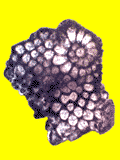
Fourteen miogypsinid populations (ground-down free specimens, thin sections, and polished slabs) from Jamaica are analysed using univariate and bivariate statistics. The populations consist of one sample of free specimens from which orientated equatorial sections were prepared and thirteen populations with random equatorial sections on polished blocks. The populations are sorted into chronospecies based on mean X (Xm) values with four chronospecies (Miogypsinoides complanatus, Miogypsina thalmanni, Mio. 'basraensis', and Mio. tani) identified. Three samples collected from a single traverse show a succession of three successive chornospecies (Ms. complanatus, Mio. thalmanni, and Mio. 'basraensis'). Ms. complanatus is calibrated to around the Rupelian/Chattian boundary (based on data from Antigua), whereas advanced forms of Mio. tani are calibrated with the latest Chattian (based on planktic foraminifers, calcareous nannofossils, and Sr isotopes). The zonation for the Chattian using Larger Benthic Foraminifers is revised and five zones based on miogypsininids are recognized. This zonation enables the unconformity between the Moneague Formation (Rupelian to mid Chattian) and Newport Formation (latest Chattian) in Jamaica to be quantified. Comparison between the Americas and the Neotethys/Indo-Pacific indicates that miogypsinid evolution in the Chattian was more rapid in the Americas and that by the base of the Miocene, American miogypsinids were two chronospecies more advanced compared with their allies in the Neotethys/Indo-Pacific. This demonstrates that high resolution scanning of polished slabs represents a valuable tool for biostratigraphy of Larger Benthic Foraminifers.
Downloads
Published
Issue
Section
License
Copyright (c) 2026 Carnets Geol.

This work is licensed under a Creative Commons Attribution-NonCommercial-ShareAlike 4.0 International License.